
Table of Contents
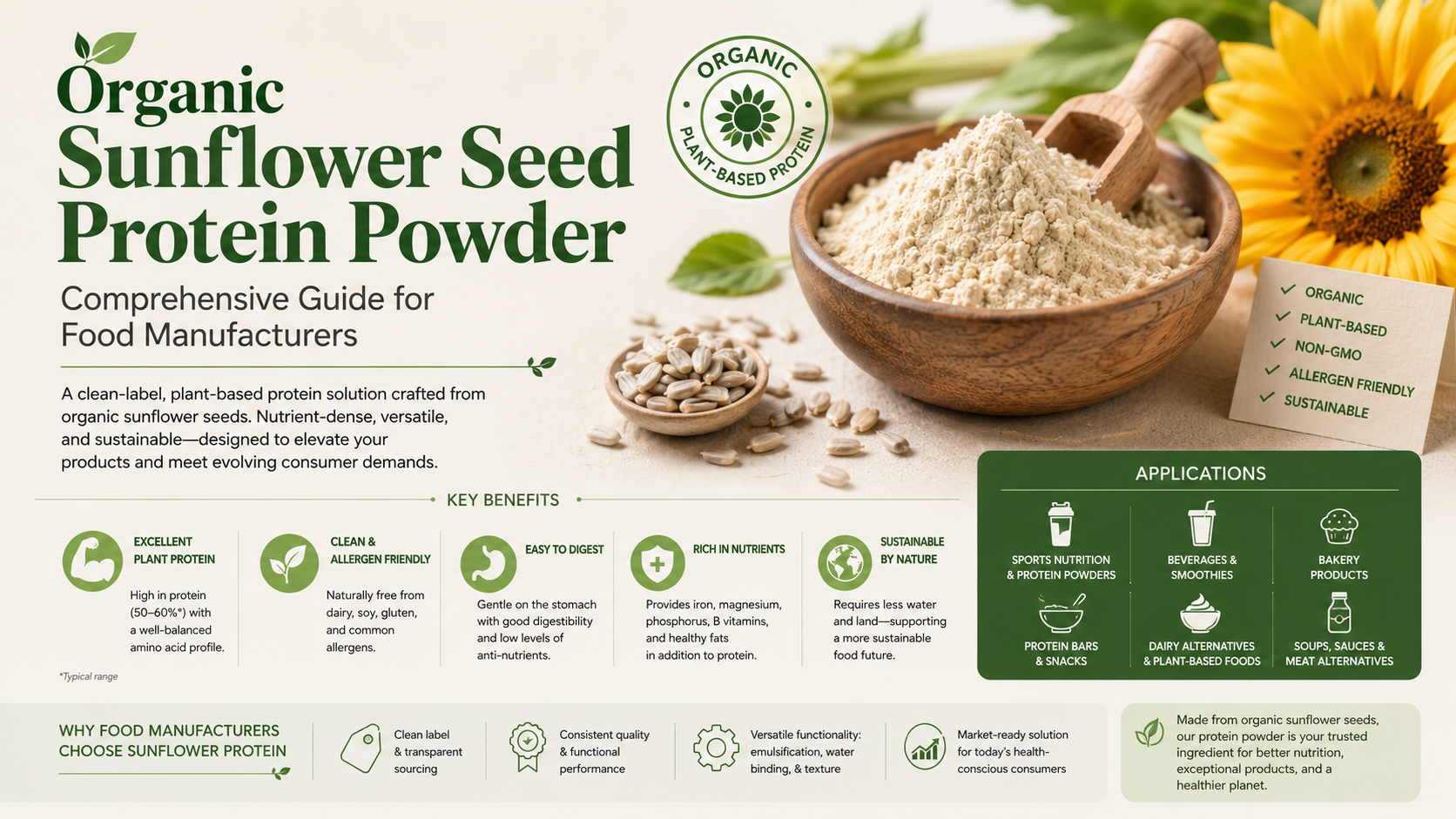
The global shift toward plant-based eating has created unprecedented demand for protein ingredients that satisfy both nutritional requirements and consumer expectations for clean, transparent labeling. Within this evolving landscape, organic sunflower seed protein powder has emerged as one of the most strategically compelling options available to food manufacturers.
Derived from certified organic, non-GMO sunflower seeds through a process that separates protein from the seed’s oil fraction, organic sunflower protein powder delivers a combination of nutritional density, functional versatility, and clean-label compatibility that few plant proteins can match. Unlike soy protein — constrained by allergenicity and GMO concerns — or pea protein — limited by flavor and digestive profile — sunflower protein occupies a unique market position that aligns precisely with the demands of modern plant-based food development.
This comprehensive guide provides procurement professionals, R&D formulators, and brand managers with a complete understanding of organic sunflower seed protein powder: its production and forms, nutritional profile, functional performance across food matrices, applications across key categories, and the procurement frameworks that support reliable supply at scale.
What Is Organic Sunflower Seed Protein Powder?
From Seed to Ingredient: The Production Process
Organic sunflower seed protein powder begins as sunflower seed meal — the residual material left after oil extraction from organically grown sunflower seeds. This meal contains approximately 40-50% protein in its crude form, which is then further processed to produce protein-enriched fractions:
| Product Form | Protein Content | Processing Level | Typical Applications |
|---|---|---|---|
| Organic Sunflower Protein Concentrate | 60-70% protein | Mild processing; some fiber and fat retained | Bakery, snacks, meat analogs |
| Organic Sunflower Protein Isolate | 80-95% protein | Extensive processing; most non-protein components removed | Beverages, high-protein bars, clinical nutrition |
Both forms are certified organic, non-GMO verified, and suitable for use in products carrying organic, vegan, non-GMO project verified, and allergen-free labeling claims.
Regulatory and Certification Landscape
For food manufacturers sourcing organic sunflower protein for international markets, key certifications include:
- USDA Organic — Required for products marketed as organic in the United States
- EU Organic — Required for products marketed as organic in the European Union
- Non-GMO Project Verified — Increasingly demanded by North American retailers and consumers
- Gluten-Free Certification — Relevant given sunflower protein’s natural gluten-free status
These certifications provide the documentary foundation for clean-label claims and support premium pricing strategies across retail and foodservice channels.
Nutritional Profile and Health Positioning
Amino Acid Composition
Organic sunflower seed protein provides a well-balanced amino acid profile, though it is notably lower in lysine compared to animal proteins and soy. Its strength lies in sulfur-containing amino acids (methionine and cysteine), which complement legume proteins like pea protein that are lower in these amino acids.
| Amino Acid Group | Significance |
|---|---|
| Sulfur Amino Acids (Methionine, Cysteine) | Supports protein synthesis; sunflower protein is naturally rich in these |
| Essential Amino Acids | Provides 9 essential amino acids for human nutrition |
| Branched-Chain Amino Acids (BCAAs) | Supports muscle maintenance and recovery positioning |
| Lysine (limiting) | Lower than soy; formulate accordingly when targeting complete amino acid profiles |
Dietary Positioning
Organic sunflower protein supports multiple health and lifestyle positioning claims that resonate with contemporary consumer segments:
- Plant-Based and Vegan — 100% plant-derived protein
- Allergen-Friendly — Free from the “Big 8” allergens (milk, eggs, fish, shellfish, tree nuts, peanuts, wheat, soybeans); sunflower is not a priority allergen
- Non-GMO — Verified non-GMO through third-party certification
- Clean-Label — Single-ingredient designation with a consumer-recognizable source
- Sustainable — Derived as a co-product of sunflower oil production, reducing agricultural waste
Functional Properties: Why Sunflower Protein Performs
Understanding the functional behavior of organic sunflower protein powder is essential for formulators working across food matrices. Its performance profile differs meaningfully from both soy and pea protein.
Water Binding and Hydration
Organic sunflower protein exhibits strong water absorption capacity — typically 3-4 times its weight in water. This property is particularly valuable in:
- Bakery applications — Controls moisture migration, extends shelf life, improves crumb softness
- Meat analogs — Mimics the water-holding capacity of animal muscle tissue
- Protein bars — Prevents excessive hardening and moisture loss during storage
Emulsification and Foaming
The protein fraction in sunflower seed meal contains surface-active proteins that stabilize oil-in-water emulsions and air-in-water foams. This functional property enables:
- Plant-based dairy alternatives — Supports stable emulsions in milk-style beverages
- Dairy-free creamers — Creates stable whipping cream textures
- Foamed beverages — Maintains volume and stability in cappuccino-style drinks
Thermal Stability
Organic sunflower protein demonstrates good stability under conditions common to food manufacturing:
- Baking temperatures — Retains functional integrity up to approximately 180-200°C (356-392°F)
- Extrusion processing — Performs adequately in both cold-extrusion and thermoplastic extrusion processes used for snacks and meat analogs
- HTST/UHT processing — Compatible with high-temperature short-time pasteurization used in beverage production
Flavor Profile
Perhaps the single most significant differentiator of organic sunflower protein is its neutral taste profile. Unlike pea protein — which carries a characteristic earthy, beany flavor that requires masking — or soy protein — which can impart bitter notes and anti-nutritional factors — organic sunflower protein blends seamlessly into both savory and sweet formulations with minimal flavor interference.
Applications Across Food Categories
Plant-Based Meat and Dairy Alternatives
Organic sunflower protein is particularly well-suited for the rapidly expanding plant-based meat and dairy alternatives market, where its combination of functional performance and allergen-free positioning addresses critical market gaps.
Plant-Based Meat Applications:
- Burgers and Patties — Provides binding and water retention that mimics the juicy texture of ground meat; combined with pea or fava bean protein for complete amino acid profile
- Sausages and Nuggets — Offers excellent fat and water binding for stable emulsions in extruded and formed products
- Plant-Based Seafood Analogs — Works with algae and seaweed proteins for seafood-style applications
Dairy Alternative Applications:
- Plant-Based Yogurts — Supports fermentation by lactic acid bacteria while providing smooth texture
- Vegan Cheese — Contributes to melt and stretch properties in cheese analogs
- Creamers and Whipped Toppings — Foam stability enables light, airy textures
Bakery and Snacks
The neutral flavor and strong hydration properties of organic sunflower protein make it highly effective in bakery and snack formulations where protein enrichment is desired without disrupting sensory acceptance.
Bakery Applications:
- Protein-Enriched Bread and Muffins — Boosts protein content from approximately 8-10% to 15-20% per serving without affecting crumb structure or flavor
- Gluten-Free Bakery — Provides structure-building functionality where wheat gluten is absent
- Cookies and Pastries — Delivers protein enrichment with minimal impact on sweetness perception
Snack Applications:
- Protein Bars and Bites — High protein density (up to 80% in isolate form) enables strong protein claims with minimal ingredient volume
- Extruded Snacks — Contributes to expansion and crispness in puffed snack formulations
- Savory Coatings — Binds seasonings and provides functional coating layers
Beverages and Functional Nutrition
The solubility profile of organic sunflower protein isolate — particularly when processed using appropriate drying methods — supports beverage applications where smooth mouthfeel and clean taste are essential.
Beverage Applications:
- Protein Shakes and Smoothies — High solubility with minimal viscosity contribution
- Functional Drinks — Enables protein fortification in RTD beverages without flavor conflict
- Plant-Based Protein Shakes — Vegan positioning combined with neutral taste makes it ideal for mainstream protein beverages
Vegan and Allergen-Free Meal Solutions
For brands developing products targeting the growing intersection of vegan, allergen-free, and clean-label consumer segments, organic sunflower protein provides a rare combination of complete nutritional positioning and formulation flexibility.
- Ready-to-Eat Vegan Meals — Adds protein to grain-based and vegetable-forward meal solutions
- Nutritional Meal Replacements — Supports high-protein positioning in wellness-oriented formats
- Medical Nutrition — Soy-free and dairy-free profile makes it suitable for hypoallergenic clinical nutrition products
Procurement Considerations for Food Manufacturers
Grade Selection Framework
Selecting the appropriate form of organic sunflower protein depends on the specific formulation requirements:
| Application | Recommended Form | Key Selection Criteria |
|---|---|---|
| High-protein beverages | Isolate (80%+) | Particle size, solubility, viscosity |
| Protein bars | Isolate or high-grade concentrate | Compression binding, flavor neutrality |
| Meat analogs | Concentrate | Texturization capacity, fat binding |
| Bakery products | Concentrate | Water absorption, neutral flavor |
| Snacks | Concentrate | Expansion properties, cost efficiency |
Supply Chain Considerations
The organic sunflower protein market is characterized by:
- Geographic concentration — Primary production in Eastern Europe (Ukraine, Russia, Romania) and Argentina; supply disruptions can impact availability
- Seasonal availability — Sunflower seed harvest typically occurs in Q3-Q4; plan procurement accordingly
- Certification lead time — Organic and non-GMO verification requires 36+ month transition periods for new agricultural sources
- Quality specifications — Establish clear specs for protein content (dry basis), moisture, ash, and microbiological limits
Cost Positioning
Organic sunflower protein is typically priced at a premium to organic pea protein and organic soy protein, reflecting its relatively smaller production scale and premium functional properties. When evaluating cost-performance, consider:
- Functional substitution ratios may differ from commodity proteins
- Flavor masking costs are significantly lower than pea protein formulations
- Allergen-free positioning supports premium retail pricing strategies
FAQ
Is organic sunflower seed protein powder allergen-free?
Yes. Sunflower seed is not classified among the “Big 8” priority food allergens recognized by FDA and EFSA. Organic sunflower protein powder is naturally free from soy, dairy, gluten, peanuts, and tree nuts, making it suitable for allergen-free formulations targeting the growing consumer segment with multiple dietary sensitivities.
Does sunflower protein affect the taste or color of finished products?
Organic sunflower protein powder has a mild, neutral flavor profile that integrates seamlessly into most formulations without requiring flavor masking. In terms of color, it produces a slightly darker appearance than pea protein — a consideration in applications where visual whiteness is important, though acceptable in bakery, snacks, and whole-food applications.
Is organic sunflower seed protein suitable for vegan and plant-based products?
Yes. Organic sunflower protein powder is 100% plant-derived, certified vegan, and organic. It is an ideal ingredient for brands developing products targeting the vegan consumer segment.
How does sunflower protein compare to pea and soy proteins?
Compared to pea protein, sunflower protein offers a milder flavor profile and lower anti-nutritional factor content. Compared to soy protein, sunflower protein is allergen-free and non-GMO, addressing two of the primary concerns limiting soy’s clean-label appeal. A detailed comparison is available in our dedicated article: “Organic Sunflower Protein vs Pea Protein: Which Is Better for Clean-Label Formulations?”
What protein content can be achieved in finished products?
Organic sunflower protein isolate can achieve protein contents of 80-95% on a dry basis. Organic sunflower protein concentrate typically ranges from 60-70% protein. In practice, finished product protein content depends on formulation density and processing conditions.
Is organic sunflower protein suitable for large-scale food manufacturing?
Yes. ORGANICWAY supplies organic sunflower protein powder, isolate, and concentrate in quantities ranging from pilot-scale samples to full-container industrial supply. Our ingredients are produced under ISO-certified facilities with full traceability from seed to final product.
What certifications are available for organic sunflower protein?
Available certifications include USDA Organic, EU Organic, Non-GMO Project Verified, Kosher, and Halal. Contact our sales team for region-specific certification documentation and compliance support.
Recommended Products

Organic Sunflower Seed Protein Powder
With its neutral-to-mildly-nutty flavor and excellent emulsification properties, sunflower seed protein is the clean-label…

Organic Pea Protein Powder
Organic Pea Protein Powder Isolate is a clean-label, high-purity ingredient derived from 100% Non-GMO…

Organic Soy Protein Powder
Organic Soy Protein Powder is derived from USDA and EU certified organic non-GMO soybeans…
Related Posts


