
Table of Contents
The plant-based food industry is undergoing a critical phase of maturation. What began as a niche category for vegetarian and vegan consumers has evolved into a mainstream food sector with ambitions that extend far beyond dietary restriction — targeting omnivores, flexitarians, and health-conscious consumers across all demographic segments.
Yet this maturation has exposed fundamental limitations in the protein ingredients that first powered the plant-based revolution. Soy protein — the founding pillar of the plant-based meat category — carries allergenicity concerns that limit its addressable market. Pea protein, the category’s growth engine over the past decade, struggles with flavor profiles that constrain formulation flexibility and consumer acceptance. Both face persistent GMO concerns that conflict with the clean-label expectations of contemporary food consumers.
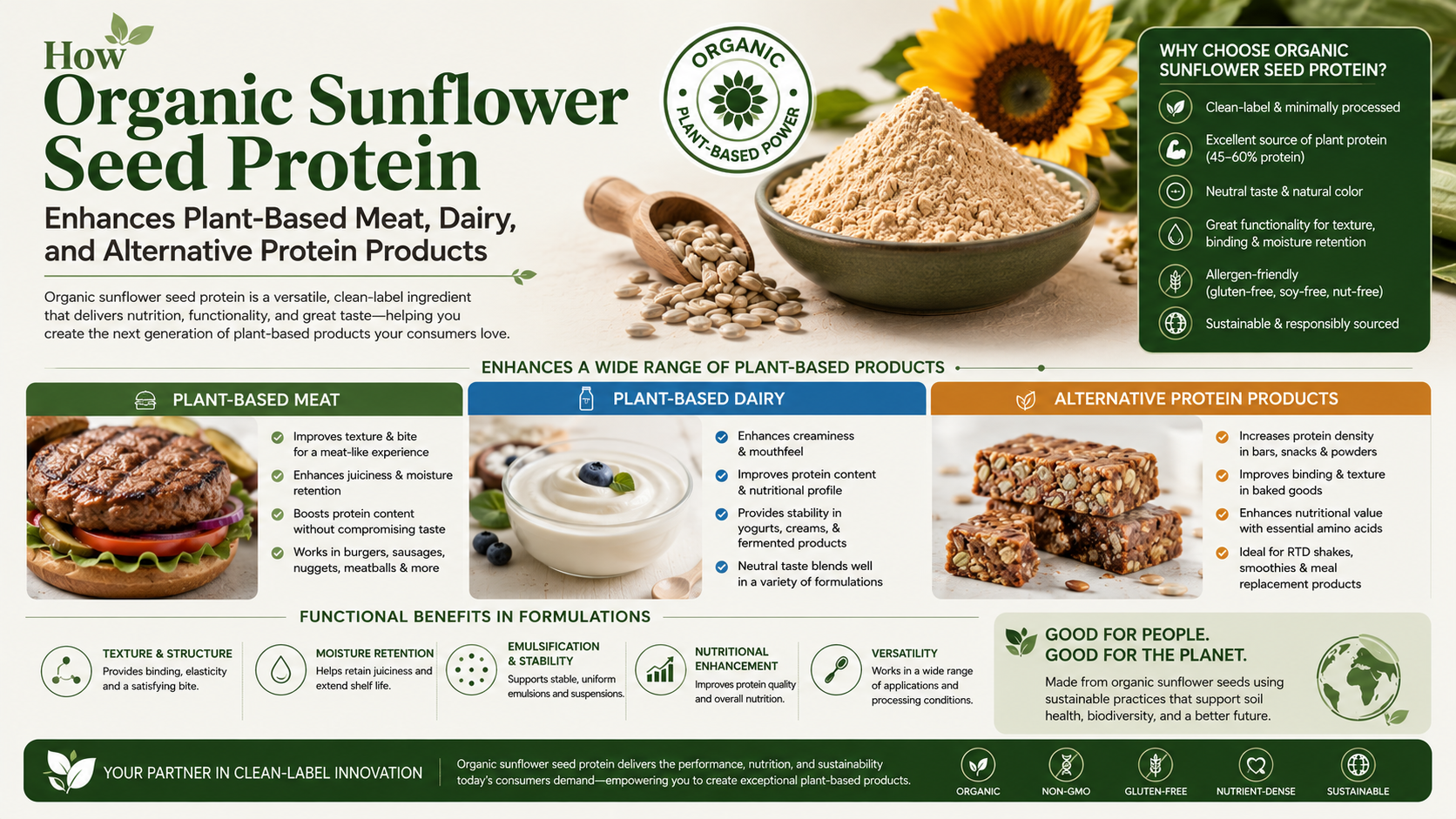
Organic sunflower seed protein has emerged as the ingredient that addresses these limitations without introducing new compromises. Its combination of allergen-free positioning, neutral flavor, superior functional performance, and clean-label compatibility makes it uniquely suited to the next generation of plant-based food development.
This article examines how organic sunflower seed protein enhances performance across the plant-based meat, dairy alternatives, and alternative protein product categories — and why leading food brands are making the strategic switch.
The Soy Problem: Why Brands Are Moving Away from Soy Protein
Before examining sunflower protein’s advantages, it is important to understand the structural forces driving brands away from soy — because these same forces illuminate why sunflower protein’s properties are so strategically valuable.
Allergenicity and Regulatory Constraints
Soy is one of the “Big 8” priority food allergens recognized by regulatory authorities in the United States (FDA), European Union (EFSA), and virtually every major global food safety framework. This classification creates multiple commercial constraints:
- Mandatory allergen declarations on all products containing soy
- Restricted access to markets with strict allergen-labeling requirements
- Inability to target the growing consumer segment with soy sensitivities or allergies
- Potential liability exposure in markets with strict food safety regulations
For brands pursuing broad retail distribution across multiple geographic markets, soy’s allergen status is an increasingly untenable constraint.
GMO Supply Chain Complexity
The overwhelming majority of global soybean production is genetically modified. While organic certification requires non-GMO sourcing, the practical realities of supply chain segregation, identity preservation, and third-party verification create operational complexity and cost premiums that erode soy’s price competitiveness.
Consumer research consistently shows that GMO concerns influence purchase decisions for plant-based products — precisely the consumers brands most want to attract. The organic sunflower protein supply chain, by contrast, is predominantly sourced from organically certified agricultural production systems where GMO avoidance is structurally embedded.
Flavor and Sensory Limitations
Soy protein in its unprocessed form carries characteristic beany, bitter flavor notes that require significant formulation investment to mask. This sensory challenge limits the product categories where soy can be used without extensive flavor systems — and those flavor systems themselves conflict with clean-label positioning.
How Organic Sunflower Seed Protein Enhances Plant-Based Meat
Creating plant-based meat products that satisfy the expectations of consumers accustomed to animal protein requires ingredients that deliver specific functional properties: binding, water retention, texture development, and flavor compatibility.
Organic sunflower protein — particularly in concentrate and isolate forms — provides all three.
Binding and Water Retention
The texture of animal meat is largely determined by the behavior of muscle proteins during cooking — specifically, their ability to bind water and fat while developing a fibrous, chewy structure. Sunflower protein’s functional properties enable analogous behavior in plant-based systems:
- Protein network formation — Upon heating, sunflower protein forms cohesive networks that replicate the texture-building function of myofibrillar proteins in animal muscle
- Water retention — Strong water-holding capacity prevents moisture loss during cooking, addressing one of the most common consumer complaints about plant-based meat products
- Fat binding — Emulsification capacity enables stable fat distribution throughout the product matrix, contributing to mouthfeel and flavor delivery
Thermal and Extrusion Performance
Modern plant-based meat production relies heavily on high-temperature extrusion and thermomechanical processing to develop the fibrous texture that mimics animal protein. Organic sunflower protein demonstrates strong performance under these conditions:
- Thermal stability — Retains functional integrity at processing temperatures up to 180-200°C (356-392°F)
- Extrusion compatibility — Forms appropriate texturization in both cold-extrusion and thermoplastic extrusion systems
- Structural coherence — Produces coherent, layered fiber structures in high-moisture extrusion processes
Amino Acid Completeness for Protein Claims
With protein contents reaching 80% in isolate form and 60-70% in concentrate form, organic sunflower seed protein provides a credible foundation for high-protein positioning. When combined with complementary plant proteins (particularly pea protein for lysine enrichment), sunflower-based formulations can achieve complete amino acid profiles that support strong protein content claims.
Formulation example: A plant-based burger patty achieving 20g protein per serving can be formulated using a sunflower protein concentrate base (providing binding, texture, and neutral flavor) supplemented with pea protein (providing complementary amino acid profile and cost efficiency).
Redefining Dairy Alternatives with Sunflower Protein
The dairy alternative category — encompassing plant-based milks, yogurts, cheese, and creamers — presents a distinct set of formulation challenges where organic sunflower protein’s functional profile offers exceptional value.
Emulsification for Stable Milk-Style Beverages
Plant-based milks have historically relied on stabilizers, emulsifiers, and texturizing agents to achieve the visual and mouthfeel characteristics of dairy milk. Organic sunflower protein provides functional solutions that align with clean-label expectations:
- Emulsification — Surface-active proteins stabilize oil droplets in oil-in-water emulsions, preventing separation and creaming in plant-based milk beverages
- Foam stability — For cappuccino-style and specialty coffee applications, sunflower protein contributes to stable, creamy foam without the beany off-notes of soy or pea
- Mouthfeel — Contributes to the full-bodied, creamy texture that distinguishes premium plant-based milks from commodity products
Texture Development in Plant-Based Yogurts
The fermentation and texture characteristics of plant-based yogurts depend critically on protein selection. Organic sunflower protein supports fermentation by providing:
- Adequate nitrogen for lactic acid bacterial growth
- Texture-building functionality during fermentation
- Sufficient protein content to support nutritional protein claims
Cheese Analogs and Dairy Alternative Spreads
Organic sunflower protein’s melting and stretching properties — when formulated with appropriate fat systems and hydrocolloids — contribute to cheese-like textures in plant-based cheese applications:
- Sliceable cheese analogs — Provides structure and binding for deli-style sliceable products
- Shredded cheese alternatives — Functional performance in high-heat applications like pizza topping
- Cream cheese and spreads — Emulsification and smooth texture development
Soy-Free Positioning: The Strategic Market Opportunity
The transition from soy to sunflower protein is not merely a formulation improvement — it represents a strategic repositioning that opens new market segments and competitive advantages.
Addressing the Multi-Allergen Consumer
Contemporary consumers are increasingly navigating multiple dietary restrictions simultaneously. The intersection of vegan, gluten-free, soy-free, and dairy-free dietary patterns creates a market segment that soy-based products cannot serve. Organic sunflower protein, with its clean allergen-free profile, enables brands to address this high-value, rapidly growing segment.
Label Simplicity and Clean-Label Appeal
Consumer research on label-scanning behavior consistently identifies ingredient lists with unfamiliar or chemical-sounding ingredients as a primary barrier to purchase. Soy protein formulations frequently require multiple functional ingredients that complicate the label. Organic sunflower protein, in many applications, can be incorporated with minimal additional functional ingredients — supporting shorter, cleaner ingredient lists.
Premium Retail and Foodservice Positioning
Retailers and foodservice operators are increasingly demanding differentiated plant-based products that can command premium shelf positioning and menu pricing. The soy-free, allergen-free, clean-label story enabled by organic sunflower protein provides a compelling basis for premium positioning that distinguishes products from commodity soy-based competitors.
Sustainability and ESG Alignment
Organic sunflower protein’s sustainability credentials extend beyond its organic and non-GMO status. The ingredient’s production model aligns with the circular economy principles increasingly valued by corporate ESG programs.
Co-Product Utilization
Sunflower protein is primarily derived from the protein meal remaining after sunflower seed oil extraction — the same process used to produce organic sunflower oil. This co-product utilization means that the environmental burden of protein production is shared with oil production, reducing the net land use, water consumption, and carbon footprint per unit of protein.
Traceability and Transparency
The concentrated geographic production of organic sunflower protein — primarily Eastern Europe and Argentina — enables robust traceability programs that satisfy the transparency requirements of leading retailers and foodservice operators. Full-chain traceability from seed to final ingredient supports ESG reporting and responsible sourcing commitments.
FAQ
Is organic sunflower seed protein suitable for vegan products?
Yes. Organic sunflower seed protein powder, isolate, and concentrate are 100% plant-derived and certified vegan. They contain no animal-derived ingredients and are suitable for use in vegan-certified products across all categories.
What makes sunflower protein a better choice than soy protein for plant-based meat?
Organic sunflower protein addresses the three primary limitations of soy in plant-based meat applications: allergenicity (soy is a Big 8 allergen; sunflower is not), GMO concerns (soy supply is predominantly GMO; organic sunflower is certified non-GMO), and flavor profile (soy requires extensive flavor masking; sunflower has a neutral profile).
Can organic sunflower protein be used in products targeting the sports nutrition market?
Yes. The combination of high protein content (up to 95% in isolate form), complete amino acid profile when combined with complementary plant proteins, clean-label positioning, and excellent digestibility makes organic sunflower protein well-suited for sports nutrition applications including protein bars, ready-to-drink beverages, and plant-based recovery products.
What certifications are available for organic sunflower protein?
Standard certifications include USDA Organic, EU Organic, Non-GMO Project Verified, Kosher, and Halal. ORGANICWAY provides full certification documentation and technical support for regulatory compliance across target markets.
How does the cost of organic sunflower protein compare to organic soy protein?
Organic sunflower protein typically commands a higher per-kilogram price than organic soy protein, reflecting its smaller production scale. However, when formulation costs are included — particularly the flavor masking and functional ingredient investments required for soy — total formulation costs are competitive, and sunflower-based formulations often achieve superior cost-performance in premium applications.
Recommended Products

Organic Sunflower Seed Protein Powder
With its neutral-to-mildly-nutty flavor and excellent emulsification properties, sunflower seed protein is the clean-label…

Organic Soy Protein Powder
Organic Soy Protein Powder is derived from USDA and EU certified organic non-GMO soybeans…
Related Posts


