
Table of Contents
A Natural Sweetener, Not an Artificial Substitute
Unlike sugar alcohols (erythritol, xylitol) or high-intensity sweeteners (stevia, sucralose), organic dextrose powder is a naturally derived monosaccharide — the same D-glucose molecule found in fruits and honey. It is not a substitute or imitation; it is real sugar in its simplest, most bioavailable form, which is precisely why formulators who care about clean labels and predictable chemistry reach for it. Where sugar alcohols can cause digestive discomfort at higher doses and high-intensity sweeteners bring a lingering aftertaste that consumers increasingly reject, dextrose behaves like the familiar sugar bakers have always trusted, only delivered as a free-flowing powder that scales cleanly from a test kitchen to a continuous line. That identity matters for marketing as much as for manufacturing, because shoppers recognize “dextrose” as a real food ingredient rather than a laboratory construct, and the organic certification removes the last objection a label reader might raise.
For healthy baking, this means a sweetener that supports genuine reformulation rather than a mere calorie swap:
- Authentic flavor profile: No aftertaste, no cooling sensation, no chemical notes. Dextrose delivers a clean, mild sweetness that complements baked goods without altering their character, so a brand can reduce refined sucrose while keeping the taste consumers expect and avoiding the metallic or licorice-like edges that plague some alternatives. The neutrality also lets fruit, spice, and cocoa notes come through instead of being masked by the sweetener itself.
- Predictable functionality: As a real sugar, dextrose behaves predictably in dough systems — it browns, caramelizes, and feeds yeast just like conventional sugar, with minor adjustments needed for sweetness intensity, which removes the reformulation risk that makes product teams hesitant to switch. Bakers can lean on decades of established sugar chemistry rather than running blind trials on an unfamiliar molecule.
- Clean-label compliance: “Organic dextrose” is a straightforward, consumer-understandable ingredient name. No confusing chemical nomenclature, no asterisk explaining what the molecule is, and no footnote required to reassure a shopper scanning the panel at speed in the aisle. That legibility translates directly into trust and repeat purchase.
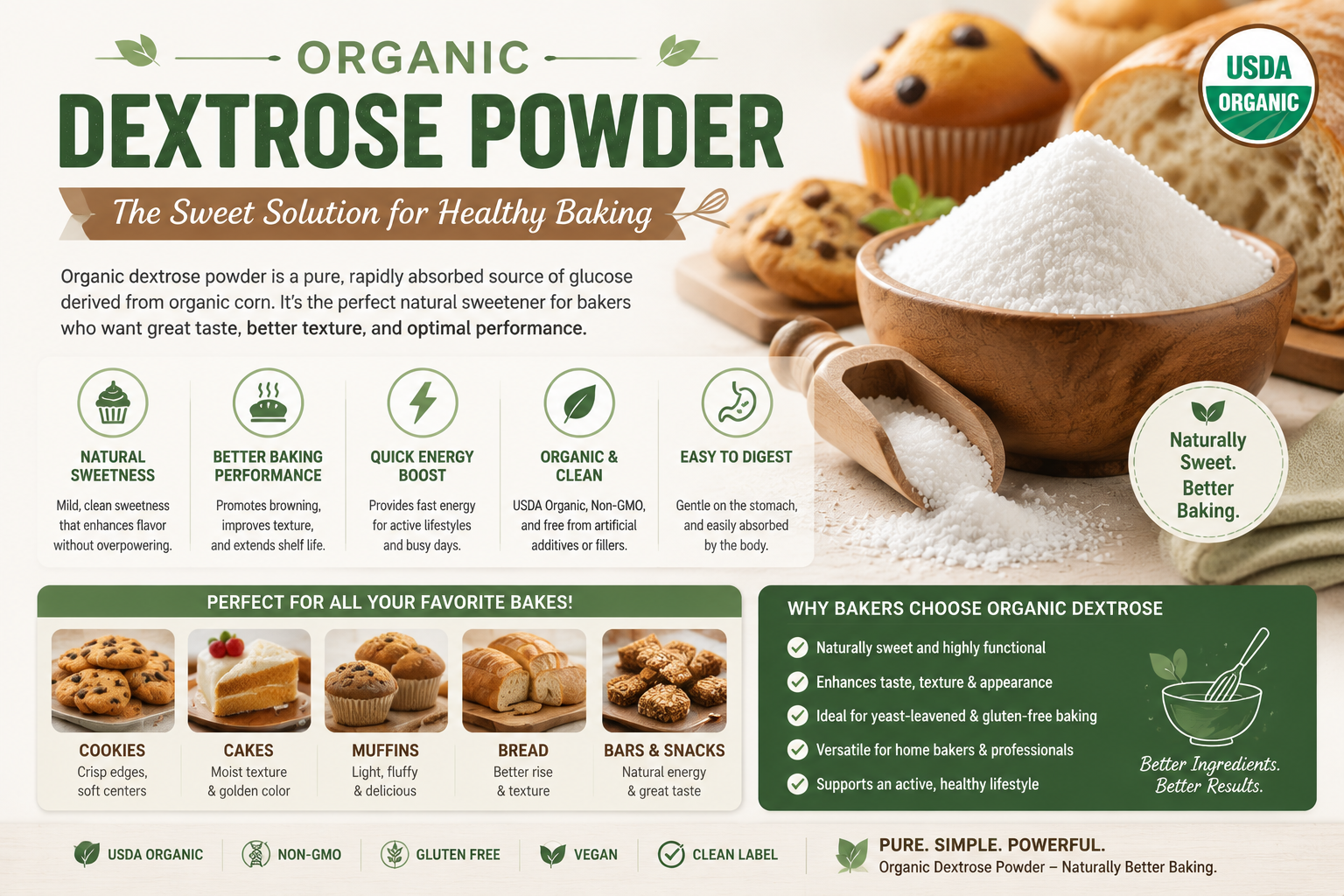
Technical Properties for Baking
| Property | Organic Dextrose | Sucrose (Table Sugar) | Implication for Baking |
|---|---|---|---|
| Sweetness (relative) | 70–80% | 100% | Use ~25% more by weight for equivalent sweetness |
| Browning (Maillard) | Excellent | Good | Dextrose promotes even more pronounced browning |
| Crystallization | Low tendency | High tendency | Smoother texture in finished products |
| Solubility (cold) | High | Moderate | Easier incorporation in no-bake recipes |
| Hygroscopicity | Moderate | Low | Slightly moister crumb in baked goods |
Key Applications in Healthy Baking
1. Muffins and Quick Breads
Organic dextrose powder dissolves readily into batter systems, promoting even sweetness distribution and consistent crumb texture. Its moderate hygroscopicity helps retain moisture, extending shelf life in muffins and quick breads — a significant advantage for healthy bakery brands that want to reduce or eliminate preservatives, because the ingredient itself contributes the softness that a clean label would otherwise lose. In a category where “no preservatives” is a selling point but staling is the enemy, dextrose quietly does double duty as sweetener and shelf-life aid. The rapid dissolution also prevents gritty pockets that undissolved coarse sugar can leave in delicate crumb.
Formulation tip: Replace sucrose at a 1.25:1 ratio (dextrose to sugar by weight). The enhanced Maillard browning means you may need to reduce oven temperature by 10-15°F (5-8°C) to prevent over-darkening, and you should check bake time on the first run because the faster caramelization can shorten the window before the crust sets. A small bench trial against your current sucrose baseline will reveal the exact temperature offset for your specific formula and pan.
2. Cookies and Energy Bars
For cookies, dextrose’s low crystallization tendency produces a softer, chewier texture compared to sucrose-based formulations. In energy bars and snack bites, dextrose functions as both a sweetener and a binding agent, helping to hold together oats, nuts, and dried fruit mixtures without relying on syrups that add moisture and shorten shelf life. The binding effect is especially useful in no-bake bars, where a dry, free-flowing powder integrates more uniformly than a viscous liquid sweetener that can pool during setting. Chewiness also reads as “fresh” to consumers, supporting a premium healthy positioning.
Formulation tip: For crispier cookies, combine dextrose with a small percentage of organic cane sugar (70/30 ratio) to balance chewiness with snap, because the cane sugar reintroduces the crystallization that gives a cookie its break. This blend lets you keep most of dextrose’s browning and moisture benefits while recovering the textural contrast that makes a cookie satisfying rather than doughy.
3. Cakes and Pastries
Dextrose excels in cake applications where a tender crumb and fine texture are desired. Its ability to inhibit gluten development (similar to sucrose) produces softer, more tender cake layers. For pastries, dextrose’s high solubility ensures smooth fillings and glazes without graininess, which matters when a filling sits against a delicate shell and any sugar speck would read as a defect. The tenderizing action also helps high-fiber healthy cakes, where added bran or whole grain tends to toughen the crumb and dextrose can partially offset that penalty. Pastry creams stay glossy and pourable, a real advantage for automated depositing.
4. Bread and Yeast Baked Goods
As a monosaccharide, dextrose is immediately available for yeast fermentation without requiring enzymatic breakdown. This means faster proofing times and more consistent rise in bread and roll production. For artisan breads, dextrose contributes to a deeper crust color and more complex caramel notes, rewarding the baker with a loaf that looks as good as it tastes. The quick fermentability also stabilizes schedules in commercial plants where proofing cabinets run on tight timers and a slow starter can cascade into missed shipments. A small dextrose feed at mixing shortens the variability between winter and summer dough temperatures.
5. Gluten-Free and Allergen-Free Baking
Organic dextrose powder is naturally gluten-free, dairy-free, soy-free, and nut-free, making it an ideal sweetener for allergen-free baking applications. Its clean functional profile allows formulators to create allergen-free products without compensating with artificial ingredients, which is critical because the allergen-free shopper is usually also the label-reading shopper who will abandon a product at the first suspicious additive. In gluten-free systems, where structure is already a challenge, dextrose’s tenderizing and browning contributions help a free-from loaf resemble its conventional counterpart closely enough to satisfy mainstream palates, not just the allergic ones.
Health Benefits That Resonate with Consumers
Zero Fructose, Zero Compromise
A key differentiator for organic dextrose in the healthy baking category is its zero-fructose profile. While sucrose contains 50% fructose — which has been linked to metabolic concerns when consumed in excess — dextrose is 100% glucose, the body’s preferred energy substrate that enters metabolism directly without first cycling through the liver the way fructose does. For a brand targeting metabolic-health-minded buyers, that single molecular fact is a powerful, defensible claim that does not require a footnote about “relative to a serving of fruit.” It reframes the sweetener as supportive rather than suspect.
For health-conscious consumers reading ingredient labels, this distinction matters in three concrete ways:
- “Organic dextrose” signals a natural, identifiable ingredient that a shopper can picture coming from a plant, not a reactor, which lowers the cognitive friction of adding a sweet product to a health-oriented cart.
- The absence of fructose addresses concerns about liver metabolism and metabolic health, a topic that has moved from clinical journals into everyday conversation and now influences pantry purchases among millennials and Gen Z especially.
- USDA Organic certification adds an additional layer of trust and traceability, because the organic seal implies a farm origin and a chain of custody that a generic sweetener line cannot claim, reassuring the buyer that the sugar is not just functional but responsibly grown.
Supporting Active Lifestyles
Healthy baking products targeting fitness-oriented consumers — protein muffins, energy cookies, pre-workout bars — benefit from dextrose’s role as a rapid energy source. Unlike low-calorie sweeteners that may cause gastrointestinal discomfort or fail to provide usable energy, dextrose delivers genuine metabolic fuel that supports physical performance, which is why sports nutrition has used glucose for decades and why a baked good that carries it can credibly sit in the active-lifestyle set. The fast gastric emptying of glucose also makes it suitable for products consumed around training, where timing of energy availability matters more than total calorie count. For recovery formats, dextrose pairs naturally with protein to drive replenishment.
Sustainability: Why Organic Matters for Baking Brands
Beyond health and functionality, organic dextrose powder supports baking brands’ sustainability commitments in ways that survive scrutiny from the increasingly sophisticated ESG buyer:
- Organic certification ensures non-GMO source corn cultivated without synthetic pesticides or herbicides, protecting soil microbiology and the farmworkers who would otherwise handle those inputs, a story that audits well and resists greenwashing challenges.
- Supply chain transparency from farm to finished ingredient supports clean-label storytelling that goes beyond a single claim to a verifiable narrative, which is what retailers now ask for before granting shelf space to a sustainability-positioned SKU.
- Reduced environmental impact through organic farming practices that improve soil health and biodiversity, benefits that compound across the sourcing region rather than being extracted once and depleted, giving the brand a defensible long-term position as regulations tighten.
For brands competing in the premium healthy baking segment, these sustainability attributes translate into market differentiation and consumer loyalty that a price cut alone could never buy, because the buyer is purchasing alignment with their values as much as a better cookie. The organic source also future-proofs the formula against looming restrictions on synthetic agricultural inputs in key export markets.
Practical Sourcing Guide for Manufacturers
Quality Specifications to Request
When sourcing organic dextrose powder for baking applications, request the following from your supplier so that incoming quality is verified rather than assumed, and so that batch-to-batch variation never surprises your line:
| Specification | Recommended Standard |
|---|---|
| Purity | ≥ 99.5% D-glucose |
| Particle size | Fine powder (80–120 mesh) for even distribution |
| Moisture | 8.5%–10.5% (monohydrate) |
| Microbiological | < 100 CFU/g total plate count, negative for pathogens |
| Heavy metals | Compliant with USP <231> / EP 2.4.27 |
| Certifications | USDA Organic, EU Organic, Non-GMO Project Verified, Kosher, Halal |
Storage and Handling
- Store in a cool, dry environment (below 25°C / 77°F), because although dextrose is stable, high ambient heat near a bakery oven or boiler room can slowly cake the powder and slow downstream dosing accuracy.
- Keep packaging sealed after opening to prevent moisture absorption, since the moderate hygroscopicity that helps crumb moisture in the final product can also clump the raw powder if it sits exposed to humid air on a busy floor.
- Shelf life: 18–24 months from production date under proper storage conditions, which gives planners ample window to rotate stock without write-offs and supports the bulk purchasing that lowers per-kilo cost.
Conclusion
Organic dextrose powder represents a sweet spot in healthy baking — delivering authentic sweetness, reliable functionality, and clean-label positioning in a single ingredient. For food manufacturers developing the next generation of healthier baked goods, it offers the performance of real sugar with the transparency and sustainability that today’s consumers demand, and it does so without forcing a compromise between taste and label. The practical upside is equally real: faster fermentation, smoother texture, deeper color, and a moisture benefit that extends shelf life, all from one powder a buyer already trusts. Brands that adopt it early can tell a coherent story — real sugar, organically farmed, functionally superior — that resists the whipsaw of sweetener fads and regulatory surprises alike, and that story is exactly what premium shelves reward.
Contact ORGANICWAY to request organic dextrose powder samples specifically tested for baking applications, along with technical formulation support and competitive bulk pricing, so your next reformulation moves from concept to commercial batch with fewer unknowns and a supplier who understands the line, not just the spec sheet.
Recommended Products

Organic Dextrose Powder
Available in two crystalline forms — Organic Dextrose Monohydrate (CAS 5996-10-1, ≥99.5% purity) and…
Related Posts


