Table of Contents
What is organic phycocyanin powder?
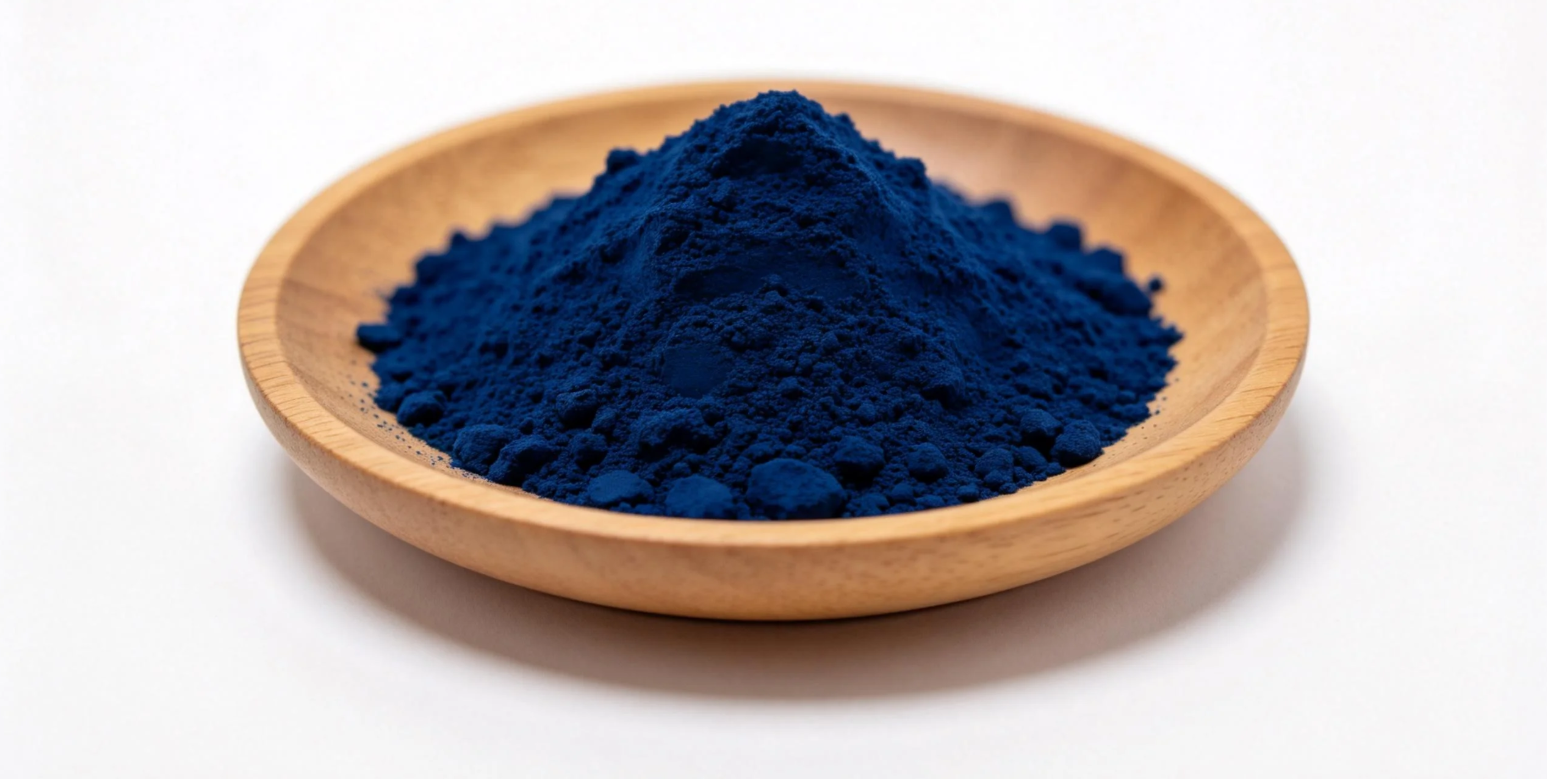
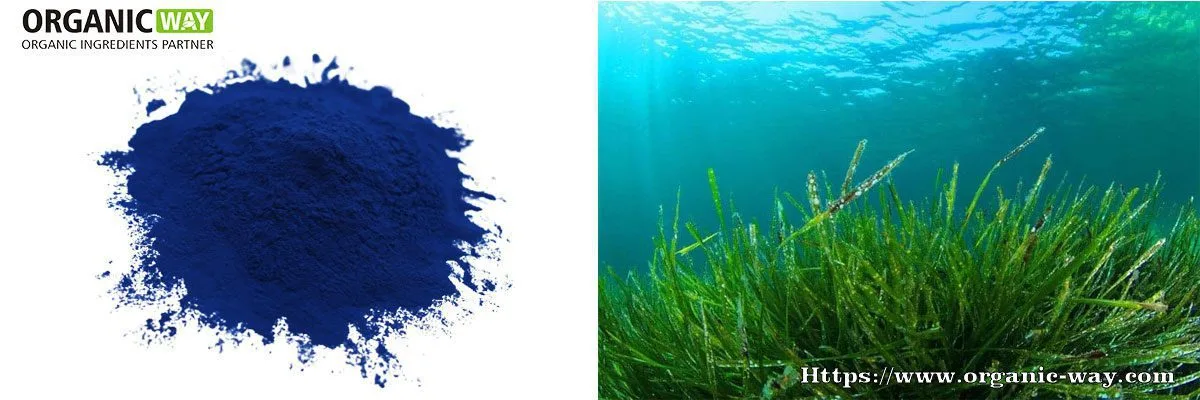
Organic phycocyanin is a blue phycobiliprotein pigment complex — the primary blue colorant in Spirulina platensis (blue-green algae). It consists of α and β subunits covalently bound to a linear tetrapyrrole chromophore called phycocyanobilin, which absorbs light at λmax 620 nm and emits bright blue fluorescence at λem 650 nm. This gives phycocyanin its vivid blue color .
Organic Way’s phycocyanin is extracted using a proprietary water-based process — no ethanol, hexane, or other synthetic solvents. The extract is then concentrated and spray-dried to produce a free-flowing blue powder.
Four Concentration Grades for Every Application:
- Food Standard (≥20%, E620 ≥200): Cost-effective grade for beverages, confectionery, RTD drinks, and ice cream. Purity ratio A620/A280 ≥3.5.
- High-Purity Food (≥35%, E620 ≥350): Premium grade for tablets, capsules, and high-end supplements. Superior color yield per gram.
- Cosmetic Grade (≥15%, E620 ≥150): Stricter microbial limits (TPC <100 CFU/g) and lower heavy metal thresholds per ICP-MS. Suitable for face masks, serums, and haircare.
- Research/Pharma Grade (≥50%, E620 ≥500): Highest purity for clinical research, fluorescence studies (λex 620nm / λem 650nm), and advanced nutraceutical formulations.
Why Phycocyanin is the Premium Clean-Label Blue:
- ORAC ≥30,000 µmol TE/g — antioxidant capacity 10× higher than most common plant extracts
- Studied bioactivity — C-phycocyanin’s interactions with COX-2 and TNF-α pathways documented in peer-reviewed literature
- pH stability range: 4.0–8.0 — stable across most beverage and food matrices
- Fluorescence properties —The only naturally occurring blue fluorescent pigment, used for biological labeling and scientific research.
- Dual-functionality: simultaneously a colorant and a protein-derived pigment compound
Critical Compliance Note — Cyanotoxin and Heavy Metal Testing:
Spirulina platensis is a cyanobacterium capable of bioaccumulating heavy metals from its cultivation medium and producing hepatotoxic microcystins under stress conditions. Organic Way’s phycocyanin uses controlled, single-species closed cultivation systems to prevent contamination. Every batch is tested by ICP-MS for Pb, As, Cd, Hg (below Prop 65 / EFSA thresholds) and by ELISA + HPLC for microcystin-LR (<1 µg/g food grade; <0.5 µg/g cosmetic grade). COA with full testing data available on request.
For EU market entry: verify Novel Food status per EFSA Regulation 2015/2283. For US market: GRAS self-affirmed dossier or FDA GRAS No Objection Letter available on request.
Production & Quality Assurance:
- Certified organic Spirulina platensis sourcing (USDA NOP / EU 834/2007)
- Incoming testing: microcystin screen (ELISA), heavy metals (ICP-MS), moisture
- Water-based extraction at controlled temperature (≤40°C) — no solvents used
- Membrane filtration → spray drying
- Lot-specific COA: phycocyanin content, E620 value, purity ratio, moisture, heavy metals, microbiology, microcystins
- Third-party verification (SGS / Eurofins) available on request
Technical Specifications
Four-Grade Comparison
| Parameter | Food Standard | High-Purity Food | Cosmetic | Research/Pharma | Test Method |
|---|---|---|---|---|---|
| Phycocyanin Content | ≥20% | ≥35% | ≥15% | ≥50% | A620/A652 ratio |
| Color Value (E620) | ≥200 | ≥350 | ≥150 | ≥500 | EU/FAO color value |
| Purity Ratio (A620/A280) | ≥3.5 | ≥4.0 | ≥3.0 | ≥5.0 | UV-Vis spectrophotometry |
| Solubility | ≥95% cold/hot water | ≥97% cold/hot water | ≥98% water/glycerin | ≥99% water | USP <467> |
| pH Stability Range | 4.0–8.0 (blue) | 4.0–8.0 (vivid blue) | 3.5–9.0 (blue-green) | 3.5–8.5 | Buffer titration |
| Moisture | ≤6.0% | ≤5.0% | ≤5.0% | ≤4.0% | Karl Fischer |
| Ash | ≤8.0% | ≤6.0% | ≤6.0% | ≤4.0% | AOAC 942.05 |
| Lead (Pb) | <0.1 ppm | <0.1 ppm | <0.05 ppm | <0.05 ppm | ICP-MS |
| Arsenic (As, total) | <0.1 ppm | <0.1 ppm | <0.05 ppm | <0.05 ppm | ICP-MS |
| Cadmium (Cd) | <0.1 ppm | <0.1 ppm | <0.05 ppm | <0.05 ppm | ICP-MS |
| Mercury (Hg) | <0.05 ppm | <0.05 ppm | <0.02 ppm | <0.02 ppm | ICP-MS |
| Microcystin-LR | <1 µg/g | <1 µg/g | <0.5 µg/g | <0.5 µg/g | ELISA + HPLC |
| ORAC Value | ≥30,000 µmol TE/g | ≥40,000 µmol TE/g | N/A | ≥50,000 µmol TE/g | ORAC assay |
| Color Appearance | Blue powder | Deep blue powder | Blue-green powder | Brilliant blue powder | Visual |
| Particle Size | 80–200 mesh | 100–200 mesh | 100–200 mesh | 100–200 mesh | Sieve |
| Typical Application | Beverages, confectionery | Supplements, tablets | Cosmetics, skincare | Research, clinical | — |
Microbiological Specifications
| Parameter | Food Grade (Standard / High-Purity) | Cosmetic Grade | Test Method |
|---|---|---|---|
| Total Plate Count (TPC) | ≤1,000 CFU/g / ≤500 CFU/g | ≤100 CFU/g | ISO 4833 |
| Yeast & Mold | ≤100 CFU/g | ≤50 CFU/g | ISO 21527 |
| Coliform | ≤10 CFU/g | Negative/g | ISO 4832 |
| E. coli | Negative/1g | Negative/1g | ISO 16654 |
| Salmonella | Negative/25g | Negative/25g | ISO 6579 |
| Staphylococcus aureus | Negative/1g | Negative/1g | ISO 6888 |
Heavy Metals, Contaminants & Cyanotoxin Compliance
| Parameter | Specification | Regulatory Standard |
|---|---|---|
| Lead (Pb) | <0.1 ppm (food) / <0.05 ppm (cosmetic) | Prop 65 / EFSA / Codex |
| Arsenic (As, total) | <0.1 ppm (food) / <0.05 ppm (cosmetic) | Prop 65 |
| Cadmium (Cd) | <0.1 ppm | EU Regulation 2023/915 |
| Mercury (Hg) | <0.05 ppm | Prop 65 |
| Microcystin-LR | <1 µg/g (food) / <0.5 µg/g (cosmetic) | WHO guideline / EFSA |
| Residual Solvents | ND (water extraction only) | ICH Q3C / GC-MS |
| Pesticide Residues | ND (per EC 396/2005) | GC-MS/MS |
Certifications
| Certification | Issuing Body | Scope |
|---|---|---|
| USDA Organic | USDA NOP (via accredited certifier) | Production + processing |
| EU Organic | EU Reg. (EC) No 834/2007 | Import + sale in EU |
| Organic | Japanese Agricultural Standards | Japan market |
| Non-GMO Project Verified | Non-GMO Project | Raw material + finished product |
| Kosher | OU / Star-K (lot-specific) | Processing facility |
| Halal | MUI / IFRC (lot-specific) | Processing facility |
| Vegan / Vegan Action | Vegan Society | 100% plant-based |
| Gluten-Free | GFCO | Verified gluten-free |
| GRAS | Self-affirmed / FDA notification | US food use — confirm status on inquiry |
⚠️ EU Novel Food Note: Under EFSA Regulation 2015/2283, phycocyanin as a Spirulina extract may require Novel Food authorization for commercial sale in the EU. Verify current authorization status before EU market entry.
Applications & Formulation Guidance
| Application | Recommended Grade | Typical Addition | Notes |
|---|---|---|---|
| Functional Beverages / RTD | Food Standard (≥20%) | 0.5–2.0% | Blue label appeal; pH 4.0–7.0 optimal |
| Protein Shakes / Sports Nutrition | Food Standard or High-Purity | 1.0–3.0% | Clean-label natural blue; no FD&C artificial dye |
| Ice Cream / Frozen Desserts | Food Standard | 0.3–1.0% | Blue swirl/ripple effect |
| Confectionery (gummies, marshmallows) | High-Purity Food | 0.5–1.5% | Natural blue alternative to FD&C Blue No.1 |
| Pasta / Noodles / Colored Grains | Food Standard | 0.5–1.0% | Blue-purple spiral pasta |
| Tablet / Capsule Coating | High-Purity Food | 1.0–3.0% | Premium natural appearance |
| Face Masks / Skincare | Cosmetic Grade | 0.5–2.0% | Soothing-formulation positioning |
| Haircare (shampoo, conditioner) | Cosmetic Grade | 0.2–1.0% | Blue-tinged natural ingredient claim |
| Pet Treats / Premium Pet Food | Food Standard | 0.5–2.0% | Human-grade natural colorant for premium pet brands |
| Fluorescence Research / Biotech | Research/Pharma Grade | Per protocol | λex 620nm / λem 650nm |
| Sauces & Dressings | Food Standard | 0.3–0.8% | Blue condiment (mix with yellow = green) |
Stability Notes:
- pH: Optimal blue color at pH 4.0–8.0. Below pH 3.5: turns greenish-blue. Above pH 9.5: degrades to yellow-green.
- Temperature: Pasteurization (72°C, 15s) retains ~85% activity. UHT (>130°C) degrades 40–50%. For hot-fill beverages, consider post-addition or microencapsulation.
- Light: Direct sunlight degrades ~30% in 2 hours. Use opaque or amber packaging.
- Freeze-thaw: Stable through 5 cycles — suitable for frozen applications.
- Preservatives: Vitamin C and citric acid enhance retention in acidic systems.
FAQ
Q1: What is phycocyanin, and how is it related to Spirulina?
A: Phycocyanin is a blue phycobiliprotein pigment complex found in cyanobacteria, most notably Spirulina platensis. It is the compound responsible for Spirulina’s characteristic blue color. The molecule consists of α and β protein subunits covalently bound to a linear tetrapyrrole chromophore (phycocyanobilin). This gives phycocyanin its vivid blue color. Organic Way’s phycocyanin is extracted via a gentle water-based process — no synthetic solvents.
Q2: What concentration grades are available, and how do I choose the right one?
A: We offer four grades: Food Standard (≥20%, E620 ≥200) for beverages and confectionery; High-Purity Food (≥35%, E620 ≥350) for premium supplements and tablets; Cosmetic (≥15%, E620 ≥150) with stricter microbial and heavy metal limits; and Research/Pharma (≥50%, E620 ≥500) for clinical and biotech applications. For most food and beverage applications, the Food Standard grade provides the best cost-to-performance ratio. The High-Purity grade offers better color yield per gram for premium products.
Q3: Is your phycocyanin free from microcystins and other cyanotoxins?
A: Yes. Every batch is tested for microcystin-LR via ELISA (limit: <1 µg/g food grade, <0.5 µg/g cosmetic grade) and verified by HPLC. Spirulina platensis can produce hepatotoxic microcystins when stressed — our certified organic cultivation uses controlled, single-species closed systems to prevent contamination. COA with full microcystin testing data is available per batch. Request from [email protected].
Q4: What is the heat and pH stability of organic phycocyanin?
A: Phycocyanin is most stable in pH 4.0–8.0 environments (vivid blue). Below pH 3.5 it turns greenish-blue; above pH 9.5 it degrades to yellow-green. For heat: pasteurization (72°C, 15s) retains ~85% activity. UHT processing (>130°C) retains only 50–60%. For hot-fill or baked goods, use post-addition or microencapsulated forms. Adding vitamin C or citric acid improves retention in acidic beverages. Direct sunlight degrades ~30% in 2 hours — opaque or amber packaging is required.
Q5: What certifications does organic phycocyanin carry, and is it GRAS approved?
A: Organic phycocyanin is certified USDA Organic, EU Organic, Organic, Non-GMO Project Verified, Vegan, Kosher (OU/Star-K), Halal (MUI/IFRC), and Gluten-Free (GFCO). For US market: GRAS self-affirmation is available; we can provide a GRAS dossier or FDA GRAS No Objection Letter upon request. For EU market: verify current Novel Food status under EFSA Regulation 2015/2283 before commercial sale.
Q6: What is the minimum order quantity (MOQ) and lead time?
A: Standard MOQ is 25kg per grade. For volume pricing (bulk discounts), orders of 100kg or more are recommended. High-Purity and Research/Pharma grades have longer lead times due to additional processing. Production lead time: 10–14 business days from confirmed PO. Samples (100g per grade) available within 3–5 business days. Private-label packaging from 200kg. Contact [email protected] for volume pricing.
Q7: Can phycocyanin be used as a natural blue colorant to replace FD&C Blue No.1?
A: Yes. Phycocyanin is the primary natural blue pigment approved for use in food, beverages, cosmetics, and supplements. Unlike synthetic FD&C Blue No.1 (Allura Blue), phycocyanin carries a dual functionality: it provides vivid blue color as a protein-derived natural pigment. This enables clean-label positioning that synthetic dyes cannot match. Key formulation considerations: pH must be maintained between 4.0–8.0 for optimal blue color; light and heat sensitivity require proper packaging and storage; color intensity is dose-dependent. For acidic beverages (pH <4.0), consider adding a buffering agent or use microencapsulated phycocyanin.
Packing
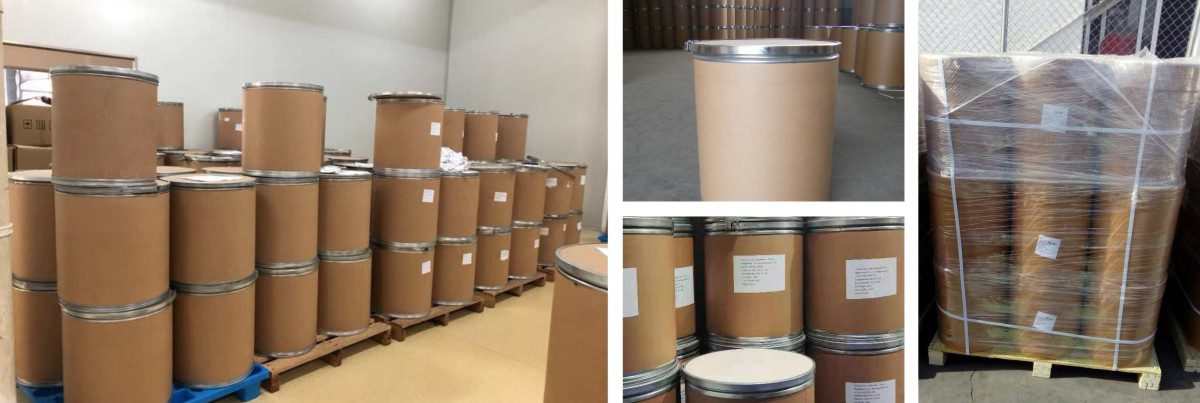
| Format | Net Weight | MOQ | Notes |
|---|---|---|---|
| Aluminum foil pouch (inner PE) | 1 kg | 25 kg | Standard; moisture barrier |
| Aluminum foil pouch (inner PE) | 5 kg | 25 kg | Standard; moisture barrier |
| Kraft paper bag (inner PE liner) | 25 kg | 25 kg | Export packaging |
| White woven PP bag | 25 kg | 25 kg | Humid climates |
| Private-label retail | 100g / 500g / 1kg | 200 kg | Retail / Amazon |
| GMP bottle (pharmaceutical grade) | 100g / 500g | 100 kg | Research/Pharma grade |
Storage Conditions: ≤25°C, RH ≤60%, sealed, away from direct sunlight and strong odors. Protect from heat and humidity. Shelf life: 24 months from manufacture date (sealed). After opening: reseal immediately; use within 3 months. Do not freeze in glass containers.