
Table of Contents
What This Guide Covers
This technical reference is written for food scientists, R&D formulators, and procurement professionals evaluating mung bean protein as a functional ingredient for plant-based product development. It provides detailed data on protein isolation methods, amino acid composition, functional properties under relevant food-processing conditions, specification grades, and practical formulation guidance across major application categories.
For health benefits and consumer-focused dietary applications of mung bean protein, see our Organic Mung Bean Protein Health & Nutrition Guide. For related legume protein comparisons, see our guides on Fava Bean Protein and Chickpea Protein.
Botanical Source and Protein Context
Mung bean protein is isolated from the dehulled cotyledons of Vigna radiata (L.) Wilczek, the same legume species that produces mung bean starch and mung bean vermicelli (glass noodles). The protein content of whole mung beans ranges from 24% to 28% on a dry weight basis, which is notably higher than most cereal grains (8-12%) and comparable to other legumes such as lentils (25-28%) and chickpeas (20-25%).
Mung bean protein has gained industrial attention for three reasons that differentiate it from more established plant proteins:
- Low allergenicity profile — Unlike soybean (a Big 8 allergen) and wheat gluten (celiac trigger), mung bean protein has no major regulatory allergen designation in the U.S. (FDA), EU (EFSA), or Codex Alimentarius frameworks.
- Mild flavor profile — Sensory panels consistently describe mung bean protein as less “beany” or “grassy” than pea protein, with lower hexanal and other lipid oxidation volatiles that typically cause off-notes.
- Co-product synergy — The mung bean starch manufacturing industry already generates a protein-rich byproduct stream, creating an economically viable supply chain for food-grade protein isolates.
Nutritional Context
| Component | Whole Mung Bean | Mung Bean Protein Isolate (80%) | Pea Protein Isolate (80%) |
|---|---|---|---|
| Protein (% dry basis) | 24–28 | 80–85 | 80–85 |
| Fat (%) | 1.0–1.5 | 2.0–4.0 | 3.0–5.0 |
| Total Carbohydrate (%) | 60–65 | 3.0–6.0 | 2.0–4.0 |
| Ash (%) | 3.0–4.0 | 4.0–6.0 | 4.0–6.0 |
| Moisture (%) | 10–12 | 5.0–8.0 | 5.0–8.0 |
Protein Isolation and Processing
Starch-Protein Separation: The Industrial Foundation
Mung bean protein production is intimately tied to mung bean starch manufacturing. Whole mung beans are first dehulled, then subjected to wet-milling in an aqueous medium. The starch granules (15-35 μm, oval to kidney-shaped) settle rapidly due to their size and density, while the protein-rich supernatant is recovered for further processing.
Key process steps:
- Cleaning and Dehulling — Removal of seed coat (testa) using abrasive dehullers. The hull fraction (~8-10% of seed weight) is rich in insoluble fiber and is diverted to animal feed or fiber ingredient streams.
- Soaking — Dehulled splits are soaked in water (1:3 to 1:5 bean-to-water ratio) at 25-40°C for 4-12 hours to soften the cotyledons and initiate endogenous enzyme activity that partially degrades starch-protein complexes.
- Wet Milling — Soaked splits are ground with additional water using a stone mill or pin mill. The slurry passes through a series of screens (80-200 mesh) to separate fiber.
- Starch Sedimentation — The screened slurry enters sedimentation tanks or hydrocyclones. Starch granules settle due to higher density (1.48-1.52 g/cm³ vs. ~1.35 g/cm³ for protein bodies). The protein-rich supernatant is the starting material for protein isolation.
- Protein Recovery — Two primary routes exist:
Route A: Alkaline Extraction-Isoelectric Precipitation (AE-IP)
The conventional and most widely used commercial method:
- Extraction: The protein-rich supernatant is adjusted to pH 9.0-10.0 using food-grade NaOH or KOH. At alkaline pH, protein solubility increases dramatically as the pH moves away from the isoelectric point. Extraction is conducted at 40-50°C for 30-60 minutes with continuous agitation.
- Clarification: The alkaline extract is centrifuged at 3,000-5,000 × g to remove insoluble fiber and residual starch.
- Isoelectric Precipitation: The clarified extract is acidified to pH 4.2-4.6 (the isoelectric point of mung bean globulins, which constitute 60-70% of total protein) using food-grade HCl or citric acid. The protein precipitates as a curd.
- Neutralization and Drying: The protein curd is washed, neutralized to pH 6.8-7.2 with NaOH, and spray-dried.
| Process Parameter | Typical Range | Effect on Protein Quality |
|---|---|---|
| Extraction pH | 9.0–10.0 | Higher pH → higher yield but potential lysinoalanine formation |
| Extraction Temperature | 40–50°C | Above 55°C → increased denaturation, reduced solubility |
| Precipitation pH | 4.2–4.6 | Optimal at pI of 8S globulin fraction |
| Spray Dryer Inlet Temp | 170–190°C | Higher → reduced moisture but potential Maillard damage |
| Spray Dryer Outlet Temp | 80–95°C | Critical for solubility preservation |
Route B: Enzymatic Extraction
Emerging alternative for premium organic-grade protein:
- Mechanism: Carbohydrase enzymes (cellulase, hemicellulase, pectinase) degrade the cell wall polysaccharide matrix that embeds protein bodies within cotyledon cells, releasing protein without harsh alkaline conditions.
- pH: Maintained at 6.0-7.0 throughout, preserving native protein conformation.
- Advantages: Higher solubility index (85-92% vs 65-78% for AE-IP), better emulsification capacity, no lysinoalanine formation, simpler organic certification compliance.
- Limitations: Higher enzyme cost, longer processing time (2-4 hours vs 1-2 hours for AE-IP), lower overall yield (65-75% vs 80-88% for AE-IP).
Route Comparison for Formulators
| Property | AE-IP Route | Enzymatic Route |
|---|---|---|
| Protein Purity (dry basis) | 80–85% | 78–83% |
| Solubility at pH 7 | 65–78% | 85–92% |
| Emulsification Activity Index | 25–35 m²/g | 35–48 m²/g |
| Emulsion Stability | 70–80% | 80–90% |
| Foaming Capacity | 40–60% | 55–75% |
| Color (L* value) | 75–82 | 78–85 |
| Sensory (beaniness) | Moderate | Mild |
| Cost Index | 1.0× | 1.3–1.6× |
Amino Acid Profile and Protein Quality
Complete Amino Acid Composition
Mung bean protein belongs to the 7S/8S globulin family (vicilin-type storage proteins), which determines its amino acid profile. The 8S globulin fraction accounts for approximately 60-70% of total protein, with 7S globulin and albumin fractions making up the remainder.
| Amino Acid | Content (g/100g protein) | FAO/WHO Reference Pattern (adult) | Amino Acid Score |
|---|---|---|---|
| Essential Amino Acids | |||
| Histidine (His) | 2.5–3.1 | 1.5 | 1.67–2.07 |
| Isoleucine (Ile) | 4.0–4.8 | 3.0 | 1.33–1.60 |
| Leucine (Leu) | 7.5–8.5 | 5.9 | 1.27–1.44 |
| Lysine (Lys) | 6.0–7.2 | 4.5 | 1.33–1.60 |
| Methionine + Cysteine (Met+Cys) | 1.8–2.4 | 2.2 | 0.82–1.09 |
| Phenylalanine + Tyrosine (Phe+Tyr) | 8.0–9.5 | 3.8 | 2.11–2.50 |
| Threonine (Thr) | 3.0–3.8 | 2.3 | 1.30–1.65 |
| Tryptophan (Trp) | 0.8–1.0 | 0.6 | 1.33–1.67 |
| Valine (Val) | 4.5–5.5 | 3.9 | 1.15–1.41 |
| Non-Essential Amino Acids | |||
| Aspartic Acid + Asparagine (Asx) | 11.0–13.0 | — | — |
| Glutamic Acid + Glutamine (Glx) | 16.0–19.0 | — | — |
| Serine (Ser) | 4.5–5.5 | — | — |
| Glycine (Gly) | 3.5–4.5 | — | — |
| Arginine (Arg) | 6.5–7.5 | — | — |
| Alanine (Ala) | 4.0–5.0 | — | — |
| Proline (Pro) | 3.5–4.5 | — | — |
PDCAAS and DIAAS Assessment
PDCAAS (Protein Digestibility Corrected Amino Acid Score):
The first-limiting amino acid in mung bean protein is the sulfur-containing pair (methionine + cysteine), with an amino acid score of 0.82-1.09 depending on cultivar and growing conditions. True fecal protein digestibility in rats ranges from 78-85%, yielding a PDCAAS of approximately 0.60-0.70.
For comparison:
- Soy protein isolate: PDCAAS 0.92-1.00
- Pea protein isolate: PDCAAS 0.70-0.82
- Mung bean protein isolate: PDCAAS 0.60-0.70
- Rice protein isolate: PDCAAS 0.45-0.55
In vitro DIAAS (Digestible Indispensable Amino Acid Score) estimation, based on INFOGEST static digestion protocols, suggests a DIAAS of 0.65-0.75 for mung bean protein isolate when methionine is the limiting amino acid.
Amino Acid Complementation
Mung bean protein is rich in lysine but limiting in sulfur amino acids — the classic legume amino acid pattern. This makes it an effective complementary protein when combined with cereal proteins (rice, wheat) that are lysine-poor but methionine-rich:
| Blend | Ratio | PDCAAS (estimated) |
|---|---|---|
| Mung Bean : Rice Protein | 50:50 | 0.75–0.85 |
| Mung Bean : Pea Protein | 50:50 | 0.68–0.78 |
| Mung Bean : Brown Rice : Pea | 40:30:30 | 0.72–0.82 |
Functional Properties for Formulation
Protein Solubility
Solubility is the single most important functional property because it governs nearly all other functionalities — a protein that is insoluble cannot emulsify, foam, or gel effectively.
pH-Solubility Profile (AE-IP Mung Bean Protein, 80%):
| pH | Solubility (%) | Notes |
|---|---|---|
| 2.0 | 25–35 | Below solubility minimum, acid-denatured |
| 3.0 | 15–25 | Near pI region |
| 4.0–4.5 | 5–12 | Isoelectric point (pI) minimum |
| 5.0 | 20–30 | Transition zone |
| 6.0 | 40–55 | Increasing |
| 7.0 | 65–78 | Neutral pH, good solubility |
| 8.0 | 72–85 | Alkaline region |
| 9.0 | 80–90 | Maximum solubility |
Temperature-Solubility Profile (pH 7.0):
| Temperature (°C) | Solubility (%) | Notes |
|---|---|---|
| 20 | 68–78 | Ambient |
| 40 | 70–80 | Slightly enhanced |
| 60 | 40–55 | Onset of denaturation |
| 80 | 15–25 | Extensive denaturation |
| 90 | 8–15 | Near-complete denaturation |
Formulation implication: Mung bean protein performs best in neutral to mildly alkaline formulations (pH 6.5-8.0) at process temperatures below 60°C. For acidic beverages (pH 3.5-4.5), alternative proteins or solubility-enhancing modifications are recommended.
Emulsification Properties
| Parameter | Mung Bean Protein (AE-IP) | Mung Bean Protein (Enzymatic) | Pea Protein (AE-IP) |
|---|---|---|---|
| Emulsification Activity Index (m²/g) | 25–35 | 35–48 | 30–40 |
| Emulsion Stability Index (min) | 20–30 | 30–45 | 18–28 |
| Oil Droplet Size (d₄,₃, μm) | 15–25 | 8–18 | 12–22 |
| Critical Concentration (g/L) | 10–15 | 8–12 | 8–12 |
Mung bean protein forms oil-in-water emulsions with moderate stability. The 8S globulin fraction contributes surface activity at the oil-water interface, while the albumin fraction provides electrostatic stabilization. Emulsification is strongly pH-dependent, with optimal performance at pH 7-8 where protein surface hydrophobicity and charge combine favorably.
Foaming Properties
| Parameter | Value |
|---|---|
| Foaming Capacity at pH 7.0 | 40–60% (volume increase) |
| Foam Stability at 30 min | 55–70% (residual foam) |
| Optimal Protein Concentration | 1.0–2.0% (w/v) |
Foaming capacity is moderate compared to egg white protein (300-400%) but adequate for applications where high foam volume is not critical, such as protein-fortified batters or frozen dessert aerations. Foam stability is surprisingly good due to the formation of a viscoelastic interfacial film by 8S globulins.
Water and Oil Holding Capacity
| Property | Value |
|---|---|
| Water Holding Capacity | 2.5–3.5 g water/g protein |
| Oil Holding Capacity | 2.0–3.0 g oil/g protein |
These values are comparable to soy protein isolate (WHC 3.0-4.0, OHC 2.5-3.5) and adequate for meat analogue and bakery applications where moisture retention and fat binding are desired.
Gelation Properties
Least Gelation Concentration (LGC): 12-16% (w/v) at pH 7.0, heating to 90°C for 30 min followed by cooling to 4°C.
The gelation mechanism involves heat-induced unfolding of 8S globulin subunits, exposure of hydrophobic patches, and subsequent protein-protein aggregation into a three-dimensional network. Gel strength is moderate — lower than soy protein but superior to rice protein.
| Protein Concentration (% w/v) | Gel Strength (g force) |
|---|---|
| 10 | No gel |
| 12 | Weak gel (15–25) |
| 14 | Moderate gel (30–50) |
| 16 | Firm gel (55–80) |
| 18 | Strong gel (85–120) |
Specification Grades and Quality Parameters
Commercial Grade Specifications
| Parameter | Mung Bean Protein 80% | Mung Bean Protein 85% |
|---|---|---|
| Protein (N × 6.25, dry basis) | ≥ 80.0% | ≥ 85.0% |
| Moisture | ≤ 8.0% | ≤ 8.0% |
| Fat | ≤ 4.0% | ≤ 3.0% |
| Ash | ≤ 6.0% | ≤ 5.0% |
| Total Carbohydrate (by difference) | ≤ 8.0% | ≤ 5.0% |
| Crude Fiber | ≤ 2.0% | ≤ 1.5% |
| pH (5% aqueous dispersion) | 6.5–7.5 | 6.5–7.5 |
| Color (L value, CIELAB)* | ≥ 75 | ≥ 78 |
| Particle Size (D₉₀, μm) | ≤ 150 | ≤ 120 |
Particle Size Distribution
| Grade | D₁₀ (μm) | D₅₀ (μm) | D₉₀ (μm) | Application Suitability |
|---|---|---|---|---|
| Fine Powder | 15–25 | 45–65 | 80–100 | RTD beverages, instant powder blends |
| Standard Powder | 25–40 | 60–80 | 120–150 | Protein bars, baked goods, meat analogues |
| Coarse Powder | 50–80 | 100–130 | 180–220 | Textured vegetable protein (TVP) extrusion |
Microbiological Specifications
| Parameter | Limit |
|---|---|
| Total Plate Count | ≤ 10,000 CFU/g |
| Yeast & Mold | ≤ 100 CFU/g |
| Coliforms | ≤ 10 CFU/g |
| E. coli | Negative in 1g |
| Salmonella spp. | Negative in 25g |
| Bacillus cereus | ≤ 100 CFU/g |
Heavy Metal Limits (EU Regulation 1881/2006 Compliance)
| Metal | Limit (mg/kg) |
|---|---|
| Lead (Pb) | ≤ 0.20 |
| Cadmium (Cd) | ≤ 0.10 |
| Arsenic (As) | ≤ 0.10 |
| Mercury (Hg) | ≤ 0.05 |
Application Matrix for Formulators
| Application Category | Recommended Grade | Usage Level (% w/w) | Key Functionality | Critical Factor |
|---|---|---|---|---|
| Protein Powder Blends | 80% Fine | 50–100 (in blend) | Nutrition + mild flavor | Solubility, dispersibility |
| RTD Protein Beverages | 85% Fine or Enzymatic | 3–8 | Protein fortification | pH-stable solubility |
| Protein Bars | 80% Standard | 15–25 | Texture + protein | WHC, shelf-life hardness |
| Plant-Based Meat Analogues | 80% Coarse/Standard | 6–15 | Water binding + texture | Gelation, WHC |
| Bakery (Bread, Cookies) | 80% Standard | 3–10 | Protein enrichment | Dough rheology |
| Gluten-Free Products | 80% Fine | 5–12 | Structure + protein | Combine with starch |
| Infant Nutrition | 85% Fine | 2–6 | Amino acid balance | Purity, microbiological |
| Dairy Alternatives | 80% Standard | 2–5 | Protein fortification | Flavor compatibility |
| Extruded Snacks | 80% Coarse | 10–20 | Expansion + protein | Extrusion behavior |
| Clinical/Medical Nutrition | 85% Fine | Variable | Hypoallergenic protein | Purity, amino acid profile |
Substitution Guidance
When replacing other plant proteins with mung bean protein:
| Replacing | Substitution Ratio | Adjustment Needed |
|---|---|---|
| Pea Protein (80%) | 1:1 | None for most applications; flavor may improve slightly |
| Soy Protein (90%) | 1.15:1 | Adjust protein target; more water needed |
| Rice Protein (80%) | 1:1 | Test solubility at target pH |
| Wheat Gluten (75%) | 1.3:1 | Gluten-free claim enabled; add binder for structure |
Organic Certification and Quality Control
Certification Framework
Organic mung bean protein must comply with the organic regulations of the target market:
| Market | Standard | Key Requirement |
|---|---|---|
| United States | USDA NOP 7 CFR Part 205 | No synthetic pesticides, non-GMO seed, certified processor |
| European Union | EU Reg. 2018/848 | Equivalent standards, third-party certification |
| China | GB/T 19630 | National organic product standard |
| Japan | JAS Organic | MAFF-accredited certification body |
Typical QC Parameters for Organic Grade
Beyond the standard specifications, organic-grade mung bean protein is typically tested for:
| Test | Method | Typical Specification |
|---|---|---|
| Pesticide Residues (500+ screen) | GC-MS/MS, LC-MS/MS | ≤ LOQ (0.01 mg/kg) |
| Glyphosate/AMPA | LC-MS/MS | ≤ 0.01 mg/kg |
| GMO Screening | PCR (35S, NOS, FMV) | Negative |
| Mycotoxins (Aflatoxin B1/B2/G1/G2, OTA) | HPLC-FLD | ≤ EU limits |
| Acrylamide | LC-MS/MS | ≤ 0.1 mg/kg |
| Allergen Cross-Contact (Soy, Gluten) | ELISA | ≤ 20 ppm |
Comparison with Other Plant Proteins
| Parameter | Mung Bean Protein (80%) | Pea Protein (80%) | Soy Protein (90%) | Rice Protein (80%) |
|---|---|---|---|---|
| Protein (dry basis) | 80–85% | 80–85% | 88–92% | 78–82% |
| PDCAAS | 0.60–0.70 | 0.70–0.82 | 0.92–1.00 | 0.45–0.55 |
| Limiting AA | Met+Cys | Met+Cys | Met+Cys | Lys |
| Solubility (pH 7) | 65–78% | 40–60% | 35–50% | 10–20% |
| Flavor | Mild, slightly sweet | Grassy, beany | Beany, bitter notes | Bland, slightly cereal |
| Allergen Status | Non-allergenic (regulatory) | Non-allergenic (regulatory) | Big 8 Allergen (FDA) | Non-allergenic (regulatory) |
| GMO Risk | Very low (no commercial GM mung bean) | Low | High (~94% GM in US) | Low |
| Color (L)* | 75–82 | 72–80 | 80–88 | 82–88 |
| Cost Index | 1.3–1.6× | 1.0× | 0.6–0.8× | 0.8–1.0× |
The data and specifications in this guide represent typical values for commercially available organic mung bean protein ingredients. Individual suppliers may offer products with different specifications. Procurement professionals should request certificates of analysis (CoA) for each production lot and verify compliance with their product-specific requirements.
For formulation support, sample requests, and technical documentation, Contact Us.
Recommended Products
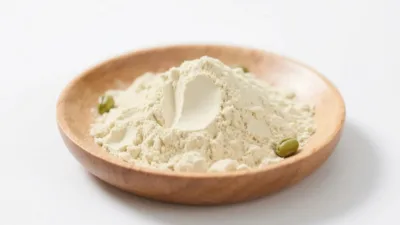
Organic Mung Bean Protein Powder
Organic Mung Bean Protein Powder is a high-purity plant protein isolate (≥80% protein, dry…


