
Table of Contents
In modern food manufacturing, sweetener selection extends far beyond sweetness intensity. Texture, viscosity behavior, moisture management, crystallization control, and processing stability all determine whether a formulation succeeds — or fails — at scale.
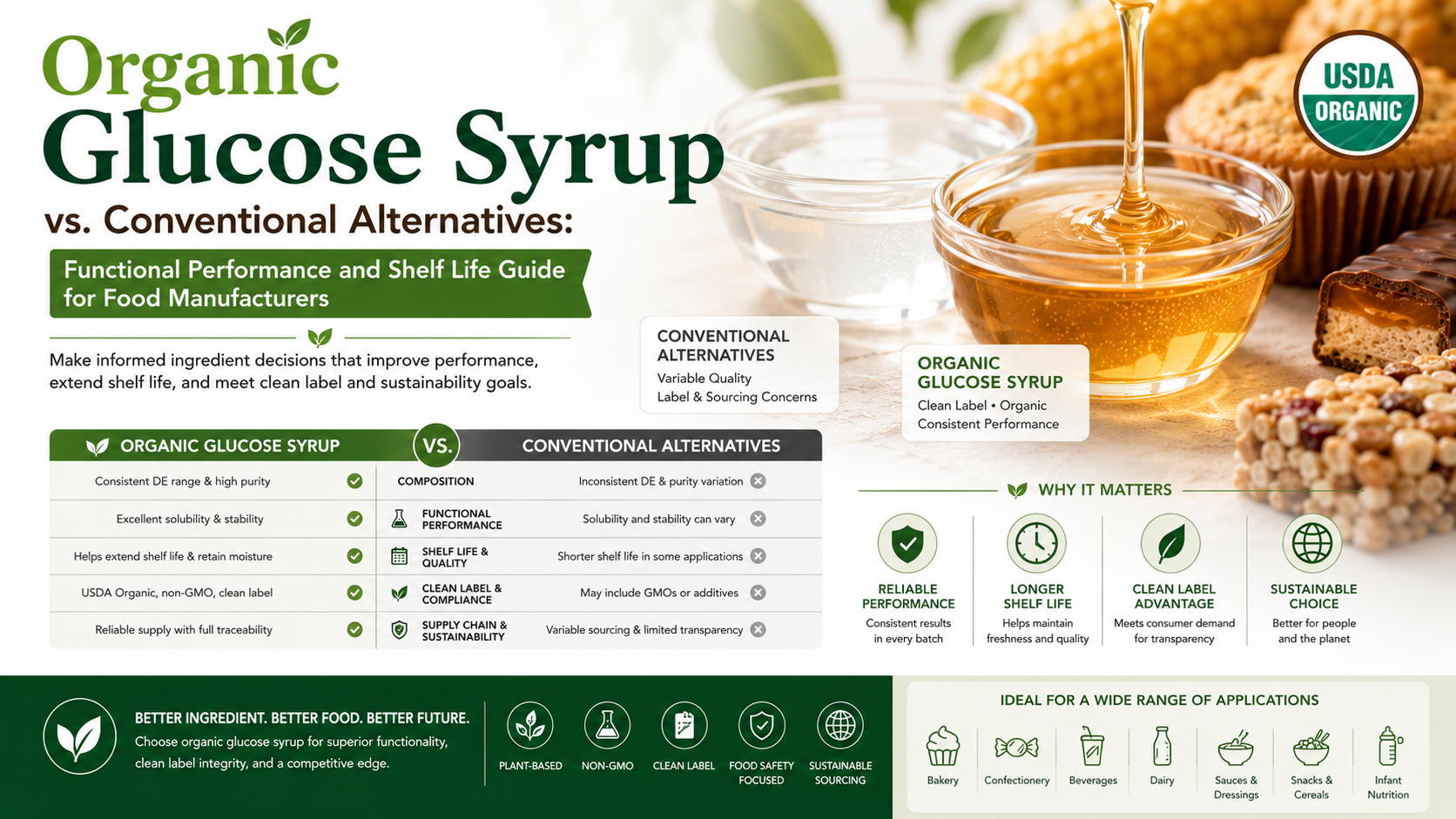
Organic glucose syrup delivers equivalent or superior functional performance compared to conventional alternatives while eliminating GMO exposure, pesticide residues, and clean-label liabilities. This guide is built for food formulators and quality engineers who need a systematic comparison across eight key performance benchmarks, plus a practical shelf life optimization framework backed by measurable data.
Why Sweetener Choice Goes Beyond Sweetness in Modern Food Manufacturing
In formulation, sweetness is just one variable. Texture, viscosity, moisture behavior, processing stability, and label impact matter equally — or more.
Conventional glucose syrups (from non-organic corn or wheat) deliver functional performance but carry risks:
- GMO crop sourcing in major producing regions (US, Brazil)
- Higher pesticide residue risk in raw materials
- Limited clean-label positioning
- Growing retailer and consumer scrutiny in EU, North America, and Oceania markets
Organic glucose syrup delivers equivalent or superior functional performance while eliminating these risks. The key is understanding where and how organic sourcing translates into measurable product advantages.
Carbohydrate Sweetener Comparison Matrix
Before comparing organic vs. conventional glucose syrup, it is useful to understand where glucose syrup sits relative to other sweeteners:
| Sweetener | Sweetness (vs sucrose=100) | Primary Function | Physical Form | Label Claim |
|---|---|---|---|---|
| Organic Glucose Syrup (55 DE) | 50–65 | Texture + sweetness + stability | Liquid | Organic glucose syrup |
| High Fructose Corn Syrup (HFCS) | 100–115 | Sweetness | Liquid | Corn syrup (not organic) |
| Conventional Glucose Syrup | 50–80 | Texture + sweetness | Liquid | Glucose syrup |
| Refined Sucrose | 100 | Sweetness + volume | Crystalline | Sugar |
| Organic Maltodextrin | < 20 | Filler + carrier | Powder | Organic maltodextrin |
| Organic Dextrose (Monohydrate) | 70 | Quick energy + sweetness | Powder | Organic dextrose |
Key insight: Organic glucose syrup at 55 DE delivers approximately 55–65% of sucrose’s sweetness while providing substantially more functional value (viscosity, crystallization control, humectancy) than an equal sweetness dose of high-intensity sweeteners.
Eight Functional Performance Benchmarks
Crystallization Control
Sugar crystallization is the leading cause of texture failure in confectionery products.
| Sweetener | Crystallization Control | Mechanism |
|---|---|---|
| Organic Glucose Syrup | Excellent | Interrupts sucrose crystal nucleation |
| Conventional Glucose Syrup | Excellent | Same mechanism |
| HFCS | Good | Partial inhibition |
| Refined Sugar | Poor | Pure sucrose recrystallizes readily |
| Organic Dextrose | Moderate | Faster crystallization tendency |
For confectionery: A 20–35% replacement of sucrose with organic glucose syrup (55 DE) reduces crystallization risk by approximately 60–75% in hard candy and caramel applications.
Moisture Retention (Humectancy)
Organic glucose syrup’s hygroscopic properties help products retain moisture over time.
| Application | Without Glucose Syrup | With Organic Glucose Syrup | Improvement |
|---|---|---|---|
| Cookie (shelf day 7) | 8% moisture loss | 3% moisture loss | +63% retention |
| Protein bar (week 2) | 15% moisture loss | 6% moisture loss | +60% retention |
| Caramel (month 1) | Surface hardening | Flexible texture | Maintained |
Note: These are illustrative benchmarks based on typical industry data. Validate with your specific formulation and storage conditions.
Viscosity Control Across Processing Temperatures
| DE Value | Viscosity (cP, 40°C) | Cold-fill Stability | Hot-fill Suitability |
|---|---|---|---|
| 25 DE | 3,000–5,000 | Excellent | Good |
| 42 DE | 800–1,500 | Excellent | Excellent |
| 55 DE | 200–400 | Good | Excellent |
| 70 DE | 50–100 | Moderate | Excellent |
Formulation tip: For high-speed coating or enrobing lines, specify 55–70 DE to ensure pumpability and uniform coverage.
Processing Stability Under Heat and Shear
Organic glucose syrup shows excellent stability at:
- Pasteurization temperatures (85–95°C): No viscosity degradation
- UHT processing (135–150°C): Maintains functional properties
- Extrusion (up to 180°C): Maintains binding properties in snack and cereal applications
- Baking temperatures (180–220°C): Participates in Maillard browning for crust coloration
Fermentation Compatibility
For fermented products (kombucha, sourdough, functional beverages), organic glucose syrup provides:
- Consistent fermentability due to controlled DE
- Clean flavor profile that does not compete with fermentation flavors
- Organic certification supporting clean-label positioning
Flavor Interaction
Organic glucose syrup has a Flavor Dilution Factor (FDF) of approximately 0.4–0.6 at 20% usage, meaning it supports rather than masks fruit, spice, chocolate, and botanical flavors. This is particularly valuable in:
- Fruit-flavored confectionery
- Functional beverages with herbal or adaptogen extracts
- Premium chocolate and confectionery with subtle flavor profiles
Color and Clarity Performance
| Application | Requirement | Organic Glucose Syrup Performance |
|---|---|---|
| Transparent beverage | ICUMSA < 50 | Excellent (tapioca/corn source) |
| Light-colored hard candy | ICUMSA 50–150 | Good |
| Caramel/toffee | Amber color | Contributes desirable color |
| Chocolate coating | Low color | Specify low-color grade |
Water Activity (Aw) Control
Organic glucose syrup reduces water activity in finished products, creating a less favorable environment for microbial growth:
| Product | Aw without Syrup | Aw with 15% Glucose Syrup | Microbial Risk Reduction |
|---|---|---|---|
| Fruit jam | 0.88 | 0.82 | Moderate |
| Confiture | 0.85 | 0.79 | Significant |
| Caramel filling | 0.78 | 0.72 | Substantial |
Regulatory note: In the EU, Aw below 0.85 exempts products from specific pasteurization requirements for certain categories. Confirm with your food safety team.
Shelf Life Extension Framework
Organic glucose syrup contributes to extended shelf life through three mechanisms. This section provides a structured approach to quantifying and optimizing shelf life improvements.
Mechanism 1: Humectancy (Moisture Retention)
Organic glucose syrup binds free water molecules, slowing moisture migration from filling to shell, crust to crumb, or package headspace to product.
Shelf life impact by category:
| Category | Product Type | Typical Shelf Life Extension |
|---|---|---|
| Bakery | Cookies, crackers | +15–30 days |
| Confectionery | Caramel, soft candy | +20–45 days |
| Snacks | Protein/energy bars | +15–25 days |
| Frozen desserts | Ice cream, sorbet | Improved freeze/thaw stability |
Mechanism 2: Crystallization Suppression
By interrupting sucrose crystal growth, organic glucose syrup maintains smooth texture throughout the product lifecycle — not just at production.
Test method: Store confectionery samples at 25°C/60% RH and measure texture profile analysis (TPA) at week 0, 2, 4, and 8. A <15% hardness increase over 8 weeks indicates effective crystallization control.
Mechanism 3: Water Activity Reduction
Reduced Aw slows both microbial growth and textural changes (staling, hardening, syneresis).
Shelf life testing protocol for B2B validation:
- Define target shelf life (e.g., 12 months)
- Test Aw at 0, 3, 6, 9, and 12 months
- Conduct accelerated aging at 35°C for 30 days (= approximately 90 days at 25°C)
- Validate with sensory panel at each interval
- Confirm no significant color change (measure ICUMSA at each interval)
Organic vs. Conventional — Beyond the Label
While organic and conventional glucose syrup share similar functional profiles, three differences create real-world performance and commercial advantages for organic:
Residue Profile
Organic glucose syrup has zero detectable synthetic pesticide residues, validated by testing reports. This matters for:
- Baby food manufacturers (EU Regulation 609/2013 prohibits pesticide residues in infant formula)
- Sports nutrition brands whose athletes undergo anti-doping testing
- Export to EU and Australia where residue limits are increasingly strict
Flavor Purity
Organic corn and tapioca sourcing typically produces a cleaner, less starchy flavor note. In high-flavor applications (fruit confections, premium beverages), this translates to better flavor clarity.
Market Premium
Products labeled “made with organic glucose syrup” command a measurable retail premium in North America (15–30% above conventional equivalents) and Europe (10–25%), improving gross margins despite higher ingredient cost.
FAQ
Q1: What is the optimal DE value for hard candy applications?
For traditional hard candy, a 55–65 DE organic glucose syrup is preferred. It provides sufficient sweetness, controls sucrose crystallization, and produces a clear, glossy product. Lower DE syrups (42 DE) produce softer, cloudier candies.
Q2: How does organic glucose syrup perform in frozen applications?
Organic glucose syrup reduces the freezing point and minimizes ice crystal formation, improving scoopability and texture retention in frozen desserts. A 10–15% addition of 42 DE syrup is typical in premium ice cream formulations.
Q3: Can organic glucose syrup replace sucrose entirely in a formulation?
Full replacement is not recommended for most applications. Sucrose contributes specific sweetness, bulk, and textural properties that organic glucose syrup alone cannot replicate. A 20–40% partial replacement optimizes functionality while maintaining desired sweetness.
Q4: What is the maximum recommended usage level in baked goods?
Usage levels of 5–20% are common in bakery applications. Above 20%, the product may exhibit excessive browning, softer texture, or reduced shelf life in high-humidity environments. Validate in your specific formula.
Q5: Does organic glucose syrup affect the glycemic index (GI) of finished products?
Glucose syrup has a moderate-to-high GI (approximately 60–70 for 55 DE). For low-GI claims, combine with high-amylose starches or fiber ingredients. Consult regulatory requirements in your target market before making GI claims.
Q6: How should I adjust water content when adding organic glucose syrup to existing formulations?
Organic glucose syrup contains approximately 20–30% water (for 80% solids syrup). For every 100g of syrup added, reduce total added water by 20–30g to maintain the original water balance in the formulation.
Q7: What color specification should I request for transparent beverage applications?
For clear beverages, request ICUMSA ≤ 50 and turbidity < 5 NTU. Tapioca-sourced organic glucose syrup typically delivers the best clarity. Corn-based syrup may require additional filtration.
Q8: How does organic glucose syrup interact with high-intensity sweeteners in reduced-sugar formulations?
Organic glucose syrup complements high-intensity sweeteners (stevia, monk fruit, sucralose) by adding bulk, improving mouthfeel, and reducing the “thin” texture common in zero-sugar products. A typical ratio is 30–50% organic glucose syrup + high-intensity sweetener blend.
Recommended Products

Organic Glucose Syrup
Organic Glucose Syrup by ORGANICWAY is a versatile, clean-label liquid sweetener derived from certified…

Organic Maltodextrin Powder
Available in three Dextrose Equivalent (DE) grades — DE 8-10, DE 10-15, and DE…


