
Table of Contents
For centuries, garlic has been one of the most widely used flavoring ingredients in global cuisines. Today, food and supplement manufacturers have two main options when incorporating garlic into their products: fresh garlic or organic garlic powder. The choice sounds simple, but at industrial scale it determines consistency, cost, food safety exposure, and the speed at which a production line can run, so the decision deserves a careful, evidence-based comparison rather than a default inherited from a recipe written for a home kitchen. Garlic’s chemistry is also unusually sensitive to preparation: crushing, heating, and drying each change the balance of allicin and its downstream compounds, so the form a manufacturer chooses quietly shapes both flavor and the bioactive story that can appear on the pack. Treating the decision as purely culinary misses half the value. A manufacturer that understands the chemistry can also tell a more honest story on the label, because the choice between fresh and powder is really a choice about how much control it wants over flavor, safety, and cost across an entire year of production rather than a single kitchen session.
While both deliver distinctive aroma and taste, the needs of large-scale production often make organic garlic powder the preferred choice. Here’s an in-depth comparison to help manufacturers make informed sourcing decisions that protect margin and brand reputation at the same time. Fresh garlic carries water, enzymes, and microbiology that vary with every shipment, whereas a dehydrated, standardized powder turns a volatile agricultural commodity into a predictable manufacturing input that behaves the same way in January and July.
1. Flavor Consistency and Stability
- Fresh Garlic: Flavor intensity varies significantly depending on growing conditions, harvest time, and storage. This inconsistency can make it challenging to achieve a uniform taste profile in processed foods, because a batch harvested after rain tastes markedly different from one pulled during a dry spell, and that variance flows straight into the finished product the consumer judges. Even within a single supplier, season-to-season swings force continuous recipe rebalancing that eats engineering time.
- Organic Garlic Powder: Offers stable, concentrated flavor and consistent aroma across batches. Manufacturers can achieve standardized taste in products ranging from sauces to plant-based snacks without worrying about seasonal fluctuations, because the drying and milling step averages out the field variability that plagues the fresh bulb. The concentrated format also means less material by weight delivers the same sensory hit, simplifying dosing on the line, and because the powder is already dehydrated the buyer avoids the freight and shrink that fresh bulbs incur before they ever reach the mixer. That efficiency compounds across every SKU that uses the ingredient.
2. Shelf Life and Storage
- Fresh Garlic: Highly perishable and prone to sprouting, mold, and microbial growth. Requires temperature-controlled storage, which increases logistics costs and creates a spoilage risk that can force a costly line stoppage if a contaminated lot is discovered after it has entered the plant. Cold chain also ties up capital in refrigeration that a dry ingredient simply does not need.
- Organic Garlic Powder: Naturally dehydrated and processed for long shelf stability without chemical preservatives. Ideal for large-scale inventories and long-distance shipping, especially in bulk packaging, because the low moisture content removes the conditions that microbes need to grow and lets a buyer hold safety stock without fear of sudden loss. Ambient storage also simplifies warehouse planning and lowers energy overhead.
3. Clean-Label and Organic Certification
Consumers are demanding clean-label and certified organic products more than ever, and garlic is a category where the organic claim is both credible and easy to communicate because the crop is recognizable and the farming story is intuitive to shoppers.
- Fresh Garlic: While fresh garlic can be organic, it’s often harder to guarantee consistent certification across large-scale sourcing, because loose bulbs move through many hands and commingling at packing houses can blur the paper trail that auditors require. The shorter shelf life also compresses the window in which a certifier can verify a lot.
- Organic Garlic Powder: Derived from certified organic farms and processed under strict food safety standards, making it easier for manufacturers to meet USDA, EU Organic, and non-GMO labeling requirements with documentation that survives a customer audit. A single certified batch can be traced from field to pouch, which is exactly what retailers now demand before listing a product.
4. Production Efficiency
- Fresh Garlic: Requires washing, peeling, chopping, and careful handling before it can be used in recipes. This slows down production and increases labor costs, and the trim waste adds disposal expense while creating housekeeping challenges that food-safety teams watch closely. Each manual step is also a point where contamination can enter.
- Organic Garlic Powder: Ready-to-use, with uniform particle sizes available in different formats such as organic garlic flakes and organic garlic granules. This flexibility allows manufacturers to simplify workflows and reduce processing time, because the ingredient drops straight into a blend without prep and the chosen granulation can be matched to the texture the application needs. Flakes suit visible inclusions; granules disperse evenly in liquids.
5. Versatile Applications
Organic garlic powder and related products integrate seamlessly into various food and nutraceutical formulations, which is why it appears across so many categories instead of being confined to one narrow use. The dry format survives high-heat processing that would destroy fresh aromatics, disperses uniformly in liquids and doughs, and keeps its potency through the long retail dwell time that fresh preparations cannot match, so a single inventory line can feed sauces, snacks, and supplements without separate handling rules. That versatility is exactly what lets a co-manufacturer standardize one ingredient across a customer’s whole portfolio.
- Seasoning Blends & Sauces → spice mixes, condiments, marinades where the dry form disperses without clumping and survives high-heat cooking that would scorch fresh paste.
- Plant-Based Foods → vegan meats, dairy alternatives, soups where garlic carries the savory depth that replaces animal notes consumers are trying to avoid.
- Snack Foods → chips, crackers, popcorn, roasted nuts where a shelf-stable powder keeps flavor consistent across a long retail life instead of fading like fresh aromatics.
- Nutraceuticals → capsules, tablets, and immune-support supplements where standardized allicin potential matters more than culinary nuance and a dry ingredient is simply easier to compress and encapsulate.
In contrast, fresh garlic has limited compatibility in mass production due to moisture content and perishability, which is why even brands that feature “fresh” on the front of the pack usually rely on powder in the actual formulation to keep the back-of-house reality manageable. Fresh bulbs also force batch-to-batch recipe tuning that powder eliminates, and the trim loss alone can swing a product’s food cost by more than the sweetener line ever will. For a plant manager, the powder is simply the predictable input.
6. Cost and Logistics Advantages
- Lower transportation and storage costs with bulk organic garlic powder, because a truckload of dry powder replaces many times its weight in fresh bulbs and needs no refrigeration from port to plant.
- Reduced processing waste compared to peeling and trimming fresh garlic, since the powder arrives as usable material with no skins, roots, or sprout ends to discard and no wash water to treat, which also shrinks the environmental footprint of the plant and simplifies compliance with local discharge limits that food factories must meet.
- Easier international supply chain management with a dry, stable product that clears customs and sits in a warehouse without the time pressure that perishables impose on every link in the chain.
For global manufacturers, these benefits make organic garlic powder a smarter and more sustainable choice that compounds across the whole operation rather than showing up in only one line item on the cost sheet.
Why Manufacturers Are Choosing ORGANICWAY
At ORGANICWAY, we supply premium-quality organic garlic powder, organic garlic flakes, and organic garlic granules to food, beverage, and supplement manufacturers worldwide. Our products are built for the realities of industrial production, not just for the spec sheet, which is why formulators keep coming back once they have run a line on our material. We hold each lot to a consistent assay, ship in the granulation the application needs, and document the farm and the process so a customer’s quality team can answer a retailer audit without a scramble, and that quiet reliability is what turns a first order into a standing contract.
- USDA & EU Certified Organic, so a single supplier satisfies both North American and European labeling needs without dual sourcing.
- Non-GMO, Allergen-Free, and 100% Additive-Free, which removes the most common clean-label objections before a customer even raises them.
- Available in multiple granulation sizes for versatile applications, letting one relationship cover flakes, granules, and fine powder across a whole product range.
- Bulk packaging options to meet industrial-scale demands while keeping per-kilo logistics sane for high-volume runs.
Enhance your product line with consistent flavor, clean-label appeal, and long shelf life by standardizing on a dehydrated ingredient that behaves the same way every shift, every season, and every market you serve.
Recommended Products
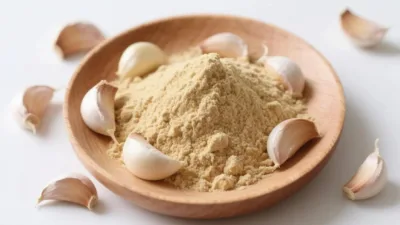
Organic Garlic Powder
Organic Garlic Powder delivers potent, concentrated garlic essence from 100% organically grown Allium sativum.…
Related Posts


