
Table of Contents
Carbohydrate ingredients are the most widely used functional ingredients in the food and beverage industry, serving roles that span from primary sweetening to texture modification, carrier functionality, and energy delivery. Among the organic carbohydrate options available to formulators, three ingredients generate the most frequent comparison questions: organic dextrose powder, organic maltodextrin powder, and organic glucose syrup.
These three ingredients share a common origin — they are all derived from the breakdown of starch — but their functional properties, nutritional profiles, and optimal applications differ substantially. Selecting the wrong carbohydrate for your formulation can result in off-flavors, incorrect texture, insufficient sweetness, regulatory labeling complications, or cost inefficiencies.
This guide provides a systematic comparison of all three ingredients across chemistry, functionality, application performance, and commercial considerations. By the end of this article, you will have a clear framework for selecting the right carbohydrate ingredient for your specific formulation goals.
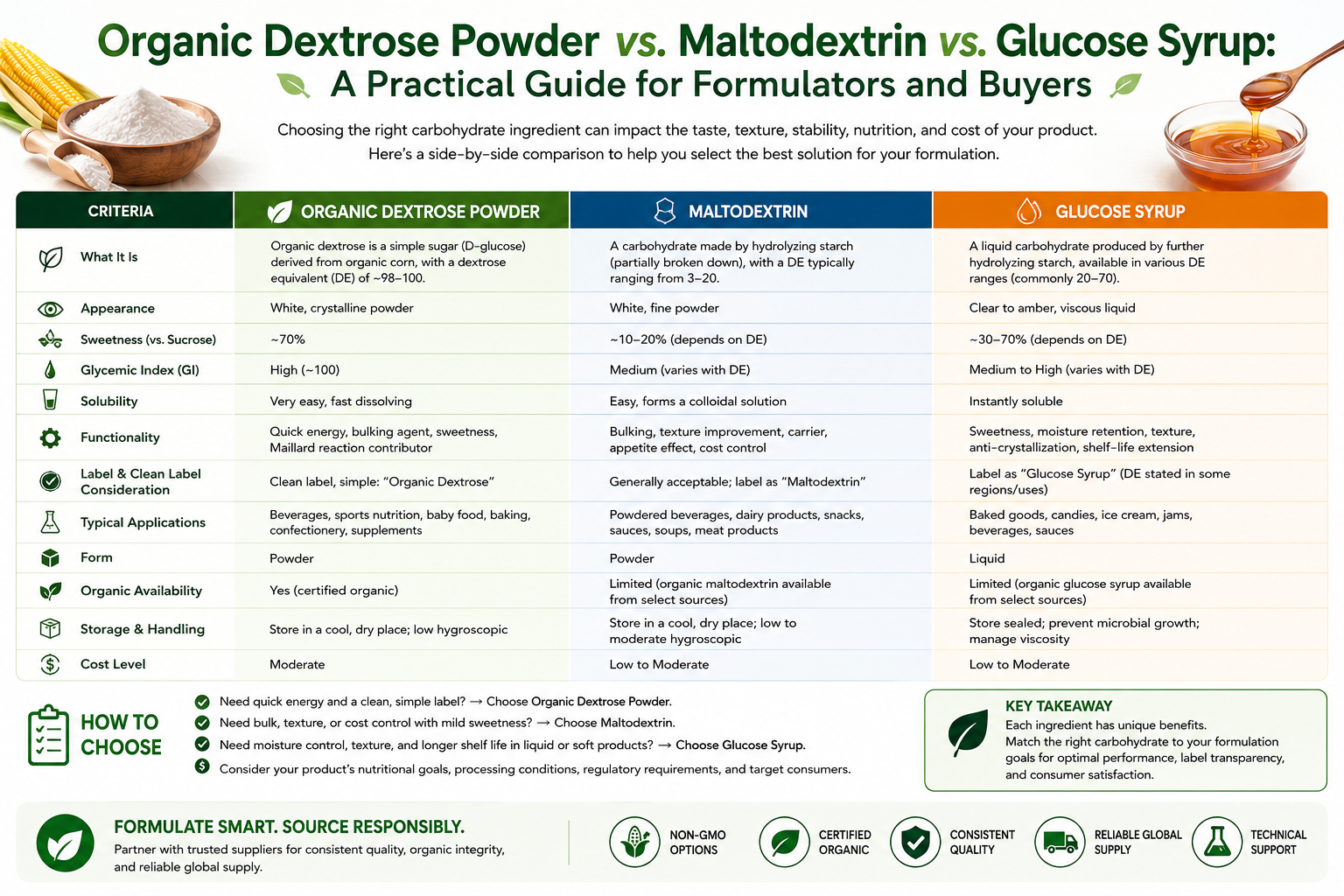
Understanding the Chemistry
The Starch-to-Carbohydrate Continuum
All three ingredients exist on a dextrose equivalent (DE) continuum that describes the degree of starch hydrolysis — how completely the starch molecules have been broken down into smaller sugar units.
| Ingredient | Dextrose Equivalent (DE) | What This Means |
|---|---|---|
| Organic Dextrose Powder | 95–100 | Near-complete hydrolysis; primarily single glucose units |
| Organic Maltodextrin | 3–20 | Minimal hydrolysis; long glucose polymer chains |
| Organic Glucose Syrup | 28–95 | Partial hydrolysis; mixture of glucose polymers and maltose |
The DE value directly correlates with sweetness, viscosity, functional properties, and physiological effects. Understanding where each ingredient falls on this continuum is the foundation for making informed selection decisions.
Structural Differences at a Glance
| Property | Organic Dextrose Powder | Organic Maltodextrin | Organic Glucose Syrup |
|---|---|---|---|
| Chemical Structure | Single glucose unit (monosaccharide) | Long glucose polymer chains (polysaccharide) | Mix of short polymers (di-, tri-, oligosaccharides) |
| Molecular Weight | ~180 g/mol | ~2,000–20,000 g/mol | ~300–3,000 g/mol |
| Crystallinity | Highly crystalline | Amorphous | Varies by DE; lower DE = more amorphous |
| Physical Form | Dry powder | Dry powder | Liquid syrup |
| Sweetness | ~70% of sucrose | Nearly tasteless (DE <10) to mildly sweet | Varies with DE; 30–80% of sucrose |
Source and Processing
All three ingredients are typically derived from organic corn starch, with the following processing routes:
Organic Dextrose Powder: Corn starch → Enzymatic hydrolysis (with glucoamylase) → Purification → Crystallization → Drying → Powder
Organic Maltodextrin: Corn starch → Partial enzymatic hydrolysis (alpha-amylase) → Spray drying → Powder
Organic Glucose Syrup: Corn starch → Enzymatic hydrolysis (variable enzyme exposure) → Purification → Liquid syrup
The key difference is the enzyme selection and exposure duration — shorter hydrolysis produces maltodextrin; extended hydrolysis produces dextrose; intermediate conditions produce glucose syrup.
Functional Performance Comparison
Energy Delivery and Glycemic Response
For formulators targeting energy delivery, glycemic response, or nutritional claims, understanding the metabolic pathway is critical:
Organic Dextrose Powder:
- D-glucose is absorbed directly in the small intestine without requiring enzymatic breakdown
- Produces a rapid, predictable blood glucose response
- Glycemic Index (GI): High (~100–106)
- Ideal for: Fast glycogen replenishment, immediate energy, low-volume high-efficiency delivery
Organic Maltodextrin:
- Must be broken down by salivary and pancreatic amylase before absorption
- Produces a slower, more sustained glucose release
- Glycemic Index: Variable, typically Moderate-High (85–105 depending on DE)
- Ideal for: Sustained energy, carrier for other nutrients, volume extension
Organic Glucose Syrup:
- Contains a mixture of glucose polymers that break down at varying rates
- Produces a moderate glycemic response (DE-dependent; higher DE = faster response)
- Glycemic Index: Moderate-High (60–100 depending on DE)
- Ideal for: Balanced energy delivery, moisture retention in confectionery
Sweetening Performance
Sweetness calibration is one of the most practically important selection criteria:
| Sweetness Level | Ingredient Recommendation | Notes |
|---|---|---|
| High sweetness (near sucrose replacement) | Organic Glucose Syrup (high DE 60–95) | Can achieve 70–80% of sucrose sweetness |
| Moderate sweetness | Organic Dextrose Powder | ~70% sucrose; clean, familiar sweet taste |
| Low sweetness (flavor carrier) | Organic Maltodextrin | ~5–10% sweetness at DE <10; almost neutral |
| Zero sweetness | Organic Maltodextrin (DE 3–6) | Virtually tasteless; purely functional |
Texture and Mouthfeel
| Texture Goal | Best Choice | Mechanism |
|---|---|---|
| Smooth, clean finish | Organic Dextrose Powder | No viscosity contribution; dissolves completely |
| Bulky, full mouthfeel | Organic Maltodextrin | High viscosity at low concentrations |
| Moisture retention | Organic Glucose Syrup | Humectant properties; prevents crystallization |
| Anti-crystallizing | Organic Glucose Syrup | Inhibits sucrose and fructose crystallization |
| Foam stabilization | Organic Maltodextrin | Film-forming at air-water interface |
Processing Characteristics
| Processing Factor | Organic Dextrose Powder | Organic Maltodextrin | Organic Glucose Syrup |
|---|---|---|---|
| Heat stability | Excellent | Good | Moderate; may caramelize at high heat |
| Acid stability | Excellent | Good | Moderate |
| Browning (Maillard reaction) | Strong contributor | Moderate contributor | Strong contributor |
| Fermentation substrate | Excellent (fast) | Good (slow) | Good (fast) |
| Solubility | Rapid | Rapid | Instantaneous (liquid) |
| Viscosity | None | Medium-High | Variable (DE-dependent) |
| Storage stability | Excellent (dry) | Excellent (dry) | Requires preservatives; limited shelf life |
Application-Specific Guidance
Beverage Applications
| Beverage Type | Recommended Carbohydrate(s) | Rationale |
|---|---|---|
| RTD energy drinks | Organic Dextrose Powder | Fast energy; neutral flavor; easy dissolution |
| Sports drinks (isotonic) | Organic Dextrose Powder + Organic Maltodextrin | Rapid + sustained energy; optimized osmolality |
| Protein/enzyme drinks | Organic Dextrose Powder | Supports nutrient absorption without flavor interference |
| Plant-based milks | Organic Dextrose Powder | Clean sweetness; blends with nut/oat bases |
| Ready-to-drink tea/coffee | Organic Dextrose Powder | Low turbidity; does not alter clarity |
| Carbonated beverages | Organic Dextrose Powder | Readily fermentable by yeasts in controlled fermentation |
Sports and Functional Nutrition
| Product Type | Recommended Carbohydrate(s) | Rationale |
|---|---|---|
| Pre-workout formulas | Organic Dextrose Powder | Immediate glycogen availability |
| Intra-workout drinks | Organic Dextrose Powder + Maltodextrin | Fast + sustained delivery |
| Post-workout recovery | Organic Dextrose Powder | Rapid glycogen replenishment |
| Protein bars | Organic Maltodextrin | Bulk, texture, sustained energy |
| Energy gels | Organic Dextrose Powder + Glucose Syrup | High energy density; fast absorption |
| Electrolyte powders | Organic Dextrose Powder | Supports glucose-sodium co-transport |
Confectionery and Bakery
| Product Type | Recommended Carbohydrate(s) | Rationale |
|---|---|---|
| Hard candies | Organic Glucose Syrup | Prevents crystallization; provides sweetness and body |
| Gummies and jellies | Organic Glucose Syrup + Organic Dextrose Powder | Gel formation; controlled crystallization |
| Chocolate coatings | Organic Glucose Syrup | Humectant; prevents sugar bloom |
| Baked goods | Organic Dextrose Powder | Maillard browning; clean sweetness |
| Energy/protein bars | Organic Maltodextrin | Texture bulk; carrier for proteins |
| Gluten-free breads | Organic Dextrose Powder | Fermentation substrate for yeast |
Infant and Medical Nutrition
| Product Type | Recommended Carbohydrate(s) | Rationale |
|---|---|---|
| Infant formula | Organic Lactose (primary) + Organic Dextrose Powder | Mimics breast milk carbohydrate profile |
| Oral rehydration solutions | Organic Dextrose Powder | Optimal for sodium-glucose co-transport (ORT) |
| Medical nutrition shakes | Organic Dextrose Powder | Fast energy for patients with compromised digestion |
How to Select the Right Carbohydrate: A Four-Step Framework
Step 1: Define the Primary Function
What is the carbohydrate’s main job in your formulation?
| Primary Function | Recommended Ingredient |
|---|---|
| Fast energy / immediate glucose | Organic Dextrose Powder |
| Bulk / texture / carrier | Organic Maltodextrin |
| Sweetness + humectancy | Organic Glucose Syrup |
| Moisture retention | Organic Glucose Syrup |
| Anti-crystallization | Organic Glucose Syrup |
| Sustained energy | Organic Maltodextrin or Blends |
Step 2: Evaluate Processing Requirements
What does your manufacturing process demand?
- Dry mixing → Choose powder forms (dextrose, maltodextrin)
- Liquid processing → Glucose syrup is pre-dissolved
- High heat applications → Dextrose offers superior heat stability
- Browning/crusting → Dextrose provides Maillard reactivity
Step 3: Align with Market Positioning and Labeling Strategy
Consumer-facing label considerations:
| Label Claim | Implications |
|---|---|
| “Clean label” | Dextrose and glucose syrup are consumer-recognized names; maltodextrin may raise questions |
| “Organic” | All three available in organic grades |
| “Non-GMO” | All available; verify non-GMO project verification |
| “Sugar-free” | None of these qualify; consider erythritol or allulose |
| “Low glycemic” | Maltodextrin (low DE) or low-DE glucose syrup preferred |
Step 4: Optimize Cost and Supply
| Cost Consideration | Guidance |
|---|---|
| Unit price | Maltodextrin is typically the lowest cost; dextrose is mid-range; glucose syrup cost is volume-dependent |
| Landed cost | Consider freight for powders vs. liquid syrups; syrups may require temperature-controlled transport |
| Waste | Dextrose has minimal waste due to complete solubility; maltodextrin may cake and be lost in handling |
| Shelf life | Dextrose and maltodextrin (dry) have 24–36 month shelf life; glucose syrup typically 12–18 months |
Combining Carbohydrates: The Synergy Approach
When Blending Makes Sense
Many high-performance formulations use combinations of these three carbohydrates to achieve multiple objectives simultaneously:
Example 1: Endurance Sports Drink
- 60% Organic Dextrose Powder (fast energy)
- 40% Organic Maltodextrin (sustained energy, bulk)
Example 2: Premium Protein Bar
- Organic Maltodextrin (texture, carrier)
- Organic Glucose Syrup (sweetness, moisture retention)
- Organic Dextrose Powder (fast energy component)
Example 3: Functional Confectionery
- Organic Glucose Syrup (primary body and humectancy)
- Organic Dextrose Powder (sweetness boost, crystallization control)
Blending Considerations
When blending carbohydrates:
- Calculate the combined DE to understand overall sweetness and glycemic impact
- Verify total carbohydrate declaration for nutrition labeling compliance
- Test synergistic effects — viscosity and texture interactions can be non-linear
- Confirm all ingredients meet organic certification requirements for final product labeling
Conclusion
Organic dextrose powder, organic maltodextrin, and organic glucose syrup are not interchangeable ingredients — they are complementary tools that serve distinct functional purposes in food and beverage formulations.
Choose organic dextrose powder when your formulation requires fast energy delivery, clean label sweetness, precise dissolution, or direct blood glucose response. It is the preferred choice for sports nutrition beverages, clean-label energy drinks, and applications where consumer recognition matters.
Choose organic maltodextrin when you need bulk, texture, a near-neutral flavor profile, or a carrier for strong-flavored functional ingredients. It excels in protein bars, nutritional supplements, and applications where sweetness must be carefully controlled.
Choose organic glucose syrup when your formulation benefits from humectancy, anti-crystallization properties, or liquid processing compatibility. It is indispensable in confectionery, certain bakery applications, and products requiring controlled moisture.
Consider blending all three when your formulation demands multiple functional properties simultaneously — the synergy between these carbohydrates often outperforms any single ingredient used in isolation.
FAQ
Q1: Can organic dextrose powder be substituted for maltodextrin in a formula?
Not directly. While both are carbohydrate powders, they serve fundamentally different functions. Dextrose is a simple sugar that provides fast energy and moderate sweetness, while maltodextrin is nearly taste-neutral and provides bulk and viscosity. Substituting one for the other will alter your product’s sweetness, energy delivery profile, texture, and potentially its nutritional claims. Always reformulate when switching between these ingredients.
Q2: Which organic carbohydrate is best for clean-label products?
Organic dextrose powder offers the cleanest consumer label profile because “dextrose” is widely recognized by consumers as a simple sugar derived from natural sources. Organic maltodextrin and glucose syrup are less familiar to general consumers and may raise questions on clean-label products. However, in professional B2B formulations where the target audience understands technical ingredient names, all three organic grades provide clean-label options.
Q3: Can I use organic maltodextrin in ready-to-drink beverages?
Organic maltodextrin can be used in RTD beverages, but it is less ideal than organic dextrose powder for several reasons: maltodextrin dissolves more slowly in cold liquids, can contribute slight cloudiness, and may produce a fuller mouthfeel that is not always desirable in clear beverages. Organic dextrose powder is the preferred choice for clear RTD beverages due to its rapid, complete dissolution and neutral flavor profile.
Q4: How do these three ingredients compare in sweetness?
At equal concentrations: Organic Glucose Syrup (high DE) offers the highest sweetness at 60–80% of sucrose. Organic Dextrose Powder is moderate at ~70% of sucrose. Organic Maltodextrin is the lowest — virtually tasteless at DE below 10, and only mildly sweet at DE 15–20. When formulating for sweetness control, start with dextrose or glucose syrup and use maltodextrin as a volume extender that does not significantly increase perceived sweetness.
Q5: Are these three ingredients interchangeable for clean-label formulations?
No. While all three can be labeled simply as “organic glucose syrup solids,” “organic maltodextrin,” and “organic dextrose,” they are not interchangeable from a functional standpoint. Each has distinct properties for solubility, sweetness, texture, and physiological response. The right choice depends on your specific application requirements and cannot be determined by price or label preferences alone.
Q6: What organic certifications should I require for these carbohydrate ingredients?
For organic claims in finished products, require: USDA NOP Organic certification (for US market), EU Organic certification (for EU market), and JAS Organic certification (for Japan). All three ingredients are available in certified organic grades. Ensure your supplier provides transaction certificates for each shipment and verify that the organic certificate covers the specific production facility, not just the parent company.
Q7: How do I calculate the glycemic impact of blended carbohydrates?
Glycemic impact is calculated as a weighted average based on the DE of each carbohydrate in your blend. A higher proportion of high-DE ingredients (dextrose, high-DE glucose syrup) increases glycemic response, while higher maltodextrin content moderates it. For precision targeting, work with a nutritionist or food scientist to calculate the combined glycemic load of your formulation, particularly for sports nutrition or medical nutrition products.
Q8: What storage conditions are required for these organic carbohydrate ingredients?
Both organic dextrose powder and organic maltodextrin should be stored in a cool (below 25°C), dry environment with relative humidity below 60%. They are hygroscopic and will absorb moisture, leading to caking or clumping. Organic glucose syrup should be stored at 15–25°C to prevent crystallization and microbial growth. All three should be protected from strong odors, as they can absorb flavor compounds from the environment.