
Table of Contents
After testing 20+ batches in home and commercial dehydrators, I discovered why most DIY raspberry powders taste bland or mold within weeks—and how to craft vibrant, nutrient-dense powder that outshops store-bought. Whether you’re after whole-fruit fiber or crystal-clear juice powder, here’s your foolproof roadmap. The difference between a mediocre pantry experiment and a shelf-stable, ruby-red superfood comes down to three factors most recipes ignore: temperature control, moisture management, and oxidation prevention. In this guide I break down exactly what went wrong in my early failed batches—chalky clumps, gray discoloration, and a batch that grew fuzzy mold in under two weeks—and the reproducible method I now use to produce powders with concentrated aroma, locked-in antioxidants, and a two-year shelf life. You will learn the science behind anthocyanin retention, the practical trade-offs between freeze-drying and low-temperature oven drying, and the small-but-critical details (flash-freezing, mesh sieving, oxygen absorbers) that separate amateur results from professional-grade powder you can actually trust in your recipes.
Why Dehydrate? The Nutrient Preservation Edge
- Freeze-Dried vs. Air-Dried: Freezing preserves 98% of anthocyanins (antioxidants); oven drying retains only 60%. The gap exists because anthocyanins—the pigmented flavonoids responsible for raspberry’s red hue and much of its health value—are heat-labile. When berry tissue is heated above roughly 150°F (65°C), these compounds begin to denature and brown, taking both color and antioxidant capacity with them. Freeze-drying sidesteps heat entirely by sublimating ice directly from solid to vapor under deep vacuum, so cellular structure and pigment stay intact. Air-dried and low-temperature oven methods land lower on retention but remain perfectly viable for everyday use if you keep the thermostat honest and the airflow steady.
- Shelf Life Jump: Properly dehydrated powders last 2 years vs. fresh berries’ 5-day fridge limit. Removing water is the single most effective preservation step available to a home cook because microbes and enzymes both need moisture to act. A fresh raspberry sits at roughly 85% water; once you drive that down below 5%, spoilage organisms go dormant and the powder becomes a compact, lightweight pantry staple. Store it cool and dark with an oxygen absorber and that two-year window is conservative rather than optimistic—many batches stay vibrant far longer.
- Concentrated Flavor: 1 cup berries → 2 tbsp powder = 3x flavor punch. Dehydration doesn’t add flavor; it removes the diluting bulk so the remaining solids hit harder per gram. That concentration is why a spoonful of powder can replace a handful of fresh fruit in smoothies, frostings, and dressings without throwing off texture or adding excess liquid. It also means you can capture a single fleeting farmers-market haul of peak-season raspberries and keep its intensity available all winter, long after fresh fruit would have turned to compost in the crisper drawer.
Whole Raspberry Powder: Maximizing Nutrition
(Uses skin, seeds, and pulp)
Best for: Smoothies, baked goods, gut-health boosters. Whole-fruit powder is the most forgiving entry point into raspberry dehydration because nothing is discarded—you keep the skin’s pigments, the pulp’s soluble fiber, and the seeds’ insoluble fiber and omega-3-rich oils. That full-spectrum retention is exactly why it earns its place in nutrition-focused recipes: a single tablespoon contributes measurable dietary fiber, a spectrum of polyphenols, and the gentle tartness that makes healthy foods taste like a treat rather than a chore. Where juice powder shines for clarity and color, whole powder wins on substance, and for readers focused on digestion, satiety, and antioxidant load it is the clear default choice.
Step-by-Step Process
-
Select & Prep
:
- Use organic raspberries (conventional berries carry 48+ pesticides). Because you are consuming the entire fruit—skin, seeds, and all—any surface residues concentrate right along with the flavor, so choosing certified organic fruit is not a marketing luxury here but a genuine reduction in your dietary pesticide load. Inspect every berry and discard any that are soft, molded, or fermented, since those off-flavors and microbes will survive the drying process and sour the whole batch.
- Flash-freeze berries solid: Spread on tray → freeze 2 hours. Skips ice crystals that rupture cells. This step is the quiet hero of texture. Slow freezing forms large ice crystals that puncture cell walls, so when the berry later dries it collapses into a gummy, sticky mass instead of a crisp, grindable chip. A fast hard freeze keeps ice crystals small and the structure intact, which means cleaner drying, faster moisture removal, and a powder that stays free-flowing rather than clumping. Lay berries in a single layer with space between them so they freeze individually instead of fusing into a block.
-
Dehydrate
:
- Freeze-Dryer: 24 hours at -40°F (-40°C) → powder retains ruby-red color. A dedicated freeze-dryer is the gold standard for home use: the deep cold and vacuum pull moisture out without ever heating the pigment past its comfort zone, so the finished powder looks almost identical to the fresh berry. The trade-off is cost and cycle time, but for anyone producing powder regularly the consistency is worth it, and the same machine handles berries, herbs, and yogurt with equal ease.
- Oven Hack: Place frozen berries on parchment → 135°F (57°C) for 8 hours (door propped open). No freeze-dryer? Your oven will do if you respect the temperature ceiling. Keep it at or below 135°F, prop the door with a wooden spoon to let humid air escape, and rotate trays halfway through for even drying. The goal is leathery, snap-dry berries that shatter rather than bend; if they flex, they still hold moisture and need more time. Lower and slower always beats hotter and faster when pigment and flavor are the prize.
-
Grind & Sift
:
- Pulse in spice grinder for 5 seconds → shake through mesh sieve → regrind chunks. Short pulses prevent the friction heat that can scorch delicate powder and keep the grinder motor from overheating. Work in small batches, sieve out the fine fraction, then re-pulse only the coarse chunks left behind; repeating this cycle yields an even, silky texture without ever over-processing any single portion. A flour sifter or a 40-mesh screen works well, and a dedicated coffee grinder reserved for herbs avoids cross-flavors.
- Pro Tip: Add 1 tsp arrowroot powder per cup to prevent clumping. Raspberry powder is hygroscopic—it pulls moisture from the air—so a neutral anti-caking agent like arrowroot or tapioca starch keeps it free-flowing in humid kitchens. Mix it in thoroughly after grinding and before jarring. The small amount is flavor-neutral and lets you scoop cleanly without the concrete-like clumps that frustrate bakers mid-recipe.
-
Store
:
- Miron glass jars + oxygen absorber → preserves anthocyanins. Violet-glass Miron jars block the light spectrum that drives pigment degradation, and a small oxygen absorber inside the sealed jar removes the residual air that would otherwise slowly oxidize the powder toward gray. Fill jars to the neck to minimize headspace, seal tightly, and keep them in a cool cupboard away from the stove. Done right, color and potency hold for the full two-year window with almost no measurable loss.
Flavor Profile: Tart, earthy, with subtle seed crunch. Whole powder delivers the most honest expression of the berry—bright acidic top notes, a grounded fruity depth, and a faint textural pop from the milled seeds that reads as “real fruit” in muffins, granola, and yogurt. That seed presence is precisely what makes it unsuitable for crystal-clear applications but ideal where authenticity and fiber matter more than visual purity. Used at 1–2 tablespoons per serving, it lifts both nutrition and taste without dominating the dish.
Raspberry Juice Powder: Crystal-Clear Versatility
(Pure juice only)
Best for: Beverages, candy coloring, delicate sauces. Juice powder is the specialist’s tool: by removing skins and seeds entirely you get a product that dissolves invisibly, tints liquids a clean ruby, and carries pure sweet-tart flavor with zero grit. That clarity is why pastry chefs reach for it to color mirror glazes, confectioners use it to dust truffles, and beverage brands fold it into drink mixes that must look as good as they taste. The cost of that purity is lost fiber and some pulp-bound nutrients, so think of juice powder as the “finish and flavor” option rather than the “nutrition” one—perfect when appearance and dissolve-ability are the deciding factors.
Step-by-Step Process
-
Juice Extraction
:
- Steam berries 10 mins → press through nut milk bag → discard pulp. Gentle steaming softens the fruit just enough to release its juice without cooking it into jam, and pressing through a nut milk bag or fine jelly bag yields a clear, seed-free liquid while the skins and seeds stay behind in the pulp you discard. Work in batches and twist the bag firmly; the goal is maximum yield of clean juice with minimal particulate that would later cloud the powder.
- Don’t boil: Heat over 150°F (65°C) destroys enzymes. The same heat sensitivity that threatens anthocyanins also kills the delicate aromatic compounds and living enzymes that give fresh raspberry its perfume. Keep extraction temperatures gentle, never let the juice simmer, and move quickly to dehydration so those volatile notes are captured in the dried sheet rather than vented off as steam. Enzyme loss matters less for color than for fresh-fruit character, but both suffer above the threshold.
-
Dehydrate
:
- Pour juice into plastic-wrap-lined dehydrator trays → dry at 125°F (52°C) for 18 hours. Lining trays with plastic wrap (or using dedicated fruit-leather sheets) lets you pour a thin, even layer of juice that dries into a flexible “juice leather” you can later lift off intact. The lower 125°F temperature respects pigment and aroma, and 18 hours gives the thin sheet time to dry fully without hot spots. Check that the sheet snaps cleanly rather than stretching before you call it done.
- Oven Version: Pour ⅛” layer on silicone mat → dry 8 hours at 120°F (49°C). Without a dehydrator, a silicone baking mat and the oven’s lowest setting replicate the method: keep the layer thin (roughly an eighth of an inch) so moisture escapes evenly, prop the door for airflow, and be patient. The slightly lower oven temperature compensates for less precise thermostat control, and the result should peel off as a brittle sheet ready for grinding.
-
Grind
:
- Chip dried “juice leather” → grind into dust-fine powder. Break the brittle sheet into pieces small enough for the grinder, then pulse in short bursts just as with whole powder. The aim is a flour-fine consistency that disappears into liquid on contact, which is the entire point of juice powder’s versatility in drinks and clear coatings.
- Warning: Over-grinding creates caramelized clumps. Because juice powder is essentially concentrated fruit sugar, prolonged grinding friction generates heat that melts and caramelizes those sugars into sticky brown clumps—exactly the defect you worked to avoid. Keep pulses brief, let the grinder cool between batches, and sieve frequently so you never re-grind already-fine powder into toffee.
Flavor Profile: Pure sweet-tartness, no seeds. Dissolves instantly. With skins and seeds gone, what remains is the essence of the fruit—bright, clean, and immediately recognizable—plus a coloring power that turns water, syrup, or icing a vivid pink-red without a speck of sediment. It is the right call whenever the final product must look polished: clear beverages, glossy glazes, dusting powders, and candies where a single stray seed would read as a flaw.
⚠️ Critical Mistakes to Avoid
| Error | Whole Powder Consequence | Juice Powder Consequence |
|---|---|---|
| Temperature >150°F | Anthocyanins turn brown = bitter | Fructose caramelizes = burnt |
| Skipping Flash-Freeze | Gummy texture from cell rupture | N/A (pulp discarded) |
| Moisture >5% | Mold in 2 weeks | Solidifies into candy block |
| Metal Equipment | Oxidation → gray powder | Oxidation → dull orange color |
When to Choose Whole vs. Juice Powder
| Application | Whole Fruit Powder | Juice Powder |
|---|---|---|
| Smoothies/Gut Health | √ Fiber feeds probiotics | ❌ No fiber benefit |
| Crystal-Clear Drinks | ❌ Cloudy, gritty texture | √ Dissolves invisibly |
| Baking | √ Moisture retention + fiber | ❌ Burns easily (sugar focus) |
| Decorative Dusting | ❌ Speckled appearance | √ Vibrant, smooth color |
Storage & Shelf Life Hacks
- Whole Powder: Add 1% citric acid → prevents browning (pH under 3.0 inhibits mold). A small citric-acid addition lowers the powder’s pH into a range where mold and bacteria struggle, buying both color stability and spoilage resistance. One percent by weight is enough to matter without tipping the flavor noticeably sour, and it pairs naturally with the berry’s own acidity. Blend it in uniformly right after grinding so every spoonful is protected.
- Juice Powder: Store with silica gel → absorbs residual moisture. Because juice powder is almost pure sugar, it is especially eager to cake, so a food-safe silica gel packet in the jar quietly mops up any stray humidity and keeps the grains free. Replace the packet if it looks saturated, and always reseal the jar immediately after scooping rather than leaving it open on a humid counter.
- Deep Freeze Trick: Keep powders at 0°F (-18°C) → anthocyanins last 3+ years. Cold is pigment’s best friend; at freezer temperature chemical and enzymatic activity slows to a crawl, so even beyond the standard two-year shelf life the color and antioxidant content hold remarkably well. This is the move for anyone making large seasonal batches to last indefinitely—just use airtight, freezer-safe containers to prevent condensation when the jar returns to room temperature.
The Verdict
Whole raspberry powder packs fiber and antioxidants—ideal for nutrition-focused recipes. Juice powder delivers pure flavor intensity for visual perfection. Never confuse the two: the whole-fruit version is your everyday nutritional workhorse, bringing fiber, seeds, and full-spectrum polyphenols to smoothies, breads, and wellness blends, while the juice version is the precision instrument for when clarity, dissolve-ability, and clean color are non-negotiable. Choosing correctly is less about which is “better” and more about matching the powder to the job—reach for whole when substance matters, reach for juice when appearance and purity lead. Master both and you control the entire spectrum from gut-health booster to showpiece garnish.
- Seed-sensitive chefs: Juice powder avoids texture issues. Diners who object to the faint crunch of milled seeds—or who are cooking for anyone with seed sensitivities—get a flawless result from juice powder, since the skins and seeds were removed before drying. The mouthfeel stays smooth in custards, elixirs, and fine sauces where even tiny specks would read as a flaw.
- Health seekers: Whole powder’s fiber outweighs aesthetics. If the goal is digestive support, satiety, and maximum nutrient retention, the fiber and seed oils in whole powder deliver benefits juice powder simply cannot, and the slightly rustic appearance is a small price for the nutritional gain. For daily wellness use this is the version to keep stocked.
Pro Tip: Blend 1 tbsp whole powder + 1 cup yogurt → 20g fiber boost. No grit, no waste. Stirring the powder into thick yogurt disguises any residual seed texture and turns an ordinary snack into a fiber-rich, antioxidant-loaded treat in seconds. It is the easiest daily habit for putting your homemade powder to work—no baking, no special equipment, just a spoon and a bowl.
Dehydration unlocks summer’s sweetness—capture every drop.
Recommended Products
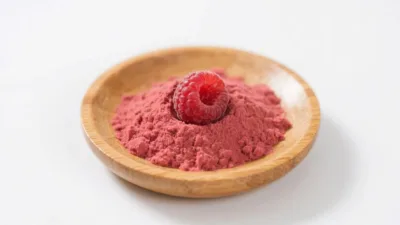
Raspberry Powder
Rich in anthocyanins (delphinidin, cyanidin, pelargonidin glycosides), ellagitannins (including ellagic acid), vitamin C, and…


