
Table of Contents
Navigating the world of fruit powders means dodging diluted extracts and pesticide residue traps. The modern supplement aisle is crowded with products that look vivid and healthy on the shelf yet fall apart under scrutiny, and raspberry-based powders are among the most frequently misrepresented categories. Let’s decode how to spot premium organic raspberry powder vs. juice powder — because not all red powders are created equal. Whole-fruit powder and juice powder are processed from the same botanical but deliver markedly different nutrition, texture, and chemistry, and understanding those differences is the single most valuable skill a buyer can develop. In the sections below we break down the red flags that signal a cut or adulterated product, compare the two forms side by side, walk through the lab data that proves authenticity, and explain exactly which format earns its place in your kitchen, lab, or production line.
Cutting Through Marketing Haze: 3 Red Flags
“Freeze-Dried” ≠ Organic
- Non-organic raspberries rank #4 on EWG’s Dirty Dozen™ (pesticide load), which means conventionally grown berries carry some of the heaviest fungicide and insecticide residues of any common fruit; a “freeze-dried” label only describes the drying method and says nothing about how the berry was farmed, so a product can be gently preserved yet still loaded with synthetic agrochemicals that survive the drying process and end up in your smoothie.
- Must-have certifications: USDA Organic + EU Bio SealFake Color Alerts — legitimate certification marks are your first line of defense, because audited supply chains require residue testing and traceable farms; when a brand shows only a decorative leaf logo instead of a verifiable USDA Organic seal and an EU Bio Seal, treat the claim as marketing rather than proof, and remember that a genuine organic raspberry powder should owe its color to anthocyanins rather than to added pigment.
- Beet powder or artificial dyes often bulk low-grade products, a trick that lets a seller stretch a small amount of real raspberry across a much larger batch while keeping a cheerful red hue; beetroot powder is cheap, stable, and easy to blend in, but it shifts the flavor profile, dilutes the antioxidant value, and quietly converts a premium superfood into a colored starch filler that delivers none of the benefits you are paying for.
- Test: Mix 1 tsp in vinegar → true raspberry powder turns bright pink (anthocyanins react to acid)“Juice Powder” Scams — this kitchen experiment exploits the pH sensitivity of natural pigments, so a genuine sample will visibly shift color as the acid hits, whereas a dyed or adulterated sample stays the same flat red; the same logic exposes juice powder scams, where a label boasting “raspberry juice powder” may actually be built on a cheaper base with only a splash of real juice for flavor.
- Cheap brands use apple/pear fillers → check ingredient list for “100% raspberry juice” — bulking agents like apple or pear concentrate are inexpensive, mildly sweet, and nearly invisible once dried, which is why the only reliable safeguard is the ingredients panel itself; if you do not see the words “100% raspberry juice” or “100% organic raspberry” with no second fruit listed, you are almost certainly holding a blend rather than a pure product.
Powder vs. Juice Powder: Battle of the Benefits
| Metric | Organic Raspberry Powder | Organic Raspberry Juice Powder |
|---|---|---|
| Source Material | Whole freeze-dried berries (seeds + fiber) | Cold-pressed juice only |
| Fiber Content | 8g/serving (removes constipation) | 0g (ideal for liquid diets) |
| Antioxidant Density | 25mg anthocyanins/g | 50mg anthocyanins/g (2x concentrated) |
| Best Texture | Grainy → perfect for baking | Silky → dissolves instantly |
| Cost Efficiency | $0.40/gram | $0.75/gram (requires less per use) |
Authenticity Test: Real raspberry juice powder leaves zero grit when stirred in cold water, because the solids have been pressed out and the remaining juice solids are fine enough to stay suspended; if you detect sandy particles or a chalky film at the bottom of the glass, the product likely contains whole-fruit grind or filler rather than true juice powder, and that texture difference is one of the fastest field checks a buyer can perform before committing to a bulk purchase.
Lab Report Must-Checks
Insist on third-party certificates verifying:
- Anthocyanin Potency → Min. 20mg/g for powder, 45mg/g for juice powder — these pigments are the primary reason buyers choose raspberry in the first place, so a certificate of analysis that reports the actual anthocyanin concentration tells you whether the product was made from ripe, pigment-rich fruit and processed gently enough to preserve those compounds through drying and milling.
- Heavy Metals → Lead <0.1ppm, Cadmium <0.05ppm — berries can accumulate trace metals from soil and water, and because powders concentrate many berries into a small serving, a low per-berry load can still become meaningful in the finished ingredient, which is why responsible suppliers publish heavy-metal screens and keep results well inside the strict thresholds that protect daily consumers.
- Solvent Residues → Hexane/ethanol ND (non-detect) — mechanical and aqueous processing should not require hydrocarbon solvents, so any detectable hexane or ethanol residue points to a shortcut extraction method that has no place in a clean-label organic ingredient; “ND” on the report is the result you want to see printed in black and white.
- Microbiology → Total yeast/mold <10 CFU/g — low microbial counts confirm that the facility controls humidity and sanitation during drying and packing, because a powder that sits at higher mold levels risks off-flavors, shortened shelf life, and spoilage once it reaches a warm kitchen, making this single number a surprisingly good proxy for overall manufacturing discipline.
Hot Tip: Brands hiding full lab reports often sell diluted products, because a transparent supplier has nothing to lose by publishing its certificate of analysis and every reason to showcase strong numbers; when a vendor answers a request for third-party testing with vague assurances or a locked PDF, that reluctance is itself a data point, and experienced formulators treat missing paperwork as a confirmation of weaker quality rather than a neutral absence.
Form-Specific Selection Criteria
For Powder: Prioritize Seed Integrity
- Cheap grinders overheat → destroy nutrients + create bitter aftertaste, because the frictional heat generated by underpowered milling equipment pushes the berry past its thermal comfort zone, oxidizing delicate oils and scorching the seed fraction until the finished powder tastes burnt instead of bright; this is why the same berry can emerge as a culinary asset or a waste product depending entirely on the machine that ground it.
- Look for: Cryogenic milling (-40°C) → preserves ellagic acid — freezing the berry with liquid nitrogen before grinding keeps the cell walls from generating heat, so heat-labile compounds such as ellagic acid survive intact and the powder retains both its nutritional story and its clean flavor, making cryogenic processing one of the clearest signals that a supplier invested in quality rather than speed.
For Juice Powder: Verify Drying Method
- Spray-dried: Loses 70% aroma → tastes flat, since the high inlet temperatures used to flash off water volatilize the very aromatic molecules that make raspberry smell like raspberry, leaving a one-dimensional sweet-tart note that professional tasters immediately recognize as processed and dull compared with a gently dried counterpart.
- Premium choice: Refractance Window™ drying → locks in fresh flavor — this low-temperature method draws moisture out through a flexible membrane using warm air just above ambient, protecting volatiles so the reconstituted juice smells and tastes remarkably close to the fresh berry, which is why it commands a premium and why discerning brands specify it by name on their specification sheets.
Packaging Dealbreakers
- Oxygen absorbers in opaque jars → prevents oxidation (powder turns brown when degraded), because anthocyanins and oils are vulnerable to the slow attack of atmospheric oxygen, and a sachet of iron powder inside an opaque vessel buys months of stability that a clear screw-top simply cannot offer; browned powder is the visible fingerprint of a product that was either poorly packed or improperly stored.
- Juice powder in nitrogen-flushed bags → blocks moisture clumping, since the fine juice solids are hygroscopic and will cake into a brick the moment humid air reaches them, so displacing the headspace with inert nitrogen keeps the granules free-flowing and protects them from the microbial growth that moisture invites, extending both usability and shelf life.
Purpose-Driven Picks
| Your Goal | Best Form | Key Feature to Seek |
|---|---|---|
| Baking muffins/energy balls | Powder | Fiber-rich (absorbs moisture) |
| Clear sports drinks | Juice Powder | No pulp/sediment → smooth hydration |
| DIY vitamin C serum | Juice Powder | High acidity (pH 2.8-3.2) → exfoliates |
| Gut health boost | Powder | Prebiotic fiber feeds good bacteria |
| Keto jam-making | Either | Juice powder sets faster → no pectin needed |
Top Brand Red Flags vs. Green Flags
| Suspicious Signs | Quality Indicators |
|---|---|
| Vague “natural flavors” | Single ingredient: organic raspberry |
| Bright pink color | Deep magenta with burgundy specks |
| Clumps in bag | Flows like fine sand |
| Cheap plastic packaging | Glass/Mylar with oxygen barrier |
| Sold in clear containers | UV-blocking opaque vessels |
Pro Application Hacks
Powder Power Moves
- Sourdough Secret: Replace 15% flour → natural dough conditioner, because the berry fiber binds water and the mild acidity gently supports wild yeast activity, producing a more tender crumb and a subtle pink tint that reads as artisanal; bakers report improved oven spring and a longer-lasting loaf when the powder is folded in during the autolyse rather than dumped in at the end.
- Meat Rub Upgrade: Mix with cocoa + coffee → deepens flavor crust, since the fruit acids tenderize the surface while the cocoa and coffee build a bittersweet backdrop that makes the raspberry notes pop against roasted meats; the combination browns beautifully under high heat and leaves a glossy, complex crust that home cooks mistake for a restaurant technique.
Juice Powder Genius
- Cocktail Trick: 1 tsp = flavor equivalent of ½ cup fresh berries, which means a bar can deliver consistent intensity year-round without worrying about seasonal variability, spoilage, or the seeds that clog a fine strainer; the powder dissolves cleanly in both alcoholic and zero-proof builds, making it a favorite for batch prep and bottled cocktails that need a stable red hue.
- Skincare Blend: Add to clay mask → brightens hyperpigmentation, because the natural acids and antioxidants complement the drawing action of the clay, and the low grit of juice powder makes it safe to leave on delicate skin for a short treatment; users report a more even tone after regular use, though anyone with sensitive skin should patch-test first given the ingredient’s acidity.
Chef’s Note: “Juice powder outperforms vanilla in white chocolate—just ¼ tsp creates a raspberry ripple effect.” The concentrated, sediment-free nature of a true juice powder means it tints and flavors fat-based mediums without seizing or speckling them, so pastry teams can achieve a clean raspberry swirl in ganache, confectionery coatings, and frozen desserts where whole powder would leave an unappealing grainy texture and a darker, muddier color.
The Final Sift
Choosing elite organic raspberry products boils down to:
- Transparency (demand full lab reports) — a supplier that publishes anthocyanin potency, heavy-metal screens, solvent residue results, and microbiology counts is telling you they have nothing to hide, and those four documents together answer nearly every quality question a buyer can ask.
- Purpose alignment (fiber needs = powder; potency = juice powder) — match the format to the job, because reaching for whole powder in a clear beverage wastes its fiber advantage and reaching for juice powder in a high-fiber bake loses the structure you needed, and the right pick makes the recipe work the first time.
- Processing integrity (avoid high-heat methods) — cryogenic milling for powder and Refractance Window™ or similar low-temperature drying for juice powder protect the compounds you are actually buying, so the processing line on the spec sheet matters as much as the farm it started from.
When in doubt, taste-test: Premium powder should explode with tart-sweet complexity — not cardboard bitterness. Your recipes (and gut microbiome) will taste the difference, because a well-made whole-fruit powder carries the seeds, skin, and aromatic volatiles that define real raspberry, while a diluted or heat-damaged product flattens into sweetness with none of the layered finish that signals genuine fruit. The small premium you pay for verified organic material is, in practice, the cost of buying the compound you came for rather than its imitation.
Sources: Journal of Food Science (anthocyanin stability), OMRI Certification Standards
Storage Tip: Freeze juice powder 6+ months; powder lasts 1 year in cool darkness. Juice powder’s concentrated sugars and fine particle size make it especially prone to caking and flavor loss once exposed to warmth or humidity, so a sealed bag in the freezer is the most reliable home method, while whole powder’s fiber buffers it slightly and tolerates a cool pantry shelf for up to a year as long as the container stays opaque, airtight, and away from the stove.
Recommended Products
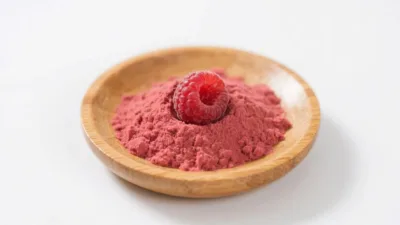
Raspberry Powder
Rich in anthocyanins (delphinidin, cyanidin, pelargonidin glycosides), ellagitannins (including ellagic acid), vitamin C, and…


