
Table of Contents
Food and beverage manufacturers operating in the low-sugar and functional nutrition segments face a consistent pressure: consumers demand cleaner labels and proven health benefits, while formulators need ingredients that perform reliably at scale. Prebiotic fibers have moved from niche supplement territory into mainstream dairy, bakery, and ready-to-drink categories, but not all fibers behave the same way under processing conditions or deliver comparable consumer appeal. Fructooligosaccharides (FOS), particularly in certified organic forms, have attracted serious attention from R&D teams because they sit at a useful intersection—mild sweetness, confirmed prebiotic activity, and compatibility with a broad range of manufacturing processes. This guide covers the technical detail that procurement specialists, formulation scientists, and product managers need to specify organic FOS powder or syrup confidently.
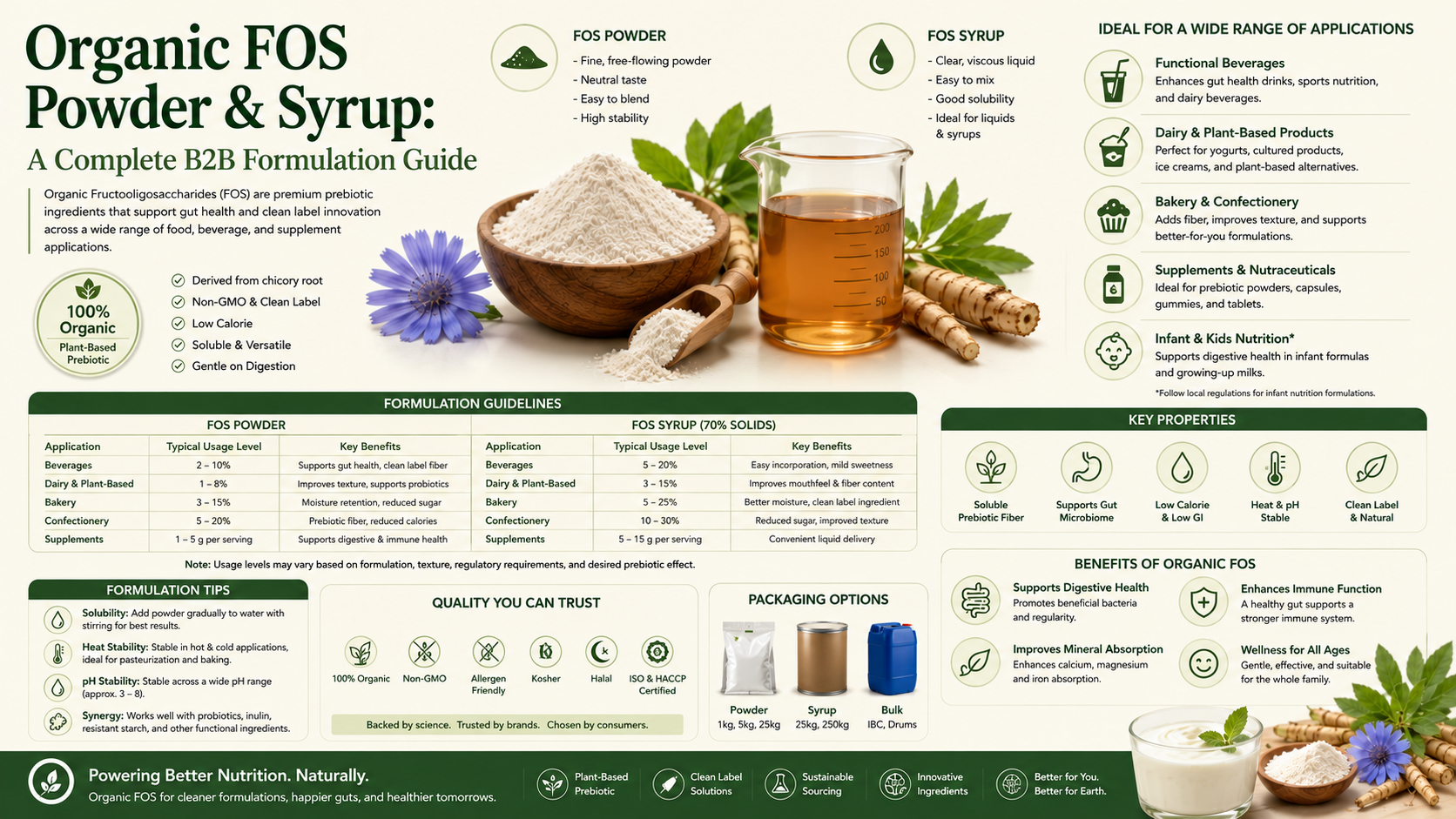
What Is Organic FOS? Forms and Manufacturing
Fructooligosaccharides are short-chain carbohydrates composed of fructose units linked to a terminal glucose. The degree of polymerization (DP) in commercial FOS ranges from DP2 to DP4, meaning chains of two to four monosaccharide units. This relatively short chain length distinguishes FOS from long-chain inulin and determines its solubility, sweetness profile, and fermentation rate in the colon.
Plant Sources
Organic FOS is derived primarily from three plant sources:
- Chicory root (Cichorium intybus): The dominant commercial source, particularly for European-supply chains. Chicory root inulin is enzymatically hydrolyzed to produce standardized short-chain FOS fractions.
- Sugarcane (Saccharum officinarum): Sucrose extracted from sugarcane is enzymatically converted to FOS using fructosyltransferase enzymes, yielding 1-kestose, nystose, and fructosylnystose as principal components.
- Jerusalem artichoke (Helianthus tuberosus): Naturally high in inulin-type fructans; used in some specialty FOS formulations where a whole-food narrative supports label strategy.
Manufacturing Pathways
Two production routes are used commercially. The enzymatic synthesis route starts with concentrated sucrose solution and applies microbial fructosyltransferases to build short-chain FOS directly. This pathway yields a product with a defined DP2–DP4 distribution and residual sucrose content typically below 5%. The extraction and hydrolysis route begins with chicory or Jerusalem artichoke inulin, applies controlled enzymatic or mild acid hydrolysis, and separates the resulting short-chain fractions by membrane filtration and chromatographic purification.
Organic certification requires that the starting raw material—chicory root or sugarcane—is grown under certified organic management and that no prohibited processing aids are used at any production stage. Third-party audits cover both the agricultural supply chain and the processing facility.
Commercial Forms
- Organic FOS powder: Spray-dried to moisture content ≤5%, bulk density typically 0.45–0.65 g/cm³, water activity ≤0.3. Suitable for dry blending, tablet compression, and powdered beverage bases.
- Organic FOS syrup: Solids content 75–78 Brix, viscosity 3,000–8,000 cP at 25°C depending on DP profile. Preferred for liquid applications where dissolving dry powder introduces processing steps.
Organic FOS vs. Other Prebiotic Fibers: A Technical Comparison
Selecting a prebiotic fiber requires matching functional attributes to the specific product matrix and target consumer claim. The four most commonly specified options in B2B formulation are FOS, inulin, galactooligosaccharides (GOS), and resistant dextrin. The table below summarizes key technical parameters.
| Parameter | Organic FOS (DP2–4) | Inulin (DP10–60) | GOS (DP2–8) | Resistant Dextrin |
|---|---|---|---|---|
| Chain length | Short (DP2–4) | Long (DP10–60) | Short-medium (DP2–8) | Branched, DP3–30 |
| Sweetness contribution | 30–50% of sucrose | ~10% of sucrose | 30–40% of sucrose | Negligible |
| Solubility (25°C) | >80 g/100 mL | 10–15 g/100 mL (native); higher for HP | >80 g/100 mL | >70 g/100 mL |
| Fermentation rate | Rapid (proximal colon) | Moderate–slow (distal colon) | Moderate | Slow–moderate |
| Digestive tolerance threshold | ~10–15 g/day before GI discomfort | ~10–15 g/day | ~15–20 g/day | ~25–30 g/day |
| Texture contribution | Low viscosity | Gelling at >3% in gels | Low viscosity | Very low viscosity |
| Thermal stability | Stable ≤130°C at neutral pH | Stable ≤130°C; degrades under acid/heat | Stable under mild conditions | Highly stable, pH 3–9, ≤180°C |
| Primary origin | Chicory, sugarcane | Chicory root | Lactose (dairy) | Corn or tapioca starch |
| Organic certified availability | Yes, commercial scale | Yes, commercial scale | Limited | Limited |
| Allergen considerations | None declared | None declared | Dairy-derived; may require declaration | None declared |
FOS vs. Inulin: FOS and inulin share the same fructan backbone but differ critically in chain length. Long-chain inulin creates gel-like texture at concentrations above 3–4% in aqueous systems, making it useful as a fat replacer in dairy and spreads. FOS contributes no appreciable texture effect at equivalent doses, which is an advantage in clear beverages and thin-bodied products where viscosity is undesirable. Inulin also ferments more slowly, which can reduce bloating risk when consumed at higher doses, but its practically zero sweetness means it contributes nothing to sugar reduction claims.
FOS vs. GOS: GOS is synthesized from lactose and is therefore dairy-derived, a significant labeling concern for plant-based products and consumers avoiding dairy. FOS carries no allergen burden. Both deliver similar prebiotic bifidogenic effects in clinical literature, but FOS has more extensive clinical documentation in adult populations while GOS has strong evidence in infant nutrition.
FOS vs. Resistant Dextrin: Resistant dextrin (Fibersol-type) is enzymatically modified starch with exceptional process stability—it tolerates acidic retort conditions and high-temperature extrusion better than FOS. For products processed at pH below 4 and above 130°C for extended times, resistant dextrin is the more stable choice. FOS performs well within typical bakery and UHT dairy process windows but should be evaluated at extremes.
How Organic FOS Improves Taste and Texture in Low-Sugar Applications
At 30–50% of sucrose sweetness, organic FOS contributes perceptible sweetness at meaningful use levels without the glycemic load of sucrose or the off-notes associated with high-intensity sweeteners. In formulations targeting 25–40% sugar reduction, FOS can replace a portion of sucrose and provide a sweetness base that makes stevia or monk fruit more tolerable by moderating their characteristic aftertaste.
Moisture Retention
FOS is hygroscopic and moderately humectant. In soft-baked goods—cookies, muffins, nutrition bars—FOS at 4–8% inclusion extends shelf-life moisture retention compared to equivalent sucrose replacement with most bulk sweeteners. Water activity in finished products with FOS inclusion tends to run 0.02–0.04 aw lower than the sucrose control at identical moisture content, which reduces microbial growth risk without requiring additional preservatives.
Dough and Batter Behavior
In yeast-leavened systems, FOS passes through fermentation largely intact. Sucrose, by contrast, provides fermentable substrate to yeast; replacing 20–30% of sucrose with FOS slightly reduces CO₂ production and can extend proof time by 10–15%. Formulators should account for this during process optimization. In chemical leavening systems (baking powder/baking soda), FOS has no direct effect on leavening chemistry.
Mouthfeel and Body
In beverage applications, FOS at 2–5% adds perceptible body without contributing viscosity on the order of hydrocolloids or high-DP inulin. This body improvement is particularly valued in reduced-sugar ready-to-drink teas and sports drinks where sucrose removal leaves a thin, watery texture.
Formulation Applications by Product Category
Bakery and Snack Bars
FOS integrates well into baked goods processed at standard oven temperatures (160–220°C). Short bake times limit FOS degradation to less than 5% loss at 180°C for 20 minutes. Recommended inclusion: 3–8% on dry weight basis. At these levels, FOS contributes 1.5–4 g prebiotic fiber per 40 g serving, sufficient for some regulatory fiber content claims depending on jurisdiction.
Ready-to-Drink Beverages
FOS powder dissolves completely in cold water (<25°C) within 2–3 minutes with moderate agitation. In UHT-processed dairy beverages (135–145°C, 4–15 seconds), FOS shows less than 8% degradation under standard indirect heating conditions. Recommended inclusion: 2–5% w/w. In acidic beverages (pH 3.5–4.2), hydrolysis rate increases at elevated temperatures; pilot-scale stability testing is advisable for hot-fill acidic products.
Dairy and Fermented Products
In yogurt and kefir, FOS at 1.5–3% w/w provides a mild sweetness boost and serves as additional substrate for lactic acid bacteria, which can improve texture in reduced-fat formulations. In ice cream, FOS at 3–6% contributes to depression of freezing point (approximately −0.3°C per 1% FOS vs. −0.6°C per 1% sucrose), supporting a softer scoop from the freezer at −18°C.
Nutrition and Sports Bars
In compressed or enrobed bar formats, FOS syrup (75–78 Brix) functions as a binder and humectant. Typical inclusion at 8–15% of formula by weight. FOS syrup’s lower hygroscopicity compared to sorbitol or maltitol syrups reduces the risk of surface stickiness in ambient-temperature distribution. For bars targeting fiber claims, verify that FOS contribution meets the applicable regulatory definition of dietary fiber in your target market.
Pet Food and Treats
Organic FOS is used in premium pet food applications as a prebiotic to support companion animal digestive health. Typical inclusion in dry kibble: 0.5–1.5% w/w. FOS tolerance data in dogs supports doses up to approximately 1 g/kg body weight/day without significant gastrointestinal side effects. Extruded pet treats at 140–160°C for 30–60 seconds retain the majority of FOS activity.
Powder vs. Syrup: Which Form Should You Specify?
| Attribute | Organic FOS Powder | Organic FOS Syrup |
|---|---|---|
| Dry matter content | 95–98% | 75–78 Brix |
| Typical packaging | 25 kg paper/poly bags | 275 kg IBCs, 1,250 kg IBCs |
| Shelf life | 24 months at <25°C, <60% RH | 18 months at <25°C |
| Thermal stability | Stable to 130°C (short-term) | Stable to 130°C (short-term) |
| Cold-water solubility | >80 g/100 mL; dissolves in 2–3 min | Fully miscible |
| Viscosity at 25°C | N/A (dry) | 3,000–8,000 cP |
| Application fit | Dry blends, tablets, powdered beverages, bakery | Liquid nutrition, bars, dairy, confectionery |
| Handling considerations | Dust management; hygroscopic—seal after opening | Heated transfer lines recommended in cold climates |
| Cost per kg (relative) | Higher per kg | Lower per kg (lower processing cost) |
| Organic certification | Available | Available |
For production facilities already set up for liquid ingredient handling, syrup typically lowers per-unit ingredient cost due to reduced drying energy in manufacturing. Powder is preferred when the downstream process requires precise dry weight control or when storage conditions cannot maintain syrup temperature above crystallization risk (approximately 15°C for high-solids FOS syrups).
Regulatory and Label Considerations
GRAS Status
FOS has been affirmed as Generally Recognized As Safe (GRAS) in the United States for use in conventional foods. Multiple GRAS notifications have been filed with FDA covering scFOS (short-chain FOS) at various use levels. Formulators should review the specific GRAS notice applicable to their intended use levels and food categories when preparing regulatory dossiers.
Organic Certification
Organic FOS must be produced from certified organic raw materials under USDA NOP, EU Organic Regulation (EC) 834/2007 and successor regulations, or equivalent national standards. Certificates should specify both the agricultural origin and the processing facility. Buyers should request current organic transaction certificates with each shipment, not just annual scope certificates.
Clean Label and Dietary Fiber Claims
In the United States, short-chain FOS (scFOS) is listed as a dietary fiber on the Nutrition Facts label under FDA’s definition following the 2016 rulemaking, provided the ingredient meets the regulatory definition of a non-digestible carbohydrate with a physiological benefit. In the EU, FOS used as an ingredient is labeled under its common name “fructooligosaccharides” or “oligofructose”; fiber content contributions follow Regulation (EU) No 1169/2011 definitions.
For organic certification on finished products, FOS must be sourced from certified organic suppliers and listed appropriately in organic system plans. Non-organic FOS is not permitted as an ingredient in USDA Certified Organic products unless it appears on the National List of Allowed and Prohibited Substances—formulators should verify current regulatory status before substituting sources.
THC and Allergen Status
Organic FOS derived from chicory root or sugarcane contains no cannabinoids; THC content is not a relevant concern. FOS is not derived from any of the major allergens regulated under FDA’s food allergen labeling requirements or EU Annex II. GOS-based alternatives, by contrast, require evaluation for dairy allergen carry-through depending on processing conditions.
Sourcing and Quality Criteria

Selecting an organic FOS supplier requires more than reviewing a specification sheet. The following criteria are practical checkpoints for procurement and quality assurance teams:
Certifications to Request
- USDA NOP Organic Certificate (or EU Organic equivalent) — current scope certificate plus transaction certificates per shipment
- Kosher and Halal certification if required by finished product specification
- ISO 22000 or FSSC 22000 food safety management system certification
- Non-GMO Project Verified or equivalent third-party non-GMO verification
Certificate of Analysis (COA) Parameters
A complete COA for organic FOS should include: assay (FOS content by HPLC, minimum 95% on dry matter for pure FOS grades), moisture content, ash content, heavy metals (lead, arsenic, cadmium, mercury per applicable limits), microbial testing (TPC, yeast and mold, Salmonella, E. coli), residual sucrose content, and pH of 10% solution. For organic-certified product, the COA should cross-reference the applicable organic certificate number.
Supply Chain Transparency
Request traceability documentation from raw material origin through to finished ingredient. Chicory root supply chains in Belgium and the Netherlands are well-documented; less familiar origins may require additional supplier audit steps. For sugarcane-derived FOS, verify that the cane source is not commingled with conventional material during harvest or early-stage processing.
Practical Procurement Considerations
Minimum order quantities for organic FOS powder from commercial suppliers typically range from 500 kg to 2 MT for powder and 1–5 MT for syrup. Standard lead times from European and North American distributors run 4–8 weeks for stocked items; direct mill orders may extend to 10–14 weeks. Request advance notice of any planned formula or source changes, which should trigger re-qualification under most quality management systems.
Working with ORGANICWAY
ORGANICWAY supplies certified organic FOS powder and syrup to food and beverage manufacturers across North America, Europe, and Asia-Pacific. Technical data sheets, sample requests, and COA documentation are available for qualification purposes.
For formulation support or sourcing inquiries, contact the technical sales team directly at info@organic-way.com.
Formulators evaluating FOS for gut health positioning can reference the health benefits of organic FOS syrup as a natural prebiotic for supporting clinical and consumer communication material. For a broader overview of FOS positioning within the clean-label nutrition trend, see organic fructooligosaccharides and the next frontier in clean-label nutrition.
Product specifications, pricing tiers by volume, and current organic certification documentation are available through the ORGANICWAY product portal. Sampling lead time is typically 5–10 business days for standard powder and syrup grades.