Table of Contents
What is organic phycocyanin powder?
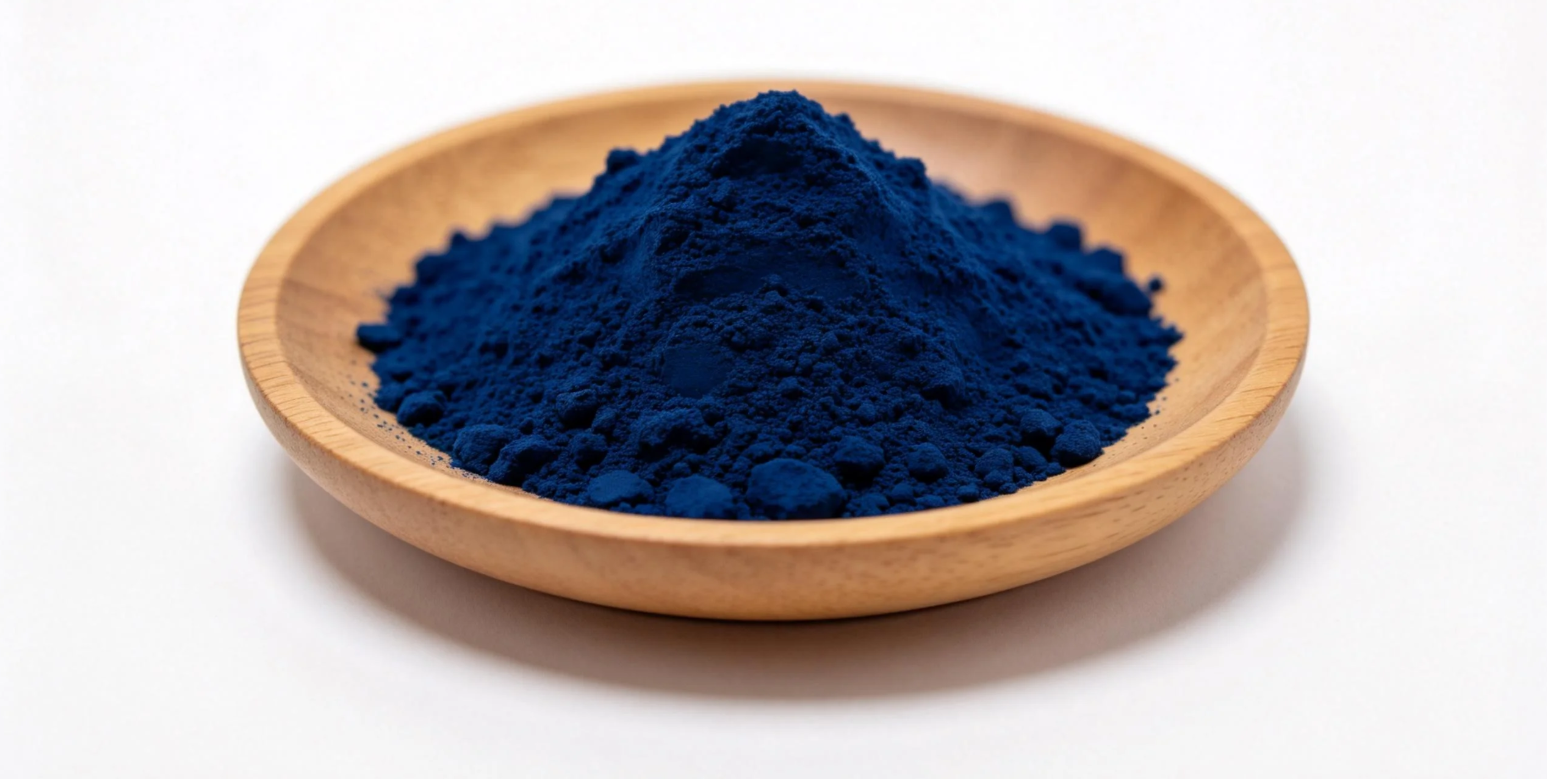
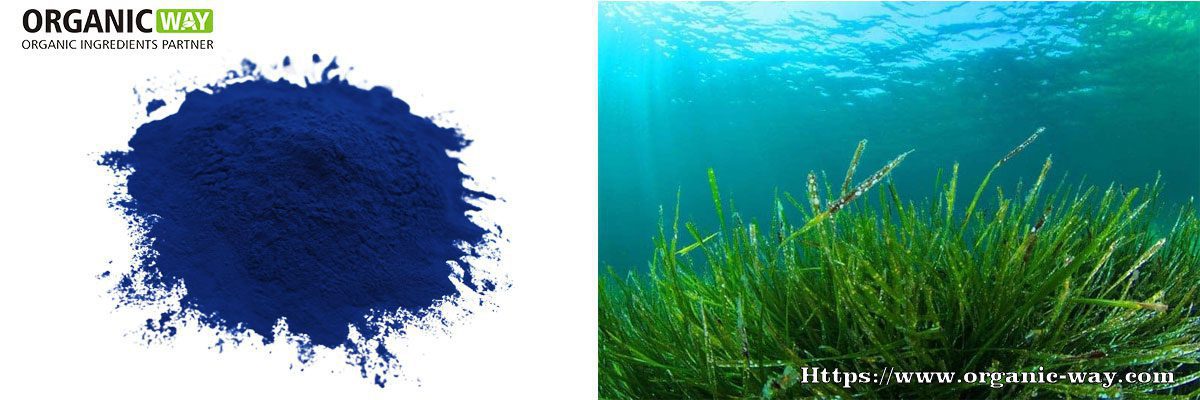
Organic phycocyanin is a blue phycobiliprotein pigment complex — the primary blue colorant in Spirulina platensis (blue-green algae). It consists of α and β subunits covalently bound to a linear tetrapyrrole chromophore called phycocyanobilin, which absorbs light at λmax 620 nm and emits bright blue fluorescence at λem 650 nm. This gives phycocyanin its vivid blue color and unique bioactive properties unmatched by any synthetic alternative.
Organic Way’s phycocyanin is extracted using a proprietary water-based process — no ethanol, hexane, or other synthetic solvents. The extract is then concentrated and spray-dried to produce a free-flowing blue powder.
Four Concentration Grades for Every Application:
- Food Standard (≥20%, E620 ≥200): Cost-effective grade for beverages, confectionery, RTD drinks, and ice cream. Purity ratio A620/A280 ≥3.5.
- High-Purity Food (≥35%, E620 ≥350): Premium grade for tablets, capsules, and high-end supplements. Superior color yield per gram.
- Cosmetic Grade (≥15%, E620 ≥150): Stricter microbial limits (TPC <100 CFU/g) and lower heavy metal thresholds per ICP-MS. Suitable for face masks, serums, and haircare.
- Research/Pharma Grade (≥50%, E620 ≥500): Highest purity for clinical research, fluorescence studies (λex 620nm / λem 650nm), and advanced nutraceutical formulations.
Why Phycocyanin is the Premium Clean-Label Blue:
- ORAC ≥30,000 µmol TE/g — antioxidant capacity 10× higher than most common plant extracts
- Natural anti-inflammatory activity — C-phycocyanin inhibits COX-2 and TNF-α pathways (peer-reviewed literature)
- pH stability range: 4.0–8.0 — stable across most beverage and food matrices
- Fluorescence properties —The only naturally occurring blue fluorescent pigment, used for biological labeling and scientific research.
- Dual-functionality: simultaneously a colorant AND a bioactive ingredient — a claim no synthetic blue can make
Critical Compliance Note — Cyanotoxin and Heavy Metal Testing:
Spirulina platensis is a cyanobacterium capable of bioaccumulating heavy metals from its cultivation medium and producing hepatotoxic microcystins under stress conditions. Organic Way’s phycocyanin uses controlled, single-species closed cultivation systems to prevent contamination. Every batch is tested by ICP-MS for Pb, As, Cd, Hg (below Prop 65 / EFSA thresholds) and by ELISA + HPLC for microcystin-LR (<1 µg/g food grade; <0.5 µg/g cosmetic grade). COA with full testing data available on request.
For EU market entry: verify Novel Food status per EFSA Regulation 2015/2283. For US market: GRAS self-affirmed dossier or FDA GRAS No Objection Letter available on request.
Production & Quality Assurance:
- Certified organic Spirulina platensis sourcing (USDA NOP / EU 834/2007)
- Incoming testing: microcystin screen (ELISA), heavy metals (ICP-MS), moisture
- Water-based extraction at controlled temperature (≤40°C) — no solvents used
- Membrane filtration → spray drying
- Lot-specific COA: phycocyanin content, E620 value, purity ratio, moisture, heavy metals, microbiology, microcystins
- Third-party verification (SGS / Eurofins) available on request
Technical Specifications
Four-Grade Comparison
| Parameter | Food Standard | High-Purity Food | Cosmetic | Research/Pharma | Test Method |
|---|---|---|---|---|---|
| Phycocyanin Content | ≥20% | ≥35% | ≥15% | ≥50% | A620/A652 ratio |
| Color Value (E620) | ≥200 | ≥350 | ≥150 | ≥500 | EU/FAO color value |
| Purity Ratio (A620/A280) | ≥3.5 | ≥4.0 | ≥3.0 | ≥5.0 | UV-Vis spectrophotometry |
| Solubility | ≥95% cold/hot water | ≥97% cold/hot water | ≥98% water/glycerin | ≥99% water | USP <467> |
| pH Stability Range | 4.0–8.0 (blue) | 4.0–8.0 (vivid blue) | 3.5–9.0 (blue-green) | 3.5–8.5 | Buffer titration |
| Moisture | ≤6.0% | ≤5.0% | ≤5.0% | ≤4.0% | Karl Fischer |
| Ash | ≤8.0% | ≤6.0% | ≤6.0% | ≤4.0% | AOAC 942.05 |
| Lead (Pb) | <0.1 ppm | <0.1 ppm | <0.05 ppm | <0.05 ppm | ICP-MS |
| Arsenic (As, total) | <0.1 ppm | <0.1 ppm | <0.05 ppm | <0.05 ppm | ICP-MS |
| Cadmium (Cd) | <0.1 ppm | <0.1 ppm | <0.05 ppm | <0.05 ppm | ICP-MS |
| Mercury (Hg) | <0.05 ppm | <0.05 ppm | <0.02 ppm | <0.02 ppm | ICP-MS |
| Microcystin-LR | <1 µg/g | <1 µg/g | <0.5 µg/g | <0.5 µg/g | ELISA + HPLC |
| ORAC Value | ≥30,000 µmol TE/g | ≥40,000 µmol TE/g | N/A | ≥50,000 µmol TE/g | ORAC assay |
| Color Appearance | Blue powder | Deep blue powder | Blue-green powder | Brilliant blue powder | Visual |
| Particle Size | 80–200 mesh | 100–200 mesh | 100–200 mesh | 100–200 mesh | Sieve |
| Typical Application | Beverages, confectionery | Supplements, tablets | Cosmetics, skincare | Research, clinical | — |
Microbiological Specifications
| Parameter | Food Grade (Standard / High-Purity) | Cosmetic Grade | Test Method |
|---|---|---|---|
| Total Plate Count (TPC) | ≤1,000 CFU/g / ≤500 CFU/g | ≤100 CFU/g | ISO 4833 |
| Yeast & Mold | ≤100 CFU/g | ≤50 CFU/g | ISO 21527 |
| Coliform | ≤10 CFU/g | Negative/g | ISO 4832 |
| E. coli | Negative/1g | Negative/1g | ISO 16654 |
| Salmonella | Negative/25g | Negative/25g | ISO 6579 |
| Staphylococcus aureus | Negative/1g | Negative/1g | ISO 6888 |
Heavy Metals, Contaminants & Cyanotoxin Compliance
| Parameter | Specification | Regulatory Standard |
|---|---|---|
| Lead (Pb) | <0.1 ppm (food) / <0.05 ppm (cosmetic) | Prop 65 / EFSA / Codex |
| Arsenic (As, total) | <0.1 ppm (food) / <0.05 ppm (cosmetic) | Prop 65 |
| Cadmium (Cd) | <0.1 ppm | EU Regulation 2023/915 |
| Mercury (Hg) | <0.05 ppm | Prop 65 |
| Microcystin-LR | <1 µg/g (food) / <0.5 µg/g (cosmetic) | WHO guideline / EFSA |
| Residual Solvents | ND (water extraction only) | ICH Q3C / GC-MS |
| Pesticide Residues | ND (per EC 396/2005) | GC-MS/MS |
Certifications
| Certification | Issuing Body | Scope |
|---|---|---|
| USDA Organic | USDA NOP (via accredited certifier) | Production + processing |
| EU Organic | EU Reg. (EC) No 834/2007 | Import + sale in EU |
| JAS Organic | Japanese Agricultural Standards | Japan market |
| Non-GMO Project Verified | Non-GMO Project | Raw material + finished product |
| Kosher | OU / Star-K (lot-specific) | Processing facility |
| Halal | MUI / IFRC (lot-specific) | Processing facility |
| Vegan / Vegan Action | Vegan Society | 100% plant-based |
| Gluten-Free | GFCO | Verified gluten-free |
| GRAS | Self-affirmed / FDA notification | US food use — confirm status on inquiry |
⚠️ EU Novel Food Note: Under EFSA Regulation 2015/2283, phycocyanin as a Spirulina extract may require Novel Food authorization for commercial sale in the EU. Verify current authorization status before EU market entry.
Applications & Formulation Guidance
| Application | Recommended Grade | Typical Addition | Notes |
|---|---|---|---|
| Functional Beverages / RTD | Food Standard (≥20%) | 0.5–2.0% | Blue label appeal; pH 4.0–7.0 optimal |
| Protein Shakes / Sports Nutrition | Food Standard or High-Purity | 1.0–3.0% | Clean-label natural blue; no FD&C artificial dye |
| Ice Cream / Frozen Desserts | Food Standard | 0.3–1.0% | Blue swirl/ripple effect |
| Confectionery (gummies, marshmallows) | High-Purity Food | 0.5–1.5% | Natural blue alternative to FD&C Blue No.1 |
| Pasta / Noodles / Colored Grains | Food Standard | 0.5–1.0% | Blue-purple spiral pasta |
| Tablet / Capsule Coating | High-Purity Food | 1.0–3.0% | Premium natural appearance |
| Face Masks / Skincare | Cosmetic Grade | 0.5–2.0% | Anti-inflammatory, soothing |
| Haircare (shampoo, conditioner) | Cosmetic Grade | 0.2–1.0% | Blue-tinged natural ingredient claim |
| Pet Treats / Premium Pet Food | Food Standard | 0.5–2.0% | Human-grade natural colorant for premium pet brands |
| Fluorescence Research / Biotech | Research/Pharma Grade | Per protocol | λex 620nm / λem 650nm |
| Sauces & Dressings | Food Standard | 0.3–0.8% | Blue condiment (mix with yellow = green) |
Stability Notes:
- pH: Optimal blue color at pH 4.0–8.0. Below pH 3.5: turns greenish-blue. Above pH 9.5: degrades to yellow-green.
- Temperature: Pasteurization (72°C, 15s) retains ~85% activity. UHT (>130°C) degrades 40–50%. For hot-fill beverages, consider post-addition or microencapsulation.
- Light: Direct sunlight degrades ~30% in 2 hours. Use opaque or amber packaging.
- Freeze-thaw: Stable through 5 cycles — suitable for frozen applications.
- Preservatives: Vitamin C and citric acid enhance retention in acidic systems.
FAQs
Q1: What is phycocyanin, and how is it related to Spirulina?
A: Phycocyanin is a blue phycobiliprotein pigment complex found in cyanobacteria, most notably Spirulina platensis. It is the compound responsible for Spirulina’s characteristic blue color. The molecule consists of α and β protein subunits covalently bound to a linear tetrapyrrole chromophore (phycocyanobilin). This gives phycocyanin both its vivid blue color and its scientifically validated antioxidant and anti-inflammatory properties. Organic Way’s phycocyanin is extracted via a gentle water-based process — no synthetic solvents.
Q2: What concentration grades are available, and how do I choose the right one?
A: We offer four grades: Food Standard (≥20%, E620 ≥200) for beverages and confectionery; High-Purity Food (≥35%, E620 ≥350) for premium supplements and tablets; Cosmetic (≥15%, E620 ≥150) with stricter microbial and heavy metal limits; and Research/Pharma (≥50%, E620 ≥500) for clinical and biotech applications. For most food and beverage applications, the Food Standard grade provides the best cost-to-performance ratio. The High-Purity grade offers better color yield per gram for premium products.
Q3: Is your phycocyanin free from microcystins and other cyanotoxins?
A: Yes. Every batch is tested for microcystin-LR via ELISA (limit: <1 µg/g food grade, <0.5 µg/g cosmetic grade) and verified by HPLC. Spirulina platensis can produce hepatotoxic microcystins when stressed — our certified organic cultivation uses controlled, single-species closed systems to prevent contamination. COA with full microcystin testing data is available per batch. Request from sales@organic-way.com.
Q4: What is the heat and pH stability of organic phycocyanin?
A: Phycocyanin is most stable in pH 4.0–8.0 environments (vivid blue). Below pH 3.5 it turns greenish-blue; above pH 9.5 it degrades to yellow-green. For heat: pasteurization (72°C, 15s) retains ~85% activity. UHT processing (>130°C) retains only 50–60%. For hot-fill or baked goods, use post-addition or microencapsulated forms. Adding vitamin C or citric acid improves retention in acidic beverages. Direct sunlight degrades ~30% in 2 hours — opaque or amber packaging is required.
Q5: What certifications does organic phycocyanin carry, and is it GRAS approved?
A: Organic phycocyanin is certified USDA Organic, EU Organic, JAS Organic, Non-GMO Project Verified, Vegan, Kosher (OU/Star-K), Halal (MUI/IFRC), and Gluten-Free (GFCO). For US market: GRAS self-affirmation is available; we can provide a GRAS dossier or FDA GRAS No Objection Letter upon request. For EU market: verify current Novel Food status under EFSA Regulation 2015/2283 before commercial sale.
Q6: What is the minimum order quantity (MOQ) and lead time?
A: Standard MOQ is 25kg per grade. For volume pricing (bulk discounts), orders of 100kg or more are recommended. High-Purity and Research/Pharma grades have longer lead times due to additional processing. Production lead time: 10–14 business days from confirmed PO. Samples (100g per grade) available within 3–5 business days. Private-label packaging from 200kg. Contact sales@organic-way.com for volume pricing.
Q7: Can phycocyanin be used as a natural blue colorant to replace FD&C Blue No.1?
A: Yes. Phycocyanin is the primary natural blue pigment approved for use in food, beverages, cosmetics, and supplements. Unlike synthetic FD&C Blue No.1 (Allura Blue), phycocyanin carries a dual functionality: it provides vivid blue color AND scientifically validated antioxidant/anti-inflammatory properties. This enables clean-label positioning that synthetic dyes cannot match. Key formulation considerations: pH must be maintained between 4.0–8.0 for optimal blue color; light and heat sensitivity require proper packaging and storage; color intensity is dose-dependent. For acidic beverages (pH <4.0), consider adding a buffering agent or use microencapsulated phycocyanin.
Packing
| Format | Net Weight | MOQ | Notes |
|---|---|---|---|
| Aluminum foil pouch (inner PE) | 1 kg | 25 kg | Standard; moisture barrier |
| Aluminum foil pouch (inner PE) | 5 kg | 25 kg | Standard; moisture barrier |
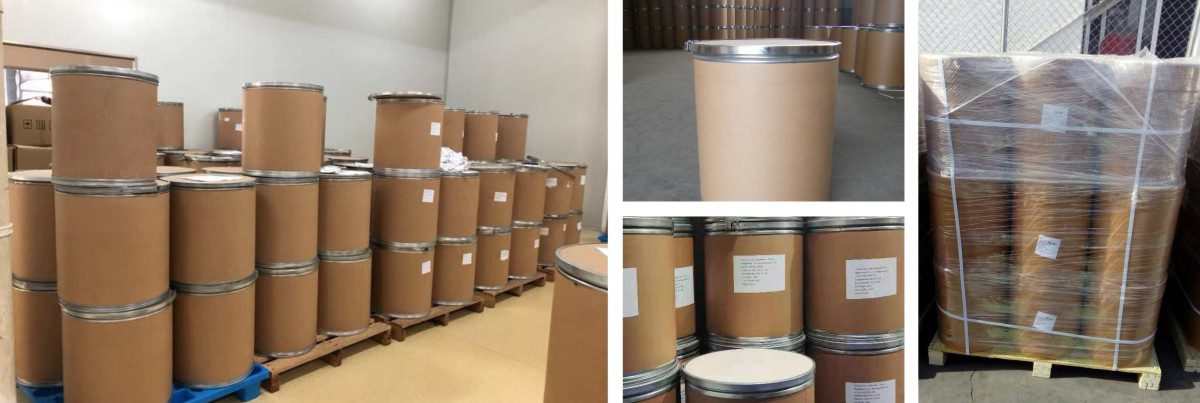
| Kraft paper bag (inner PE liner) | 25 kg | 25 kg | Export packaging |
| White woven PP bag | 25 kg | 25 kg | Humid climates |
| Private-label retail | 100g / 500g / 1kg | 200 kg | Retail / Amazon |
| GMP bottle (pharmaceutical grade) | 100g / 500g | 100 kg | Research/Pharma grade |
Storage Conditions: ≤25°C, RH ≤60%, sealed, away from direct sunlight and strong odors. Protect from heat and humidity. Shelf life: 24 months from manufacture date (sealed). After opening: reseal immediately; use within 3 months. Do not freeze in glass containers.
Related Articles
Organic Phycocyanin Powder vs. Synthetic Blue Colorants: Which Is Better for Your Brand?
In the competitive food and beverage industry, color is a key factor in attracting consumers. For decades, many…
Read More →
The Rising Demand for Organic Phycocyanin Powder in Clean-Label Food Applications
In recent years, consumers have shown a strong preference for clean-label products — foods made with natural, minimally…
Read More →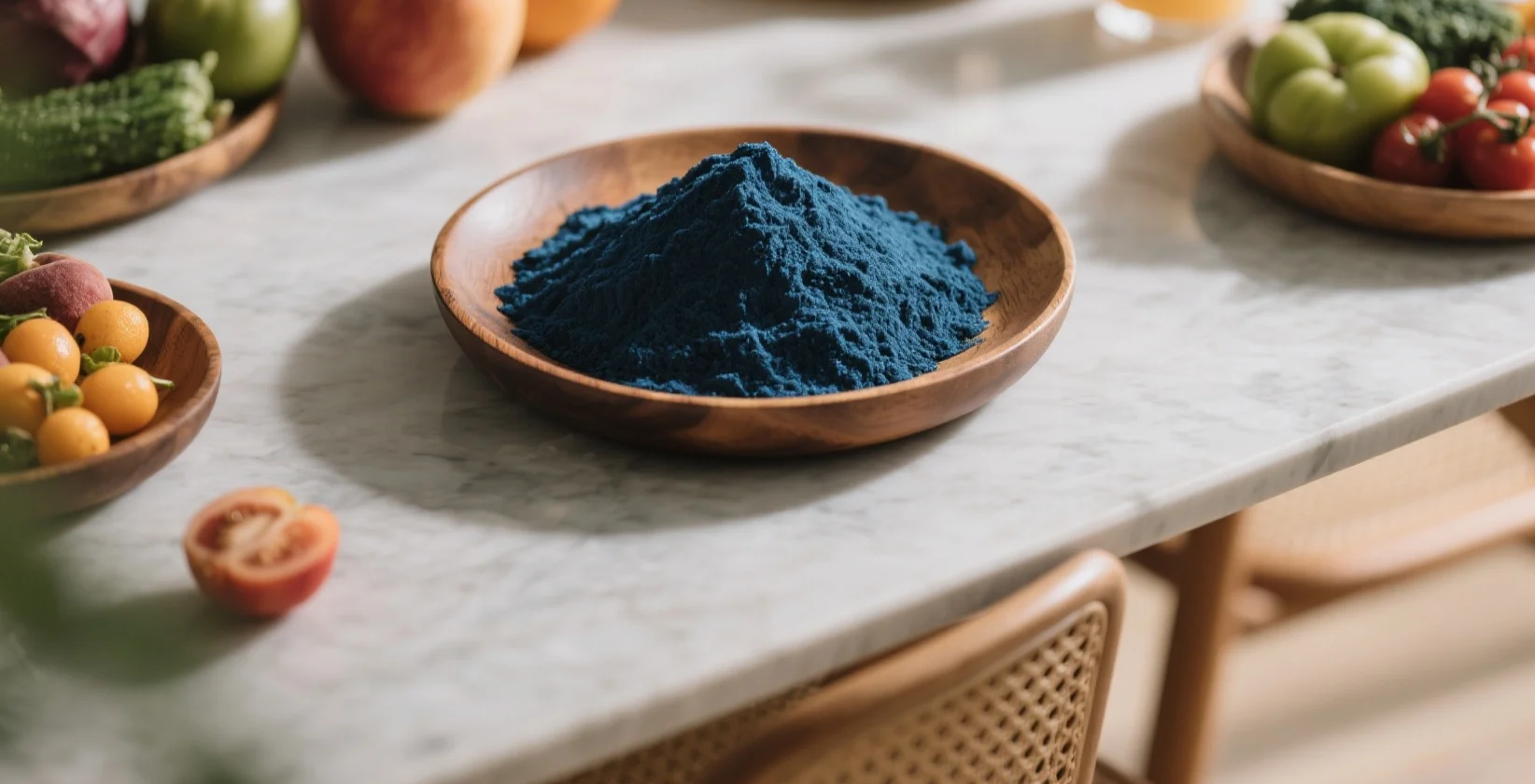
How Organic Phycocyanin Powder Enhances Functional Beverages and Nutraceuticals
As consumers become increasingly health-conscious, they expect more from their food and beverages. Today’s market trends show a…
Read More →