
Table of Contents
The decision between protein sources is among the most consequential formulation choices facing food manufacturers developing plant-based products. Two ingredients that increasingly appear in this decision framework are organic sunflower protein powder and organic pea protein powder — both plant-derived, both allergen-friendly in different ways, and both certified organic.
Yet these proteins differ in ways that materially affect formulation outcomes, cost structures, and ultimately, consumer acceptance. Making the right choice requires understanding not just the headline nutritional data, but the nuanced functional, sensory, and commercial factors that determine whether a formulation succeeds or fails in the market.
This comparison provides formulators, procurement professionals, and brand managers with a systematic evaluation of organic sunflower protein and organic pea protein across the dimensions that matter most: nutritional profile, functional performance, flavor and sensory impact, allergen status, sustainability, and application-specific suitability.
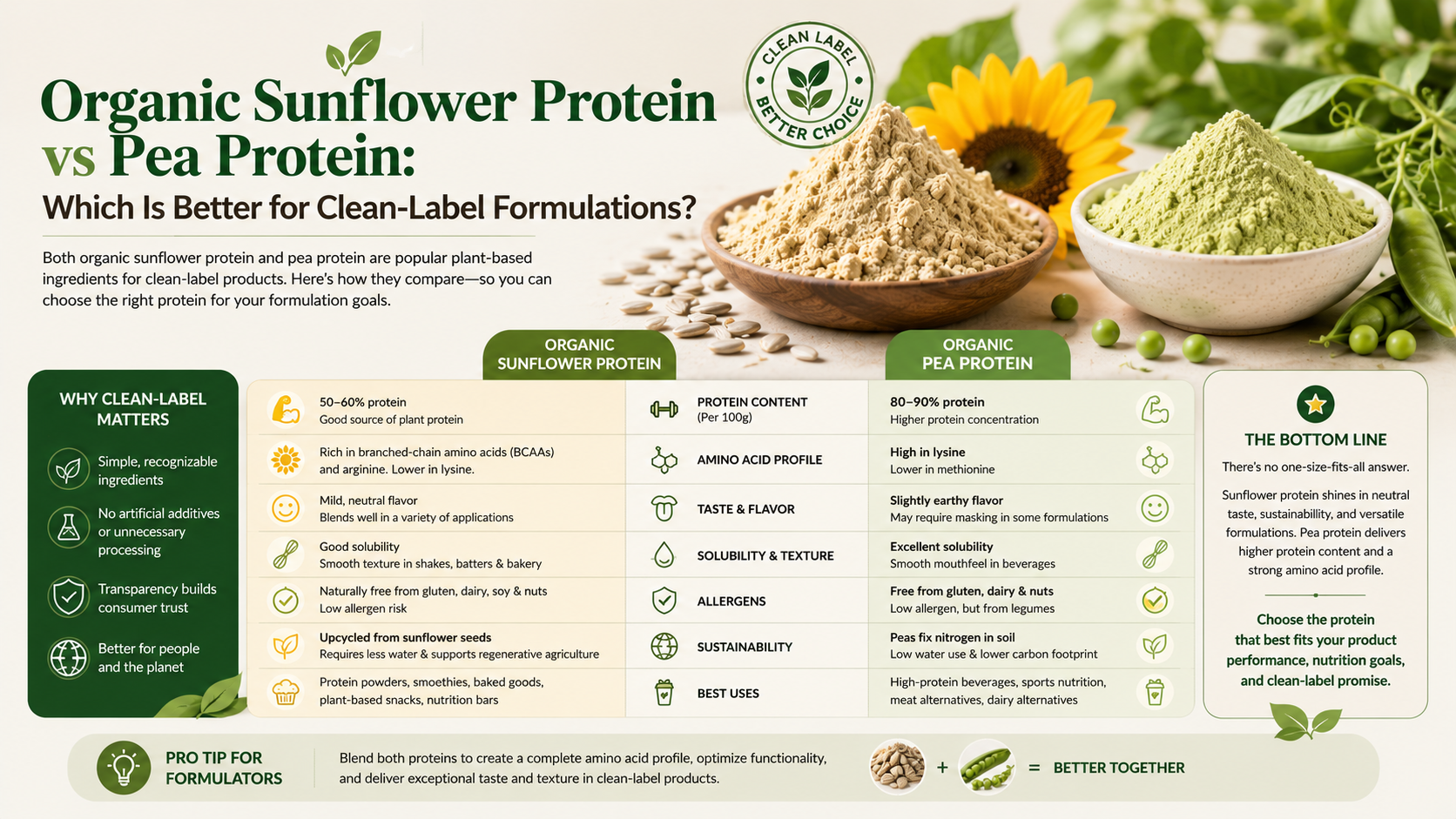
Nutritional Profiles Compared
Amino Acid Composition
Both proteins provide essential amino acids, but their profiles complement each other in ways that have significant formulation implications:
| Amino Acid | Organic Sunflower Protein | Organic Pea Protein |
|---|---|---|
| Lysine | Lower (limiting amino acid) | High (compensates for sunflower) |
| Methionine + Cysteine | High (sulfur-rich) | Lower |
| Arginine | Moderate | High |
| BCAAs (Leucine, Isoleucine, Valine) | Moderate | Moderate to High |
| Overall Completeness | Near-complete; lower lysine | Complete when combined with grains |
Key insight: Sunflower protein and pea protein are naturally complementary — sunflower is rich where pea is low (sulfur amino acids), and pea is rich where sunflower is low (lysine). Combining both in a formulation can achieve a more complete amino acid profile without relying on soy.
Protein Content and Digestibility
| Property | Organic Sunflower Protein | Organic Pea Protein |
|---|---|---|
| Protein Content (Isolate) | 80-95% | 80-90% |
| Protein Content (Concentrate) | 60-70% | 70-85% |
| PDCAAS (Protein Digestibility) | ~0.89-0.92 | ~0.82-0.89 |
| Digestible Indispensable Amino Acid Score (DIAAS) | ~0.86 | ~0.82 |
Sunflower protein demonstrates marginally superior digestibility metrics compared to pea protein, though both are well-absorbed relative to whole plant sources.
Functional Performance in Food Formulations
Flavor and Sensory Impact
This is where the most meaningful differences emerge between the two proteins — and where organic sunflower protein holds a decisive advantage in most formulation contexts.
| Property | Organic Sunflower Protein | Organic Pea Protein |
|---|---|---|
| Taste | Mild, neutral, slightly nutty | Earthy, beany, sometimes chalky |
| Flavor Masking Required | Minimal | Significant (often requires vanilla, chocolate, or flavor systems) |
| Color Impact | Slightly darker | Can produce grayish discoloration in high-pH formulations |
| Off-Odor | Minimal | May develop cardboard-like notes during storage |
For brands prioritizing clean-label formulations — minimizing added flavors, sweeteners, and masking agents — organic sunflower protein’s neutral flavor profile is a significant competitive advantage.
Solubility and Viscosity
| Property | Organic Sunflower Protein | Organic Pea Protein |
|---|---|---|
| Solubility (pH 7) | High (especially isolate grade) | Moderate |
| Viscosity Contribution | Lower at equivalent protein loads | Higher; limits protein concentration in beverages |
| pH Stability | Stable across pH 4-8 | Best at pH <4 or >8; may precipitate near isoelectric point |
Organic sunflower protein isolate is particularly advantageous for ready-to-drink protein beverages, where lower viscosity at equivalent protein loads enables higher protein concentrations without the chalky, gritty mouthfeel associated with pea protein.
Water Binding and Texture
| Property | Organic Sunflower Protein | Organic Pea Protein |
|---|---|---|
| Water Holding Capacity | High (3-4x weight) | High |
| Fat Binding | Good | Good |
| Emulsification | Good to excellent | Moderate |
| Foaming Properties | Good | Moderate to good |
| Gelation | Moderate | Good (at higher concentrations) |
Both proteins are effective in meat analog and bakery applications, though sunflower protein’s superior emulsification profile gives it an edge in smooth-textured products like plant-based dairy alternatives.
Applications: Where Each Protein Excels
Beverages
Winner: Organic Sunflower Protein
The combination of high solubility, low viscosity, and neutral flavor makes organic sunflower protein isolate the preferred choice for ready-to-drink protein beverages, smoothies, and functional drinks. Pea protein’s earthy notes and higher viscosity at equivalent protein loads make it less suitable for clear or lightly flavored beverage applications.
Recommended: Organic sunflower protein isolate for protein-enriched beverages, RTD shakes, and plant-based protein drinks.
Protein Bars and Bites
Winner: Organic Sunflower Protein (flavor-sensitive applications); Organic Pea Protein (cost-sensitive applications)
For premium protein bars targeting mainstream consumers who expect neutral taste and clean flavor, organic sunflower protein’s flavor profile reduces the need for extensive flavor systems. For cost-competitive sports nutrition bars where flavor masking is already built into the brand’s formulation architecture, pea protein remains cost-effective.
Bakery and Snacks
Winner: Both — context-dependent
Both proteins perform well in bakery and snack applications. Organic sunflower protein concentrate offers advantages in neutral flavor applications; organic pea protein provides excellent cost efficiency in extruded snacks and savory crackers.
Recommended: Organic sunflower protein concentrate for cookies, muffins, and premium bakery applications; organic pea protein for high-volume extruded snack formulations.
Plant-Based Meat Analogs
Winner: Both — used in combination
Optimal plant-based meat analog formulations typically combine both proteins. The synergy between sunflower protein (excellent binding, emulsification, neutral flavor) and pea protein (texture, cost efficiency, amino acid complementarity) enables formulations that match or exceed the sensory quality of single-protein systems.
Sustainability Comparison
Environmental Footprint
| Factor | Organic Sunflower Protein | Organic Pea Protein |
|---|---|---|
| Crop Water Requirements | Moderate | Lower (legume nitrogen fixation) |
| Nitrogen Fixation | No (requires external nitrogen) | Yes (natural soil nitrogen fixation) |
| Co-Product Utilization | Excellent (oil co-production) | Moderate (animal feed for residual) |
| Land Use Efficiency | Moderate | High |
| Supply Chain Geography | Eastern Europe, Argentina | Canada, France, China |
Both proteins offer sustainability advantages over animal proteins. Organic sunflower protein benefits from its status as a co-product of sunflower oil production — the protein meal that becomes sunflower protein concentrate or isolate would otherwise be used primarily for animal feed. This co-product utilization reduces the net environmental burden of the ingredient.
Organic pea protein benefits from nitrogen fixation, which reduces fertilizer requirements, but the land area required for pea cultivation is typically higher per unit of protein produced compared to sunflower.
The Market Shift: Why Manufacturers Are Choosing Sunflower Protein
Across the plant-based food industry, a clear pattern has emerged: brands that began with pea protein-based formulations are increasingly reformulating with sunflower protein or sunflower-pea blends. The primary drivers for this shift include:
Consumer Preference for Flavor-Neutral Proteins. Research consistently shows that consumer rejection of plant-based products is most frequently driven by off-flavors and poor taste. Organic sunflower protein’s neutral profile reduces formulation complexity and allows clean-label positioning that pea protein cannot support.
Allergen and Clean-Label Differentiation. As the plant-based market matures, allergen-free positioning has become a key differentiator. Pea protein, while not a priority allergen, is increasingly perceived by consumers as a potential allergen and carries a “beany” connotation. Sunflower protein’s clean, allergen-free story resonates strongly with mainstream consumers.
Functional Versatility. The emulsification and foaming capabilities of organic sunflower protein enable applications — particularly in beverages and dairy alternatives — where pea protein’s performance is constrained by viscosity and flavor limitations.
FAQ
Which protein has a better amino acid profile?
Both proteins provide high-quality plant protein with all essential amino acids. Organic sunflower protein is notably rich in sulfur amino acids (methionine and cysteine) but lower in lysine. Organic pea protein is rich in lysine but lower in sulfur amino acids. Combining both proteins in a formulation creates a complementary amino acid profile suitable for sports nutrition and complete protein positioning.
Which protein is better for allergen-free formulations?
Organic sunflower protein is the stronger choice for allergen-free positioning. It is free from the “Big 8” priority allergens, while pea protein — though not a priority allergen — is a legume that cross-reacts with soy allergens and is subject to increasing consumer concern about legume sensitivity.
Which protein is better for clean-label products?
Organic sunflower protein is generally better suited for clean-label formulations. Its neutral flavor reduces or eliminates the need for flavor systems, masking agents, and added sweeteners that complicate clean-label ingredient declarations.
Which protein is better for beverages?
Organic sunflower protein isolate is the preferred choice for ready-to-drink protein beverages. Its superior solubility, lower viscosity contribution, and neutral flavor enable clean-tasting protein beverages at protein concentrations of 20g+ per serving.
Can these proteins be used together?
Yes. Combining organic sunflower protein and organic pea protein is a common and effective formulation strategy that leverages the strengths of both ingredients — sunflower for flavor neutrality and functional performance, pea for amino acid complementarity and cost efficiency.
Which protein is more sustainable?
Both proteins offer significant sustainability advantages over animal proteins. Organic sunflower protein benefits from co-product utilization in sunflower oil production. Organic pea protein benefits from nitrogen fixation. The relative sustainability depends on geographic sourcing, agricultural practices, and supply chain logistics. Both are superior options to conventional animal-derived proteins from an environmental footprint perspective.
Which protein is more cost-effective?
Organic pea protein is currently available at a lower per-kilogram price than organic sunflower protein, reflecting its larger production scale. However, when formulation costs are included — specifically the flavor systems and masking agents required for pea protein — the total cost differential narrows significantly, and in premium applications, organic sunflower protein often delivers better cost-performance value.
Recommended Products

Organic Pea Protein Powder
Organic Pea Protein Powder Isolate is a clean-label, high-purity ingredient derived from 100% Non-GMO…


