
Table of Contents
The ketogenic and low-carbohydrate diet market has grown from a niche health trend into a mainstream lifestyle category, with global keto diet adoption estimated at over 50 million people across North America, Europe, and Asia-Pacific. This growth has created a parallel demand for food and beverage products that support the metabolic requirements of ketogenic eating — without the digestive discomfort, bitter aftertaste, or ingredient-label confusion associated with traditional sugar alternatives.
Organic allulose syrup addresses these requirements more completely than any other commercially available liquid sweetener. Its metabolic pathway, calorie profile, glycemic impact, and functional performance in food systems make it uniquely suited for the special dietary market.
This guide covers the science behind why allulose is compatible with ketogenic and low-carb diets, how it compares to other sweeteners in this space, and what formulation and marketing considerations matter for brands targeting health-conscious consumers.
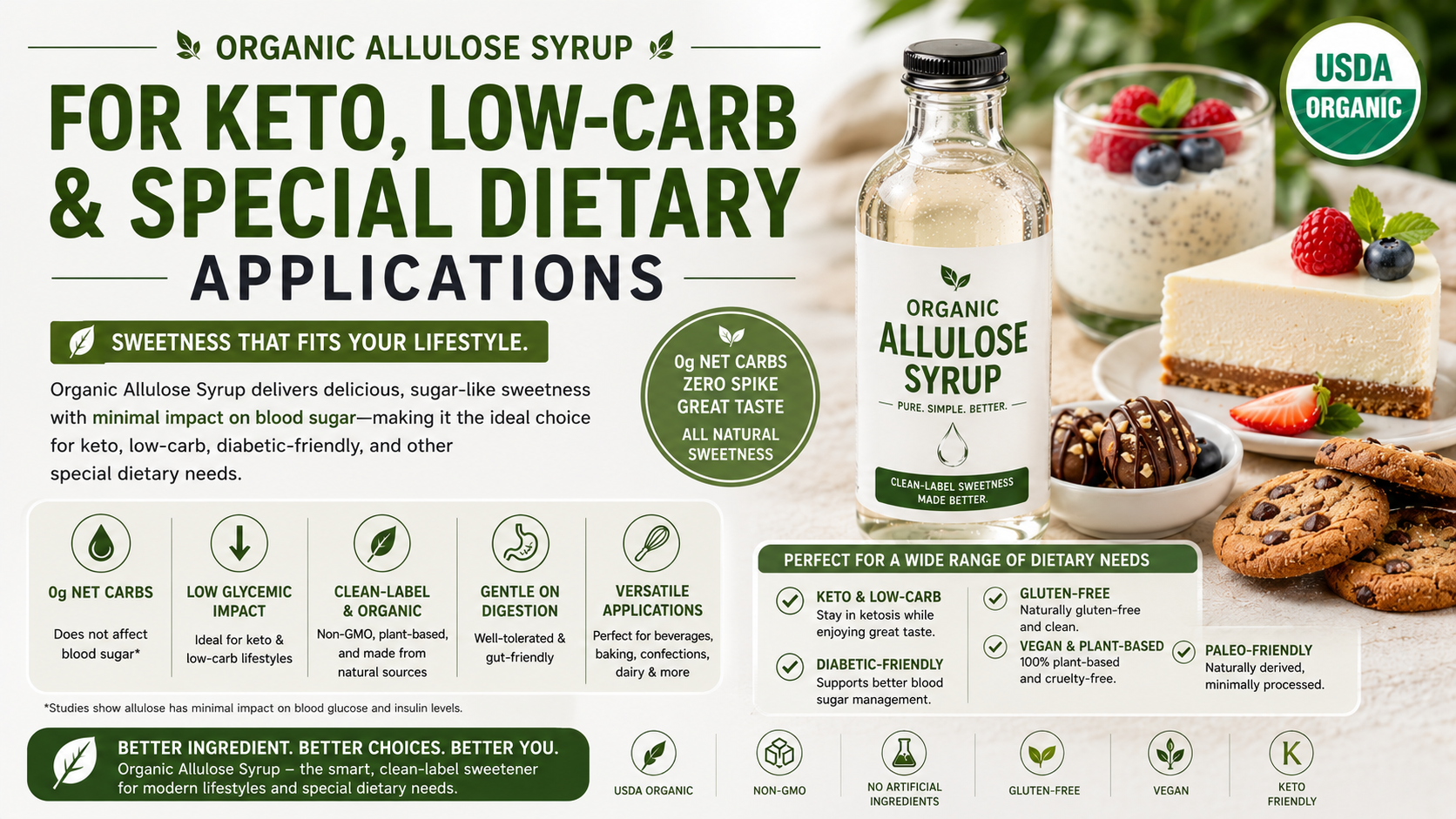
Understanding the Metabolic Science: Why Allulose Does Not Break Ketosis
The defining metabolic characteristic of a ketogenic diet is the sustained production of ketone bodies from fat metabolism, rather than glucose metabolism from dietary carbohydrates. Every ingredient in a keto-formulated product must be evaluated against this constraint.
The key question for any sweetener: Does it raise blood glucose or insulin?
How the Body Metabolizes Allulose
Unlike sucrose, glucose, fructose, or even most sugar alcohols, allulose (D-psicose) follows a unique metabolic pathway:
- Absorption in the small intestine: Allulose is absorbed but not metabolized. Studies using carbon-labeled allulose show that >90% is absorbed and then excreted unchanged in urine within 24 hours — the highest excretion rate of any dietary monosaccharide studied.
- No glucose spike: Clinical studies consistently show that allulose consumption does not raise blood glucose levels in healthy adults, in people with type 2 diabetes, or in individuals following a ketogenic diet.
- Minimal insulin response: The insulin response to allulose is negligible — significantly lower than fructose, which itself is lower than glucose.
- Colonic fermentation: The small fraction of allulose that reaches the colon is fermented by gut microbiota, producing short-chain fatty acids (SCFAs) including acetate and propionate. This fermentation does not produce glucose or interfere with ketone body production.
This metabolic profile is why nutrition researchers classify allulose as a “non-digestible” or “rare” sugar with zero-glycemic characteristics — fundamentally different from both fermentable sugars and sugar alcohols.
Calorie Impact: Quantifying the Difference
The calorie contribution of allulose is far lower than its weight equivalence to sugar suggests:
| Sweetener | Calories per gram | Calories vs. Sucrose (per teaspoon, 4g) |
|---|---|---|
| Sucrose | 4.0 kcal/g | ~16 kcal per teaspoon |
| Fructose | 4.0 kcal/g | ~16 kcal per teaspoon |
| Erythritol | 0.2 kcal/g | ~0.8 kcal per teaspoon |
| Xylitol | 2.4 kcal/g | ~9.6 kcal per teaspoon |
| Maltitol | 2.1 kcal/g | ~8.4 kcal per teaspoon |
| Allulose | 0.2–0.4 kcal/g | ~1.2 kcal per teaspoon |
For manufacturers targeting “reduced calorie” or “low calorie” label claims, allulose offers the most favorable calorie-to-sweetness ratio among all natural sweeteners currently available.
Impact on Ketone Production
Independent feeding studies in humans have measured ketone body (beta-hydroxybutyrate) concentrations following allulose consumption:
- Fasting state: Allulose consumption during fasting does not suppress ketone body production
- Post-meal state: Consuming allulose-sweetened products as part of a ketogenic meal (containing 70–80% fat, 15–20% protein, 5–10% carbs) does not disrupt the post-meal ketone concentration
- Gut health benefit: The SCFAs produced from colonic fermentation of allulose may actually support ketone body production through gut-brain signaling pathways — a secondary benefit currently under active research
How Allulose Compares to Other Keto Sweeteners
Understanding the sweetener landscape is essential for formulators and for brands communicating with consumers.
Comprehensive Comparison Table
| Attribute | Allulose | Erythritol | Stevia (Reb A) | Monk Fruit | Xylitol | Maltitol |
|---|---|---|---|---|---|---|
| Sweetness (vs. sucrose) | ~70% | ~70% | 200–400× | 100–250× | ~100% | ~75% |
| Calories per gram | 0.2–0.4 | 0.2 | 0 | 0 | 2.4 | 2.1 |
| Glycemic impact | None | None | None | None | Low | Low-Med |
| Digestive tolerance | Excellent | Good | Excellent | Excellent | GI discomfort >10g | GI discomfort >20g |
| Cooling sensation | Minimal | Strong (menthol-like) | None | None | Mild | Mild |
| Bitter/licorice aftertaste | None | None | Yes (high conc.) | None | None | None |
| Bulk/Volume | Full bulk | Partial bulk (60–70%) | Requires bulking agent | Requires bulking agent | Full bulk | Full bulk |
| Browning/Caramelization | Yes (moderate) | No | No | No | Yes | Yes |
| Label for keto consumers | Easy to explain | Familiar | Familiar | Familiar | Higher calorie than expected | GI issues at keto levels |
| Organic certification | Available | Limited organic supply | Available | Available | Available | Limited |
The Allulose Advantage for Keto Formulations
The key competitive advantages of allulose syrup for keto-formulated products:
1. Volume and bulk: Unlike stevia or monk fruit (which require bulking agents), allulose can serve as the primary sweetener in most formulations. This simplifies the ingredient deck — an important consideration for brands targeting the clean-label keto consumer.
2. No bitter aftertaste: Stevia’s most significant formulation challenge is its dose-dependent bitterness and licorice-like aftertaste. Allulose has no such limitation, allowing for straightforward formulation without flavor masking.
3. No digestive discomfort: Erythritol causes digestive discomfort in some consumers at intake levels above 10–15g (equivalent to ~2–3 servings of heavily sweetened keto products). Allulose causes no such issues even at much higher intake levels, making it more consumer-friendly for products with multiple servings per day (e.g., keto protein bars, meal replacement drinks).
4. Partial browning capability: Unlike all sugar alcohols and high-intensity sweeteners, allulose participates in browning reactions. For keto cookies, keto granola bars, and similar baked goods, this means realistic appearance and acceptable sensory quality — not the pale, under-baked look of erythritol-only formulations.
Target Applications for Keto and Special Diets
Ketogenic Food Products
Keto cookies and snack bars
- Allulose syrup provides bulk, browning, and moisture retention in baked goods at replacement levels of 60–100% of sugar
- Combine with coconut oil, almond flour, and natural flavor extracts for authentic keto baked goods
- Recommended: 40–60% sugar replacement with allulose syrup for optimal texture and browning; supplement remaining sweetness with 50–100 ppm monk fruit extract for consumer-preferred sweetness levels
Keto chocolate and cocoa products
- Allulose syrup supports caramelization and viscosity control in sugar-free chocolate formulations
- Compatible with high-cacao (70–90%) dark chocolate — the segment with the strongest keto positioning
- No bloom formation (fat or sugar crystallization) at typical storage temperatures, extending shelf life
Keto ice cream and frozen desserts
- Allulose syrup’s low freezing point depression produces a softer, more scoopable texture compared to erythritol-formulated keto ice creams
- No crystallization during storage — prevents the gritty texture common in sugar alcohol-based keto ice creams
- Fat content can be maintained at premium levels without relying on sugar for creaminess
Keto beverages and drink mixes
- Allulose syrup dissolves completely in hot and cold liquids — ideal for keto coffee creamers, powdered drink mixes, and RTD keto beverages
- Compatible with MCT oil emulsions used in keto coffee drinks
- Stable across pH range 2.5–8.0, covering all common beverage formats
Weight Management Products
Meal replacement shakes
- Allulose’s zero-glycemic profile supports blood sugar stability during calorie restriction, reducing hunger spikes and cravings
- Non-fermentable — safe for use with probiotic ingredients commonly included in weight management formulations
Low-calorie dessert mixes
- Allulose syrup enables premium dessert positioning (puddings, mousses, gelatins) at 70–90% calorie reduction versus full-sugar versions
- No artificial aftertaste means consumer acceptance is higher than stevia-only formulations
Diabetic-Friendly Products
Blood glucose management: Allulose is classified as a zero-glycemic-index ingredient by the International Standards Organization (ISO) and is recognized by diabetes associations in Japan and the United States as a suitable sweetener for diabetic dietary use.
Formulators targeting the diabetic-friendly or “suitable for people with diabetes” market segment can use allulose as the primary sweetener and make substantive health claims supported by clinical evidence.
Labeling and Regulatory Considerations for Special Diet Products
Label Claims That Are Supported by Evidence
| Claim | Supported? | Evidence Basis |
|---|---|---|
| “Zero sugar” | Yes (US: <0.5g per serving) | Allulose qualifies under US FDA zero-sugar definition |
| “Reduced calories” | Yes | 0.2–0.4 kcal/g vs 4 kcal/g for sucrose |
| “Low glycemic” | Yes | ISO GI testing: GI = 0–5 |
| “Keto-friendly” | Yes (descriptive) | No glucose spike, no ketosis disruption |
| “Diabetic-friendly” | Yes (qualified claim) | Recognized by ADA and Japanese Diabetes Association |
| “Non-fermentable” | Yes (descriptive) | Human studies confirm non-fermentation in small intestine |
| “Sugar-free” | Jurisdiction-dependent | Check local food regulations; EU restricts “sugar-free” to no mono/disaccharides |
Market-Specific Regulatory Notes
United States (FDA): Allulose is GRAS affirmed. For products making “keto-friendly” or similar claims, ensure the overall macronutrient profile meets consumer expectations (typically <5–10g net carbs per serving for products labeled as keto). The FDA has not issued specific guidance on “keto” labeling, so the claim is generally supported by truthful description of the product’s carbohydrate profile.
European Union: The Novel Food authorization for allulose remains under EFSA review. Keto and weight management products intended for EU retail should not currently use allulose unless the specific use has received EFSA approval or falls within the novel food authorization scope.
China: Allulose is approved as a Novel Food ingredient. “Low glycemic,” “diabetic-friendly,” and related claims are available for compliant products.
Japan: Japan has the most supportive regulatory environment for allulose, with full market authorization and several health claim approvals. Japanese precedent provides a strong scientific foundation for global formulations.
How to Formulate With Organic Allulose Syrup for Keto Products
Sweetness Calibration for Keto Formulations
To achieve consumer-preferred sweetness in keto products without relying on high-intensity sweeteners (which require bulking agents), use a two-tier approach:
Tier 1: Primary bulk sweetener
- Organic allulose syrup: 50–100% replacement of sugar by weight
- Provides: sweetness + bulk + functional properties (browning, moisture, viscosity)
Tier 2: Sweetness boost (if needed)
- Organic monk fruit extract (70–80 ppm): Adds intense sweetness without bulk
- Alternative: Organic stevia extract (Reb A, 50–100 ppm): Use when cost is primary concern; monitor for bitterness
Example — Keto cookie formulation (per 100g batch):
| Ingredient | Conventional | Keto Formulation |
|---|---|---|
| Wheat flour | 50g | Almond flour 40g + coconut flour 8g |
| Sugar | 25g | 0g |
| Organic allulose syrup | 0g | 18g |
| Monk fruit extract | 0g | 60 ppm |
| Butter/coconut oil | 20g | 22g |
| Egg | 10g | 12g |
| Vanilla extract | 1g | 1.5g |
| Salt | 0.5g | 0.8g |
| Net carbs per cookie (35g) | ~18g | ~3.5g |
| Calories per cookie | ~150 kcal | ~130 kcal |
Common Formulation Pitfalls and How to Avoid Them
| Pitfall | Cause | Solution |
|---|---|---|
| Cookies spread too much | Allulose reduces viscosity more than sugar | Increase fat content 5–10% or add 2–3% resistant starch |
| Brown too dark | Allulose browns faster than sucrose at high temps | Reduce oven temp by 10–15°C or reduce baking time |
| Too sweet or bitter | Over-reliance on stevia for sweetness | Use allulose as primary sweetener; reduce stevia to 30 ppm |
| Crystallization in syrups | Allulose can recrystallize at >75% concentration in aqueous solutions | Maintain Brix below 70% or add 5–10% sorbitol as crystallization inhibitor |
| Flat texture in baked goods | Allulose produces less gas retention than sucrose in leavened products | Increase leavening agent 10–15% or combine with baking powder |

Consumer Communication: What Keto Consumers Actually Read
Research into keto consumer purchasing behavior reveals specific label-reading patterns. Formulators and brand teams should ensure their finished product labels and marketing communicate the following effectively:
What keto consumers look for on ingredient labels:
- Recognizable ingredients — “allulose” is immediately understood; avoid obscure chemical names
- Net carb calculation — consumers calculate net carbs (total carbs minus fiber and sugar alcohols)
- No maltitol — the keto community is actively avoiding maltitol due to its glycemic impact and digestive effects
- Minimal ingredient list — shorter ingredient decks are perceived as more authentic
- Clean calorie count — low calories reinforce the keto positioning without requiring complex explanation
What to include in product descriptions:
- “Contains allulose — metabolized differently from ordinary sugars, with minimal impact on blood sugar and ketone production”
- “X grams of net carbs per serving” — calculated clearly
- “Sweetened with organic allulose — the keto-friendly sugar alternative backed by clinical research”
Working With ORGANICWAY
ORGANICWAY supplies organic allulose syrup for keto, weight management, and special dietary product formulations, with:
- USDA Organic, Non-GMO Project Verified, Kosher, and Halal certified product options
- Full technical documentation including specifications, organic certificates, and safety data sheets
- Formulation support for keto cookie, bar, beverage, and confectionery applications
- Regulatory consultation support for US, EU, China, and Japan market access