
Table of Contents
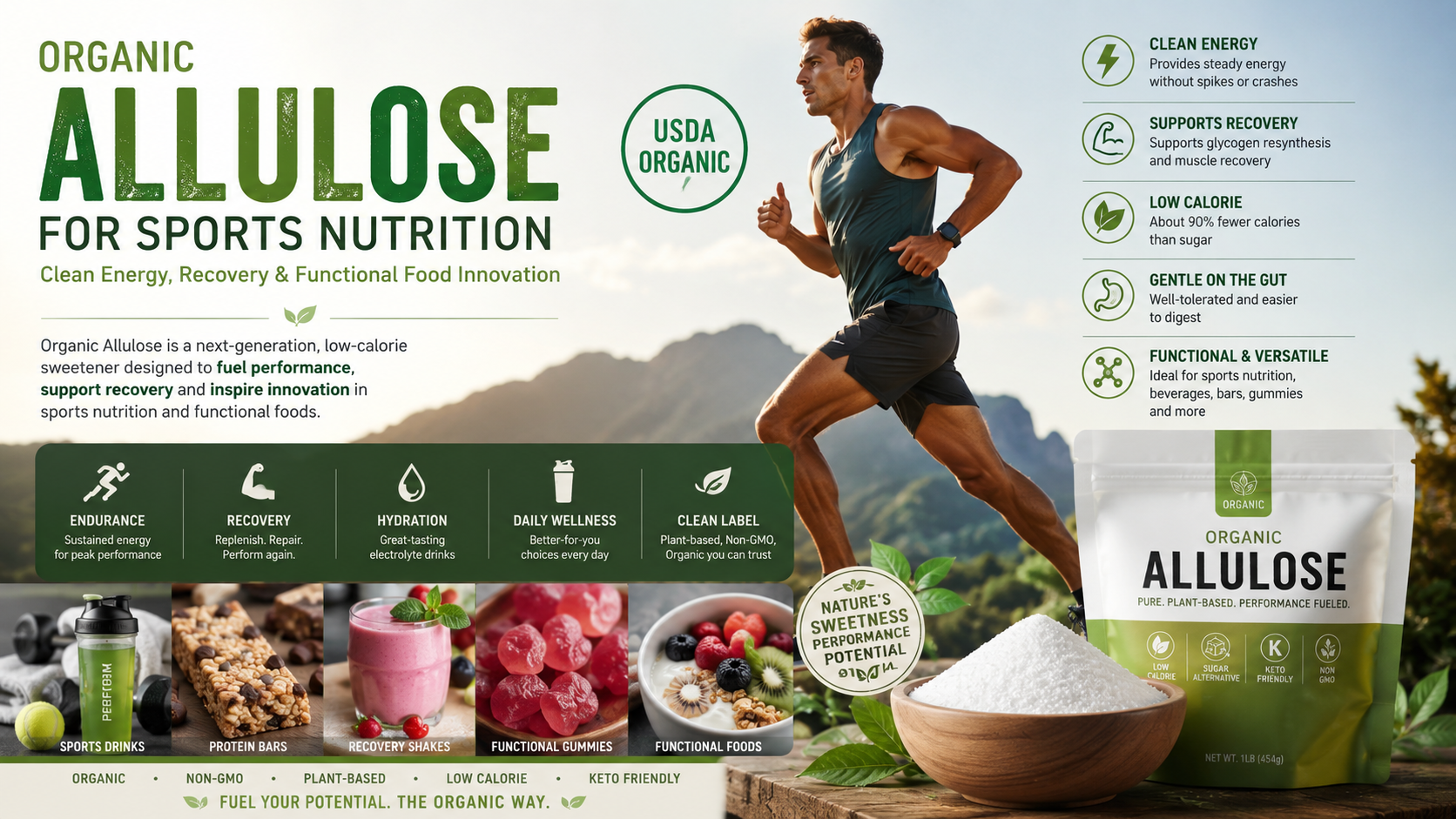
The sports nutrition industry is undergoing a fundamental shift. Athletes and active consumers no longer accept the trade-off between performance nutrition and clean labels. They want products that deliver functional benefits — energy, recovery, hydration — without artificial ingredients, excessive sugar, or empty calories.
Organic allulose powder has emerged as a key enabler of this shift. With near-zero calories, no glycemic impact, and sugar-like functional properties, allulose allows sports nutrition brands to formulate products that meet both performance expectations and clean-label demands.
The Sports Nutrition Sweetener Challenge
Why Sugar Is Being Replaced
Traditional sports nutrition products have long relied on sugar — maltodextrin, dextrose, fructose — as primary carbohydrate sources. While these ingredients deliver rapid energy, they present growing challenges:
- Caloric density: Many consumers want energy without excess calories
- Glycemic concerns: Blood sugar spikes and crashes can affect sustained performance
- Clean-label pressure: Athletes increasingly prefer recognizable, natural ingredients
- Regulatory trends: Sugar taxes and labeling requirements are reshaping product design
What Sports Nutrition Brands Need
An ideal sweetener for sports nutrition must deliver:
- Clean, pleasant sweetness without off-notes
- Minimal impact on blood glucose and insulin
- Compatibility with protein systems and amino acid profiles
- Stability across processing (extrusion, baking, spray-drying)
- Shelf stability without texture degradation
- Clean-label and organic certification potential
Organic allulose meets all of these requirements, making it one of the most versatile sweetener options available to sports nutrition formulators.
Allulose vs. Traditional Sports Carbohydrates
| Property | Organic Allulose | Maltodextrin | Dextrose | Fructose |
|---|---|---|---|---|
| Calories (kcal/g) | ~0.4 | 3.8 | 3.6 | 4.0 |
| Glycemic Index | ~0 | 85–105 | 96–100 | 22 |
| Sweetness (% of sucrose) | ~70% | ~5% | ~75% | ~120% |
| Insulin response | None | High | High | Moderate |
| Keto-friendly | Yes | No | No | No |
| Clean-label perception | Excellent | Moderate | Moderate | Moderate |
| Organic available | Yes | Yes | Yes | Yes |
| Cost per kg | $$–$$$ | $ | $ | $$ |
Allulose occupies a unique position: it is not a performance carbohydrate (it does not provide metabolizable energy), but rather a sweetness and functionality enabler that allows formulators to reduce sugar content while maintaining the taste and texture that consumers expect.
When to Use Allulose vs. Performance Carbohydrates
- Pure performance products (race-day gels, intra-workout drinks): Allulose alone is not a replacement for performance carbs — athletes still need metabolizable glucose/maltodextrin for energy delivery
- Recovery products (post-workout shakes, protein bars): Allulose can partially or fully replace sugar, as rapid carbohydrate replenishment is less critical in recovery windows
- Everyday functional products (protein bars, meal replacements, snacks): Allulose is an excellent full or partial sugar replacement
- Keto and low-carb sports products: Allulose is the preferred sweetener, as it does not interfere with ketosis
Application Guide: Sports Nutrition Product Categories
Protein Bars and Energy Bars
Why allulose works: Protein bars are one of the most challenging sports nutrition products to formulate without sugar. Sugar provides sweetness, binding, moisture retention, and browning — all of which allulose replicates.
| Formulation Role | How Allulose Helps |
|---|---|
| Sweetness | 70% sucrose sweetness, clean taste |
| Binding | Helps hold bar matrix together |
| Moisture retention | Prevents hardening over shelf life |
| Browning | Enables golden-brown baked appearance |
| Clean label | Certified organic, non-GMO |
Typical usage: 8–15% of bar formulation (replacing sugar on a 1:1 weight basis with ~1.3x for sweetness equivalence).
Common pairing: Allulose + oligofructose/inulin for prebiotic fiber + allulose + soluble corn fiber for texture and bulk.
Ready-to-Drink (RTD) Protein Beverages
Why allulose works: RTD protein shakes need sweetness without excessive calories or sugar-related viscosity changes. Allulose powder dissolves easily and provides clean sweetness without contributing to the “syrupy” mouthfeel that sugar can create at high concentrations.
Typical usage: 3–7% of beverage formulation.
Formulation notes: Allulose is heat-stable, so it survives UHT/HTST processing. It does not contribute to viscosity, which may require separate mouthfeel management with gums or fibers.
Pre-Workout and Intra-Workout Supplements
Why allulose works: Pre-workout powders often rely on intense sweeteners (sucralose, acesulfame-K) that leave bitter or chemical aftertastes. Allulose provides a clean, natural sweetness base that masks the off-notes of amino acids, caffeine, and other functional ingredients.
Typical usage: 2–5% of powder blend.
Formulation notes: Allulose pairs well with monk fruit or stevia for a blended sweetness system that achieves full sucrose equivalence with a clean flavor profile.
Protein Cookies and Baked Snacks
Why allulose works: Protein cookies, brownies, and muffins benefit from allulose’s browning capability and moisture retention. Unlike erythritol (which can create gritty or crumbly textures in baked goods), allulose produces soft, chewy textures similar to sugar-sweetened products.
Typical usage: 15–25% of dry mix.
Electrolyte and Hydration Products
Why allulose works: Hydration drinks and electrolyte powders need pleasant sweetness without excess sugar calories. Allulose dissolves completely, has no impact on fluid absorption, and doesn’t interfere with electrolyte delivery.
Typical usage: 2–5% of powder or liquid formulation.
Meal Replacement Powders and Shakes
Why allulose works: Meal replacement products must balance nutrition density with calorie control. Allulose allows formulators to achieve palatable sweetness without adding significant caloric load, making it easier to hit target macro profiles.
Typical usage: 3–8% of total formulation.
Clean Label and Compliance Considerations
Regulatory Benefits for Sports Nutrition
| Market | Allulose Regulatory Status | Labeling Advantage |
|---|---|---|
| United States | GRAS; exempt from “Added Sugars” | “0g Added Sugar” claim possible |
| European Union | Novel Food approved | Reduced-calorie claim permitted |
| China | Approved food ingredient | Standard food ingredient labeling |
| Japan | Long-established; “almost zero calorie” | “Zero calorie” front-of-pack claim |
WADA and Informed Sport Compliance
Allulose is a food ingredient, not a prohibited substance. It does not appear on the World Anti-Doping Agency (WADA) prohibited list and is fully compatible with Informed Sport and NSF Certified for Sport certification programs.
Keto and Low-Carb Positioning
For brands targeting the growing keto-sports segment, allulose is one of the few sweeteners that:
- Does not raise blood glucose
- Does not trigger insulin release
- Does not interfere with ketosis
- Is available in certified organic form
- Functions similarly to sugar in food matrices
This makes it the preferred sweetener for keto protein bars, low-carb pre-workouts, and sugar-free electrolyte drinks.
Market Trends Driving Adoption
The Clean-Label Sports Nutrition Shift
- The global sports nutrition market is projected to exceed $30 billion by 2027
- “Clean label” and “natural” are now the top two purchase drivers for sports nutrition consumers
- Sugar reduction is the #1 reformulation priority for sports nutrition brands worldwide
Key Consumer Segments
| Segment | Why Allulose Appeals |
|---|---|
| Everyday athletes | Health-conscious, want taste without guilt |
| Keto athletes | Need zero-net-carb sweeteners that work in food matrices |
| Diabetic athletes | Need non-glycemic sweeteners with proven safety |
| Plant-based athletes | Aligned with natural, plant-derived ingredient preferences |
| Professional athletes | Need clean, WADA-compliant ingredients |
Formulation Best Practices
Sweetness Blending
For most sports nutrition applications, the most cost-effective and functional approach is to blend allulose with a high-intensity sweetener:
| Blend | Ratio (Allulose : HI Sweetener) | Application |
|---|---|---|
| Allulose + Monk Fruit | 70 : 30 | Protein bars, cookies |
| Allulose + Stevia | 75 : 25 | RTD beverages, powders |
| Allulose + Erythritol + Monk Fruit | 40 : 40 : 20 | Keto bars (cost optimization) |
Common Formulation Mistakes
- Over-reliance on allulose alone: At very high levels (>25%), allulose may require additional bulking agents for optimal texture
- Ignoring moisture management: While allulose is a humectant, high-protein systems may still need additional moisture management
- Not accounting for sweetness gap: At 70% sucrose equivalence, allulose alone may not achieve target sweetness — plan for blending or slight overage
Why Partner With ORGANICWAY
ORGANICWAY supplies certified organic allulose powder specifically graded for sports nutrition and functional food applications. Our organic allulose offers:
- USDA Organic and EU Organic certified
- Non-GMO verified with complete traceability
- Consistent particle size for uniform blending in dry mixes
- Batch-to-batch specification reliability for scaled manufacturing
- Technical formulation support for sports nutrition product development
- Global supply chain with competitive bulk pricing
Whether you are launching a new clean-label protein bar, reformulating an existing sports drink, or developing a keto-friendly pre-workout, ORGANICWAY can provide the organic allulose and technical guidance to bring your product to market.
Contact our team at info@organic-way.com to discuss your project, request samples, or receive a customized specification sheet.
Recommended Products

Allulose Sweetener
Available in two professional formats: free-flowing Allulose Powder (≥98% purity) and liquid Allulose Syrup…
Related Posts


