
Table of Contents
For food manufacturers, ingredient selection is not merely a purchasing decision — it shapes product identity, regulatory compliance, and brand positioning. When it comes to organic dextrose powder, the choice between organic and conventional grades carries compounding implications across your entire supply chain.
Organic dextrose powder serves as a foundational carbohydrate ingredient across functional beverages, sports nutrition products, baked goods, confectionery, infant nutrition, and plant-based formulations. Unlike conventional dextrose — produced from genetically modified corn under conventional agricultural systems — organic dextrose is derived from certified organic, non-GMO corn and manufactured under strict organic protocols that eliminate synthetic pesticides, fertilizers, and processing aids.
This guide provides a systematic framework for procurement professionals, R&D formulators, and quality managers to evaluate, select, and contract organic dextrose powder with confidence. We cover quality parameters, regulatory requirements, supplier evaluation, and strategic sourcing practices that protect both product integrity and commercial performance.
What Is Organic Dextrose Powder?
Chemical and Functional Profile
Organic dextrose powder is the crystallized form of D-glucose — a monosaccharide that serves as the primary energy currency in biological systems. Derived from the hydrolysis of organic corn starch, it undergoes enzymatic or acid-catalyzed conversion followed by purification and crystallization.
| Property | Specification | Significance for Manufacturers |
|---|---|---|
| Chemical Formula | C6H12O6 | Simple sugar, directly metabolizable |
| Dextrose Equivalent (DE) | 95–100 | Near-complete hydrolysis; rapid dissolution |
| Physical Form | White crystalline powder | Consistent flowability; easy blending |
| Solubility | Highly soluble in water | Critical for RTD beverages and instant formats |
| Sweetness | ~70% of sucrose | Moderate sweetness; clean taste profile |
| Moisture Content | ≤5% | Shelf stability; prevents caking |
| Particle Size | 100–500 microns (typical) | Affects dissolution rate and texture |
Why Organic Certification Changes Everything
The organic designation is not a marketing label — it is a comprehensive production standard that touches every stage of the ingredient’s lifecycle:
Agricultural Stage: Organic corn must be grown on land that has been free from prohibited substances for a minimum of three years. This eliminates residual pesticide contamination that could affect final product safety.
Processing Stage: Organic certification prohibits the use of synthetic solvents, irradiation, and genetically modified organisms throughout manufacturing. Equipment must be dedicated or thoroughly cleaned between organic and conventional production runs.
Documentation Stage: Full chain-of-custody documentation is required from farm to finished product, enabling complete traceability.
Regulatory Alignment: USDA Organic (US), EU Organic (EU), and JAS Organic (Japan) certifications ensure compliance with the target market’s labeling requirements — critical for brands exporting to multiple regions.
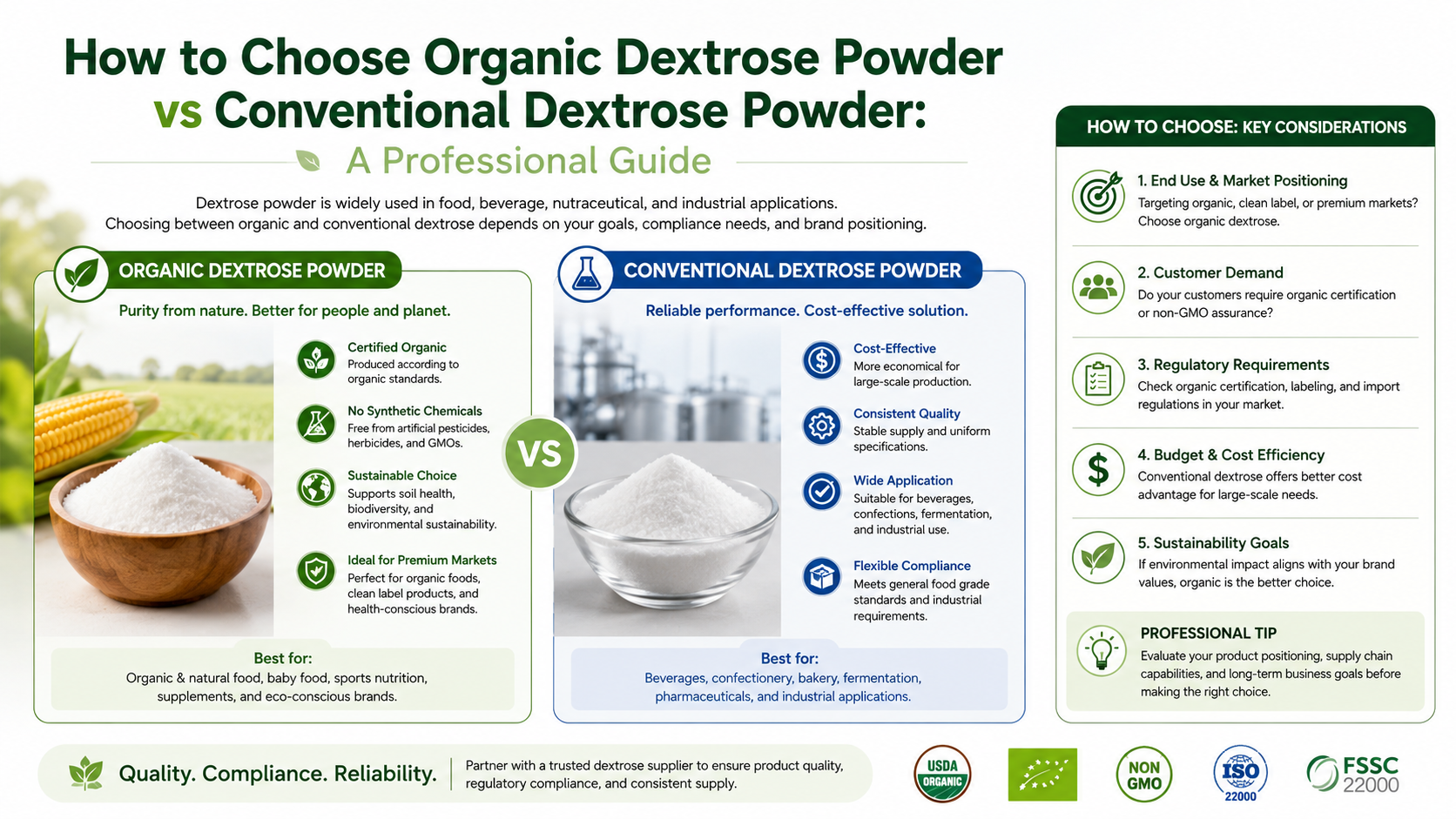
Organic vs Conventional: A Practical Comparison
The Business Case for Going Organic
For B2B buyers, the organic vs conventional decision is fundamentally a category strategy decision. Consider these factors across your product portfolio:
| Factor | Organic Dextrose Powder | Conventional Dextrose Powder |
|---|---|---|
| Raw Material Source | Certified organic, non-GMO corn | Conventional corn (may include GMO varieties) |
| Certification Requirements | USDA/EU/JAS Organic | None |
| Price Premium | 20–40% above conventional | Baseline |
| Label Claims | “Organic,” “Non-GMO,” clean-label friendly | No organic claim |
| End-Market Fit | Premium, functional, clean-label brands | Mainstream commodities |
| Regulatory Documentation | Comprehensive audit trail required | Standard COA sufficient |
| Supply Availability | More limited; requires longer lead times | Readily available globally |
| Batch Consistency | Subject to agricultural variability | Tighter process control |
Where Organic Dextrose Creates Maximum Value
Organic dextrose powder is not universally superior — it creates strategic value primarily in specific market segments:
High-Value Segments: Premium sports nutrition, organic baby food, clean-label functional beverages, and plant-based products command price premiums that justify the organic ingredient cost.
Low-Value Segments: Mass-market confectionery, standard bakery ingredients, and price-sensitive industrial applications typically cannot absorb the organic premium without compromising margin.
The Decision Matrix: If your product carries an organic certification and your brand positioning depends on clean-label claims, organic dextrose is non-negotiable. If your brand operates in the value segment, conventional dextrose may be the appropriate choice.
Key Quality Parameters Every Buyer Must Evaluate
Technical Specifications Checklist
When evaluating organic dextrose powder, request Certificates of Analysis (COA) and verify the following parameters:
| Parameter | Test Method | Typical Range | Critical for Applications |
|---|---|---|---|
| Dextrose Content | HPLC | ≥92% | All applications |
| Moisture | Karl Fischer | ≤5.0% | Powder stability, shelf life |
| Ash | Gravimetric | ≤0.5% | Purity, taste neutrality |
| pH (10% solution) | Potentiometric | 4.0–6.5 | Process compatibility |
| Sulphate Ash | USP/EP | ≤0.25% | Regulatory compliance |
| Heavy Metals (Pb) | ICP-MS | ≤0.1 mg/kg | Food safety |
| Arsenic | ICP-MS | ≤0.1 mg/kg | Food safety |
| Total Plate Count | ISO 4833 | ≤1,000 cfu/g | Safety |
| Yeast and Mold | ISO 6611 | ≤100 cfu/g | Shelf stability |
| E. coli | ISO 16649 | Negative/10g | Safety |
Organic Integrity Verification
Beyond standard food safety parameters, organic certification requires additional verification:
- Organic Certificate: Request the USDA NOP, EU Organic, or JAS certificate. Verify the certificate number against the issuing body’s public registry.
- Transaction Certificate (TC): For each shipment, request the TC that documents the organic status of the specific lot.
- Non-GMO Project Verified: While not required for organic certification, this provides an additional layer of verification for non-GMO claims.
- Country of Origin: Corn grown in the US, EU, or Australia may offer different contamination risk profiles depending on regional agricultural practices.
Six-Step Procurement Process
Step 1: Define Technical Requirements
Before engaging suppliers, internal alignment is essential. Document:
- Target applications (beverages, bakery, sports nutrition, infant formula, etc.)
- Functional requirements (dissolution rate, sweetness level, viscosity contribution)
- Regulatory markets (US, EU, Asia-Pacific)
- Certification requirements (organic standard, non-GMO, allergen-free)
- Volume and delivery schedule
Step 2: Verify Certification in Advance
Do not wait for samples — request organic certificates and transaction certificates before advancing any discussion. A reputable supplier will have these ready. Red flags include:
- Certification that does not cover the specific production facility
- Certificates that have expired or are pending renewal
- Reluctance to provide chain-of-custody documentation
Step 3: Request Samples and COA Review
Order a minimum 1–5 kg sample from the target production batch. Evaluate:
- Appearance: White, free-flowing crystalline powder; no discoloration
- Odor: Neutral; no musty, fermented, or off-notes
- Solubility: Complete dissolution in water at room temperature within 60 seconds
- Taste: Clean, mildly sweet; no bitterness or aftertaste
Cross-reference the COA against your specification sheet. Batch-to-batch consistency is the single most important predictor of production reliability.
Step 4: Assess Supply Stability
Engage suppliers on their production capacity, inventory management, and lead times:
- Annual production capacity: Ensure it covers your volume requirements with buffer
- Raw material sourcing: Understand whether they source organic corn contractually or from spot markets
- Lead time: Typical lead times for organic dextrose range from 4–8 weeks
- Minimum order quantity (MOQ): May range from 500 kg to 5 metric tons depending on supplier
- Long-term contracts: Explore volume commitment options for price stability
Step 5: Evaluate Commercial Terms
Compare proposals across multiple dimensions:
| Commercial Factor | What to Evaluate |
|---|---|
| Price per kg | Unit price, but also landed cost including freight and duties |
| Payment terms | Net 30, Net 60, letter of credit |
| Packaging options | 20 kg bags, 500 kg big bags, bulk tanker |
| Incoterms | FOB, CIF, DDP — understand where liability transfers |
| Price locking | Fixed price for contract period or quarterly adjustment |
| Volume discounts | Tiered pricing for committed volumes |
Step 6: Select a Strategic Partner
The final decision should prioritize supply reliability and quality consistency over marginal price differences. A supplier who delivers consistent quality with transparent communication is worth a 5–10% price premium. The cost of reformulation, brand damage from contamination incidents, or supply disruptions far exceeds any unit price savings.
Supplier Evaluation Framework
The Four Pillar Assessment
When evaluating organic dextrose powder suppliers, apply a structured four-pillar framework:
Pillar 1 — Certification Integrity
- Multiple organic certifications (USDA, EU, JAS) for multi-market compliance
- Third-party audit reports available on request
- Non-GMO verification through an accredited laboratory
Pillar 2 — Production Capability
- Dedicated organic production lines or rigorous changeover protocols
- HACCP and ISO 22000 food safety management systems
- Batch size capacity aligned with your procurement volumes
Pillar 3 — Technical Competency
- Willingness to provide samples from production batches (not pilot runs)
- Technical support for formulation challenges
- Flexibility on specifications within regulatory bounds
Pillar 4 — Commercial Reliability
- Transparent pricing with clear adjustment mechanisms
- Financial stability and track record (minimum 3+ years in organic ingredients)
- References from existing B2B customers in your sector
Strategic Considerations for Long-Term Sourcing
Building Supplier Relationships
The organic ingredients market operates differently from conventional commodities. Supply is more constrained, and building a collaborative relationship with your supplier yields significant advantages:
- Priority allocation during tight supply periods (harvest-dependent)
- Custom specifications negotiated for your specific application
- Joint product development for new formulations
Managing Price Volatility
Organic corn prices fluctuate based on harvest yields, growing conditions, and organic acreage trends. Strategies to manage this volatility:
- Annual price contracts with quarterly or semi-annual adjustment mechanisms
- Forward purchasing for 3–6 months of inventory buffer
- Dual-sourcing from two geographically different suppliers to reduce concentration risk
Documentation Management
Maintain organized records of:
- All organic certificates and TCs for each shipment
- COAs cross-referenced to production batches
- Supplier audit records and communication logs
- Organic integrity incident logs and resolutions
This documentation is critical for organic certification audits of your own facility.
FAQ
Q1: What is the functional difference between organic and conventional dextrose powder?
Functionally, organic and conventional dextrose are chemically identical — both are D-glucose with the same DE value, solubility, and sweetening properties. The difference lies in agricultural sourcing (organic vs conventional corn), manufacturing protocols (no synthetic inputs for organic), and regulatory compliance (organic certification required). For end products that carry an organic label, using conventional dextrose would invalidate the organic claim.
Q2: Can organic dextrose powder be used in products that require organic certification?
Yes — organic dextrose powder is specifically designed for use in certified organic products. It enables manufacturers to achieve the organic percentage thresholds required by USDA, EU, and JAS standards. When used as an ingredient in a finished product that meets all other organic requirements, it counts toward the organic content of the final formula.
Q3: What is the typical shelf life of organic dextrose powder?
Organic dextrose powder typically has a shelf life of 24–36 months when stored in original sealed packaging under cool, dry conditions (below 25°C, relative humidity below 60%). Avoid exposure to strong odors or direct sunlight, as dextrose is hygroscopic and can absorb moisture and flavors from the environment.
Q4: What are the best applications for organic dextrose powder in sports nutrition?
Organic dextrose powder is particularly effective in sports nutrition due to its rapid absorption and clean taste profile. Primary applications include pre-workout formulas, intra-workout drinks, post-workout recovery shakes, protein-enhanced beverages, and energy gels. Its high glycemic index supports fast glycogen replenishment, while its organic certification aligns with premium sports nutrition brand positioning.
Q5: How does organic dextrose powder perform in clean-label formulations?
Organic dextrose powder is highly compatible with clean-label strategies because its name — “dextrose” — is widely recognized and accepted by consumers as a simple, natural ingredient. Unlike maltodextrin or glucose syrup solids, which can raise consumer confusion, dextrose carries a familiar identity that supports front-of-pack clean-label claims.
Q6: What documentation should I request from suppliers to verify organic integrity?
Essential documents include: (1) current organic certificate from an accredited certifying body, (2) transaction certificate (TC) for each specific shipment, (3) non-GMO verification statement, (4) COA with full specification results, (5) allergen statement, and (6) safety data sheet (SDS). For EU market access, also request the Certificate of Inspection (COI) per EU Organic Regulation 2018/848.
Q7: What is the typical price premium for organic vs conventional dextrose powder?
The organic premium typically ranges from 20–40% above conventional dextrose powder, depending on supplier, order volume, certification requirements, and current organic corn market conditions. This premium reflects the higher cost of organic agricultural production, the expense of maintaining organic certification, and more constrained supply. However, in premium product categories, the retail price premium typically accommodates this ingredient cost increase.
Q8: How do I manage supply risk when sourcing organic dextrose powder?
Supply risk management strategies include: (1) qualifying two geographically distinct suppliers to avoid single-source concentration, (2) maintaining 2–3 months of safety stock, (3) negotiating annual supply agreements with volume flexibility clauses, (4) engaging early in the calendar year to secure allocation before harvest season variability, and (5) building collaborative relationships that give you priority during tight supply periods.
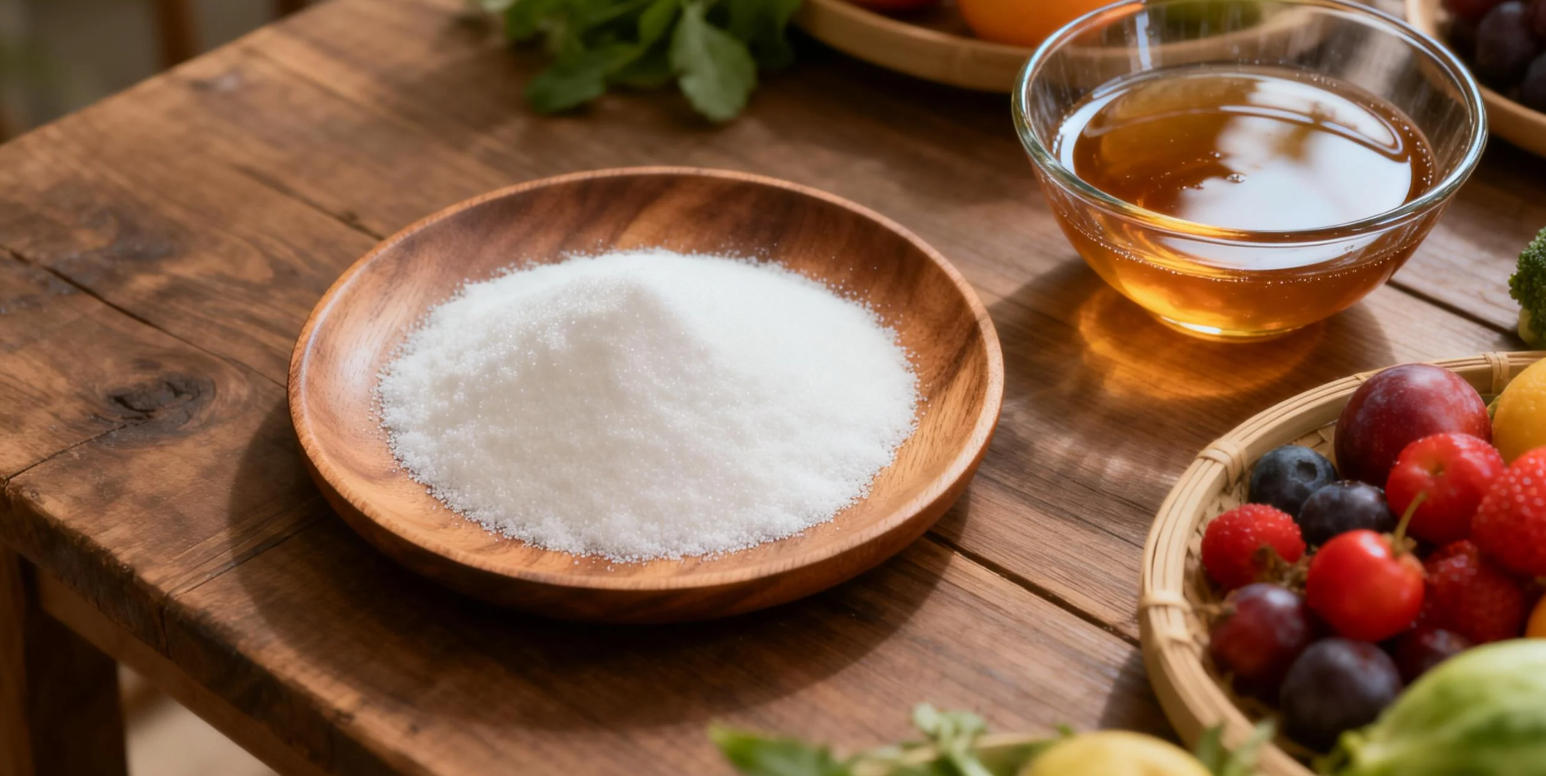
Choosing between organic and conventional dextrose powder is a strategic decision that extends far beyond ingredient cost. For manufacturers operating in premium market segments — clean-label beverages, organic sports nutrition, functional foods, and infant nutrition — organic dextrose powder is not an option but a prerequisite for category participation.
The procurement framework outlined in this guide emphasizes a systematic approach: define your technical requirements clearly, verify certification integrity rigorously, evaluate suppliers across four structured pillars, and prioritize supply reliability in your final decision.
The lowest price is rarely the best price when the hidden costs of reformulation, regulatory non-compliance, or supply disruption are factored in. Select suppliers who treat you as a strategic partner, not a transactional buyer.
Recommended Products

Organic Dextrose Powder
Available in two crystalline forms — Organic Dextrose Monohydrate (CAS 5996-10-1, ≥99.5% purity) and…
Related Posts


