
Table of Contents
The scientific name of Chaga is Inonotus obliquus, a sterile conk-forming medicinal fungus that belongs to the Hymenochaetaceae family. It is a parasitic sclerotium that grows almost exclusively on living white birch trees (Betula pendula and Betula pubescens), appearing as a dense, charcoal-black mass of irregular shape on the trunk. Unlike a typical mushroom with a cap and stem, Chaga presents as a dark, cracked crust that resembles burnt coal on the outside while revealing a reddish-brown, cork-like interior. It is a genuinely wild resource that cannot be cultivated on a commercial scale in the way that shiitake or oyster mushrooms are farmed, which is precisely why its habitat and harvest cycle carry such economic and ecological weight. It is mainly distributed across the boreal birch forests of Siberia and the Far East of Russia, where the long, severe winters and short growing seasons concentrate its bioactive compounds. It is also produced in a small amount in Hokkaido in northern Japan, in parts of North Korea, and in the Greater Khingan range of Heilongjiang province in China, though the Russian harvest still dominates global supply in both volume and research depth.
Relying on the vast birch forests stretching across several million square kilometres and the natural advantages of abundant Chaga resources, Russia has become the country with the most in-depth, longest-running research on Chaga and the single most productive country in the world. Russian phytotherapists, oncologists, and food scientists have studied the fungus since the mid-twentieth century, and the national pharmacopoeia formally recognised Chaga preparations decades ago. With the increasing number of Russian Siberian Chaga exporting countries, and with global demand rising for natural immune-support and metabolic-health ingredients, what are the real application prospects and emerging trends? The answer lies in a combination of traditional folk use, modern clinical interest, and a fast-growing nutraceutical and cosmetics market that is learning how to standardise a wild raw material into reproducible, saleable products.
“Chaga has been used in Russia for a long time, going back generations in the rural north. In previous studies, its greatest improvement to the human body lies in gastrointestinal diseases, which can significantly regulate human gastrointestinal dysfunction and imbalance, easing conditions such as gastritis, duodenal ulcers, and functional dyspepsia. In the recent period, most of the research direction has turned to Chaga’s research on diabetes and tumors, because clinicians are looking for safe adjuvants that can be taken alongside conventional therapy without heavy side effects.” said Liudmila, senior chief physician and professor of plant therapy applications at Irkutsk State Hospital, Russia. She explains that the shift reflects both patient demand for complementary approaches and a maturing body of laboratory evidence, including in-vitro and animal studies that point to measurable biological activity worth translating into human trials.
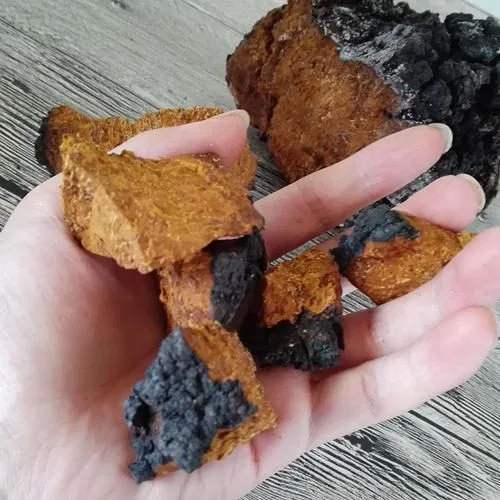
More than 200 active ingredients, and multiple health values.
The book “Exploring the medicinal fungi of Chaga from Siberia” records that there have been as many as 215 effective chemical active ingredients of Chaga identified across various studies. This unusually broad phytochemical profile is one reason Chaga is treated less like a single-ingredient supplement and more like a complex botanical matrix. The main reports are polysaccharides, triterpenes, steroids, polyphenols, and flavonoids, each contributing different mechanisms of action. The water-soluble polysaccharides, especially beta-glucans of the beta-1,3 / beta-1,6 type, are the most studied fraction and are associated with immune modulation. The triterpenes, including betulin and betulinic acid that Chaga draws from birch bark, are linked to anti-inflammatory and cell-protective effects. Polyphenols and flavonoids supply antioxidant capacity that helps neutralise free radicals generated by everyday metabolism and environmental stress.
Compounds and lignans and other components, most of which have successfully separated monomers from Chaga and identified their structures through chromatography and spectroscopy. Researchers have isolated specific melanins from the black outer crust that contribute to the fungus’s radical-scavenging power, and the lignan profile helps explain its traditional role in liver and digestive support. According to Liudmila, after diabetic patients use Siberian Chaga extract, the hypoglycemic effect is very obvious, and it can obviously restore the patient’s body function by supporting more stable glucose handling and reducing the metabolic strain of fluctuating blood sugar. Positive records and related certifications show that Chaga has effects on the rectum, intestine, and tumors on the stomach, including the lungs, have a significant effect, which is why it is studied as a supportive agent rather than a standalone cure. The consistency of these observations across Russian clinical literature is what gives the fungus its enduring reputation.
Russian doctors will recommend and instruct patients to take Siberian Chaga extract as an important auxiliary method for the treatment of tumors. Taking Siberian Chaga extract during treatment will significantly improve immunity and anti-fatigue ability, and improve the work efficiency of the body, helping patients maintain strength and appetite through demanding courses of therapy. In addition, recent studies in Russia have also found that regular use of Siberian Chaga extract has significant effects on some unexplainable diseases and very difficult skin diseases, where its anti-inflammatory and soothing properties are valued; Chaga extract also has a definite therapeutic effect on various types of leukemia according to several published observations, which has renewed interest in isolating its active fractions for clearer dosing. Chaga can also improve the vitality of the brain, and has significant effects on improving brain information exchange, relieving brain fatigue and brain cell regeneration, an area tied to its antioxidant protection of neural tissue. This has become another new direction in the study of Chaga, with researchers examining cognition, mood, and stress resilience as plausible benefits of long-term, low-dose use.
“The northern peoples in our area have a long history of using Chaga, and it was there in ancient times. They don’t know what exactly Chaga contains, but their experience passed down from their ancestors believes that it contains a very good body for humans, a comprehensive nutrient substance that sustained them through harsh winters.” said Igor, an old man living in Irkutsklin District, Russia. Local people often collect Chaga from the forest area, chop it up and make tea, simmering the broken pieces slowly to draw out colour and bitterness. It is an ancient folk medicine for treating children’s gastrointestinal diseases, prized because it is gentle and familiar. Local women often use the decoction of Chaga to wash their hair with water, which can help hair care by calming the scalp and adding shine, a tradition now being studied for its polyphenol content. International cosmetics brands began to use Chaga to develop beauty products, formulating it into serums, creams, and masks that market its antioxidant and soothing profile to consumers who want plant-based active ingredients with a story rooted in the wild north.
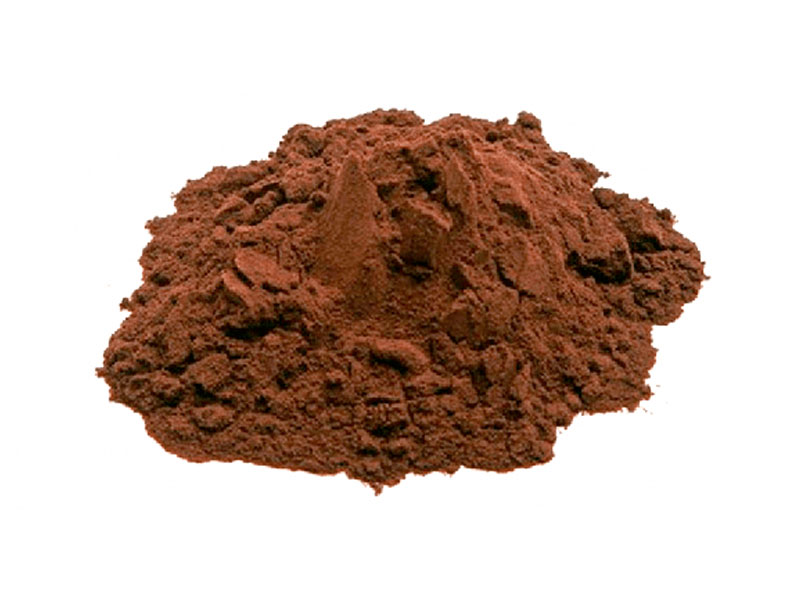
The use of Chaga has its own health and treatment.
Chaga grows in the cold zone of high latitudes, and it continues to absorb nutrients from birch trees and grows until the birch trees dry up and die, at which point the sclerotium is spent and the host is lost. Chaga grows very slowly, and its life span is more than 10-15 years before it is effective, meaning a harvested piece has accumulated a decade or more of birch-derived compounds. Therefore, the collection of Chaga and the selection of Chaga raw materials are quite particular, because immature pieces lack the density and active load of older growth, and over-harvesting weakens the forest. Sustainable sourcing matters: responsible suppliers take only mature conks, leave younger ones to keep growing, and track the region and age of each batch so buyers receive a consistent, traceable raw material rather than a mixed unknown lot.
One is to judge the quality of its block size, color, and other appearance, and the other is to detect the content of active ingredients through professional testing equipment such as HPLC and UV spectroscopy. A dense, dark, well-aged chunk with a rich rust-coloured interior is generally preferred over a pale, lightweight piece. Regarding the choice of Chaga products, Liudmila said, “If it is not for the treatment of serious diseases such as tumors and diabetes, but for health preservation and for minor illnesses and pains, you can choose crude Chaga products, such as Chaga tea bags, or I go to the forest to collect Chaga and make tea at home, because a simple daily brew is enough for general wellness and is easy to prepare.” Crude forms keep the full matrix of compounds and suit people who want a mild, food-like routine they can sustain for months.
However, if it is used for the auxiliary treatment of diseases, it is recommended to choose the Siberian Chaga extract that uses modern extraction technology. Its purity is high, and its efficacy is guaranteed through standardised concentration of the active fractions, so the user knows the strength of each serving. Dosage guided by doctors, because adjuvant use alongside prescribed therapy should be coordinated with a clinician who understands the patient’s condition and medications.” In the post-epidemic era, Chaga will become a new choice for adjuvant treatment of health preservation, tumors, and three-high chronic diseases, as more people look for natural options that fit alongside conventional care. The trend points toward better standardisation, clearer labelling of beta-glucan and triterpene content, and wider availability of both traditional crude Chaga and high-purity extracts, giving consumers and practitioners a fuller, more accountable range of choices built on a wild resource that Russia has studied longer and deeper than anywhere else in the world.