
Table of Contents
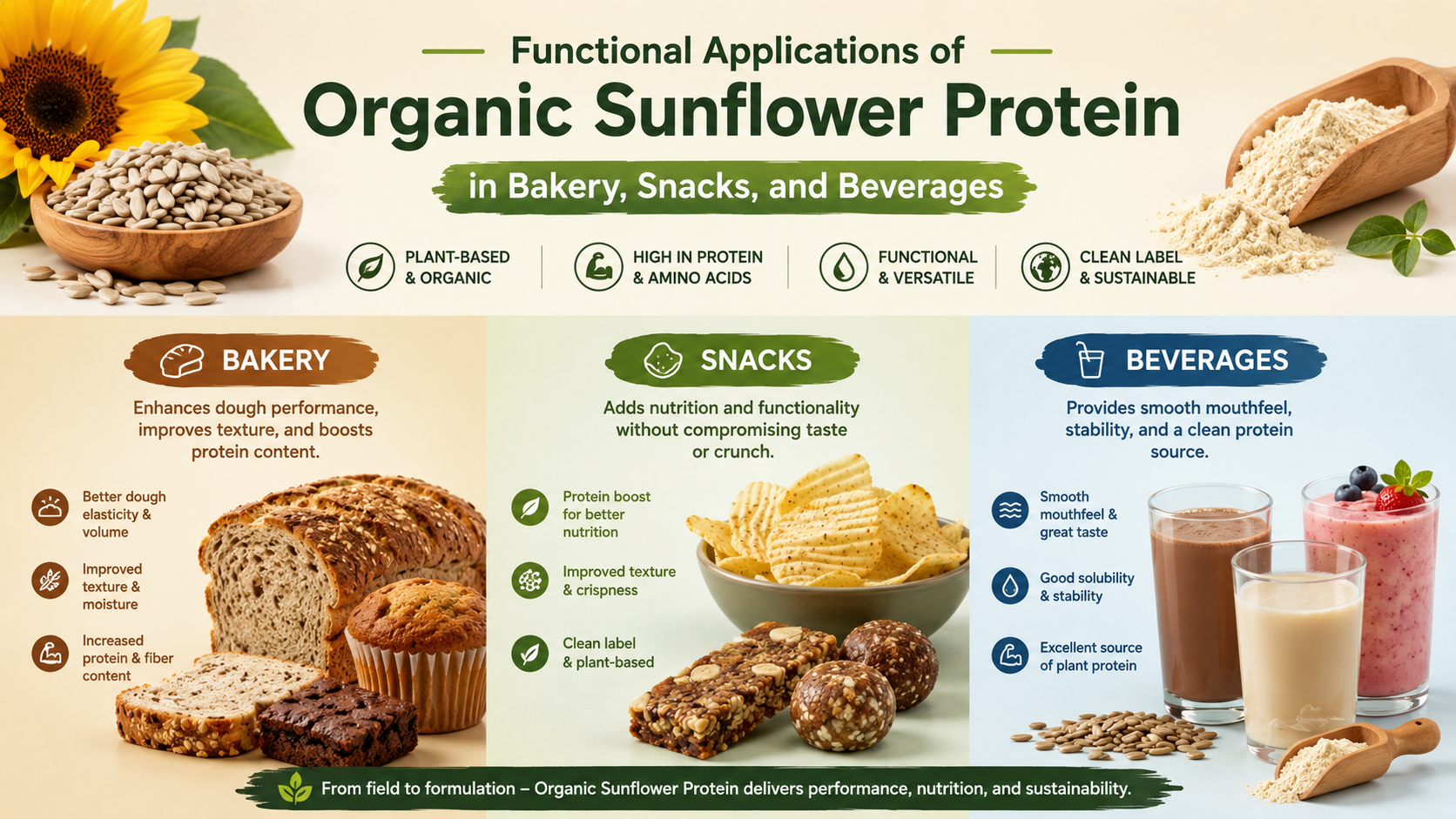
Functional ingredient selection is the technical foundation of successful food product development. In the context of protein enrichment — one of the most dynamic trends in food product innovation — organic sunflower protein has established itself as a high-performance ingredient across bakery, snacks, and beverage categories.
Unlike commodity proteins that require extensive formulation engineering to overcome functional or sensory limitations, organic sunflower protein delivers multiple functional benefits in a single ingredient: water binding, emulsification, thermal stability, neutral flavor, and clean-label compatibility. This combination enables product developers to achieve protein enrichment objectives without compromising the sensory qualities or ingredient simplicity that define premium food products.
This technical guide provides formulation professionals, R&D scientists, and procurement managers with detailed application guidance for organic sunflower protein across bakery, snacks, and beverages — covering ingredient selection criteria, incorporation strategies, processing considerations, and optimization parameters.
Functional Properties Overview
Understanding the fundamental functional behaviors of organic sunflower protein is prerequisite to effective application across food categories.
Water Binding and Hydration
Organic sunflower protein exhibits strong water absorption and water-holding capacity, typically absorbing 3-4 times its weight in water. This property is critical in formulations where moisture control determines product quality, shelf life, and consumer acceptance.
Mechanism: Protein molecules interact with water through both hydrophobic interactions (at protein surfaces) and hydrogen bonding (at polar amino acid residues). Sunflower protein’s amino acid composition — including relatively high proportions of polar amino acids — supports strong hydration behavior.
Key parameters for formulators:
- Water absorption index (WAI): 3.0-4.5 g water/g protein
- Optimal hydration temperature: 20-40°C for initial hydration; protein fully hydrates during thermal processing
- pH effect: Water binding capacity peaks near the protein’s isoelectric point (pH ~4.5) but remains strong across the pH range relevant to most food applications
Emulsification
The emulsification capacity of organic sunflower protein enables the formation and stabilization of oil-in-water emulsions — a critical functional requirement across dairy alternatives, beverages, and processed meat applications.
Mechanism: Surface-active protein molecules migrate to oil-water interfaces during mixing, reducing interfacial tension and forming a protective膜 (film) that prevents droplet coalescence. Sunflower protein’s amphiphilic character — combining hydrophobic and hydrophilic amino acid sequences — makes it an effective emulsifier without requiring chemical modification.
Emulsification performance indicators:
- Emulsifying activity index (EAI): 35-50 m2/g (concentrate grade)
- Emulsion stability: >85% stability after 24 hours at room temperature (in standard oil-in-water emulsions)
- Droplet size: Fine emulsions achievable with standard high-shear mixing; d(3,2) typically 1-5 microns
Thermal Stability
For applications involving baking, extrusion, pasteurization, or retort processing, thermal stability is a critical functional requirement. Organic sunflower protein demonstrates useful functional retention across the temperature ranges typical of food processing.
| Processing Condition | Temperature Range | Functional Impact |
|---|---|---|
| Baking | 160-200°C | Partial protein denaturation; binding and water retention maintained |
| Extrusion (thermoplastic) | 120-180°C | Protein texturization achieved; extrusion parameters must be optimized |
| Pasteurization (HTST) | 72-85°C / 15-20s | Negligible functional impact |
| UHT Processing | 130-150°C / 2-5s | Minor functional impact with isolate grade |
| Retort | 121°C / 15-40min | Moderate functional impact; recommend isolate grade for retort applications |
Solubility Profile
The solubility of organic sunflower protein determines its suitability for beverage applications and influences the texture of wet formulations.
| Product Form | Protein Dispersibility Index (PDI) | Best pH Range |
|---|---|---|
| Isolate | 70-90% | pH 6-8 (high); pH 3-4 (moderate) |
| Concentrate | 40-60% | pH 6-8 |
Bakery Applications
Protein-Enriched Bread and Muffins
Incorporating organic sunflower protein concentrate into bread and muffin formulations enables protein enrichment without disrupting crumb structure, flavor balance, or consumer acceptance.
Formulation targets:
- Target protein content: 12-18% of flour weight (vs. ~8-10% in standard white bread)
- Recommended inclusion rate: 5-10% of total flour weight for concentrate grade
- Protein source combination: Sunflower concentrate + pea protein for complete amino acid profile
Processing guidance:
- Hydrate protein powder before incorporation to minimize lump formation
- Adjust water addition to compensate for sunflower protein’s high water absorption
- Mixing time may need to be extended slightly to develop gluten network around protein particles
- Baking temperature and time generally unchanged; monitor for excessive browning due to Maillard reaction with higher protein content
Quality outcomes:
- Crumb structure: Slightly denser than control at high inclusion levels; acceptable for protein bread positioning
- Shelf life: Improved moisture retention extends freshness window
- Flavor: Neutral at recommended inclusion levels; no flavor masking required below 8% flour weight
Gluten-Free Bakery
In gluten-free formulations, where the structural function of wheat gluten is absent, organic sunflower protein concentrate contributes to network formation and crumb development that mimics the texture of conventional bakery products.
Key advantages in gluten-free applications:
- Provides some cohesive network formation that partially compensates for missing gluten
- Improves water binding and moisture retention in starch-heavy gluten-free matrices
- Contributes to browning through Maillard reaction during baking
- Enables protein enrichment claims in the gluten-free market segment
Recommended combination: Organic sunflower protein concentrate + organic rice starch + organic xanthan gum or hydroxypropyl methylcellulose (HPMC)
Cookies and Pastries
Organic sunflower protein concentrate integrates effectively into cookie and biscuit formulations, enabling protein enrichment without the flavor interference associated with pea protein or the allergen concerns of soy.
Application-specific considerations:
- Drop cookies: Direct incorporation into dough; sunflower protein’s neutral flavor supports sweet cookie profiles without masking
- Bar cookies and baked bars: Provides structural coherence and moisture retention; ideal for protein-enriched snack bar applications
- Filled pastries: Functional performance as a structural component in the pastry shell or as a protein-enriched filling ingredient
Snack Applications
Protein Bars and Bites
The protein bar category presents some of the most demanding functional requirements for protein ingredients: high protein density, neutral flavor, binding and structural integrity, shelf stability, and cost efficiency. Organic sunflower protein isolate and concentrate both address these requirements effectively.
Formulation architecture:
| Component | Function | Typical Range |
|---|---|---|
| Organic sunflower protein isolate | Primary protein source, binding | 15-30% |
| Organic sunflower protein concentrate | Texture, cost optimization | 10-20% |
| Pea protein (optional) | Amino acid complement, cost | 5-15% |
| Binder system (syrups, polyols) | Cohesion, sweetness | 20-35% |
| Fat source | Texture, mouthfeel | 8-15% |
| Fiber ingredients | Nutrition, texture | 5-15% |
| Flavor system | Taste optimization | 0.5-2% |
Critical processing parameters:
- Compression force: Higher for isolate-based bars; sunflower protein’s strong binding requires optimized compression to avoid excessive hardness
- Cooling rate: Controlled cooling prevents thermal shock and cracking in finished bars
- Moisture content: Target 8-12% moisture for shelf-stable bars; sunflower protein’s water binding supports moisture retention
Key advantage over pea protein: Sunflower protein requires significantly less flavor masking than pea protein, reducing the total flavor system required and simplifying the ingredient declaration for clean-label positioning.
Extruded Snacks
Thermoplastic extrusion of organic sunflower protein concentrate enables the production of protein-enriched snacks with expanded, crispy textures — a rapidly growing market segment combining snacking indulgence with nutritional positioning.
Extrusion parameters for sunflower protein concentrate:
- Moisture content of feed: 12-18% (wet basis)
- Barrel temperature: 100-140°C (vary with desired expansion ratio)
- Screw speed: 200-400 rpm
- Die temperature: 120-160°C
Product outcomes:
- Expansion ratio: Moderate (1.5-3.0x) depending on moisture and temperature
- Texture: Crispy, acceptable for direct expansion snacks and cereal applications
- Protein content: 15-30% achievable in finished product
- Color: Slightly darker than conventional snacks; acceptable in multigrain and whole-grain positioning
Savory Coatings and Seasoning Bases
Organic sunflower protein concentrate’s binding properties enable its use as a functional component in savory snack coatings — binding seasonings, breadcrumbs, and flavor systems to extruded or baked snack substrates.
Application benefits:
- Improved seasoning adhesion reduces seasoning loss and improves cost efficiency
- Natural, clean-label coating system replaces modified starch-based coatings
- Supports allergen-free and clean-label positioning claims
Beverage Applications
Ready-to-Drink Protein Beverages
Organic sunflower protein isolate has emerged as the preferred protein ingredient for ready-to-drink (RTD) protein beverages targeting the mainstream consumer market — a category that demands high protein content, smooth mouthfeel, neutral flavor, and clean-label formulation.
Formulation targets for RTD protein beverages:
- Protein content: 15-25g per 250-350mL serving
- Viscosity: <50 mPa·s (pourable, shaker-cup compatible)
- Flavor: Clean, neutral base compatible with vanilla, chocolate, berry, and coffee flavor profiles
- pH: 6.5-7.0 (neutral); or 3.5-4.0 (acidified)
Formulation strategy:
| Ingredient | Function | Typical Range |
|---|---|---|
| Organic sunflower protein isolate | Primary protein, neutral flavor base | 3-5% |
| Organic sunflower protein concentrate (optional) | Cost optimization | 1-2% |
| Stabilizer system (optional) | Viscosity, mouthfeel | 0.1-0.3% |
| Natural flavor | Taste optimization | 0.1-0.5% |
| Sweetener system | Sweetness delivery | Variable |
| Emulsifier (for flavored products) | Flavor oil emulsion stability | 0.05-0.2% |
Critical quality parameters:
- Solubility: Ensure protein is fully dispersed in water before final mixing; use high-shear mixing or pre-hydration step
- Viscosity: Sunflower protein isolate contributes less viscosity than pea protein at equivalent protein loads, enabling higher protein concentrations in pourable formats
- pH stability: Avoid pH values near the isoelectric point (pH ~4.5) where protein solubility and stability are minimized
Plant-Based Shakes and Smoothies
Organic sunflower protein performs exceptionally well in plant-based shake and smoothie formulations where its neutral flavor enables clean fruit, vanilla, and chocolate flavor profiles without interference.
Premium positioning opportunities:
- Organic, non-GMO, allergen-free protein positioning
- Clean-label ingredient simplicity (often 5-8 ingredients vs. 15-20 in conventional protein powders)
- Superior digestibility profile for recovery and wellness positioning
Functional Drinks
Beyond traditional protein beverages, organic sunflower protein enables protein fortification in a range of functional drink formats:
- Functional waters: Mild protein enrichment (2-5g per serving) in flavored and sparkling water applications
- RTD coffee and matcha beverages: Protein fortification that does not conflict with coffee or tea flavor profiles
- Sports drinks: Combined carbohydrate-protein formulations leveraging sunflower protein’s neutral taste and solubility
Formulation Optimization: Key Parameters
Ingredient Selection by Application
| Application | Recommended Form | Key Selection Criteria |
|---|---|---|
| RTD protein beverages | Isolate (>90% protein) | Fine particle size, high dispersibility, neutral flavor |
| Protein bars (premium) | Isolate | Compression binding, flavor neutrality |
| Protein bars (value) | Concentrate | Cost efficiency, adequate functional performance |
| Extruded snacks | Concentrate | Expansion properties, color compatibility |
| Bakery (bread/muffins) | Concentrate | Water binding, neutral flavor, cost |
| Gluten-free bakery | Concentrate or Isolate | Network formation, clean label |
| Plant-based dairy | Isolate | Emulsification, smooth texture |
Cost-Performance Optimization
For brands optimizing the cost-performance ratio of sunflower protein formulations, the following strategies are effective:
Protein blending: Combine organic sunflower protein (premium flavor and functionality) with organic pea protein (cost efficiency) at ratios of 50:50 to 70:30 to achieve complete amino acid profiles at competitive total ingredient costs.
Grade optimization: Use isolate grade where functional requirements demand it (beverages, high-protein bars); use concentrate grade where cost efficiency is prioritized and functional requirements are moderate (bakery, snacks).
Process optimization: Fine-tuning mixing protocols, hydration sequences, and thermal processing parameters can significantly improve the functional contribution of sunflower protein, reducing the required inclusion rate.
FAQ
What protein content can be achieved in bakery products using organic sunflower protein?
With organic sunflower protein concentrate at 10% inclusion (flour weight basis), protein content in standard bread formulations can increase from approximately 8-10% to 14-18%. Higher inclusion levels are possible with formulation adjustments, though texture may be affected. For isolate-grade protein, similar protein enrichment is achievable at lower inclusion levels.
How does organic sunflower protein perform in gluten-free formulations?
Organic sunflower protein concentrate contributes useful functional properties to gluten-free formulations including water binding, structure building (partial replacement for gluten), and crumb development. It is not a direct substitute for gluten but provides meaningful functional contribution when combined with starch-based and hydrocolloid systems.
What is the recommended particle size for organic sunflower protein in beverage applications?
For RTD protein beverages, a fine particle size (typically <150 microns after hydration) is essential for smooth mouthfeel. ORGANICWAY’s beverage-grade sunflower protein isolate is specifically processed to achieve optimal dispersibility and minimal gritty texture in shaken or stirred beverage applications.
Can organic sunflower protein be used in UHT-processed beverages?
Yes. Organic sunflower protein isolate demonstrates good stability under UHT processing conditions (130-150°C for 2-5 seconds). Standard quality control should confirm that functional properties are maintained post-processing, as some protein denaturation is expected.
What is the shelf life of products formulated with organic sunflower protein?
Formulated products maintain quality for standard shelf life periods typical of their category (typically 6-18 months for shelf-stable products). Organic sunflower protein’s strong water-binding properties contribute to moisture retention that supports extended freshness. Best practices for packaging (moisture barrier materials, nitrogen flushing) should be followed.
Recommended Products

Organic Pea Protein Powder
Organic Pea Protein Powder Isolate is a clean-label, high-purity ingredient derived from 100% Non-GMO…
Related Posts


