Table of Contents
What is Organic Potato Starch Powder?
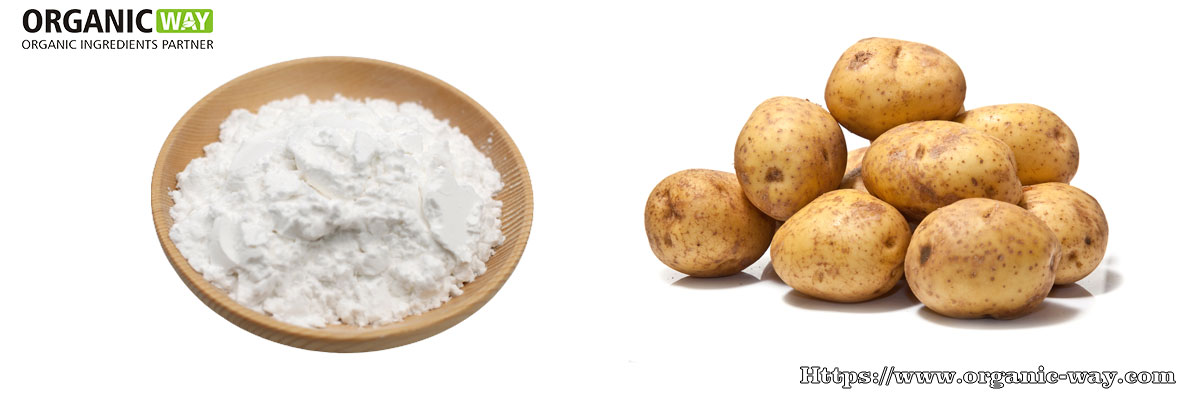
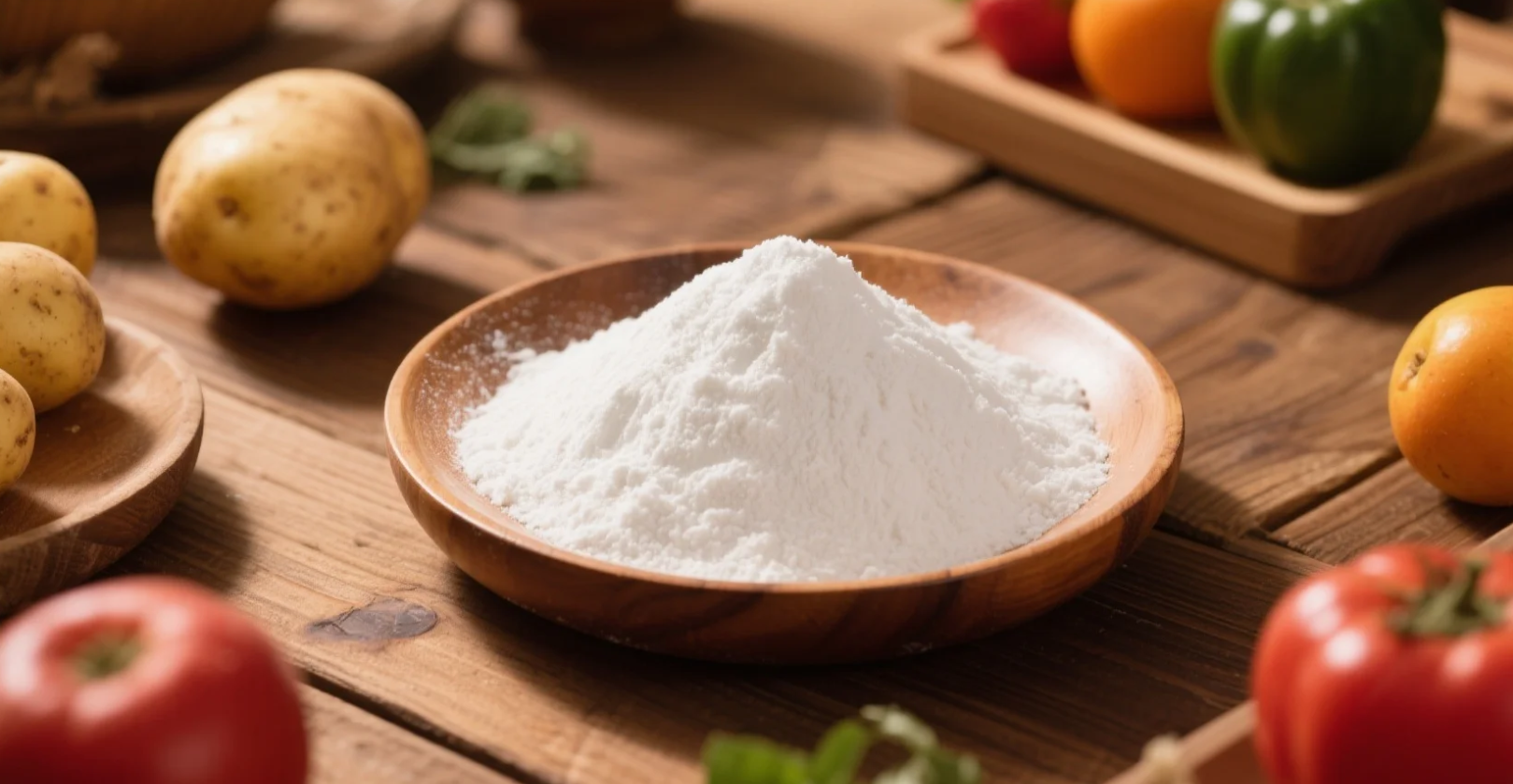
Organic Potato Starch (INCI: Solanum Tuberosum Starch; CAS: 9005-25-8; HS Code: 1108.13.0000) is a refined native carbohydrate polymer extracted from the parenchyma tissue of organically certified, non-genetically modified potatoes through mechanical wet milling. The starch granule is the largest among common commercial starches (10–100 μm; D50 ≈ 40 μm), giving it unique functional properties that distinguish it from corn, tapioca, and rice starch.
Composition: Why Amylose Content Matters
The functional character of potato starch is determined by its amylose-to-amylopectin ratio. Potato starch contains approximately 18–20% amylose (vs. 23–27% in corn starch) and approximately 80–82% amylopectin. This lower amylose content is the structural reason behind potato starch’s three signature properties:
- Paste Clarity: The lower amylose content and larger granule size produce a glassy, transparent paste with 75–90% light transmittance — significantly higher than corn starch (60–75%). This is why clear fruit sauces and jellies require potato starch.
- Gel Elasticity: Amylopectin-dominant gels are long, cohesive, and elastic rather than short and firm. Potato starch gels can be cut cleanly without crumbling, making it ideal for restructured meat products, plant-based proteins, and jelly confectionery.
- Peak Viscosity: Potato starch achieves the highest peak viscosity of all common native starches. In practice, this means 20–30% less potato starch is required to achieve the same viscosity as corn starch, reducing ingredient cost in high-volume applications.
Gelatinization Temperature Advantage
Potato starch gelatinizes at 58–67°C — 4–5°C lower than corn starch (62–72°C). This lower gelatinization temperature offers two operational advantages: (1) energy savings in processes requiring heating, and (2) thermal protection for heat-sensitive flavors, colors, or probiotic cultures in the formulation. However, it also means potato starch is more susceptible to premature swelling in humid storage environments (relative humidity > 65%).
Certifications Available
USDA Organic, EU Organic, Non-GMO Project Verified, Gluten-Free (GFCO certified), Kosher, Vegan.
Minimum Order Quantity
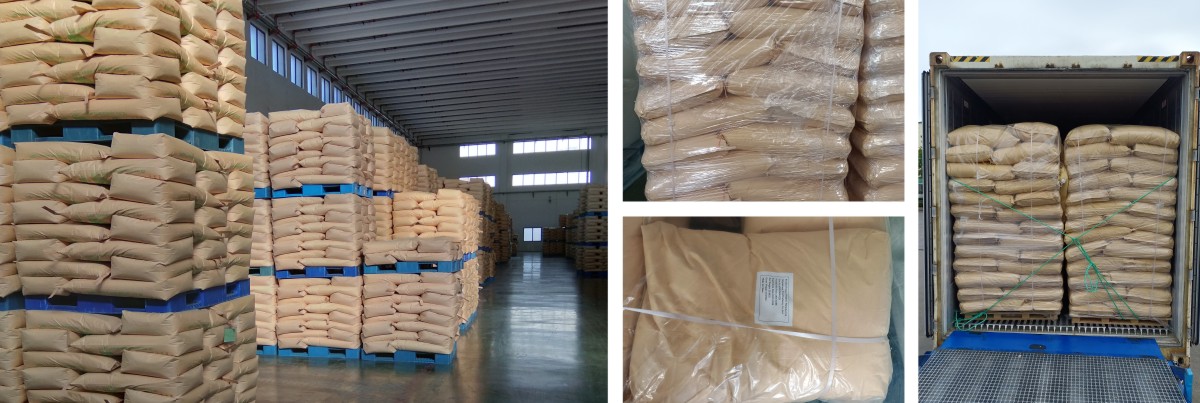
Samples available for specification verification. Commercial volumes in 25 kg kraft paper bags with PE liner; 40 bags per pallet (1 MT/pallet). Contact sales@organic-way.com for quotation and lead time.
PHYSICAL & CHEMICAL PROPERTIES
Product Specifications
| Parameter | Specification | Test Method |
|---|---|---|
| Starch Content | ≥ 98% (dry basis) | Polarimetry |
| Moisture Content | ≤ 18% | ISO 1666 / AOAC 925.10 |
| Ash Content | ≤ 0.30% (dry basis) | ISO 3595 / AOAC 923.03 |
| pH (10% slurry) | 5.0 – 8.0 | ISO 554 |
| Gelatinization Temperature | 58°C – 67°C (136°F – 153°F) | DSC |
| Gelatinization Enthalpy | 12–18 J/g | DSC |
| Amylose Content | ~18–20% | Iodine colorimetry |
| Particle Size | 10–100 μm (D50 ≈ 40 μm) | Laser diffraction |
| Bulk Density | 0.80–0.95 g/mL (tap) | Tapped density |
| Whiteness (CIE L*) | ≥ 90% | Colorimetry |
| SO2 Residue | < 10 ppm | EPA 8.1 / ion chromatography |
| Heavy Metals — Lead (Pb) | ≤ 0.5 mg/kg | ICP-MS |
| Heavy Metals — Arsenic (As) | ≤ 0.5 mg/kg | ICP-MS |
| Heavy Metals — Cadmium (Cd) | ≤ 0.1 mg/kg | ICP-MS |
| Dietary Suitability | Vegan, Gluten-Free, Non-GMO, Organic | — |
| HS Code | 1108.13.0000 | — |
Sensory Profile
| Property | Description |
|---|---|
| Color | Bright white powder; whiteness ≥ 90% (CIE L*) |
| Odor | Neutral, clean |
| Taste | Neutral, no off-notes |
| Appearance | Ultra-fine, free-flowing powder |
Why Peak Viscosity Is the Key Differentiator
Organic potato starch achieves the highest peak viscosity among common native starches. This has direct cost implications for formulators:
- 20–30% less product required compared to corn starch to achieve equivalent viscosity
- Significant cost-per-batch advantage in high-volume applications (sauces, meat processing, extruded snacks)
- Confirm exact dosage by bench-top pilot test — viscosity varies with shear rate, pH, and solids content
Amylose vs. Amylopectin Profile — Functional Impact
| Property | Organic Potato Starch | Organic Corn Starch (reference) |
|---|---|---|
| Amylose | ~18–20% | ~23–27% |
| Amylopectin | ~80–82% | ~73–77% |
| Gel texture | Long, elastic, cohesive | Short, firm, less elastic |
| Paste clarity | Very high (75–90% T) | Moderate (60–75% T) |
| Freeze-thaw stability | Poor (2–3 cycles) | Moderate (3–4 cycles) |
| Gel strength | Lower firmness, more elastic | Higher firmness, more rigid |
| Film-forming | Moderate | Good |
| Price positioning | Slightly above corn starch | Baseline |
MICROBIOLOGICAL & CONTAMINANT STANDARDS
Microbiological Limits
| Test | Specification | Method |
|---|---|---|
| Total Plate Count (TPC) | ≤ 10,000 CFU/g | ISO 4833 |
| Yeast & Mold | ≤ 500 CFU/g | ISO 7954 |
| E. coli | Negative / absent | ISO 16649 |
| Salmonella | Negative / 25g | ISO 6579 |
Regulatory Approvals by Market
| Jurisdiction | Status | Reference |
|---|---|---|
| United States (FDA) | GRAS; permitted as “Potato Starch” | 21 CFR Part 184 |
| European Union | Permitted food starch; “Potato starch” | Reg (EU) 1169/2011 / Reg 231/2012 |
| China (GB) | Listed as “马铃薯淀粉” | GB/T 8884-2017 |
| Japan (JSFA) | Listed | Japan Standards for Food Additives |
| Codex Alimentarius | Permitted as unmodified starch | GSFA Table 3 |
| Australia/New Zealand (FSANZ) | Permitted | Schedule 15 |
SO2 Residue and EU “Sulphite-Free” Labeling
Organic potato starch consistently tests below 10 ppm SO2 — well below the EU threshold of 10 mg/kg (10 ppm) for “sulphite-free” label claims under Reg (EU) 1169/2011 Annex II. Confirm the specific batch COA for exact SO2 values if your formulation or label claims require it.
CERTIFICATIONS
| Certification | Status |
|---|---|
| USDA Organic (NOP) | Available |
| EU Organic (2018/848) | Available |
| Non-GMO Project Verified | Available |
| Gluten-Free (GFCO) | Available |
| Kosher | Available |
| Vegan | Available |
| FSSC 22000 / ISO 22000 | Available |
COA, Organic Transaction Certificate, and Non-GMO certificate provided per batch. All certificates issued against the specific production batch.
APPLICATIONS & USAGE GUIDELINES
Recommended Application Sectors
| Application | Typical Dosage | Key Benefits | Notes |
|---|---|---|---|
| Meat & Sausage Processing | 1–3% (w/w) | Moisture retention, binding, elastic texture | Ion content enhances protein adhesion |
| Gluten-Free Bread & Muffins | 5–15% (flour weight) | Crumb softening, texture, moisture retention | Combine with 0.5–1% xanthan gum |
| Clear Sauces & Gravies | 1.5–3% (w/w) | High viscosity, excellent clarity, neutral flavor | Add at ≥ 70°C; avoid pH < 4.5 |
| Fruit Fillings & Pie Fillings | 3–5% (w/w) | Exceptional clarity, smooth gel, glossy finish | Excellent for berry/apple fillings |
| Jelly Candies & Fruit Gels | 2–4% (w/w) | Soft, transparent gel, clean release | Low amylose = soft gel texture |
| Extruded Snacks & Crackers | 3–8% (w/w) | Expansion control, crispness, binding | Low gelatinization temp saves energy |
| Shredded Cheese Anti-Caking | 0.5–1% (w/w) | Free-flow, moisture absorption prevention | Superior to corn starch in cheese |
| Noodles & Gluten-Free Pasta | 3–10% (w/w) | Binding, cooking tolerance, texture | Test freeze-thaw stability |
| Cosmetics (Body Powder) | Variable | Natural talc replacement, absorbency | Food-grade required |
Gelatinization Temperature: Practical Implication
Potato starch gelatinizes at 58–67°C — 4–5°C lower than corn starch (62–72°C). This provides two operational advantages:
- Energy savings in processes requiring heating above gelatinization temperature
- Thermal protection for heat-sensitive flavors, colors, or probiotic cultures
However, the lower gelatinization temperature also means potato starch is more susceptible to premature swelling during storage in humid climates (relative humidity > 65%). Request moisture-barrier packaging for tropical destinations.
Acid Sensitivity: Key Formulation Rule
Native potato starch is sensitive to low pH and prolonged cooking. Follow these guidelines:
| pH Range | Stability | Recommendation |
|---|---|---|
| pH ≥ 4.5 | Full stability | No special precautions |
| pH 4.0–4.5 | Moderate sensitivity | Add starch slurry at end of cooking cycle; brief hold |
| pH < 4.0 | Not recommended | Use organic modified potato starch or organic tapioca starch |
Freeze-Thaw Stability: Known Limitation
Native potato starch has poor freeze-thaw stability due to its low amylose content and high swelling capacity. Maximum recommended cycles:
| Freeze-Thaw Cycles | Result | Recommendation |
|---|---|---|
| 1–2 cycles | Acceptable | Monitor texture |
| 2–3 cycles | Noticeable gel breakdown, weeping | Acceptable for short-term frozen products |
| > 3 cycles | Significant syneresis | Use organic modified potato starch or organic tapioca starch |
Organic Modification Options
Organic regulations permit limited physical and biological modification without synthetic chemicals:
| Modification Type | Effect | Label Declaration | Freeze-Thaw |
|---|---|---|---|
| Organic Native | Baseline viscosity, clarity | “Organic Potato Starch” | 2–3 cycles |
| Organic Pregelatinized | Cold-water swelling; instant viscosity | “Organic Pregelatinized Potato Starch” | Limited improvement |
| Organic Heat-Moisture Treated | Reduced swelling, improved shear stability | “Organic Heat-Moisture Treated Potato Starch” | Up to 4 cycles |
| Organic Hydroxypropyl | Freeze-thaw up to 5 cycles, acid-stable | “Organic Modified Potato Starch” / “Hydroxypropylated” | Up to 5 cycles |
FAQ
Q1: How much potato starch do I need to replace corn starch in my formula?
A: Generally, 20–30% less potato starch is needed to achieve equivalent viscosity due to its higher peak viscosity. However, this varies significantly with pH, shear, temperature, and the specific matrix. Run a pilot bench test at three dosage levels (1.5%, 2.0%, 2.5%) to determine the precise substitution rate for your formula. For meat-processing applications, start at 1.5% and titrate upward.
Q2: Is organic potato starch safe for consumers with celiac disease?
A: Yes. Potato starch contains negligible protein (< 0.1%) and is inherently gluten-free. It is certified gluten-free by GFCO or equivalent bodies at < 20 ppm. It is widely used in gluten-free baking and is considered safe for celiac consumers. The trace protein content is significantly below the threshold that triggers reactions in celiac-sensitive individuals.
Q3: Can organic potato starch be used in frozen foods?
A: Native organic potato starch is not recommended for products requiring more than 2–3 freeze-thaw cycles due to syneresis (water weeping from the gel matrix). For frozen products (frozen pizzas, frozen sauces, ice cream inclusions), use organic modified potato starch (hydroxypropylated) or organic tapioca starch instead, both of which offer superior freeze-thaw stability (up to 5–6 cycles).
Q4: How does potato starch perform in high-acid formulations (pH < 4.5)?
A: Native potato starch is acid-sensitive. For products below pH 4.5 (pickled products, acidic RTD beverages, fermented sauces), either: (1) add the starch slurry at the end of the cooking cycle to minimize exposure time, or (2) switch to organic modified potato starch with proven acid stability. For RTD beverages at pH < 4.0, organic modified starch is strongly recommended.
Q5: What documentation is available to confirm organic and non-GMO status?
A: Request the following documents from your supplier: Organic Certificate (USDA NOP and/or EU organic), Non-GMO Project Verified certificate, batch-specific COA (including SO2, moisture, ash, pH, microbial results), and if required by your market, a third-party PCR (Protein Characterisation Report) or Test/Bad Seed report for non-GMO compliance. Organic Transaction Certificates are required to support your finished product’s organic certification.
Q6: Why does potato starch produce clearer gels than corn starch?
A: Potato starch has a lower amylose content (~18–20% vs. 23–27%) and a larger granule that swells more completely during gelatinization. The resulting paste scatters less light, producing a glassy, transparent appearance. This is the structural reason behind its superior paste clarity — the key differentiator for clear sauces, fruit fillings, and confectionery jellies where visual appeal matters.
Q7: Does the source potato variety affect starch performance?
A: Starch functionality varies somewhat between varieties (waxy vs. amylose-rich), but certified organic potato starch is blended to meet consistent specification parameters (viscosity, amylose, moisture, pH). For critical applications requiring precise varietal specifications, discuss with your supplier to confirm whether a single-variety or blended product is supplied.
PACKAGING & STORAGE
Packaging Options
| Package Size | Format | Packaging Material | MOQ |
|---|---|---|---|
| 1 kg | Powder | Aluminum foil pouch | Trial |
| 5 kg | Powder | Kraft paper bag + PE liner | Trial |
| 25 kg | Powder | Multi-wall kraft paper bag + PE liner | Standard |
| 1 MT | Powder | Big bag (FIBC) / palletized | Commercial |
| Custom | Powder | Bulk / containerized | Commercial |
All packaging materials comply with EU 10/2011 and FDA 21 CFR food-contact regulations. Custom labeling and COA customization available for contracted supply programs.
Storage Conditions
- Storage temperature: ≤ 25°C (cool, dry environment)
- Relative humidity: ≤ 65% RH
- Humidity warning: Potato starch absorbs moisture readily above 65% RH. In tropical climates or during monsoon seasons, pre-gelatinization or clumping may occur during storage. Request moisture-barrier packaging (PE-lined bag + outer kraft) for high-humidity destinations.
- Avoid: Moisture, humidity, strong odors, direct sunlight
- Shelf life: 24 months from manufacturing date (sealed, unopened)
- Flowability: Good; may require anti-caking agent in high-humidity long-term storage
Related Articles
Selecting the Ideal Organic Potato Starch Powder for Your B2B Needs: A Strategic Guide for Businesses
In the competitive landscape of food manufacturing, pharmaceuticals, and industrial applications, sourcing…
How Organic Potato Starch Powder Enhances Texture and Stability in Processed Foods
In the modern food industry, consumers are increasingly looking for clean-label products…
Top 5 Applications of Organic Potato Starch Powder in Gluten-Free Baking
The demand for gluten-free baked goods is growing rapidly as more consumers…
Why Choose Organic Potato Starch Powder as a Clean-Label Thickener for Your Food Products?
In today’s food industry, clean-label ingredients are no longer a trend—they’re a…