
Table of Contents
What is Organic Pea Protein Powder?
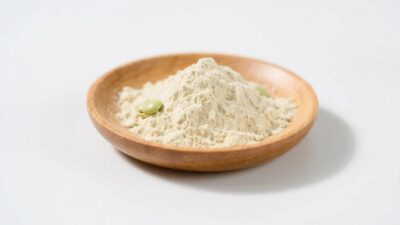
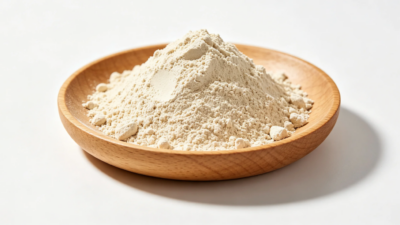
Organic pea protein powder isolate is a plant-based protein ingredient extracted from certified organic yellow peas (Pisum sativum) using a proprietary cold-water aqueous extraction process — no hexane, no chemical solvents, no heat damage. The starch and fiber fractions are removed, leaving a concentrated, highly bioavailable protein with a neutral-to-mild flavor profile that blends seamlessly into formulations.
Why Pea Protein Leads the Plant-Based Market
Pea protein has become the reference standard for plant-based protein formulation for several measurable reasons:
- PDCAAS of 0.82–0.89 — the highest among single-source plant proteins (vs. rice at 0.47, hemp at 0.66)
- Rich in lysine — a limiting amino acid in many cereals, making pea protein an ideal complement in blended systems
- Genuinely hypoallergenic — free from the Big 9 allergens (soy, dairy, gluten, tree nuts, peanuts, shellfish, fish, eggs, sesame)
- UHT-stable — maintains functional integrity under ultra-high temperature processing, enabling deployment in shelf-stable beverages
- Low sodium specification — our aqueous extraction minimizes sodium-based pH adjusters; ≤500mg/100g available
Production Process — Traceability from Farm to Powder
All raw yellow peas are sourced from certified organic farms under USDA NOP and EU Regulation (EC) No 834/2007. The production chain covers:
- Organic farm certification audit
- Incoming raw material mycotoxin + pesticide residue screening
- Cold aqueous extraction (30–45°C, no solvent)
- Membrane filtration + centrifugal separation
- Spray-drying at controlled inlet temperatures (≤180°C)
- Inline microbial monitoring + finished-goods COA
- Third-party heavy metal verification (Pb, As, Cd, Hg; Prop 65 compliant)
Functional Applications Summary
| Application | Recommended Form | Addition Level |
|---|---|---|
| Sports Protein Shakes | 80% or 85% Isolate | 15–30g/serving |
| Meat Analogues (burger, nugget) | 80% Isolate | 8–15% of formula |
| Dairy Alternatives (oat milk, yogurt) | 85% Isolate | 2–5% of formula |
| Baked Goods (protein bread, bar) | 80% Isolate | 3–8% of formula |
| Infant/Toddler Nutrition* | 85% Isolate | Per regulatory limit |
| Ready-to-Drink (UHT) Beverages | 85% Isolate | 2–4% of formula |
*Subject to local infant formula regulations; confirm with regulatory team before use.
Technical Specifications
Standard Grade Comparison
| Parameter | 80% Isolate | 85% Isolate | Test Method |
|---|---|---|---|
| Protein (dry basis) | ≥ 80.0% | ≥ 85.0% | Kjeldahl / Dumas |
| Moisture | ≤ 8.0% | ≤ 7.0% | AOAC 930.15 |
| Fat | ≤ 5.0% | ≤ 4.0% | Soxhlet |
| Ash | ≤ 6.5% | ≤ 6.0% | AOAC 942.05 |
| Fiber | ≤ 3.0% | ≤ 2.5% | AOAC 985.29 |
| Carbohydrates | ≤ 5.0% | ≤ 4.0% | By difference |
| Sodium | ≤ 500mg/100g | ≤ 400mg/100g | ICP-MS |
| Particle Size | 100–200 mesh | 100–200 mesh | Sieve analysis |
| Color | Light yellow | Light yellow | Visual |
| Odor | Mild, neutral | Mild, neutral | Sensory |
| Solubility | ≥ 85% | ≥ 90% | NSI method |
Microbiological Specifications
| Parameter | Specification | Test Method |
|---|---|---|
| Total Plate Count | ≤ 10,000 CFU/g | ISO 4833 |
| Yeast & Mold | ≤ 100 CFU/g | ISO 21527 |
| Coliform | ≤ 10 CFU/g | ISO 4832 |
| E. coli | Negative/25g | ISO 16654 |
| Salmonella | Negative/25g | ISO 6579 |
| Staphylococcus aureus | Negative/25g | ISO 6888 |
Heavy Metals & Contaminants
| Parameter | Specification | Standard |
|---|---|---|
| Lead (Pb) | ≤ 0.5 mg/kg | Prop 65 / EU 2021/1323 |
| Arsenic (As) | ≤ 0.3 mg/kg | Prop 65 |
| Cadmium (Cd) | ≤ 0.1 mg/kg | EU Regulation |
| Mercury (Hg) | ≤ 0.05 mg/kg | Prop 65 |
| Mycotoxins (Total) | ≤ 4 μg/kg (AFB1) | EU 2023/915 |
| Pesticide Residues | ND (per EC 396/2005) | Multi-residue GC-MS/MS |
Certifications
| Certification | Issuing Body | Scope |
|---|---|---|
| USDA Organic | USDA NOP (via accredited certifier) | Production + processing |
| EU Organic | EU Reg. (EC) No 834/2007 | Import + sale in EU |
| Non-GMO Project Verified | Non-GMO Project | Raw material + finished product |
| Kosher | KSA / OU (lot-specific) | Processing plant |
| Halal | IFANCA / MUI (lot-specific) | Processing plant |
| Gluten-Free | GFCO (< 10 ppm gluten) | Finished product testing |
| FSSC 22000 | Bureau Veritas | Manufacturing facility |
All certificates available upon request. Lot-specific COAs include certificate numbers and validity dates.
Applications & Formulation Guidance
Primary Application Areas
| Application | Why Pea Protein Works | Typical Addition |
|---|---|---|
| Sports Nutrition (RTD/Shake/Bar) | High BCAA, fast digestion, neutral flavor, UHT-stable | 20–30g/serving |
| Plant-Based Meat (Burger/Nugget/Sausage) | High water-holding capacity, texturization with extrusion | 8–15% of blend |
| Dairy Analogues (Yogurt/Cheese) | Gelling properties, neutral background flavor | 2–6% of blend |
| Infant / Toddler Nutrition | Hypoallergenic, high lysine, regulatory compliance possible | Per label spec |
| Baked Goods (Protein Bread/Bar/Cookie) | Heat-stable, mixes with flour, non-greasy | 3–8% of weight |
| Pasta & Noodles | Protein enrichment without color impact | 5–10% of flour |
| UHT Liquid Beverages | Superior heat stability vs. most plant proteins | 2–4% of total |
| Animal Feed / Pet Food | Hypoallergenic, high digestibility | 5–15% of recipe |
Formulation Tips
- Flavor Masking: Mild vanilla, oat, or cocoa notes pair well; avoid high-acid (<pH 4.0) systems without emulsifier support
- Blending: Pea + rice (70:30) creates a complete amino acid profile; pea + sunflower (80:20) adds methionine coverage
- Texture: In meat analogs, use cold-hydration 30 min before extrusion; protein becomes tacky and binds at >70°C
- UHT Stability: Preheat to 65°C before UHT homogenization to prevent protein aggregation
FAQ
Q1: Does your Organic Pea Protein have a noticeable beany aftertaste?
A: Our cold aqueous extraction process operates at 30–45°C and uses no chemical solvents, which substantially reduces the concentration of saponins and other off-flavor compounds associated with legumes. In independent sensory panels, our 85% isolate consistently scores below threshold for “beany” perception at inclusion rates up to 25g per serving. For additional flavor neutralization, we can supply a debittered variant on request (MOQ 500kg).
Q2: What is the difference between your 80% and 85% Isolate grades?
A: Both are classified as isolates (>80% protein). The 85% grade undergoes additional membrane filtration to further reduce carbohydrates, ash, and sodium content. It is preferred for: (1) infant and clinical nutrition where macro precision matters, (2) high-transparency nutrition labels where lower carb counts are commercially important, and (3) UHT beverages where the lower ash content improves heat stability. The 80% grade is more cost-effective for sports bars, baked goods, and meat alternatives where the extra protein density is less critical.
Q3: How does Organic Pea Protein compare to Whey in PDCAAS and DIAAS?
A: Organic pea protein isolate achieves a PDCAAS of 0.82–0.89 (vs. whey at 1.0) and a DIAAS of 0.82 (measured in rats; human DIAAS data show 0.67–0.82 depending on reference population). While pea protein’s methionine is limiting relative to whey, the practical performance difference in muscle protein synthesis is minimal at adequate total protein intake (≥1.6g/kg/day). Academic literature (van Vliet et al., 2015; Babault et al., 2015) confirms comparable lean mass gains between pea isolate and whey isolate in resistance-trained subjects.
Q4: Is this product suitable for infant formula?
A: The 85% Isolate can be considered as a protein source in toddler (12–36 months) formulations under EU Regulation 609/2013. For standard infant formula (0–12 months), pea protein is not currently included in the EU positive list for infant formula protein sources. Customers formulating for infant nutrition must independently verify regulatory status in their target market and may require additional clinical safety substantiation.
Q5: What is the minimum order quantity (MOQ) and lead time?
A: Standard MOQ is 500kg (one pallet, 25kg kraft bags). For custom specifications (debittered, specific mesh size, specific sodium threshold), MOQ is 1,000kg. Standard production lead time is 7–14 business days from confirmed PO. Sea freight samples (500g) are available within 3–5 business days with courier tracking. Private-label packaging is available from 2,000kg.
Q6: Can pea protein be used in a Prop 65-compliant product sold in California?
A: Yes. Our Organic Pea Protein Isolate is third-party tested by SGS/Eurofins and meets Prop 65 thresholds for all four regulated heavy metals (Pb ≤0.5mg/kg, As ≤0.3mg/kg, Cd ≤0.1mg/kg, Hg ≤0.05mg/kg). Lot-specific third-party Prop 65 certificates are available upon request and are provided as standard with all California-destined shipments.
Packaging & Storage
Packaging Options
| Format | Net Weight | Material | MOQ | Use Case |
|---|---|---|---|---|
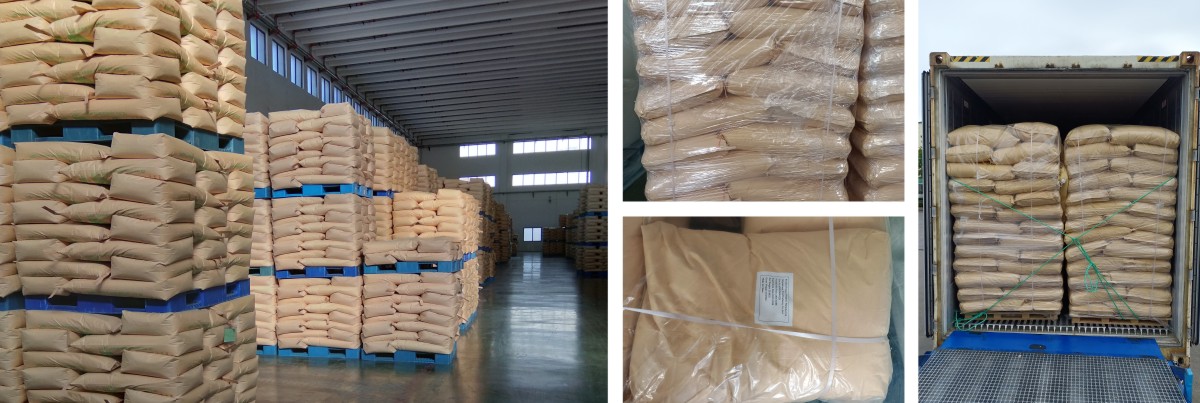
| Kraft paper bag (inner PE liner) | 25 kg | Food-grade PE + kraft | 1 pallet (500kg) | Standard B2B |
| White woven PP bag | 25 kg | FDA PP + PE liner | 1 pallet (500kg) | Export standard |
| Fiber drum | 25 kg | HDPE + lid | 1 pallet (500kg) | High-moisture regions |
| IBC tote (bulk) | 500 kg | Food-grade HDPE | 1 unit | Industrial processing |
| Custom private-label bag | 500g / 1kg / 5kg | Customer spec | 2,000kg | Retail / Amazon |
Storage Conditions
- Temperature: Store at ≤25°C (77°F)
- Humidity: Relative humidity ≤ 60%
- Light: Avoid direct sunlight exposure
- Shelf Life: 24 months from production date in original sealed packaging
- After Opening: Re-seal immediately; consume within 3 months; do not store in metal containers
Shipping Notes
- Standard palletization: 20 x 25kg bags / pallet; stretch-wrapped
- FCL (20ft): ~14 metric tons
- FCL (40ft): ~28 metric tons
- Country of Origin: China (HS Code: 3504.00.9000)
- FSVP / FDA registration documentation available for US imports