Table of Contents
What is organic cornstarch powder?
Organic Cornstarch Powder (INCI: Zea Mays Starch; CAS: 9005-25-8; HS Code: 1108.12.0000) is a refined carbohydrate polymer isolated from the endosperm of organic, non-GMO corn (Zea mays L.) through mechanical wet milling — a physical separation process that isolates the starch granule without chemical modification or solvent-based refining.
The starch granule is composed of two glucose polymers: amylopectin (approximately 73–77%), a highly branched structure responsible for gel strength and viscosity, and amylose (approximately 23–27%), a linear polymer that contributes to gel firmness and film-forming properties. This amylose-to-amylopectin ratio defines organic cornstarch’s characteristic textural profile — a “short,” smooth gel with moderate clarity — distinguishing it from other commercial starches.
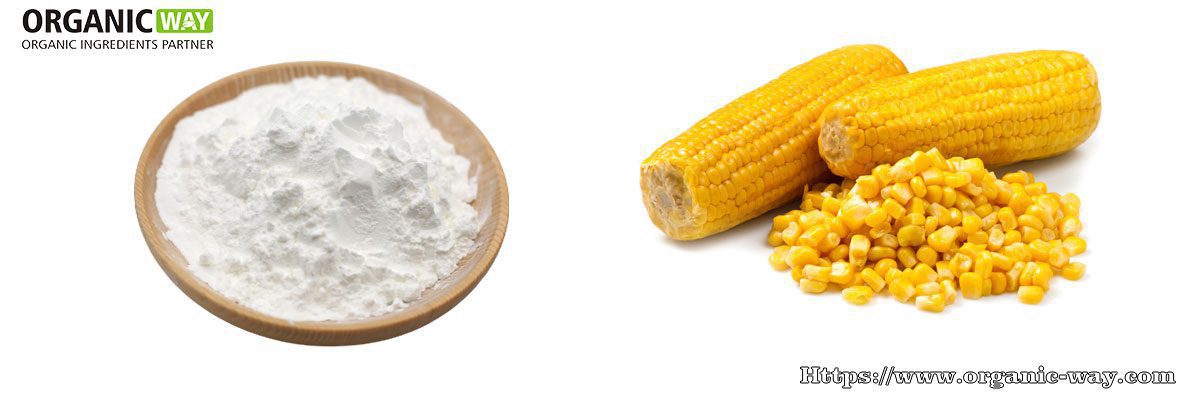
Processing: Mechanical Wet Milling
Mechanical wet milling physically fractionates the corn kernel into its anatomical components — germ (oil-rich), pericarp (fiber), and endosperm (starch-dense) — using water, mechanical force, and density separation. No sulfur dioxide steep liquor, no enzyme treatments, and no solvent extraction are used in the organic process, consistent with organic certification standards.
Why Endosperm Fraction Matters
The endosperm is the starch-dense portion of the corn kernel. Physical separation of this fraction ensures:
- Minimal protein content (≤0.5% crude protein) — critical for transparent paste clarity in sauces and pie fillings
- Low lipid content — prevents off-flavors and oxidative rancidity during storage
- Clean amylose/amylopectin ratio — consistent gelatinization behavior batch-to-batch
Clean-Label Positioning
Organic Cornstarch Powder carries no E-numbers, requires no label statement beyond its common name (“Corn Starch”), and is suitable for front-of-pack clean-label declarations. It is the preferred thickening agent for manufacturers reformulating away from modified starches (E1404–E1452), synthetic thickeners, or talc extenders.
Certifications Available USDA Organic, Non-GMO Project Verified, Vegan, Gluten-Free, Kosher. Halal certification — confirm with sales.
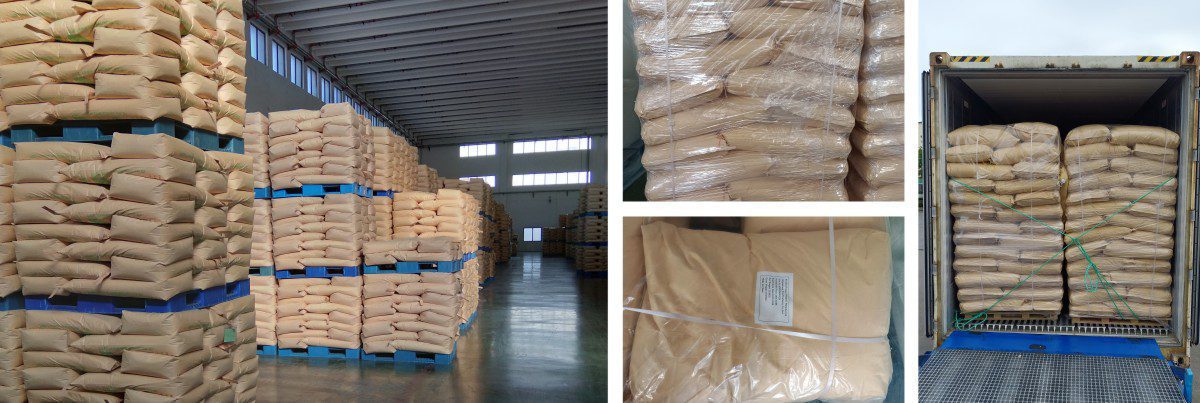
Minimum Order Quantity Sample quantities available for specification verification. Commercial volumes in 25 kg kraft paper bags. Bulk 20 MT containers available. Contact sales@organic-way.com for quotation.
PHYSICAL & CHEMICAL PROPERTIES
Standard Specifications
| Parameter | Specification | Test Method |
|---|---|---|
| Common Names | Organic Corn Starch, Organic Maize Starch, Corn Flour (UK/AU) | — |
| INCI Name | Zea Mays Starch | — |
| CAS Number | 9005-25-8 | — |
| EINECS | 232-679-6 | — |
| HS Code | 1108.12.0000 | — |
| Source | 100% Organic Non-GMO Corn (Zea mays L.), endosperm | — |
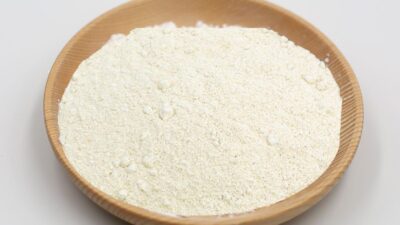
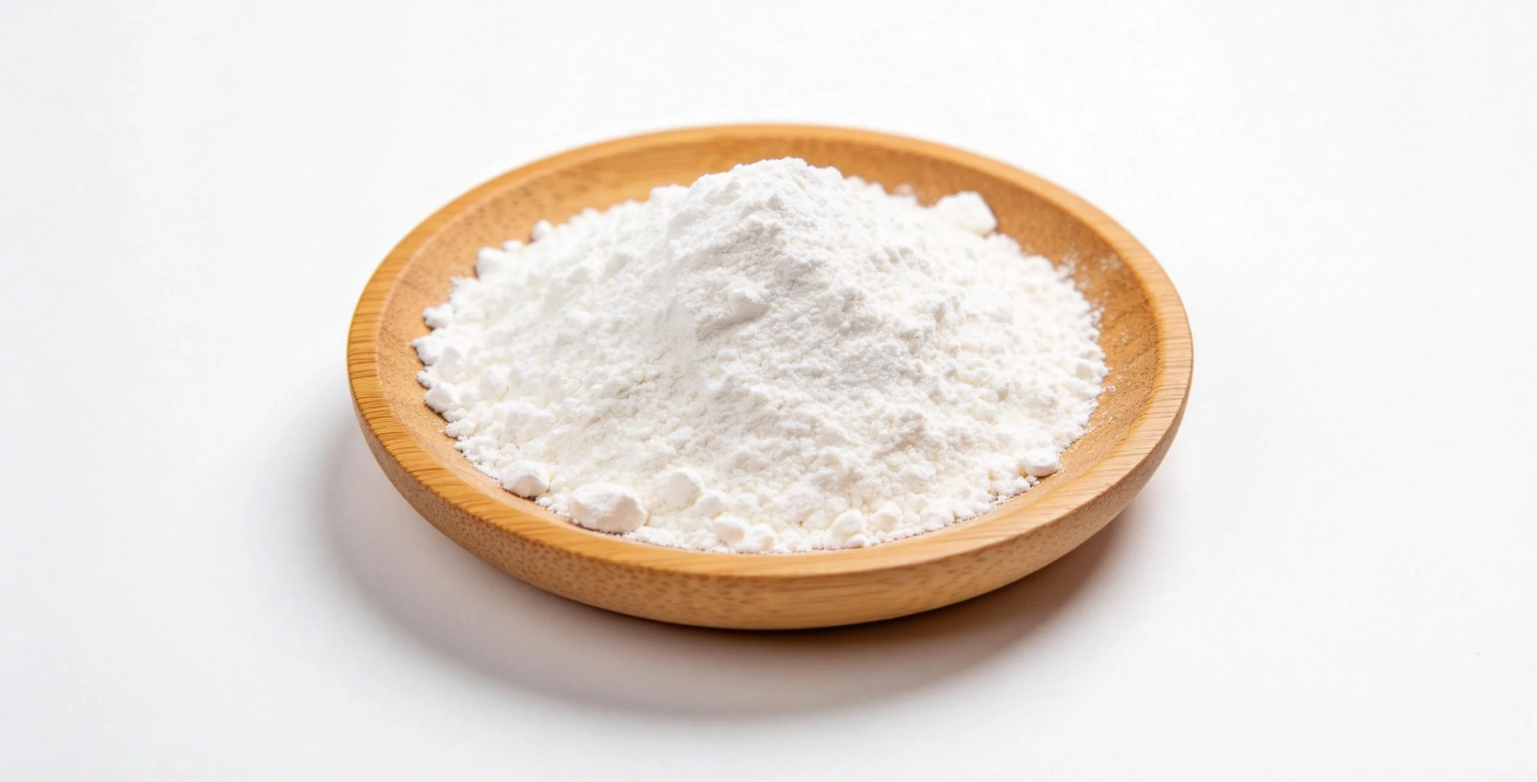
| Appearance | Ultra-fine, bright white powder; free-flowing | Visual |
| Starch Content | ≥98% (dry basis) | Polarimetry / HPLC |
| Amylose Content | 23–27% | Iodine Colorimetry / ISO 6647 |
| Amylopectin Content | 73–77% | Calculated |
| Moisture Content | ≤12% | ISO 1666 / AOAC 930.04 |
| Ash Content | ≤0.1% | ISO 3593 / AOAC 942.05 |
| Crude Protein | ≤0.5% | ISO 5983 / AOAC 990.03 |
| Fat Content | ≤0.3% | ISO 8292 / AOAC 920.39 |
| pH (10% suspension) | 4.5–6.5 | Potentiometric |
| Gelatinization Temperature | 62–72°C (144–162°F) | Brabender Amylograph / DSC |
| Gelatinization Peak | 67–70°C | DSC |
| Paste Clarity | 60–75% transmittance at 650 nm | Colorimetric |
| Ash Alkalinity | ≤1.0 meq/kg | Titration |
Viscosity Grades — Selection Guide
Organic Cornstarch is available in three viscosity grades, determined by processing conditions that affect granule size distribution and molecular weight:
| Viscosity Grade | Typical Brabender Peak Viscosity | Particle Size | Best For |
|---|---|---|---|
| High Viscosity (Standard) | 600–700 BU | Fine (90–98% through 100 mesh) | Pie fillings, puddings, thickening sauces |
| Medium Viscosity | 350–500 BU | Medium (85% through 100 mesh) | Soup thickeners, batter coatings |
| Low Viscosity / Cold-Swelling | 150–250 BU | Fine | Spray-dried applications, instant mixes, glazes |
Note: Viscosity grades are achieved through mechanical classification during milling — not through chemical modification. Confirm the required grade with your production team before ordering.
Amylose/Amylopectin Ratio & Functional Impact
| Property | Effect of Higher Amylose (25–27%) | Effect of Higher Amylopectin |
|---|---|---|
| Gel Strength | Stronger, more rigid gel | Softer, more cohesive gel |
| Paste Clarity | Higher clarity | Lower clarity, more turbid |
| Freeze-Thaw Stability | Moderate (2–3 cycles) | Poor (1–2 cycles) |
| Film Formation | Superior | Limited |
| Retrogradation | Higher (staling risk) | Lower |
| Shear Resistance | Moderate | Lower |
Organic Cornstarch vs Modified Starches vs Conventional Cornstarch
| Parameter | Organic Native Cornstarch | Conventional Modified Cornstarch | Organic Modified Starch |
|---|---|---|---|
| Processing | Mechanical wet milling only | May include acid modification, enzyme treatment, or chemical cross-linking | Organic-compliant chemical modification |
| E-Number | None | E1404–E1452 series | Varies by modification type |
| Clean-Label Status | Full clean-label | Requires E-number declaration | Depends on modification agent |
| Gelatinization Behavior | Standard (62–72°C) | Variable (can be 55–85°C depending on modification) | Variable |
| Shear Stability | Low–Moderate | High | High |
| Freeze-Thaw Stability | Moderate | Excellent | Excellent |
| Label Declaration | “Corn Starch” | “Modified Corn Starch” | “Modified Corn Starch” + organic notation |
MICROBIOLOGICAL & CONTAMINANT STANDARDS
Microbiological Limits
| Test | Specification | Method |
|---|---|---|
| Total Plate Count (TPC) | ≤50,000 CFU/g | ISO 4833 |
| Yeast & Mould | ≤1,000 CFU/g | ISO 21527 |
| Coliforms | ≤100 CFU/g | ISO 4831 |
| E. coli | Negative (<3 MPN/g) | ISO 16649 |
| Salmonella spp. | Negative / 25g | ISO 6579 |
| Staphylococcus aureus | ≤100 CFU/g | ISO 6888 |
Heavy Metal & Contaminant Limits
| Metal / Contaminant | Specification | Method |
|---|---|---|
| Lead (Pb) | ≤0.1 mg/kg | ICP-OES / AOAC 2015.01 |
| Arsenic (As) | ≤0.1 mg/kg | ICP-OES |
| Cadmium (Cd) | ≤0.1 mg/kg | ICP-OES |
| Mercury (Hg) | ≤0.05 mg/kg | ICP-OES / AAS |
| Aflatoxin B1 | ≤2 μg/kg | LC-MS/MS |
| Total Aflatoxins | ≤4 μg/kg | LC-MS/MS |
| SO₂ Residual | <10 ppm | ISO 5522 / Monier-Williams |
Regulatory Standards
- FCC (Food Chemicals Codex): Corn Starch monograph — current edition applies
- EU 231/2012: Specification for “starches, other” — food additive purity criteria applies
- FDA 21 CFR 184.1444: Corn starch — GRAS status for direct food use
- Codex Alimentarius: GSFA — corn starch permitted as a foodstuff (Table 3, Category B)
- China GB/T 8883-2017: Edible Corn Starch — national standard applies to domestic supply
- Kosher: Orthodox Union (OU) or equivalent — confirm availability with sales
- Halal: Available on request — confirm with sales team
CERTIFICATIONS
| Certification | Status | Issuing Body |
|---|---|---|
| USDA Organic | Available | USDA-accredited certifier |
| Non-GMO Project Verified | Available | Non-GMO Project |
| Vegan | Available | Third-party vegan certifier |
| Gluten-Free | Available | GFCO or equivalent |
| Kosher | Available | OU or equivalent |
| Halal | Available on request | IFANCA or equivalent |
COA, TDS, SDS, and Organic Transaction Certificate provided per batch. All certificates issued against the specific production batch. Non-GMO Project Verified certificate confirms zero detectable GMO content per the Non-GMO Project Standard threshold (<0.9%).
APPLICATIONS & USAGE GUIDELINES
Recommended Application Sectors
| Application Sector | Sub-Application | Typical Dosage | Function | Notes |
|---|---|---|---|---|
| Sauces & Gravies | White sauces, béchamel, cream soups | 2–5% w/w | Thickening | Add to cold liquid, then heat to gelatinize |
| Puddings & Pie Fillings | Instant puddings, canned pie fillings | 3–8% w/w | Thickening & gel formation | Cook to 82°C for full gelatinization |
| Baking (Gluten-Free) | GF cakes, cookies, breads | 5–15% flour replacement | Texture modifier; crumb softening | Combines well with xanthan gum (0.3–0.5%) |
| Confectionery & Candy | Powdered sugar anti-caking, gumdrops, pastilles | 1–5% | Binding, anti-caking | Use low-viscosity grade for spray-dried applications |
| Coatings & Batters | Fried chicken, fish, vegetable coatings | 5–12% w/w | Viscosity builder, adhesion | Provides smooth coating, crisp texture |
| Noodles & Pasta (GF) | GF rice/corn noodles | 5–20% w/w | Binding, gel formation | Improves texture cohesion in low-protein systems |
| Dairy & Plant-Based Yogurt | Coconut yogurt, cashew yogurt | 1–3% | Thickening, stabilization | Pre-hydrate in cold water before adding |
| Meat Alternatives | Plant-based burger patties, sausages | 2–5% | Moisture retention, binding | Improves texture and reduces purge |
| Frozen Foods | Frozen sauces, pie fillings | 3–6% | Thickening | Note: 2–3 freeze-thaw cycles max; use cross-linked starch for higher cycles |
| Soups & Bouillons | Powdered soup bases | 2–8% | Thickening | Pre-gelatinized variant available for instant soups |
| Pharmaceuticals | Tablet binding, compressibility aid | 5–25% | Excipient, diluent | USP/NF grade available — confirm with sales |
| Cosmetics & Personal Care | Body powder, dry shampoo, face masks | 5–30% | Absorbent, soft focus | Talc-free, natural alternative |
| Industrial | Biodegradable packaging film, glove coatings | Variable | Film former | Corn starch films are compostable |
Gelatinization Procedure
Organic Cornstarch must be fully gelatinized to develop its thickening function. Follow these steps for optimal results:
- Disperse cornstarch in 3–5× its weight of cold water (≤30°C) to form a slurry
- Add the slurry to the main liquid phase under agitation
- Heat while stirring continuously to 82–90°C (180–195°F)
- Hold at temperature for 2–5 minutes to complete gelatinization
- Cool as required — gel structure forms on cooling below 65°C
Critical: Never add dry cornstarch directly to boiling liquid — this causes lumping and uneven gelatinization. Always pre-disperse in cold water first.
Formulation Notes
Retrogradation (Staling): Cornstarch gels retrogradation over time — the amylose portion re-crystallizes, causing increased firmness and syneresis (water weeping). This is the primary mechanism of staling in gluten-free baked goods. Combine with hydrocolloids (hydroxypropyl methylcellulose, psyllium husk) to reduce retrogradation.
Pre-Gelatinized Variant: For instant applications (instant pudding, dry soup mixes, glazeware), pre-gelatinized cornstarch — fully gelatinized and dried prior to use — can be specified. Confirm availability with sales.
Freeze-Thaw Cycles: Native cornstarch gels are susceptible to retrogradation and syneresis after repeated freeze-thaw cycles. For frozen ready meals or frozen sauces, consider cross-linked organic modified starch or add stabilizers (e.g., 0.1–0.3% sodium carboxymethylcellulose).
Acid Stability: At pH < 4.5, native cornstarch paste viscosity decreases and paste clarity improves but gel strength is reduced. For acidic applications (fruit fillings, citrus-based sauces), use acid-modified organic starch or combine with pectin.
Shear Sensitivity: Native cornstarch paste viscosity decreases under high shear (homogenization, high-speed blending). For shear-intensive processes, chemical modification or addition of a hydrocolloid (guar gum, xanthan gum at 0.05–0.2%) provides viscosity stability.
Protein Interaction: In formulations containing high protein levels (>10% w/w, such as dairy or plant-based protein drinks), pre-hydrate the starch separately to avoid protein-starch complex formation that can reduce thickening efficiency.
FAQ
Q1: Is your organic cornstarch truly non-GMO?
A: Yes. The organic corn used to produce this starch is certified organic and non-GMO through the supply chain. Organic certification under USDA NOP and EU 2018/848 explicitly prohibits the use of genetically modified organisms at any stage of production. In addition, ORGANICWAY maintains a Non-GMO Project Verified certification, which requires testing and segregation protocols to ensure zero detectable GMO content (<0.9% threshold) from field through processing. Each batch COA documents the non-GMO status.
Q2: What is the difference between native cornstarch and modified cornstarch?
A: Native cornstarch — including this product — is produced through mechanical wet milling without any chemical, enzymatic, or physical post-treatment. Modified cornstarch has undergone additional processing (acid thinning, enzyme conversion, cross-linking, hydroxypropylation, or oxidation) to alter its functional properties.
For clean-label formulations, native cornstarch requires no E-number declaration and is labeled simply as “Corn Starch.” Modified starches must be declared as “Modified Corn Starch” and carry E-numbers (e.g., E1404, E1412, E1450). If you require functional properties that native cornstarch cannot deliver — such as high shear stability, extreme freeze-thaw resistance, or low-temperature gelatinization — an organically certified modified starch may be the appropriate solution. Contact sales to discuss organic modified starch options.
Q3: Can organic cornstarch be used as a desiccant or anti-caking agent?
A: Yes. Due to its fine particle size, high purity, and low moisture content (≤12%), organic cornstarch is used in moisture-control applications beyond food:
Anti-caking in powdered sugar and spice blends: 2–5% inclusion prevents caking and clumping
Desiccant in food packaging: Absorbs ambient moisture in dried food packages
Medical glove coatings: FDA 21 CFR 177.2600 applies — confirms suitability for glove dusting
Cosmetic body powders: Talc-free, hypoallergenic alternative; certified vegan and skin-safe
Biodegradable packaging films: Corn starch is blended with PLA (polylactic acid) to produce compostable film
For non-food applications, confirm the required specifications (particle size, purity, microbial limits) with your sales contact.
Q4: Does organic cornstarch contain SO₂, and what are the labeling implications?
A: Our organic cornstarch has a residual SO₂ level of <10 ppm, confirmed per batch on the COA. This is significantly below the EU “no sulphites declared” threshold of 10 mg/kg (10 ppm) under EU Regulation 1169/2011 — meaning this product can carry “No Sulphites Added” or “Sulphite Free” labeling in EU markets.
Conventionally processed corn starch uses SO₂ in the steeping process as a softening agent. Organic mechanical wet milling achieves similar softening through extended water-steeping and physical fractionation without chemical assistance. The <10 ppm SO₂ residual in our organic product reflects this cleaner processing method.
Q5: Is organic cornstarch safe for consumers with celiac disease or gluten sensitivity?
A: Yes. Corn (maize) is naturally gluten-free — it does not contain the gluten proteins (gliadins, secalins, hordeins) found in wheat, barley, or rye. The mechanical wet milling process physically separates the starch granule from the protein-rich germ and fiber fractions of the corn kernel, resulting in ≤0.5% crude protein content in the final starch product. This is far below any threshold for gluten cross-reactivity.
Organic Cornstarch Powder is certified Gluten-Free by GFCO (Gluten-Free Certifying Organization) or equivalent. For celiac-safe labeling claims, confirm that your supply chain, manufacturing environment, and finished product also meet the relevant gluten-free standard (FDA 21 CFR Part 101.91 for US; EC 41/2009 for EU).
Q6: What viscosity grade should I choose for my application?
A: The three viscosity grades serve different processing needs:
High Viscosity (Standard): Choose this for applications where maximum thickening is required with a single starch type — classic pie fillings, white sauces, puddings, starch-based gravies. This is the most versatile grade.
Medium Viscosity: Choose for batter coatings, soup thickeners, and applications where a lighter viscosity build is desired. Useful when combining with other thickeners in complex formulations.
Low Viscosity / Cold-Swelling: Choose for spray-dried applications (instant drink mixes, powdered soups), powdered glazes, or dry-blend formulations where the starch must hydrate and thicken without cooking. Confirm cold-swelling properties with sales for the specific variant.
If you are unsure which grade suits your process, request a technical sample and viscosity curve from our lab.
Q7: What documentation is provided with each batch for regulatory compliance?
A: Each shipment includes: (1) Certificate of Analysis (COA) with actual batch results for starch content, moisture, pH, ash, protein, microbiological results, SO₂ residual, heavy metals, and particle size; (2) Technical Data Sheet (TDS) with full specifications, handling instructions, and regulatory compliance statements; (3) Safety Data Sheet (SDS) for transport and workplace safety; (4) Organic Transaction Certificate (OTC) documenting the organic chain of custody for your finished product organic certification; (5) Non-GMO Project Verified Certificate per batch; (6) Halal/Kosher Certificate if applicable to your order. COA parameters can be customized to match your internal quality specifications upon agreement.
PACKAGING & STORAGE
Packaging Options
| Package Size | Packaging Material | MOQ | Notes |
|---|---|---|---|
| 1 kg | Aluminum foil pouch | Trial | For lab trials and small-scale R&D |
| 5 kg | Aluminum foil pouch | Trial | For pilot runs |
| 20 kg | Kraft paper bag + food-grade PE liner | Standard | Primary commercial format |
| 25 kg | Kraft paper bag + food-grade PE liner | Standard | Primary commercial format |
| 500 kg | Big bag (FIBC) | Commercial | Bulk industrial applications |
| 20 MT | 20 ft container (bagged) | Commercial | Full container load |
| Custom | Bulk tanker / dedicated container | Commercial | For long-term contracted supply |
All packaging materials comply with EU 10/2011 and FDA 21 CFR food-contact regulations. Packaging is not sterile — handle under standard food-grade hygiene conditions. Custom bag sizes, private labeling, and COA format customization available under contracted supply agreements.
Storage Conditions
- Storage temperature: ≤25°C (cool, dry environment)
- Relative humidity: ≤55% RH
- Avoid: Moisture, humidity, strong odors, direct sunlight, rodents, insects
- Shelf life: 18–24 months from manufacturing date (sealed, unopened, stored as directed)
- Post-opening: Use within 30 days; reseal immediately; monitor moisture ingress