
Table of Contents
The food and beverage industry is in the middle of a structural shift in how it sources and uses sweeteners. The drivers are not new — rising rates of metabolic disease, consumer demand for cleaner labels, regulatory pressure on added sugars — but the pace has accelerated sharply since 2022, and the ingredients landscape has changed along with it.
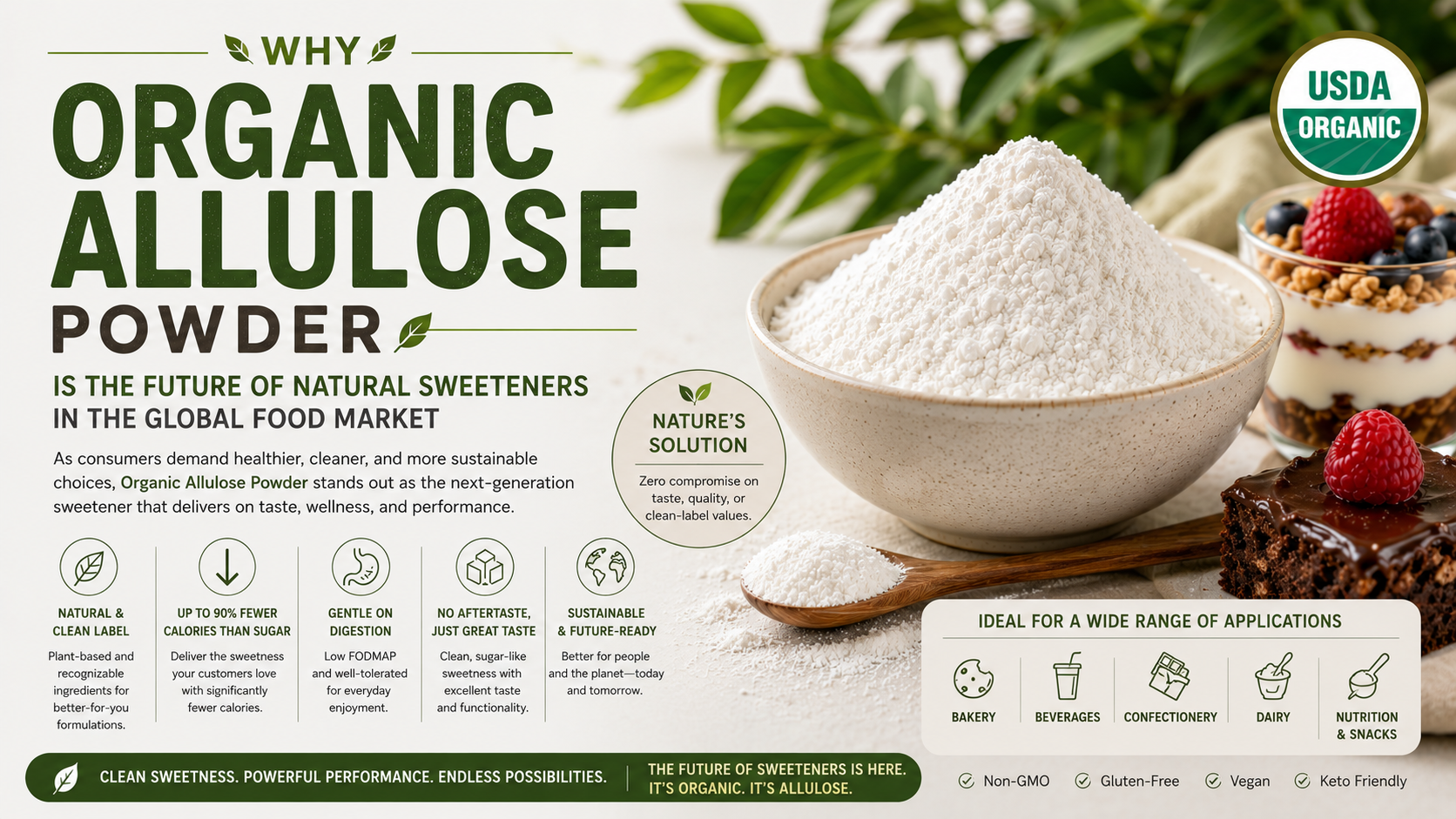
Organic allulose powder has emerged as one of the most strategically significant sweetener ingredients in this transition. This article examines why — covering market dynamics, regulatory developments, and what the global adoption curve looks like for procurement and brand teams planning their ingredient strategy.
Market Forces: What Is Driving the Shift Away from Added Sugars
Consumer-Side Pressure
Consumer attitudes toward sugar have shifted from preference-based to health-motivated. A 2024 FMCG Gurus global survey found that 63% of consumers actively try to reduce sugar intake — not because they prefer less sweetness, but because they associate added sugars with health risk. This is a fundamentally different market signal than “consumers want diet products.”
The consequence for manufacturers is a product development mandate: products must contain less sugar, but cannot taste like they do. Reduced-calorie products that compromise on taste experience are losing market share, not gaining it.
Regulatory-Side Pressure
Government-level sugar reduction programs have created structural demand for sugar alternatives in key markets:
| Market | Policy | Effective Date | Impact on Manufacturers |
|---|---|---|---|
| United Kingdom | Soft Drinks Industry Levy (Sugar Tax) — extended to more categories | 2023 expansion | Direct cost penalty for high-sugar beverages |
| European Union | Farm to Fork Strategy — 20% sugar reduction target in processed foods by 2030 | Ongoing | Voluntary but retailer-driven compliance |
| Mexico | Warning label system for high-sugar foods | 2020, enforcement strengthened 2023 | Black warning octagon labels reduce sales in sugar-heavy SKUs |
| United States | FDA Nutrition Facts panel reforms — new “Added Sugars” line | Mandatory since 2020 | Increased consumer visibility of sugar content |
| China | “Healthy China 2030” sugar reduction targets for food industry | Phased implementation | Domestic brands reformulating ahead of potential mandatory standards |
| Australia / NZ | Health Star Rating system penalizes added sugars | Ongoing | Retailer pressure for reformulation to improve star ratings |
The combined effect of these policies is a cost and reputational risk attached to high sugar content that did not exist at this scale ten years ago. Sugar reduction is now a supply chain and procurement priority, not just an R&D consideration.
The High-Intensity Sweetener Problem
The obvious solution — replacing sugar with stevia, monk fruit, or sucralose — has proven more difficult in practice than in theory. Consumer acceptance studies consistently show that products sweetened solely with high-intensity sweeteners score lower on repeat purchase intent than full-sugar equivalents, primarily due to aftertaste issues and perceived artificiality.
The “stevia aftertaste” problem has been documented extensively in product launches across beverage, bakery, and dairy categories. Even improved steviol glycosides (Reb M, Reb D) have not fully resolved the taste-profile gap at scale.
This gap has opened demand for a new category of sweetener: one that functions more like sugar, tastes more like sugar, and carries a clean-label origin story. Allulose fits this gap more closely than any other ingredient currently in commercial supply.
What Organic Allulose Is — and Why “Organic” Matters for Procurement
Allulose (also known as D-psicose) is a rare monosaccharide that occurs naturally in small quantities in figs, jackfruit, raisins, and certain grains. It provides approximately 70% of sucrose’s sweetness, participates in Maillard browning, contributes bulk and moisture retention, and provides approximately 0.2–0.4 kcal/g — roughly one-tenth the caloric load of sucrose.
For detailed technical and formulation specifications, see: Organic Allulose Powder: Reduce Calories Without Compromising Quality
The “organic” designation matters for procurement for three specific reasons:
1. Product-level certification eligibility. Brands seeking USDA Organic, EU Organic, or equivalent certifications must use certified organic ingredients. An organic-certified allulose ingredient opens the door for the finished product to carry organic certification — a meaningful premium in retail positioning.
2. Non-GMO and supply chain transparency requirements. Major retailers and natural food buyers increasingly require Non-GMO Project verification and supply chain documentation. Organic-certified allulose from ORGANICWAY comes with full traceability documentation.
3. Brand positioning premium. In the premium health and wellness segment — the primary growth channel for natural sweeteners — “organic” on the ingredient list supports a price premium that generic allulose cannot. This is not merely a label; it is a sourcing and commercial strategy decision.
Regulatory Status: Where Allulose Stands in Key Markets
Procurement teams need to understand the regulatory status of allulose in their target markets before committing to formulation or sourcing decisions. The picture varies significantly by region.
United States
Allulose received GRAS (Generally Recognized as Safe) status from the FDA in 2019. In the same year, the FDA issued guidance allowing allulose to be excluded from “Total Sugars” and “Added Sugars” declarations on Nutrition Facts labels, while still requiring listing as an ingredient. This regulatory treatment is unique to allulose among rare sugars and is a significant commercial advantage for manufacturers targeting the US market.
Status: Fully approved. Favorable labeling treatment.
European Union
As of early 2026, allulose is under novel food application review by EFSA (European Food Safety Authority). It is not yet approved for use as a food ingredient in the EU. Manufacturers targeting European markets should monitor the EFSA application status and work with regulatory consultants to assess timeline.
Status: Pending novel food approval. Not currently permitted as food ingredient.
United Kingdom
Post-Brexit, the UK has its own novel food framework. Allulose is under parallel review. Status as of 2026 mirrors the EU — under review, not yet approved.
Status: Under review. Not currently permitted.
China
Allulose is permitted as a food ingredient in China under GB standards and is increasingly used in functional food and health food categories. Domestic production capacity has grown significantly since 2022, making China both a market and a production hub.
Status: Permitted. Active market adoption.
Japan
Allulose (D-psicose) has a history of use in Japan and is classified as a food ingredient. Japanese food manufacturers have been among the earliest adopters of allulose in health-oriented product lines.
Status: Permitted. Established market.
Canada
Health Canada approved allulose as a novel food in 2021, with conditions on maximum daily intake levels for certain population groups.
Status: Approved with usage conditions.
Summary for procurement planning: Allulose is immediately available for North American, Chinese, and Japanese markets. EU and UK market entry requires waiting for regulatory approval, which is actively being pursued. This should factor into sourcing strategy and new product launch timelines by market.
Global Adoption Curve: Where the Market Is Now
Allulose adoption has followed a predictable innovation curve since commercial production became viable at scale around 2018–2019:
2018–2020: Early adopter phase. Primarily US beverage brands and specialty health food manufacturers. Limited SKU presence, premium price point, minimal consumer awareness.
2020–2022: Growth phase. Broader adoption in US bakery, confectionery, and dairy. First allulose-sweetened products from major CPG brands. Price reduction as production volume increased. Japanese market expansion.
2022–2024: Mainstream phase (US/Japan). Allulose present in mainstream retail across multiple categories. Private label adoption begins. Chinese production capacity expands, improving global supply availability and reducing cost premium vs. sucrose.
2025–2026: International expansion phase. Active regulatory pursuit in EU and UK. Significant adoption in China’s functional food sector. South Korean and Australian market entry underway. Growing use in B2B ingredient supply for brands producing for multiple markets.
The current trajectory suggests allulose will follow a path similar to erythritol — which moved from specialty ingredient to mainstream in approximately 8–10 years from commercial launch. Given the broader regulatory approvals already in place and lower aftertaste complaints versus erythritol’s cooling effect, adoption may be faster.
Sourcing Considerations: What to Evaluate in an Organic Allulose Supplier
For procurement teams entering the organic allulose market, supplier evaluation should cover:
Organic certification scope: Verify that certification covers the ingredient as produced, not just the raw material. Ask for current certificate copies and scope descriptions.
Production method documentation: Allulose is produced via enzymatic conversion from fructose. Verify that the process is classified as minimal processing under your target market’s organic standards.
Specification consistency: Particle size distribution, moisture content, and solubility must be consistent batch-to-batch. Request Certificate of Analysis samples across multiple production lots before committing to volume contracts.
Market documentation support: For US, Chinese, and Japanese markets, standard food safety documentation (COA, MSDS, allergen declarations) is typically sufficient. For EU/UK market preparation, ask about novel food dossier support.
Supply chain resilience: Organic allulose production is concentrated in a limited number of facilities. Assess supplier capacity, lead times, and contingency planning before building it into a core formulation.
Strategic Implications for Brand Teams
For food and beverage brand teams evaluating their 2025–2027 sweetener strategy, organic allulose occupies a specific and defensible niche:
- It is the only natural sweetener that functions as a full sugar replacement across complex food systems (bulk, browning, moisture retention, taste) without requiring compensating ingredients
- It supports regulatory claims in key markets that other natural sweeteners cannot (excluded from Added Sugars in the US)
- The organic certification tier differentiates it from commodity allulose in premium product positioning
- EU/UK regulatory approval, when it comes, will open a significant new market that early adopters will be better positioned to address
The core strategic question is not whether allulose will be widely adopted — the trajectory is clear. The question is whether your brand is formulating with it now to establish market position, or will be following competitors who did.
Recommended Products

Allulose Sweetener
Available in two professional formats: free-flowing Allulose Powder (≥98% purity) and liquid Allulose Syrup…
Related Posts


