
Table of Contents
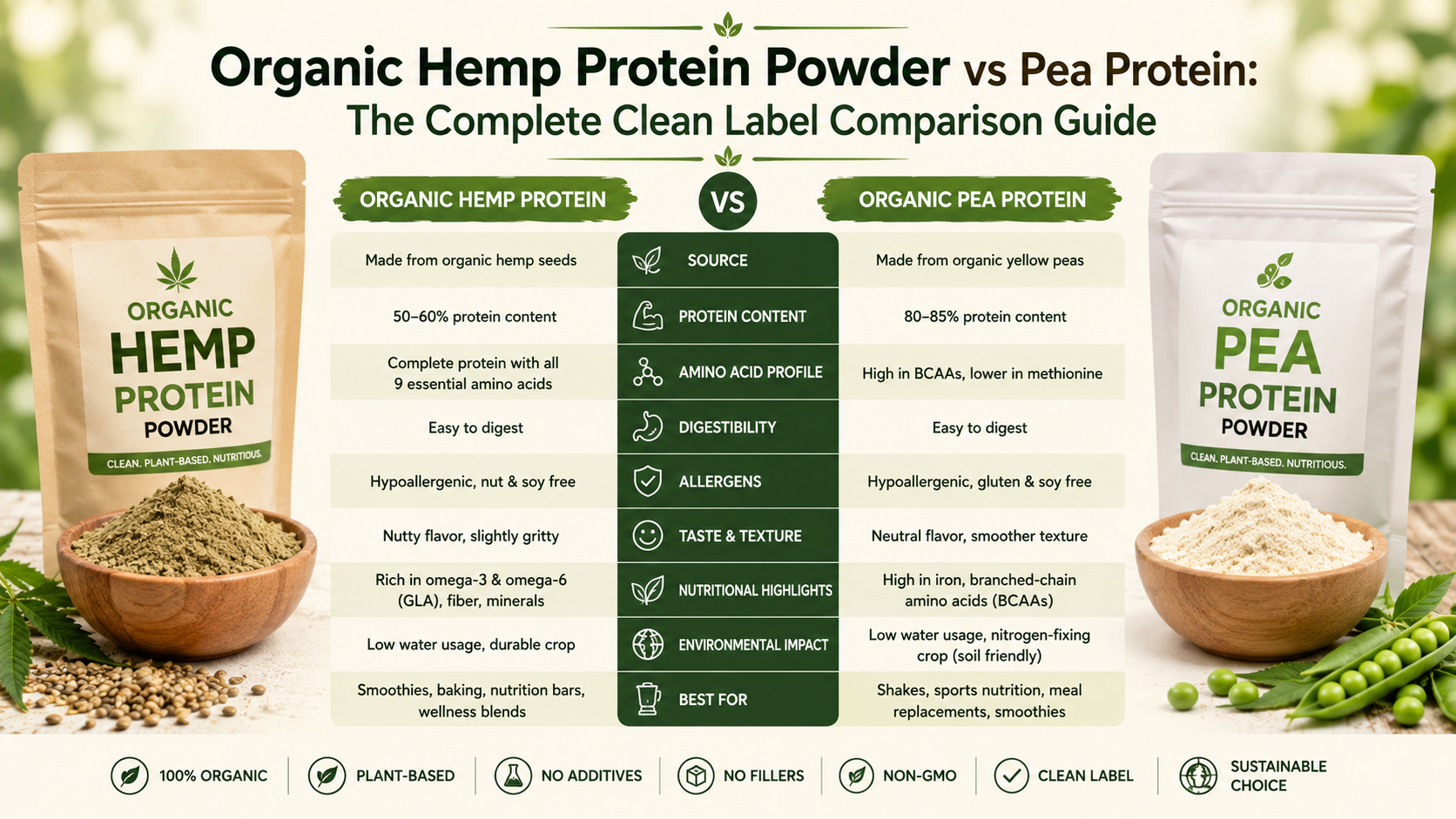
Plant-based protein has become a cornerstone of clean label product development. Among the most commonly used options, organic hemp protein powder and pea protein are often compared by brand owners, formulators, and procurement teams.
While both ingredients support plant-based positioning, they differ significantly in:
- Processing methods
- Nutritional profile
- Sensory characteristics
- Brand perception and storytelling potential
Understanding these differences is essential for making the right sourcing decision—especially for clean label brands seeking long-term differentiation rather than short-term cost optimization.
Key Insight: For clean label brands, the decision is not just about nutrition—it is about authenticity, transparency, and alignment with consumer values.
Processing and Ingredient Transparency
One of the core principles of clean label is minimal processing. Consumers increasingly scrutinize not just what is in the product, but how it got there.
Organic Hemp Protein Powder: Mechanical Simplicity
Organic hemp protein powder is typically produced through:
- Mechanical cold-pressing of organic hemp seeds to remove oil
- Gentle milling of the remaining seed cake
This process:
- Avoids chemical solvents (e.g., hexane)
- Preserves natural co-factors (fiber, minerals, phytonutrients)
- Allows the ingredient to be declared simply as “Organic hemp protein powder” on labels
Clean Label Advantage: Hemp protein aligns closely with whole-food positioning. The processing story is easy to communicate and resonates with consumers seeking “minimal intervention” ingredients.
Pea Protein: Multi-Step Extraction
Pea protein, particularly pea protein isolate, often requires:
- Wet extraction to separate protein from starch and fiber
- pH adjustment to isolate protein fractions
- Spray drying to produce a concentrated powder
While these processes are food-safe and widely accepted, they may be perceived as “over-processed” by clean label–focused consumers.
Clean Label Consideration: Brands using pea protein may need to invest more in consumer education to explain the processing story.
Transparency Comparison
| Factor | Hemp Protein | Pea Protein |
|---|---|---|
| Processing steps | 2–3 (mechanical) | 4–6 (wet extraction) |
| Chemical solvents | No | Typically no (but perceived risk) |
| Label declaration | Simple (“hemp protein”) | More technical (“pea protein isolate”) |
| Consumer perception | “Natural,” “whole food” | “Processed,” “extracted” |
Nutritional Profile Comparison
Both hemp and pea proteins contribute valuable plant-based nutrition, but in different ways.
Organic Hemp Protein Powder
Typical composition:
- Protein content: 50–65%
- Fiber: 10–20% (naturally occurring)
- Fat: 8–12% (remaining after cold-pressing)
- Minerals: Magnesium, iron, zinc, phosphorus
Amino acid profile:
- Contains all nine essential amino acids
- Relatively high in arginine and glutamic acid
- Moderate in lysine (compared to pea protein)
Nutritional narrative: Hemp protein offers “balanced, naturally occurring nutrition” rather than “engineered protein concentration.”
Pea Protein
Typical composition:
- Protein content: 80–90% (for isolates)
- Fiber: <5% (removed during processing)
- Fat: <2% (removed during processing)
- Minerals: Lower than hemp (some lost during extraction)
Amino acid profile:
- Contains all nine essential amino acids
- High in branched-chain amino acids (BCAAs): leucine, isoleucine, valine
- Excellent lysine content
Nutritional narrative: Pea protein offers “high protein density” and “targeted amino acid optimization.”
Side-by-Side Nutritional Comparison
| Nutrient | Hemp Protein (60% protein) | Pea Protein (85% protein) |
|---|---|---|
| Protein per 30g serving | ~18g | ~25.5g |
| Fiber per serving | ~5g | <1g |
| Magnesium | High | Moderate |
| Iron | High | Moderate |
| BCAA content | Moderate | High |
| Lysine | Moderate | High |
Formulation Insight: For products emphasizing “whole food nutrition,” hemp protein may be more appealing. For products focused on “maximum protein per serving,” pea protein may be preferred.
Digestibility and Consumer Experience
Digestive comfort is increasingly important, particularly for products consumed daily.
Hemp Protein: Gentle and Fiber-Rich
Organic hemp protein powder retains fiber, which can:
- Support gut health and satiety
- Slow digestion and moderate glucose response
- Provide a “whole food” digestive experience
Many consumers perceive hemp protein as gentler compared to highly refined proteins.
Consideration: The fiber content may cause mild digestive adjustment for some individuals when first introduced.
Pea Protein: Highly Digestible but Not Always Gentle
Pea protein isolate is generally well tolerated, but:
- Some individuals experience bloating or gas at high inclusion levels
- The refining process removes antinutrients (e.g., lectins, phytates) but also removes beneficial fiber
- Digestive experience can vary based on individual sensitivity
Formulation Insight: Pea protein may require digestive enzyme blends or additional fiber sources to create a “gut-friendly” product narrative.
Digestibility Comparison
| Factor | Hemp Protein | Pea Protein |
|---|---|---|
| Fiber content | High (supports gut health) | Low (minimal gut impact) |
| Digestive comfort | Generally gentle | Variable (some sensitivity) |
| Antinutrient content | Low-moderate | Very low (removed during processing) |
| Consumer perception | “Natural digestion” | “Easy to digest” |
Flavor, Color, and Formulation Impact
Flavor and appearance play a major role in clean label success.
Hemp Protein: Nutty, Earthy, and Green
Flavor profile:
- Mild, nutty, earthy flavor
- Pairs well with cocoa, coffee, vanilla, nuts, and seeds
- Can be overpowering in neutral-flavored products
Color:
- Natural green-brown tone
- Works well in whole-food, natural, or earth-toned formulations
- May limit use in light-colored or white products
Formulation impact:
- Best suited for products where a “natural” color is acceptable or desirable
- May require natural color masking for light-colored products
Pea Protein: Neutral but Challenging
Flavor profile:
- More neutral color (off-white to light tan)
- Easier to use in white or lightly colored products
- Characteristc flavor can be challenging (beany, earthy notes)
Color:
- Neutral, works in a wide range of products
- Allows for vibrant colors in final product
Formulation impact:
- Requires flavor masking systems (natural flavors, spices, sweeteners)
- More versatile for products where color neutrality is critical
Formulation Comparison
| Factor | Hemp Protein | Pea Protein |
|---|---|---|
| Flavor intensity | Mild-moderate | Moderate-high (requires masking) |
| Color impact | Green-brown | Neutral (off-white) |
| Best applications | Bars, baked goods, chocolate-flavored products | Beverages, dairy alternatives, neutral-flavored products |
| Flavor pairing | Cocoa, coffee, vanilla, nuts | Fruit, vanilla, spices |
Sustainability and Brand Storytelling
Sustainability is increasingly linked to clean label credibility. Consumers want to know not just what is in the product, but how it impacts the planet.
Hemp: The Sustainability Superstar
Environmental advantages:
- Low water requirements (compared to pea, soy, or animal proteins)
- Minimal pesticide use (hemp is naturally pest-resistant)
- Soil health benefits (deep root systems, phytoremediation potential)
- Fast-growing crop (3–4 months from seed to harvest)
- Carbon sequestration (hemp absorbs more CO₂ per hectare than many crops)
Brand storytelling potential:
- “Regenerative agriculture”
- “Carbon-neutral protein”
- “Soil-to-shelf sustainability”
Pea: Sustainable but Less Dramatic
Environmental advantages:
- Nitrogen-fixing properties (improves soil health)
- Lower water requirements than animal proteins
- Widely grown in temperate climates (reduced transportation footprint when sourced locally)
Considerations:
- Processing footprint may be higher due to extraction and purification steps
- Less “dramatic” sustainability story compared to hemp
Sustainability Comparison
| Factor | Hemp Protein | Pea Protein |
|---|---|---|
| Water use | Very low | Low-moderate |
| Pesticide use | Minimal | Low-moderate |
| Soil health | Excellent (deep roots, phytoremediation) | Good (nitrogen-fixing) |
| Processing footprint | Low (mechanical) | Moderate-high (wet extraction) |
| Carbon sequestration | High | Moderate |
| Brand storytelling | “Superstar” sustainability | “Solid” sustainability |
Cost and Supply Considerations
While clean label brands prioritize values, cost and supply stability remain critical for commercial viability.
Pea Protein: Economies of Scale
Cost advantages:
- Larger-scale global production (dominated by China, Canada, Europe)
- More stable pricing due to established supply chains
- Broader supplier availability (more options for procurement teams)
Supply considerations:
- Reliable supply for large-volume contracts
- Price volatility linked to pea crop yields and trade policies
Hemp Protein: Premium but Differentiated
Cost considerions:
- Higher unit costs (smaller-scale production, niche market)
- More limited sourcing options (fewer certified organic hemp processors)
- Premium positioning justified by differentiation and sustainability narrative
Supply considerations:
- Smaller-scale supply chains may limit very large-volume contracts
- Growing market demand may improve economies of scale over time
Cost and Supply Comparison
| Factor | Hemp Protein | Pea Protein |
|---|---|---|
| Unit cost | Higher (premium) | Lower (economies of scale) |
| Supply stability | Moderate (growing) | High (established) |
| Supplier options | Limited | Extensive |
| Price volatility | Moderate | Moderate-high (crop-dependent) |
| Differentation potential | High | Moderate |
Which Protein Is Right for Your Brand?
There is no universal “best” plant protein—only the best fit for your brand strategy.
Choose Organic Hemp Protein Powder When:
- Clean label and minimal processing are top priorities
- Whole-food positioning matters to your target consumer
- Sustainability and transparency support brand identity
- Differentiation is more important than cost efficiency
- Your products have earthy, nutty, or chocolate flavor profiles
- You want to tell a compelling sustainability story
Ideal product categories:
- Protein bars and snacks (especially seed/nut-based)
- Chocolate-flavored protein powders
- Bakery products with visible “natural” ingredients
- Premium supplements with sustainability claims
Choose Pea Protein When:
- High protein density is required (e.g., sports nutrition)
- Neutral color is critical (e.g., dairy alternatives, light-colored beverages)
- Cost efficiency and scalability are key concerns
- You have access to effective flavor masking systems
- Your target consumer prioritizes protein quantity over processing story
Ideal product categories:
- Dairy alternatives (milks, yogurts, cheeses)
- Neutral-flavored protein powders
- Ready-to-drink (RTD) beverages
- Sports nutrition products with high protein claims
Can You Use Both?
Yes. Some brands successfully combine both proteins to balance:
- Nutrition (BCAAs from pea + fiber/minerals from hemp)
- Functionality (neutrality from pea + texture from hemp)
- Cost (pea as base + hemp for differentiation)
- Storytelling (pea for protein density + hemp for sustainability)
Hybrid formulation insight: Blending proteins can create a “best of both worlds” narrative, but requires careful flavor and texture balancing.
FAQ: Hemp Protein vs Pea Protein for Clean Label Brands
Is hemp protein powder considered minimally processed?
Yes. Most organic hemp protein powders are produced using mechanical processes (cold-pressing + milling) without chemical solvents. This aligns well with minimal processing principles and resonates with clean label consumers.
Does hemp protein contain THC?
No. Certified organic hemp protein powder is derived from industrial hemp varieties and contains no psychoactive effects. THC levels comply with regulatory limits (typically <0.3% THC in the source crop, with even lower levels in the protein powder).
Which protein is better for sports nutrition?
It depends on your positioning:
Choose pea protein if your product emphasizes “high protein density” and “muscle recovery” (due to high BCAAs).
Choose hemp protein if your product emphasizes “whole food nutrition” and “sustainability” (with a more balanced amino acid profile and environmental story).
Which protein is more cost-effective?
Pea protein is generally more cost-effective due to larger-scale production and established supply chains. Hemp protein has a higher unit cost but can justify premium positioning.
Can hemp protein be used in beverages?
Yes, although formulation adjustments may be needed due to its fiber content and color. Hemp protein is commonly used in smoothies, shakes, and plant-based nutrition drinks—especially those with chocolate or coffee flavors.
Which protein is better for the environment?
Hemp protein generally has a lower environmental footprint due to:
Very low water requirements
Minimal pesticide use
Soil health benefits
Carbon sequestration
However, pea protein is also considered sustainable, particularly when sourced from responsible suppliers.
What certifications should buyers look for?
Key certifications for both proteins include:
Organic certification (USDA Organic, EU Organic)
Non-GMO status
Allergen-free statements (both are naturally allergen-friendly)
Traceability documentation (especially important for clean label brands)
Final Perspective: Aligning Protein Choice with Brand Values
Choosing between organic hemp protein powder and pea protein is not just a technical decision—it is a strategic branding decision.
- If your brand prioritizes authenticity, transparency, and sustainability, hemp protein delivers a compelling edge.
- If your brand prioritizes protein density, cost efficiency, and scalability, pea protein may be the better choice.
For many clean label brands, the optimal solution may be a hybrid approach—using pea protein as a base for nutrition and cost efficiency, while using hemp protein for differentiation and sustainability storytelling.
By aligning ingredient choice with brand values and consumer expectations, clean label manufacturers can create products that stand out in an increasingly competitive plant-based market.
Recommended Products
Organic Hemp Protein Powder
Produced using cold-press mechanical separation and fine-mesh classification, our hemp protein retains maximum nutritional…
Related Posts


