
Table of Contents
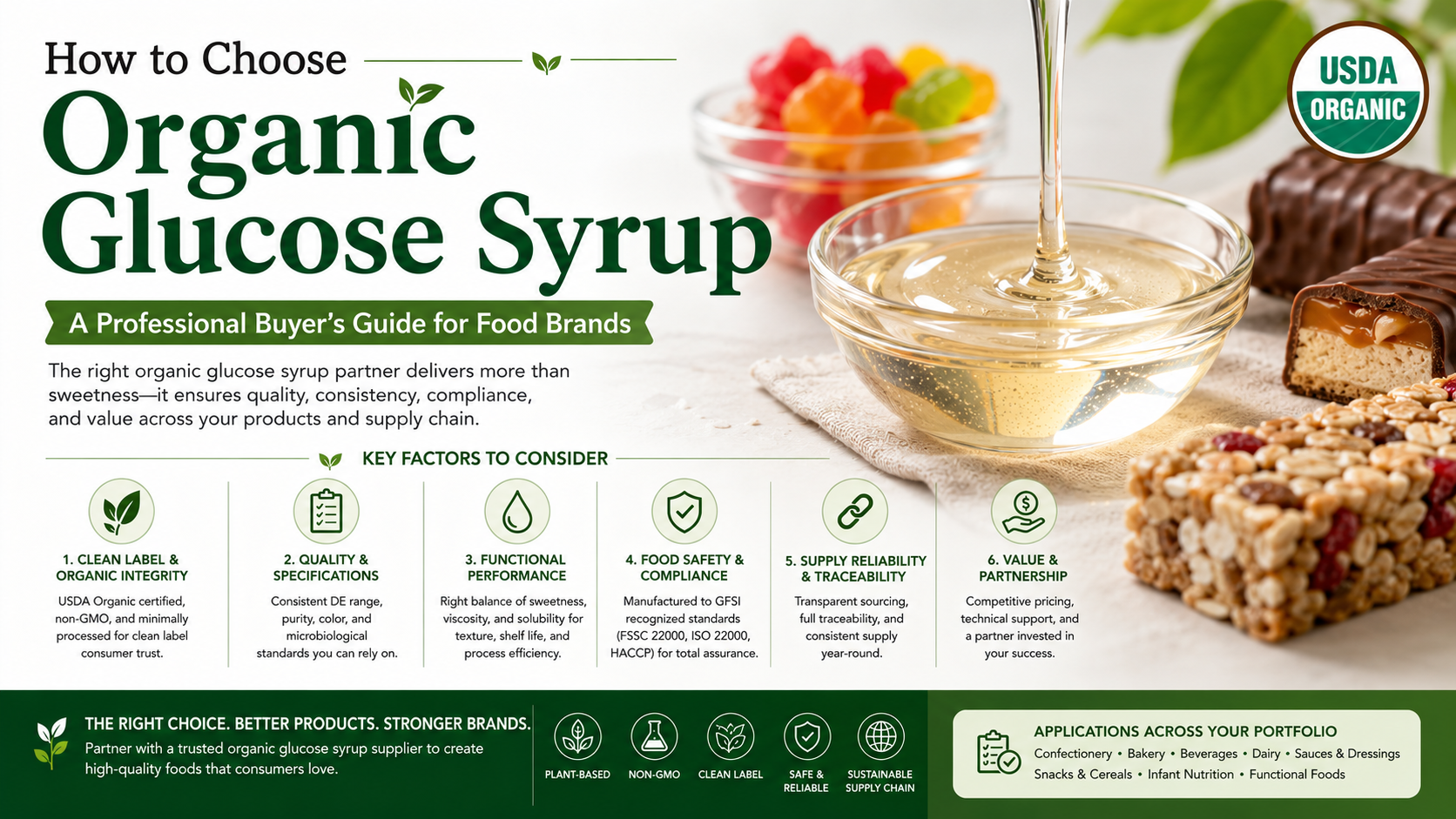
Organic glucose syrup has become a core functional ingredient for confectionery, bakery, beverage, and functional food manufacturers worldwide. Yet the market presents significant specification variability and inconsistent certification quality — selecting the wrong supplier can lead to formulation instability, retail audit failures, or export barriers.
This guide is built for B2B procurement decision-makers. We walk through seven critical technical parameters, organic certification systems, a structured supplier evaluation framework, and contract risk management strategies that help buyers make actionable, defensible sourcing decisions.
What Makes Glucose Syrup Truly Organic?
The word “organic” is not just a label — it is a supply chain commitment. For glucose syrup to carry an organic claim, every link in the chain must be verified:
- Raw material: Starch must come from certified organic crops (corn, rice, tapioca, or wheat) grown without synthetic pesticides, fertilizers, or GMOs.
- Processing: Enzymatic conversion must use approved organic processing aids. Chemical bleaching agents and synthetic refining agents are prohibited.
- Facility: Both the farm and the processing plant must hold active USDA Organic, EU Organic, or equivalent third-party certifications.
- Traceability: Full lot traceability from field to shipment is required for organic integrity.
The key document to request from any supplier is a current organic certificate (not older than 12 months) that explicitly covers both the agricultural origin and the manufacturing site. A certificate covering only raw materials but not the processing facility is insufficient.
Why this matters: Inconsistent organic sourcing is the leading cause of certification failure during retail audits or regulatory inspections. One undocumented processing step can invalidate months of organic production.
Seven Technical Specifications Every Buyer Must Define
Glucose syrup is not a commodity — it is a precision ingredient. Seven parameters determine whether a syrup performs in your formulation:
Dextrose Equivalent (DE Value)
DE measures the degree of starch hydrolysis. It is the single most important specification.
| DE Range | Sweetness | Viscosity | Typical Applications |
|---|---|---|---|
| 20–35 DE | Low | High | Bakery, fillings, coatings |
| 36–55 DE | Moderate | Medium | Confectionery, caramel |
| 55–70 DE | Higher | Low | Beverages, spray drying |
| 70+ DE | High | Very low | Fermentation, yeasted products |
Request target DE ± 2 tolerance from your supplier. A batch at 42 DE when you ordered 55 DE can cause significant texture deviations in confectionery.
Solids Content (Dry Matter)
Typical range: 70–84% solids. Higher solids mean less water in your formulation — but also higher viscosity. Confirm compatibility with your mixing and pumping equipment before specifying.
Viscosity
Measured in centipoise (cP) at a specified temperature. Viscosity directly affects:
- Pumping efficiency in automated lines
- Coating uniformity for enrobing and glazing
- Dosage accuracy in volumetric systems
Request viscosity data at your actual processing temperature, not just room temperature specification.
Color and Clarity
For clear beverages, gels, or premium confectionery, color specification is critical. Express as ICUMSA units or Lovibond scale, and define a maximum turbidity level for transparent applications.
Flavor Profile
Organic glucose syrup should have a neutral, clean taste. Request a sensory evaluation report and compare batches. Off-notes from improper enzyme selection or storage can interfere with fruit flavors, vanilla, or botanical extracts.
pH and Acid Content
pH affects stability in acidic beverage formulations and can influence enzymatic browning reactions in bakery applications. Define acceptable pH range (typically 4.0–6.0) based on your application.
Microbiological Specifications
Demand batch-level Certificate of Analysis (COA) with tested limits for:
- Total plate count (< 1,000 CFU/g)
- Yeast and mold (< 100 CFU/g)
- E. coli (absent in 1g)
- Salmonella (absent in 25g)
For extended shelf-life products or export to warm climates, stricter microbial specs are non-negotiable.
Starch Source — How to Choose the Right Base
The starch origin affects allergen labeling, flavor neutrality, and final product clarity.
| Starch Source | Allergen Status | Flavor | Clarity | Cost |
|---|---|---|---|---|
| Organic Corn | Gluten-free claim valid | Neutral | Good | Moderate |
| Organic Tapioca | Gluten-free, clean label appeal | Very neutral | Excellent | Higher |
| Organic Rice | Gluten-free | Mildly sweet | Excellent | Moderate |
| Organic Wheat | Contains gluten | Neutral | Good | Lower |
Decision rule: If your brand markets to the gluten-free consumer segment, tapioca or rice source is preferable. For cost-driven applications in markets without strict allergen labeling requirements, corn-based syrup offers reliable performance.
Always verify the starch source with a Declaration of Conformity that rules out cross-contamination with non-organic or GMO varieties.
Supplier Evaluation Framework
Beyond product specs, evaluate the supplier’s operational maturity. Use this 4-pillar assessment:
Certification Integrity
- Current organic certificate (scope covers both raw material + processing)
- Third-party audit frequency (annual minimum; GFSI-certified facilities preferred)
- Cross-contamination prevention protocols for GMO and non-organic streams
Technical Capability
- In-house or third-party lab testing for every batch COA
- DE consistency track record (request 6-month batch data variance)
- Application support available for reformulation assistance
Supply Reliability
- Geographic source diversification (single-origin organic corn creates supply risk)
- Buffer inventory policy (minimum 30-day safety stock commitment)
- Lead time and logistics capability for your target volumes
Risk Management
- Crisis response protocol for contamination or compliance failures
- Insurance coverage (product liability, contamination recall)
- Willingness to sign Long-Term Supply Agreements (LTSA) with price floors
Practical step: Request a custom sample batch with your exact target specs before committing to a purchase order. Test it in your actual production process — not just in a bench trial.
Contract and Pricing Strategy for Long-Term Procurement
Unit price should not drive procurement decisions for strategic ingredients. A lower-priced syrup that creates production failures costs more than the savings.
Recommended contract structure:
| Element | Recommendation |
|---|---|
| Price mechanism | Fixed price with quarterly review for contracts < 12 months; indexed to commodity price with cap/floor for longer terms |
| Volume commitment | Define minimum and maximum order quantities; include volume flexibility clause |
| Specification tolerance | Agree on DE tolerance (+/- 2), viscosity range, and color max in writing |
| Lead time | 4–6 weeks for initial orders; 2–3 weeks for repeat orders |
| Shelf life | Minimum 12 months from ship date with minimum 6 months remaining at arrival |
| Quality dispute | Define joint testing protocol and third-party arbitration clause |
Risk mitigation: Qualify at least two approved suppliers for any ingredient representing more than 5% of your total formulation cost. Single-source dependency is an operational risk.
Common Procurement Mistakes to Avoid
Even experienced procurement teams make these errors with organic glucose syrup:
- Accepting generic marketing samples instead of requesting production-line samples with your target specs
- Assuming organic certification is sufficient — it covers sourcing, not batch-to-batch consistency of functional parameters
- Ignoring DE tolerance — DE variance within spec can still cause texture failures in confectionery
- Underestimating logistics complexity — organic certification requires segregated transport; mixed loads with non-organic syrups can create contamination claims
- Signing spot contracts for ingredients that represent >10% of your formulation cost — long-term agreements secure supply and price stability
- Failing to verify shelf life — organic glucose syrup can darken over time; request accelerated aging test data for long-distance export
FAQ
Q1: What DE value should I specify for soft candy (gummy) applications?
For standard gummies, a 42–55 DE syrup provides the right balance of sweetness, viscosity, and chewiness. Lower DE (35–42) produces a firmer, more elastic texture; higher DE (55–65) yields softer, more tender candies.
Q2: Can organic glucose syrup be used in certified Kosher or Halal products?
Yes. Kosher and Halal certifications are available for organic glucose syrup. Request the relevant certificate from your supplier and confirm it covers the specific batch you intend to purchase.
Q3: How should I handle organic glucose syrup in co-manufacturing facilities?
Require a dedicated production schedule or validated clean-down protocol between organic and conventional runs. Cross-contamination risk must be documented in your organic system plan (OSP).
Q4: What testing should I request for each incoming batch?
Minimum: DE value, solids content, viscosity, color/clarity, and a full microbiological panel. For transparent beverage applications, also request turbidity and flavor evaluation.
Q5: How do I calculate the cost impact of switching from conventional to organic glucose syrup?
Compare unit price, then evaluate: (a) reduced need for additives or stabilizers, (b) improved shelf life reducing waste, and (c) premium pricing opportunity for the finished organic product. The total cost of ownership often favors organic despite higher unit cost.
Q6: What is the typical shelf life of organic glucose syrup?
12 months from production date when stored in sealed, food-grade containers at ambient temperature (20–25°C). Higher storage temperatures accelerate color darkening. Always verify remaining shelf life at delivery.
Q7: Can I request customized DE specifications from suppliers?
Yes. Many manufacturers can produce custom DE ranges within 20–75 DE. Specify your target DE, tolerance range, and minimum order quantity for custom production.
Q8: How does the starch source affect my allergen labeling?
Corn, wheat, and rice are common allergens. Tapioca (derived from cassava root) is generally allergen-free. Always verify with the supplier’s allergen statement and ensure it matches your regulatory labeling obligations in each target market.
Recommended Products

Organic Glucose Syrup
Organic Glucose Syrup by ORGANICWAY is a versatile, clean-label liquid sweetener derived from certified…


