
Table of Contents
As the global food industry shifts toward clean-label, organic-certified ingredients, organic dextrose powder has become one of the most versatile and sought-after sweeteners in commercial food manufacturing. But what exactly is organic dextrose powder, and why are so many food brands making the switch from conventional sweeteners?
This comprehensive introduction covers everything food manufacturers, procurement professionals, and product developers need to know about organic dextrose powder — from its chemistry and production to its applications, market drivers, and sourcing considerations.
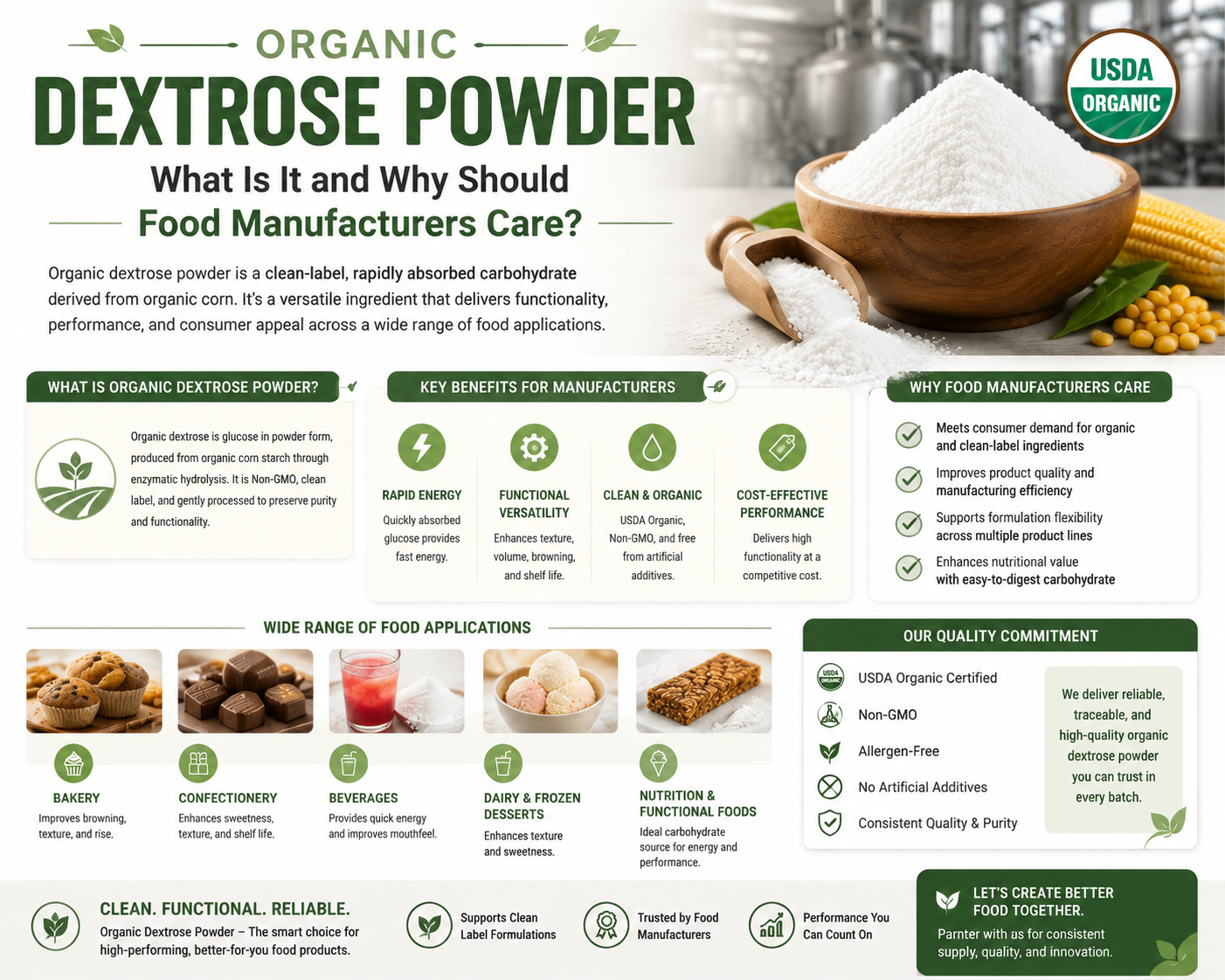
What Is Organic Dextrose Powder?
Organic dextrose powder is a purified form of D-glucose derived from organically grown, non-GMO corn through enzymatic starch hydrolysis. Chemically, it is a monosaccharide (C₆H₁₂O₆) — the simplest form of carbohydrate and the same molecule that the human body uses as its primary energy source.
Dextrose in Context
To understand where dextrose fits in the sweetener landscape, it helps to see its relationship to other common sugars and sweeteners:
| Ingredient | Type | Primary Component | Source |
|---|---|---|---|
| Organic Dextrose | Monosaccharide | Glucose (100%) | Organic corn |
| Sucrose (table sugar) | Disaccharide | Glucose (50%) + Fructose (50%) | Sugarcane / sugar beet |
| High-Fructose Corn Syrup | Sweetener blend | Glucose + Fructose (variable) | Conventional corn |
| Maltodextrin | Glucose polymer | Long-chain glucose | Corn / potato / tapioca |
| Glucose Syrup | Sugar syrup | Glucose + maltose + oligosaccharides | Corn / wheat / potato |
The key distinction: Dextrose is pure glucose — no fructose, no complex polymers, no multi-step digestion required. The body absorbs it directly and uses it immediately.
Monohydrate vs. Anhydrous Forms
Organic dextrose powder is available in two primary forms:
- Dextrose monohydrate (C₆H₁₂O₆ · H₂O): Contains one water molecule per glucose molecule. This is the most common form in food applications, appearing as a fine white crystalline powder. It provides excellent solubility and consistent dosing.
- Dextrose anhydrous (C₆H₁₂O₆): Contains no water of crystallization. Slightly sweeter per unit weight and used in specialized applications where precise moisture control is critical.
For most food and beverage manufacturing applications, dextrose monohydrate is the standard form due to its processing flexibility and cost-effectiveness.
How Is Organic Dextrose Powder Produced?
The production of organic dextrose powder follows a natural enzymatic process that preserves the molecular integrity of glucose while meeting organic certification standards:
Step 1: Organic Corn Sourcing Certified organic, non-GMO corn is harvested from farms practicing organic agriculture — no synthetic pesticides, herbicides, or fertilizers.
Step 2: Starch Extraction Corn kernels are cleaned, steeped, and milled to separate the starch from protein (gluten), fiber, and germ.
Step 3: Enzymatic Hydrolysis Natural alpha-amylase enzymes break starch chains into shorter dextrins. Glucoamylase enzymes then convert dextrins into individual glucose molecules.
Step 4: Purification The glucose solution is filtered, deionized, and carbon-treated to remove proteins, minerals, and color compounds.
Step 5: Crystallization and Drying The purified glucose solution is concentrated and crystallized under controlled conditions. Crystals are then dried to produce the final powder.
The entire process uses natural enzymes only — no synthetic chemicals, no genetically modified processing aids, and no artificial additives.
Why Food Manufacturers Are Choosing Organic Dextrose
1. Clean-Label Compliance
The clean-label movement is no longer a niche trend — it is a mainstream market requirement. According to recent industry data, 74% of global consumers say they avoid products with artificial ingredients, and 63% are willing to pay more for clean-label products.
Organic dextrose powder supports clean-label positioning with:
- A simple, recognizable ingredient name (“organic dextrose” or “organic glucose”)
- Certified organic and non-GMO status
- No artificial processing aids or synthetic additives
- Full supply chain traceability from farm to finished ingredient
2. Predictable Functional Performance
Unlike many alternative sweeteners that require complex formulation adjustments, organic dextrose behaves as a drop-in functional sweetener with well-documented properties:
- Sweetness: Approximately 75% as sweet as sucrose — easy to calculate in formulations.
- Browning: Promotes Maillard reaction, enhancing color and flavor in baked goods.
- Preservation: Lowers water activity (aw), extending shelf life in finished products.
- Fermentation: Directly available for yeast and bacterial cultures in bread and cultured products.
- Solubility: Excellent cold-water solubility for beverage applications.
3. Zero Fructose — A Growing Consumer Concern
As research continues to highlight the metabolic effects of excess fructose consumption, food manufacturers are seeking fructose-free sweetener options. Organic dextrose contains zero fructose, delivering energy as pure glucose without burdening hepatic (liver) metabolism.
This positions organic dextrose as a compelling alternative to high-fructose corn syrup and sucrose in:
- Children’s food products
- Sports and recovery nutrition
- Medical and clinical nutrition formulas
- Weight management products
4. Global Regulatory Acceptance
Organic dextrose is approved for use in virtually every global market:
- United States: GRAS (Generally Recognized as Safe), 21 CFR Part 184
- European Union: Approved food additive E 965
- China: GB 1886.233 compliant
- Japan: Listed as an existing food additive
- Australia/New Zealand: Approved under FSANZ Standard 2.9.3
This broad regulatory acceptance simplifies global product launches and reduces compliance complexity for multinational food manufacturers.
Key Applications Across Food Categories
Beverages
| Application | Dextrose Function | Examples |
|---|---|---|
| Sports and energy drinks | Rapid energy delivery, electrolyte carrier | Isotonic drinks, recovery beverages |
| Functional beverages | Clean-label sweetener, no aftertaste | Vitamin-enhanced waters, wellness shots |
| Juices and smoothies | Natural sweetness, flavor enhancer | Organic juice blends, meal replacement drinks |
| Coffee and tea beverages | Dissolvable sweetener | Instant organic beverage mixes |
Bakery and Confectionery
| Application | Dextrose Function | Examples |
|---|---|---|
| Breads and rolls | Yeast food, crust browning | Organic sandwich bread, artisan loaves |
| Cookies and biscuits | Texture modifier, sweetener | Healthy cookies, digestive biscuits |
| Cakes and pastries | Tenderizing agent, browning | Organic muffins, snack cakes |
| Candies and confections | Crystal control, binding | Energy chews, organic gummies |
Nutrition and Specialty
| Application | Dextrose Function | Examples |
|---|---|---|
| Protein powders and bars | Quick energy, carrier | Plant-based protein bars, meal replacement |
| Infant formula | Carbohydrate base | Organic infant formula, weaning foods |
| Clinical nutrition | Enteral feeding, hypoglycemia management | Medical nutrition products |
| Seasonings and sauces | Flavor carrier, browning agent | Organic sauces, marinades |
Market Outlook
The global organic dextrose market continues to expand, driven by:
- Clean-label consumer demand: Growing at 6.8% CAGR in the clean-label ingredient market.
- Sports nutrition growth: The global sports nutrition market is projected to reach $81.5 billion by 2030.
- Regulatory support for organic: Increasing government incentives for organic agriculture in the EU, US, and Asia.
- Supply chain maturity: More organic corn cultivation capacity coming online, improving availability and price competitiveness.
For food manufacturers, the message is clear: organic dextrose is not a trend ingredient — it is a strategic supply chain decision that aligns with long-term market direction.
Sourcing Organic Dextrose Powder: What to Look For
When evaluating organic dextrose powder suppliers, consider the following criteria:
Essential Certifications
- USDA Organic (for US market access)
- EU Organic (for European market access)
- Non-GMO Project Verified or equivalent third-party verification
- Kosher and Halal certification (for broad market coverage)
- ISO 22000 or FSSC 22000 (food safety management)
- HACCP implementation
Quality Parameters
| Parameter | Acceptable Range |
|---|---|
| Purity (D-glucose) | ≥ 99.5% |
| Moisture (monohydrate) | 8.5%–10.5% |
| DE (Dextrose Equivalent) | ≥ 99 |
| Heavy metals (Pb, As, Cd, Hg) | Compliant with USP/EP |
| Microbiological | TPC < 100 CFU/g, negative pathogens |
| Particle size | Per specification (typically 80–120 mesh) |
Supply Chain Capabilities
- Minimum order quantities (MOQs) that align with your production volume
- Consistent year-round supply availability
- Flexible packaging options (25kg bags, bulk totes, container loads)
- Technical support for formulation questions
- Documentation package: CoA, TDS, MSDS, organic certificates, non-GMO verification
Conclusion
Organic dextrose powder occupies a unique position in the modern food ingredient landscape: it is a scientifically simple, functionally reliable, and market-aligned ingredient that addresses the three most important trends in food manufacturing — clean-label formulation, consumer health, and supply chain sustainability.
For food manufacturers evaluating their sweetener portfolio, organic dextrose powder offers:
- Certified organic and non-GMO sourcing for premium positioning.
- Pure glucose with zero fructose for clean metabolic delivery.
- Versatile functionality across beverages, bakery, nutrition, and confectionery categories.
- Global regulatory acceptance simplifying international product launches.
- Growing consumer demand supporting long-term market growth.
Whether you are reformulating an existing product line or developing a new clean-label range, organic dextrose powder deserves a central place in your ingredient strategy.
Ready to source organic dextrose powder? Contact ORGANICWAY for samples, technical data sheets, certificates of analysis, and competitive bulk pricing. Our dedicated supply chain team provides end-to-end support from initial evaluation to ongoing quality assurance.