
Table of Contents
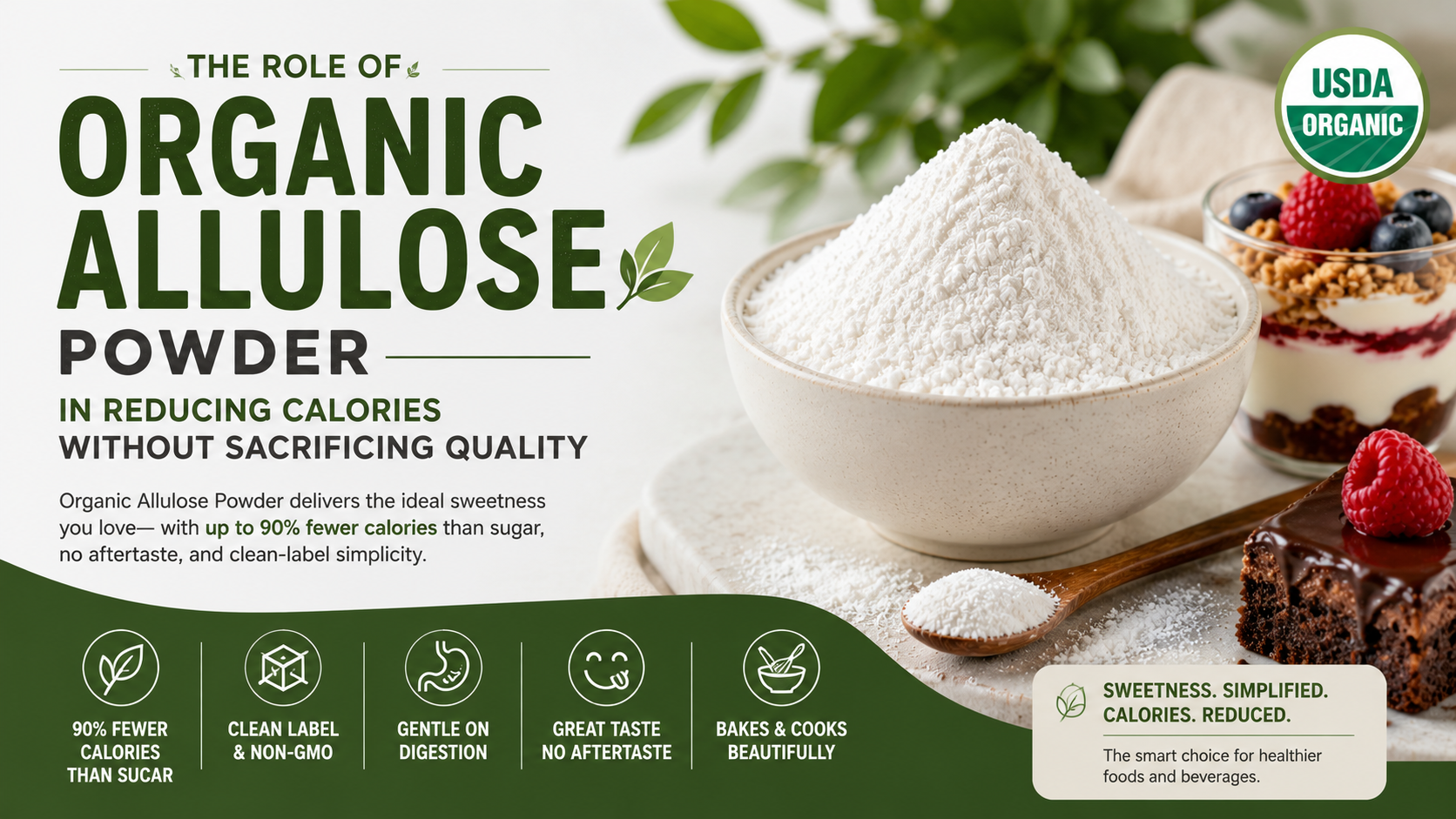
Reducing sugar is one of the most commercially important challenges in food and beverage product development. Consumers want fewer calories — but they also want the same taste, texture, and product experience they have always expected. For most sweetener alternatives, these two goals are in direct conflict.
Organic allulose powder resolves this conflict by functioning like sugar across multiple dimensions simultaneously: it provides bulk, contributes to browning, retains moisture, and delivers a clean, familiar sweetness — all at a fraction of the caloric load of sucrose.
This article examines exactly how organic allulose powder achieves calorie reduction without quality compromise, including a direct comparison with other low-calorie sweeteners and practical guidance for food manufacturers.
The Real Challenge of Calorie Reduction in Food Formulation
Sugar is not just a sweetener. In any food system, sucrose performs six distinct technical functions:
| Sugar Function | Role in the Product |
|---|---|
| Sweetness | Flavor foundation, palatability |
| Bulk and body | Volume, structure, mouthfeel |
| Moisture retention | Softness, shelf life, anti-staling |
| Browning (Maillard / caramelization) | Color development, flavor complexity |
| Cryoprotection | Ice crystal control in frozen products |
| Texture binding | Cohesion in bars, gummies, caramels |
When sugar is simply removed or replaced with a high-intensity sweetener, most of these functions disappear. The result is a product that is thinner, drier, paler, and structurally weaker than the original — and consumers notice immediately.
This is why meaningful calorie reduction in complex food products requires an ingredient that replaces sugar’s functional roles, not just its sweetness. Organic allulose powder is one of the very few ingredients that does this.
How Organic Allulose Powder Delivers Calorie Reduction
The Caloric Numbers
Sucrose provides 4 kcal/g. Organic allulose powder provides 0.2–0.4 kcal/g — approximately one-tenth of sucrose’s caloric load. This is because allulose is absorbed in the small intestine but not metabolized for energy, and is subsequently excreted via urine.
Practical calorie reduction calculation:
| Product | Sucrose in Formula | Replace with Allulose | Calorie Reduction Per 100g Serving |
|---|---|---|---|
| Chocolate chip cookie | 25g sucrose (100 kcal from sugar) | 25g allulose (~6 kcal from sweetener) | ~94 kcal saved per 100g |
| Flavored yogurt | 15g sucrose (60 kcal from sugar) | 15g allulose (~4 kcal from sweetener) | ~56 kcal saved per 100g |
| Protein bar (50g) | 12g sucrose (48 kcal from sugar) | 12g allulose (~3 kcal from sweetener) | ~45 kcal saved per 50g bar |
| RTD fruit tea (250ml) | 20g sucrose (80 kcal from sugar) | 20g allulose (~5 kcal from sweetener) | ~75 kcal saved per bottle |
These are conservative estimates based on 0.4 kcal/g for allulose. In many regulatory jurisdictions (including the FDA), allulose can be excluded from total sugar counts on nutrition labels — a significant additional benefit for product positioning.
Blood Glucose Response
Unlike sucrose and most carbohydrates, organic allulose powder produces a minimal blood glucose and insulin response. This makes it suitable for:
- Diabetic-friendly product lines
- Low glycemic index (GI) formulations
- Keto and low-carb diet applications
- Sports nutrition products where insulin spike control matters
This is a functional and labeling advantage that most bulking agents and polyols cannot provide at the same level.
Maintaining Quality: What Allulose Preserves
Taste and Flavor Profile
Organic allulose powder provides approximately 70% of sucrose’s sweetness intensity, with a clean, neutral flavor profile and no bitterness, cooling effect, or metallic aftertaste. This distinguishes it from every major high-intensity sweetener on the market.
The sweetness onset and fade closely mirror sucrose, which means consumers perceive the sweetness curve as natural — a critical factor in consumer acceptance testing for reduced-sugar products.
Texture and Mouthfeel
Because allulose has a similar molecular structure to fructose, it contributes bulk and body to food systems in ways that high-intensity sweeteners simply cannot. In bakery products, this preserves the crumb structure and chew. In beverages, it adds the roundness and fullness that zero-calorie sweetener solutions often lack.
Browning and Color Development
Allulose participates in Maillard browning reactions and caramelizes at high temperatures. This is a property shared with sucrose but absent in most sugar replacers including erythritol, sorbitol, and high-intensity sweeteners. For bakery, confectionery, and any thermally processed product, this means:
- Authentic golden-brown color without artificial colorants
- Complex flavor development during baking
- Visual product quality that matches full-sugar benchmarks
Note: Allulose browns more rapidly than sucrose at equivalent temperatures. Formulators should adjust baking time or temperature by 5–10% during initial trials to calibrate browning to the target level.
Moisture Retention and Shelf Life
Allulose is hygroscopic, retaining moisture in the same manner as sucrose. This is directly relevant to shelf-life performance in bakery products (preventing premature staling), bar products (maintaining softness), and frozen products (controlling crystallization). Replacing sugar with high-intensity sweeteners + inert bulking agents typically cannot replicate this moisture-management behavior.
Head-to-Head Comparison: Allulose vs. Other Low-Calorie Sweeteners
Food manufacturers evaluating organic allulose powder typically compare it against the three most commonly used alternatives: erythritol, stevia (steviol glycosides), and monk fruit extract. The following table provides a direct technical comparison across the criteria that matter most in commercial formulation:
| Criterion | Organic Allulose Powder | Erythritol | Stevia (Reb A) | Monk Fruit Extract |
|---|---|---|---|---|
| Caloric value | 0.2–0.4 kcal/g | 0 kcal/g | 0 kcal/g | 0 kcal/g |
| Sweetness vs. sucrose | ~70% | ~70% | 200–350× | 150–200× |
| Aftertaste | None | Slight cooling effect | Bitter/licorice at high dose | Slight fruity note |
| Bulking / body | Yes — equivalent to sucrose | Yes — but lower solubility | No | No |
| Browning reaction | Yes — participates in Maillard | No | No | No |
| Moisture retention | Yes | Limited | No | No |
| GI / blood glucose impact | Minimal | Minimal | None | None |
| Clean label perception | High — natural origin, organic available | High | High — but stevia aftertaste issues | High |
| Usage level in formula | 1:1 vs. sucrose | 1:1 vs. sucrose | 0.3–0.5% maximum | 0.05–0.3% maximum |
| Formulation complexity | Low — simple replacement | Low-medium (may cause digestive issues at high dose) | High — requires flavor masking | High — requires bulking agents |
| Cost vs. sucrose | Higher | Higher | Higher | Higher |
| Best application fit | Bakery, confectionery, frozen desserts, beverages | Confectionery, tablets, gum | Beverages, simple sweet systems | Beverages |
Key takeaway for formulators: Allulose is the only low-calorie sweetener that simultaneously provides bulk, browning, moisture retention, and clean flavor — making it the most technically capable sugar replacement for complex food systems. Erythritol is a viable alternative for confectionery and tablet applications, but its cooling effect can be a consumer acceptance issue. Stevia and monk fruit are cost-effective for beverages but require significant formulation support in solid food systems.
Application-Specific Calorie Reduction Guide
Bakery Products
Replace 50–100% of sucrose with organic allulose powder. Monitor browning — allulose browns faster, so reduce oven temperature by 5–10°C or shorten bake time by 5–10% during initial trials. Moisture retention will be maintained or improved.
Expected calorie reduction: 40–90% of calories from sugar, depending on replacement level.
Confectionery and Chocolate
Replace 30–60% of sucrose. Allulose participates in caramelization, making it particularly well-suited for caramels, toffees, and brown-sugar confections. In chocolate coatings, test viscosity as allulose affects fluidity differently than sucrose.
Expected calorie reduction: 30–55% of calories from sugar.
Frozen Desserts
Replace 50–80% of sucrose. Allulose lowers the freezing point slightly more than sucrose — adjust the formulation’s water:solids ratio to maintain the target texture at serving temperature. Ice cream and sorbet products benefit from improved creaminess and reduced ice crystal formation.
Expected calorie reduction: 45–75% of calories from sugar.
Beverages (RTD and Functional)
Replace 70–100% of sucrose. Allulose dissolves readily in cold water, making it ideal for RTD applications. It adds mouthfeel and sweetness roundness that zero-calorie sweeteners cannot replicate without flavor masking agents.
Expected calorie reduction: 65–95% of calories from sugar.
Dairy and Plant-Based Dairy Alternatives
Replace 60–100% of sucrose. Allulose is compatible with fermentation cultures in yogurt applications and does not interfere with protein stability. It improves flavor balance in high-protein dairy alternatives where bitterness from protein hydrolysis is a challenge.
Expected calorie reduction: 55–95% of calories from sugar.
Labeling and Regulatory Considerations
In the United States, the FDA has issued guidance allowing allulose to be excluded from “Total Sugars” and “Added Sugars” on Nutrition Facts labels, while still being listed in the ingredient list. This enables manufacturers to:
- Display significantly lower sugar counts without changing the ingredient
- Support “No Added Sugars” or “Low Sugar” claims where applicable
- Improve the visual appeal of the Nutrition Facts panel for health-conscious consumers
In the European Union, allulose is currently under novel food approval review (as of 2026). Manufacturers targeting EU markets should consult with regulatory advisors on the current status before formulating.
In China, allulose is permitted as a food ingredient and is increasingly used in functional food applications.
Why Manufacturers Choose ORGANICWAY for Organic Allulose Powder
ORGANICWAY supplies organic allulose powder with:
- Consistent specification: controlled particle size, solubility, and sweetness profile for repeatable manufacturing results
- Certified organic: USDA NOP and EU organic certification available, supporting product-level organic claims
- Non-GMO verified: documentation available for retailer and market requirements
- Technical support: application development guidance for bakery, beverage, confectionery, dairy, and nutrition categories
- Reliable supply: commercial-scale production with quality management documentation
For manufacturers reformulating existing products or developing new reduced-calorie lines, ORGANICWAY provides both the ingredient and the application expertise to accelerate time to market.