
Table of Contents
The global plant-based protein market has entered a period of decisive transformation, and organic sunflower protein is emerging as one of its most strategically significant ingredients. For food manufacturers, procurement teams, and C-suite decision-makers evaluating ingredient portfolios, sunflower protein offers a unique convergence of market tailwinds, sustainability credentials, allergen-free positioning, and certified organic supply chain advantages that few alternatives can match.
This guide consolidates the latest market intelligence, regional analysis, competitive dynamics, and environmental sustainability data into a single strategic reference for 2026 and beyond.
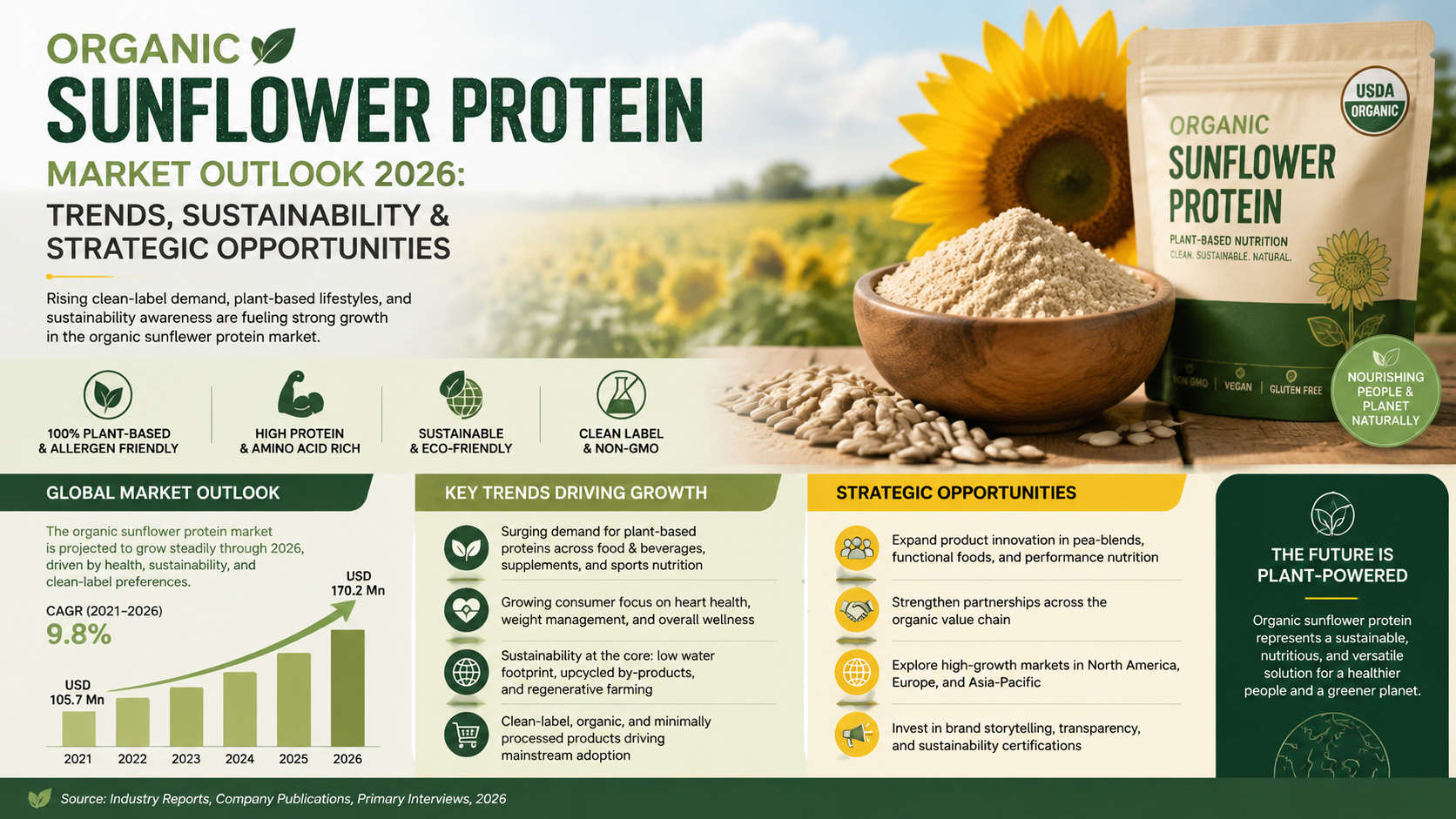
Global Market Size and Growth Trajectory
The sunflower protein market has demonstrated consistent double-digit growth, driven by consumer demand for allergen-free, clean-label, and sustainably sourced plant proteins.
Key Market Indicators:
| Metric | Value | Source |
|---|---|---|
| Global Market Value (2020) | $70.4 million | Verified industry reports |
| Projected Market Value (2030) | $156.3 million | Verified industry reports |
| Overall CAGR (2021–2030) | 8.8% | Verified industry reports |
| Organic Segment CAGR (2021–2030) | 10.0% | Verified industry reports |
The organic segment is the standout growth driver. While conventional sunflower protein still accounts for the majority of market volume (~95% in 2020), the organic sub-segment is expanding at a significantly faster rate as consumers increasingly prioritize certified ingredients free from synthetic inputs, GMOs, and pesticide residues.
Market Segmentation by Application (2020):
| Application Segment | Market Share (2020) | Growth Rate (2021–2030) |
|---|---|---|
| Nutraceuticals | ~88% | Steady growth |
| Food & Beverage | Growing share | 10.7% CAGR (fastest) |
| Cosmetics | Minor share | Emerging |
| Animal Feed | Minor share | Emerging |
The food and beverage segment is expected to register the highest growth rate through 2030, reflecting the expanding use of sunflower protein in meat analogues, protein-enriched snacks, plant-based dairy alternatives, and sports nutrition products.
Regional Market Analysis
Regional demand for sunflower protein varies significantly based on dietary trends, regulatory frameworks, and manufacturing infrastructure.
| Region | Market Size (2020) | Market Share | CAGR (2021–2030) | Primary Applications |
|---|---|---|---|---|
| North America | $25.5 million | 36.2% | 8.3% | Nutraceuticals, sports nutrition, food |
| Europe | $19.9 million | 28.3% | 8.6% | Meat analogues (EFSA-approved), bakery, functional foods |
| Asia-Pacific | $15.7 million | 22.3% | 10.2% | Clinical nutrition, dietary supplements, food |
| LAMEA | $9.3 million | 13.2% | 8.2% | Nutraceuticals, food |
Regional Highlights:
- North America maintains the largest market share, driven by high nutraceutical consumption, an established vegan and flexitarian consumer base, and the presence of major plant protein ingredient suppliers. The United States is the dominant market within the region.
- Europe represents the second-largest market with strong demand across meat analogue applications. EFSA approvals for sunflower protein in plant-based meat formulations have accelerated adoption among European food manufacturers. Clean-label regulations in the EU further advantage certified organic sunflower protein over conventional alternatives.
- Asia-Pacific is the fastest-growing region at 10.2% CAGR, fueled by rising disposable incomes, increasing health awareness, and the rapid expansion of the food and beverage industry in China, India, and Southeast Asia.
- LAMEA is the smallest regional market but maintains steady growth, with emerging opportunities in Brazil and Mexico as plant-based food cultures develop.
Dual-Certified Organic Standards: EU vs. USDA
For manufacturers sourcing organic sunflower protein, understanding the certification landscape is essential for market access and consumer trust. The two dominant organic standards — EU (EC 834/2007) and USDA (7 CFR Part 205) — share foundational requirements but differ in specific implementation details.
| Criterion | EU Organic Standard | USDA Organic Standard | Shared Requirement |
|---|---|---|---|
| Soil Preparation | 3-year conversion period | 3-year conversion period | No synthetic fertilizers |
| Pest Control | Bacillus thuringiensis only | Neem oil permitted | Biological methods only |
| Processing Additives | 47 approved substances | 38 approved substances | No hexane or bleaching agents |
| Traceability | Full blockchain tracking | Paper-based audit trails | Seed-to-package documentation |
| Microbial Testing | <10⁴ CFU/g aerobic bacteria | <10⁵ CFU/g aerobic bacteria | Pathogen testing required |
Why Dual Certification Matters:
Achieving both EU and USDA organic certification provides ingredient suppliers and food brands with access to the two largest organic consumer markets globally. For procurement teams, dual-certified sunflower protein simplifies supply chain management by allowing a single ingredient SKU to serve both North American and European product lines.
From a consumer trust perspective, dual certification signals rigorous quality control and compliance with the world’s most stringent organic farming and processing standards.
Sustainability and Environmental Profile
Sustainability has evolved from a marketing differentiator to a baseline expectation among food manufacturers, retailers, and end consumers. Organic sunflower protein offers a compelling environmental narrative that supports brands’ ESG (Environmental, Social, and Governance) objectives.
Water Efficiency
Sunflowers require significantly less irrigation than many competing protein crops. Their deep taproot system allows them to access water from deeper soil layers, making them drought-tolerant and suitable for cultivation in regions with limited water resources.
Carbon Footprint
Compared to resource-intensive protein sources like soy and almond, sunflower cultivation generates a lower carbon footprint due to:
- Shorter growing cycles that enable multiple harvest rotations
- High seed yield per hectare
- Reduced nitrogen fertilizer requirements under organic management
- The upcycling model: sunflower protein is derived from the meal remaining after oil extraction, meaning no additional land or resources are dedicated solely to protein production
Circular Economy Advantage
The upcycled nature of sunflower protein is a key sustainability differentiator. Sunflower oil extraction produces meal as a byproduct, and converting this meal into a high-value protein ingredient transforms what would be agricultural waste into a functional food ingredient. This zero-waste approach resonates strongly with circular economy principles and appeals to sustainability-conscious brands and consumers.
Organic Farming Benefits
Certified organic sunflower cultivation delivers additional environmental advantages:
- Elimination of synthetic pesticides, herbicides, and fertilizers
- Promotion of biodiversity through crop rotation and integrated pest management
- Improved soil health through organic matter enrichment
- Reduced risk of chemical runoff into waterways
Competitive Landscape and Challenges
Despite its strong growth trajectory, organic sunflower protein faces competitive and operational challenges that manufacturers must consider.
Challenge 1: Protein Content Compared to Alternatives
Sunflower protein contains 50–60g of protein per 100g in concentrated powder form, which is competitive but lower than soy protein isolate (typically 80–90g/100g). Manufacturers must account for this when calculating protein fortification levels in formulations.
Challenge 2: Processing Complexity and Cost
Sunflower protein extraction involves multiple steps:
- Cold Pressing — Oil extraction at controlled temperatures (<45°C for EU, <50°C for USDA) to preserve protein quality
- Defatting — Supercritical CO₂ extraction (approved under both organic standards; hexane is prohibited)
- Protein Concentration or Isolation — Filtration, precipitation, drying, and milling
- Quality Testing — Microbial testing, heavy metal screening, amino acid profiling
These processes require specialized equipment and quality control protocols, which contribute to higher production costs compared to some conventional protein ingredients.
Challenge 3: Allergen Considerations
While sunflower protein is free from the top 14 allergens (including soy, dairy, gluten, and nuts), sunflower seed allergies — though rare — are increasing in prevalence. Food manufacturers should implement appropriate allergen labeling protocols and consider cross-contamination risks during production.
Challenge 4: Flavor and Solubility
Sunflower protein concentrate and isolate can exhibit earthy, slightly bitter flavor notes, particularly at higher inclusion levels. However, ongoing advances in processing technology — including enzymatic hydrolysis, ultrasound-assisted extraction, and microencapsulation — are steadily improving flavor neutrality and functional properties such as solubility, emulsification, and foaming.
Technology Innovation and Processing Advances
The sunflower protein industry is benefiting from significant R&D investment in extraction and processing technologies:
| Innovation | Impact on Product Quality |
|---|---|
| Enzymatic Hydrolysis | Improves solubility, reduces bitterness, enhances bioavailability |
| Ultrasound-Assisted Extraction | Increases protein yield, reduces energy consumption |
| Supercritical CO₂ Extraction | Eliminates hexane use, preserves protein functionality |
| Microencapsulation | Extends shelf life, protects from oxidation |
| Spray Drying Optimization | Improves powder flowability and dispersibility |
These technologies are expanding the functional versatility of sunflower protein, enabling its use in an increasingly diverse range of food and beverage applications.
Strategic Opportunities for Food Manufacturers
Based on the market analysis, sustainability profile, and competitive dynamics outlined above, organic sunflower protein presents several strategic opportunities:
1. Allergen-Free Product Line Development
With growing consumer demand for allergen-free products and increasing regulatory scrutiny on allergen labeling, sunflower protein offers a naturally free-from positioning (no soy, no dairy, no gluten, no nuts) that simplifies clean-label formulation.
2. Dual-Certified Supply Chain Efficiency
A dual-certified (EU + USDA) organic sunflower protein supplier enables food brands to serve both North American and European markets with a single ingredient, reducing SKU complexity and supply chain overhead.
3. Sustainability-Driven Brand Positioning
The upcycled origin, low water footprint, and organic certification of sunflower protein provide authentic sustainability credentials that support brands’ ESG reporting and consumer-facing environmental claims.
4. Nutraceutical and Functional Food Expansion
The high digestibility, neutral flavor, and nutrient density (protein, fiber, vitamin E, phytosterols, selenium) of sunflower protein make it well-suited for nutraceutical applications and functional food formulations targeting health-conscious consumers.
5. Sports Nutrition Differentiation
As the sports nutrition market moves beyond whey and soy, allergen-free plant proteins are gaining traction. Sunflower protein’s favorable amino acid profile — particularly its high methionine and BCAA content — positions it as a viable alternative for plant-based sports nutrition products.
Conclusion
The organic sunflower protein market is poised for continued growth through 2026 and beyond, driven by the convergence of consumer demand for allergen-free proteins, clean-label formulation trends, sustainability mandates, and regulatory support for organic ingredients. Food manufacturers who invest in understanding this ingredient — its market dynamics, certification requirements, sustainability advantages, and formulation considerations — will be well-positioned to capture value in an expanding global market.
For procurement teams seeking a reliable source of dual-certified organic sunflower protein, or for product development teams evaluating formulation options, the next step is to connect with a qualified supplier who can provide technical documentation, samples, and scale-up support.
Sources: Verified industry market reports (2020–2030 projections), European Commission Organic Farming Report 2023, USDA NOP Compliance Guidelines, EFSA food ingredient approvals, MarketsandMarkets Organic Protein Report Q2 2024.