
Table of Contents
The clean-label movement has fundamentally changed how food manufacturers approach product development. Consumers no longer just read ingredient lists – they expect to recognize every item on them. Removing sugars and synthetic sweeteners while maintaining taste, texture, and shelf life is one of the most technically demanding challenges in modern food formulation. What began as a niche preference among natural-food shoppers has become a mainstream purchasing criterion that influences category leadership, retailer acceptance, and regulatory exposure across global markets. Brands that succeed in this environment treat clean-label not as a constraint but as a reformulation discipline, re-engineering products from the sweetener system outward so that the finished goods remain convenient, indulgent, and affordable while earning consumer trust at the point of purchase. For research and development teams, this shift means the sweetener is no longer a minor line on the spec sheet but a strategic decision that shapes the entire ingredient deck.
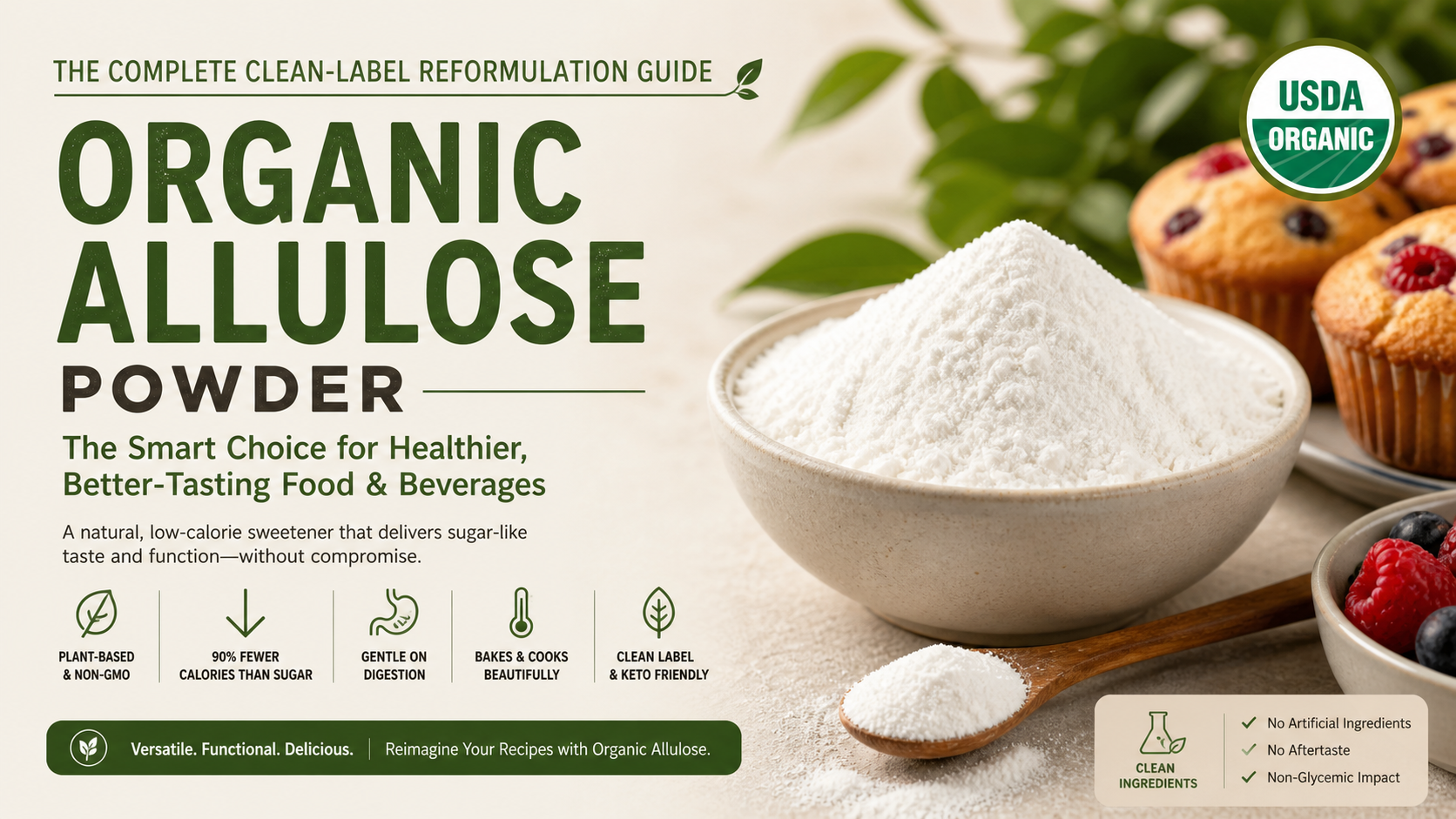
Organic allulose powder has emerged as one of the few ingredients that genuinely delivers on this challenge. Unlike high-intensity sweeteners that mask rather than replace sugar’s full functional role, allulose provides sweetness, body, browning behavior, and moisture retention – all from a certified organic, minimally processed source. It is classified as a rare sugar, occurring naturally in small quantities in figs, jackfruit, and raisins, and the commercial organic grade is produced through an enzymatic conversion of organic plant-based feedstock rather than through synthetic chemistry. Because the molecule is chemically a sugar yet metabolized differently by the body, it behaves like sugar on the processing line while contributing only a fraction of the calories, which is precisely why formulators increasingly choose it as the foundation of reduced-sugar recipes rather than as a mere sweetness top-up. This dual nature – sugar-like function with sugar-like labeling and a fraction of the energy – is what sets it apart in a crowded sweeteners market.
This guide covers everything food manufacturers need to know to use organic allulose powder in clean-label reformulation. It moves from the regulatory and labeling logic that makes organic allulose distinct, through its functional performance versus sugar, into practical application matrices, brand-positioning implications, and the technical support ORGANICWAY provides to industrial customers. Whether you are a research chef, a food scientist, or a procurement lead, the objective is the same: give you the concrete information required to move a project from concept to commercial launch with fewer reformulation cycles and a cleaner label than conventional sugar-replacement routes would allow.
What “Clean Label” Means for Sweeteners in 2025
Clean-label is no longer just a marketing term. Regulatory frameworks in the EU, UK, and increasingly in Asia-Pacific markets are tightening rules around synthetic additives, while major retailers now require clean-label formulations for premium shelf placement. In practice this means ingredient decks are being scrutinized not only for what they contain but for how recognizable and minimally processed those components appear to an ordinary shopper. Additive labeling thresholds, mandatory nutrition declarations, and retailer scorecards all push brands toward shorter, more legible lists. For a sweetener, that scrutiny is especially intense because sugar substitutes have historically been associated with chemical-sounding names and intense artificial aftertastes, which is exactly the perception organic allulose helps a brand avoid. A sweetener that can be described in plain, familiar language is therefore a structural advantage rather than a cosmetic one, and it reduces the education burden a brand must carry at the shelf.
For sweeteners specifically, “clean label” means a combination of attributes that together signal naturalness and transparency to both regulators and consumers, and any ingredient that fails one of them tends to undermine the others.
- Natural origin: derived from plant-based sources without synthetic chemical processing, so the ingredient reads as familiar rather than laboratory-made on a consumer label and survives retailer clean-label audits.
- Recognizable: familiar to consumers, not perceived as a chemical compound, which protects brand trust at the moment of purchase and during the kind of label inspection that modern shoppers routinely perform.
- Minimal processing: limited transformation steps from raw material to final ingredient, supporting clean-label claims and simplifying regulatory classification in multiple jurisdictions at once.
- No artificial additives: no synthetic flavors, colors, or preservatives in the ingredient itself, keeping the finished product free of additive-driven label warnings that erode consumer confidence.
Organic allulose powder meets all four criteria. It occurs naturally in figs, jackfruit, and raisins, and the certified organic version is produced from organic plant sources using an enzymatic conversion process classified as minimal processing under most regulatory frameworks. This natural occurrence is important because it lets formulators describe the ingredient in plain language, and the organic certification adds an additional layer of supply-chain assurance that resonates with the premium health-food segment. The result is a sweetener that satisfies both the letter of clean-label requirements and the spirit of consumer expectation, without forcing the brand to choose between functionality and perception. That alignment is rare enough in the sweeteners category that it is worth treating as a genuine competitive differentiator rather than a box-ticking exercise.
This positions it clearly above high-intensity sweeteners (stevia, sucralose, monk fruit) on the clean-label spectrum, particularly for brands targeting the premium health-food segment. Although stevia and monk fruit are plant-derived, their intense sweetness requires bulking and masking systems that reintroduce complexity into the label, whereas allulose supplies both sweetness and function in a single, simply named ingredient that consumers readily understand.
Functional Properties That Enable Real Reformulation
Replacing sugar is not just about sweetness. Sugar contributes six distinct functions in food formulation, and any credible substitute must address most of them or the product will fail on texture, appearance, or stability, which is why so many early sugar-reduction projects stall during scale-up.
| Function | Sugar’s Role | Organic Allulose Performance |
|---|---|---|
| Sweetness | 100% reference | Approximately 70% of sugar sweetness with a clean, sugar-like taste and no lingering aftertaste, allowing a substantial sugar cut without a hollow flavor. |
| Bulk & body | Provides volume and texture | Yes – delivers comparable bulk and mouthfeel at equivalent dosage, reducing the need for added starches or bulking agents. |
| Browning | Maillard reaction, caramelization | Yes – participates in Maillard browning and caramelization, giving baked goods and confectionery authentic color development. |
| Moisture retention | Keeps products soft, extends shelf life | Yes – retains hygroscopic properties that help maintain softness and extend shelf life under normal storage conditions. |
| Cryoprotection | Controls ice crystal formation in frozen products | Yes – provides a similar cryoprotective effect to sugar in frozen systems, improving scoopability and texture in ice cream. |
| Fermentation substrate | Feeds yeast in fermented products | No – allulose is not fermentable, so yeast-leavened recipes need a small fermentable sugar adjustment to support rise. |
This performance profile means allulose can replace sugar across most application types without requiring compensating ingredients – a key advantage over high-intensity sweeteners that require bulking agents, texturizers, and flavor maskers to fill functional gaps. The practical consequence is a shorter, cleaner ingredient list and a more straightforward production process, because the sweetener itself carries the body, color, and moisture that sugar would otherwise provide. For operations teams, fewer added ingredients also means fewer incoming materials to qualify, store, and track, which lowers working capital and quality overhead across the plant.
For clean-label formulators, this translates directly: fewer additives, shorter ingredient lists, and simpler production processes. Each removed bulking or masking agent is one fewer line on the label and one fewer variable to validate during scale-up, which lowers both compliance risk and development cost while speeding the path from pilot to shelf.
Organic Certification: What It Means for Your Label
Not all allulose is organic. The organic certification status of your sweetener directly affects what label claims you can make on the finished product, and for brands selling into organic channels it is often the deciding specification that determines whether a recipe is even eligible for the range.
With organic-certified allulose powder (ORGANICWAY):
- Qualifies as an organic ingredient in certified organic products, letting the finished good carry organic positioning end to end rather than only on selected components.
- Supports “USDA Organic,” “EU Organic,” and equivalent certifications at the product level, opening access to premium retail and export channels that require documented organic content.
- Non-GMO verified – compatible with Non-GMO Project and equivalent schemes, addressing a second major clean-label consumer concern without additional supplier paperwork.
- Traceable supply chain – documentation available for retailer and auditor requests, reducing compliance risk during inspections and speeding approval for new listings.
Label claim support:
- “Contains organic ingredients” as a defensible, documented claim on pack, backed by certificates that withstand retailer and regulator verification.
- Suitable for “no artificial sweeteners” claims because the ingredient is a naturally occurring sugar, not a synthetic substitute invented in a laboratory.
- Compatible with “naturally sweetened” declarations that align with consumer expectations for transparency and reinforce the brand’s clean-label narrative.
This certification value is especially significant in markets where “organic” commands meaningful price premiums: North America, Germany, Japan, and Australia are the highest-value organic ingredient markets for B2B suppliers. In these regions, the ability to print an organic claim supported by auditable documentation is frequently what separates a product that earns shelf placement from one that does not, and it is why the organic grade of allulose is treated as a strategic input rather than a commodity line item by serious brands.
Application Matrix: Which Products Benefit Most
The following table provides a practical guide for formulators choosing where to apply organic allulose powder, summarizing the primary benefit, a recommended starting replacement level, and formulation notes for each category so that trials can begin from a sensible baseline.
| Product Category | Primary Benefit | Recommended Replacement Level | Notes |
|---|---|---|---|
| Bakery (cakes, muffins, cookies) | Moisture retention, browning, texture | 50-100% of sugar | Monitor browning rate – allulose browns faster than sucrose at high temperatures, so shorten bake time or lower oven temperature slightly to avoid over-color. |
| Confectionery (caramel, fudge, soft candy) | Caramelization control, chew texture | 30-60% of sugar | Pair with a small amount of polyol if firmness is required, since allulose alone stays softer than full-sugar recipes and may need structural support. |
| Chocolate coatings | Smooth melt, no bloom | 40-70% of sugar | Test tempering parameters – allulose changes viscosity versus sucrose, so adjust conching and cooling profiles to protect snap and surface finish. |
| Beverages (RTD, functional drinks) | Mouthfeel, round sweetness | 80-100% of sugar | No fermentation concern and excellent solubility make it ideal for ready-to-drink and powdered formats where clarity and stability matter. |
| Frozen desserts (ice cream, sorbet) | Ice crystal control, creamy texture | 50-80% of sugar | Reduces freezing point slightly – adjust total solids or stabilizer level to hold the target scoopability and prevent unwanted hardening. |
| Dairy (yogurt, flavored milk) | Flavor balance, clean taste | 60-100% of sugar | Works well with probiotics and does not interfere with fermentation cultures or live-and-active claims on cultured products. |
| Protein bars and nutrition snacks | Binding, softness, reduced calories | 30-60% of sugar/syrup | Combine with fiber such as inulin or polydextrose for structure if a chewy, bound texture is required in a low-moisture system. |
Note: Replacement levels are starting-point guidelines. Final dosage should be determined through formulation trials specific to your product system, because moisture, pH, and processing conditions all influence the optimal level and the sensory result you will achieve.
How Organic Allulose Supports Premium Brand Positioning
Beyond functional performance, the ingredient choice itself communicates brand values to retailers and consumers, signaling where a product sits on the naturalness and quality spectrum before a single claim is read on the pack.
Brands using organic allulose powder can credibly claim:
- Reduced calorie without compromise: 0.2-0.4 kcal/g versus 4 kcal/g for sugar – real calorie reduction from a bulk sweetener, not a zero-calorie substitute that needs supporting ingredients to function.
- Suitable for diabetes-friendly formulations: does not raise blood glucose or insulin response, supporting low-glycemic product positioning with a credible physiological basis.
- Keto and low-carb compatible: not metabolized as carbohydrate energy, making it appropriate for ketogenic and low-net-carb product frameworks without flavor sacrifice.
- Organic and natural: supply chain traceable to certified organic plant sources, satisfying both organic and clean-label purchasing criteria at the same time.
These combined claims are rare. Most reduced-sugar products must choose between functional performance (using polyols or bulking agents) or clean-label positioning (using high-intensity sweeteners). Organic allulose powder is one of the few ingredients that supports both simultaneously, which is why it appears in an expanding share of premium reduced-sugar launches and why buyers in those segments actively ask for it by name during supplier meetings. The ability to stack calorie, glycemic, keto, and organic claims on a single ingredient is a positioning advantage that is difficult to replicate with conventional sweetener systems.
In premium retail channels – natural and specialty food chains, e-commerce health platforms, and export markets – this profile translates to measurable shelf and buyer differentiation, because buyers in those channels actively screen for both functionality and label simplicity when selecting new products, and a clean ingredient deck shortens their internal approval process. A product built on organic allulose therefore not only performs in the lab but also moves more easily through the commercial gateways that determine real-world distribution and volume.
Working With ORGANICWAY
ORGANICWAY supplies organic allulose powder with consistent particle size distribution, solubility, and certified organic documentation suited for industrial-scale food production. Our specification is built around the repeatability that contract manufacturers and private-label producers require, so that each lot performs identically on the line and qualifiers do not have to re-validate the sweetener with every shipment they receive from us.
Our technical team supports:
- Reformulation guidance for existing products, including sweetener-system redesign and label simplification that protects the sensory character consumers already recognize.
- Application-specific performance testing against your own recipe and process conditions, so recommendations reflect reality rather than generic textbook values.
- Regulatory documentation for key export markets (US, EU, Japan, Australia) to accelerate market access and reduce the risk of costly delays at customs or during audits.
- Custom particle size options for specific processing requirements such as tableting, dusting, or rapid dissolution in powdered and ready-to-drink systems.
Recommended Products

Allulose Sweetener
Available in two professional formats: free-flowing Allulose Powder (≥98% purity) and liquid Allulose Syrup…


