Table of Contents
Liquid sweetener formats introduce formulation challenges that powder versions do not face: solubility dynamics, viscosity interactions, pH stability, and compatibility with other liquid ingredients. These constraints have historically limited the use of functional sweeteners in ready-to-drink (RTD) formats.
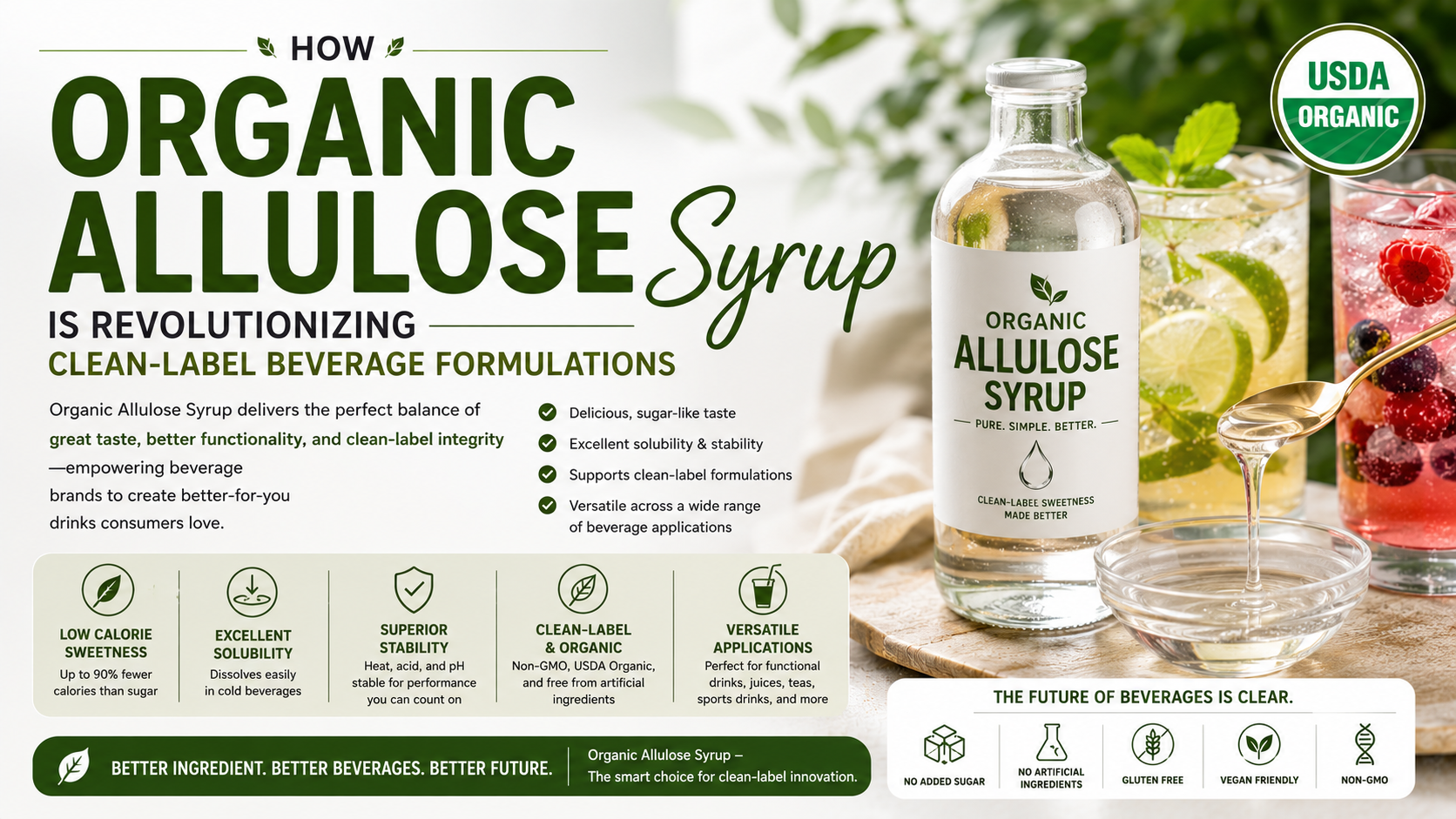
Organic allulose syrup resolves many of these challenges. Its liquid format integrates seamlessly into aqueous systems, while its functional properties — mouthfeel contribution, thermal stability across pH ranges, and clean sweetness without bitterness — make it uniquely suited for beverage and liquid food applications.
This guide covers everything beverage formulators need to successfully incorporate organic allulose syrup into RTD drinks, sauces, dressings, condiments, and liquid nutritional supplements.

Why Liquid Formats Demand a Different Sweetener Strategy
Replacing sugar in beverages is fundamentally different from dry-matrix applications like bars or powders. The challenges are distinct:
- Immediate sweetness perception: Unlike baked goods where texture delivery delays sweetness, beverages deliver sweetness on the first sip. Sweetness calibration must be precise from day one.
- Solubility in aqueous systems: The sweetener must fully dissolve without haze, precipitation, or crystallization over shelf life.
- pH environment: Beverages range from acidic (pH 2.5–3.5 for fruit juices and sodas) to neutral (pH 6.5–7.0 for RTD protein drinks).
- Viscosity interaction: Liquid sweeteners affect the body and mouthfeel of the final product — not just sweetness.
- Transparency requirements: Clear beverages (still water, clear juices) cannot tolerate turbidity from poorly dissolved ingredients.
Organic allulose syrup meets all five requirements. Its molecular structure ensures complete solubility across the full pH range typical of beverages, and its viscosity profile (approximately 1,500–2,500 cPs at 20°C for standard syrup) is compatible with most beverage processing equipment.
Functional Properties of Organic Allulose Syrup in Liquid Systems
Understanding how allulose syrup performs in liquid matrices is essential before beginning formulation work.
Sweetness Profile
| Property | Organic Allulose Syrup | Standard Sugar Syrup (55% Brix) |
|---|---|---|
| Relative sweetness | ~70% of sucrose (w/w basis) | 100% reference |
| Sweetness onset | Rapid, comparable to sucrose | Rapid |
| Lingering aftertaste | None | None |
| Bitterness | Absent | Absent |
| Cooling sensation | Minimal | None |
At typical use levels (8–15% w/w replacement of sucrose), organic allulose syrup delivers sweetness that consumers rate as indistinguishable from full-sugar equivalents in blind taste tests.
Viscosity and Mouthfeel
Organic allulose syrup contributes body and mouthfeel that high-intensity sweeteners (stevia, monk fruit, sucralose) cannot replicate. This is critical for:
- RTD protein drinks: Contributes to the creamy, full-bodied texture consumers expect from milk-based or plant-based protein beverages
- Functional waters: Adds subtle body to enhanced waters without the thin, watery mouthfeel of heavily diluted sugar
- Aloe vera drinks: Complements the mucilaginous texture of aloe vera juice without clashing
Viscosity note: Allulose syrup reduces viscosity compared to equivalent Brix sucrose syrup, which may require adjustment in products where thickness is a quality attribute (e.g., some fruit nectars).
pH and Temperature Stability
| Condition | Performance | Formulation Implication |
|---|---|---|
| Acidic (pH 2.5–3.5) | Stable — no hydrolysis or flavor degradation | Suitable for citrus, juice blends, kombucha |
| Neutral (pH 6.0–7.0) | Stable — no Maillard reaction at low temperatures | Suitable for RTD protein drinks, meal replacements |
| High temperature (≥80°C) | Stable — no caramelization at typical UHT processing temperatures | Suitable for hot-fill and UHT processed beverages |
| Pasteurization (72°C/15s) | No sweetness or color change | Standard pasteurization protocols apply without modification |
Application-Specific Formulation Guides
Ready-to-Drink (RTD) Beverages
Target products: Flavored waters, enhanced waters, RTD teas, low-calorie juice blends, functional energy drinks
Sweetener calibration:
| Sweetness Target | Allulose Syrup (% w/w) | Notes |
|---|---|---|
| Full sugar equivalent | Not achievable alone — allulose provides ~70% sweetness at equivalent weight | Combine with high-intensity sweeteners (stevia, monk fruit) for full sugar replacement |
| 30–50% sugar reduction | 6–10% allulose syrup | Clean label reduction claim; pair with 50–100 ppm stevia extract |
| 50–70% sugar reduction | 8–15% allulose syrup + 75–150 ppm monk fruit extract | Achieves sweetness parity; maintains mouthfeel |
Key formulation considerations:
- Allulose does not ferment — safe for use in non-carbonated, non-alcoholic RTD beverages
- Compatible with standard sorbate and benzoate preservatives without interaction
- Adjust acidity (citric acid, malic acid) to balance sweetness perception — allulose may require slightly higher acid levels than sucrose for equivalent taste profile
- Add viscosity modifiers (xanthan gum, pectin, CMC) at reduced rates — allulose syrup contributes less viscosity than sucrose syrup at equivalent sweetness
Protein and Nutritional Drinks
Target products: RTD protein shakes, meal replacement drinks, clinical nutrition beverages, kids’ nutrition drinks
Why allulose works here:
- Non-insulinogenic: Does not spike blood glucose or insulin, making it ideal for diabetic-friendly or low-GI nutritional products
- Non-fermentable: Will not interact with protein ingredients or probiotics during shelf life
- Neutral flavor: Does not mask or compete with protein notes, vanilla, chocolate, or fruit flavors
- Compatible with common protein sources: Whey, soy, pea, and rice proteins — no adverse interactions
Usage example — 300 kcal RTD protein shake (per liter):
| Ingredient | Conventional Formula | Allulose Formula |
|---|---|---|
| Sugar (sucrose) | 40g | 12g |
| Organic allulose syrup | 0g | 35g |
| Stevia extract | 0g | 80 ppm |
| Protein (whey) | 30g | 30g |
| Fat (MCT oil) | 10g | 10g |
| Dietary fiber | 5g | 5g |
| Total calories | ~300 kcal | ~220 kcal |
| Sugar reduction | Baseline | 40% reduction |
Sauces, Dressings, and Condiments
Target products: Salad dressings, marinades, BBQ sauces, ketchup, hot sauce, condiment packets
Formulation advantages:
- Emulsion stability: Allulose syrup is water-soluble and does not destabilize oil-in-water emulsions in dressings
- Acidic environment tolerance: Stable in pH 3.0–4.0 range typical of vinegar-based dressings and acidic sauces
- Viscosity contribution: Increases viscosity in a manner similar to inverted sugar syrups; useful in reduced-sugar ketchup and BBQ sauce formulations
- NoMaillard browning at sauce-processing temperatures: Unlike glucose syrup, allulose does not participate in Maillard browning at typical sauce processing temperatures — useful when you want to avoid color development
Replacement guidance for sauces:
| Sauce Type | Sucrose Replacement Rate | Notes |
|---|---|---|
| Salad dressings ( vinaigrette) | 70–90% of sugar | May reduce emulsion stability at >80% replacement; test at scale |
| BBQ sauce | 50–70% of sugar | Adjust vinegar level for sweetness balance; allulose caramelizes less than sucrose |
| Ketchup | 50–80% of sugar | Monitor viscosity reduction; consider adding xanthan gum or locust bean gum |
| Marinades | 80–100% of sugar | Allulose penetrates protein surfaces effectively; good for glaze formation |
| Fruit preserves | 50–70% of sugar | Allulose does not crystallize — reduces syneresis risk in preserves |
Frozen Liquid Products (Sorbets, Shaved Ice)
Target products: Frozen dessert syrups, shaved ice toppings, frozen cocktail mixers, iced coffee syrups
Why allulose syrup works in frozen formats:
- Reduced freezing point depression: Allulose lowers the freezing point less than sucrose, resulting in a softer texture at equivalent solids
- No crystallization: Unlike sucrose, allulose does not recrystallize during freeze-thaw cycles — critical for products stored in home freezers
- Excellent thaw stability: No phase separation or textural degradation after thawing
Usage example — frozen dessert syrup (per 100g product):
- Allulose syrup: 40–60g (provides sweetness + freeze point control)
- Water: 30–50g
- Fruit puree or flavor: 5–15g
- Citric acid: to taste
- Xanthan gum: 0.1–0.2g (stabilizer)
Labeling Guidance by Market
Understanding how organic allulose syrup can be labeled in your target market is as important as the formulation itself.
United States (FDA)
- Allulose (D-psicose) is recognized as Generally Recognized as Safe (GRAS) for use as a sweetener and flavor adjuvant
- Labeling as “Added Sugars”: As of 2021, the FDA requires allulose to be listed in the Added Sugars section of the Nutrition Facts panel, but with a mandatory “includes” statement noting it is “a sugar not chemically related to other sugars” (pending ongoing regulatory review)
- Calorie calculation: FDA allows manufacturers to count allulose as 0.2 kcal/g for nutrition labeling purposes (vs. 4 kcal/g for sucrose)
- Organic label: With USDA Organic certified allulose syrup, the product qualifies for organic certification at the finished goods level
European Union
- Allulose is currently under review by EFSA as a Novel Food; commercial food use in the EU is not yet authorized
- EU brands targeting the low-sugar market should consult regulatory counsel before using allulose in products destined for EU retail
China
- Allulose is approved as a Novel Food ingredient; import and domestic use are permitted under GB standards
- Calorie labeling follows Chinese GB 28050-2011 standards; check with local regulatory counsel for exact declaration requirements
Japan
- Allulose (D-psicose) is fully approved for use in all food and beverage categories
- Japan has been among the most active markets for allulose beverage innovation, providing extensive precedent for formulation approaches
Internal Sourcing: Why Organic Certification Matters for Liquid Ingredients
For beverages and liquid products, organic certification of the allulose syrup supplier is not merely a marketing claim — it affects your entire formulation and supply chain:
- Supply chain traceability: Organic certification requires documentation of the raw material source (organic plant matter such as figs, jackfruit, or organic starch sources) through the enzymatic conversion process
- Processing aids: The enzymatic conversion process used to produce allulose may involve processing aids; organic certification requires full disclosure and approval of all processing aids used
- Residue limits: Certified organic products must meet strict pesticide and chemical residue limits — important for products targeting premium retail channels and export markets
- Market channel access: Major natural food retailers (Whole Foods, Sprouts, natural channels in EU and Asia-Pacific) require organic certification at the ingredient level for “organic” label claims on finished products
ORGANICWAY’s organic allulose syrup is produced from certified organic plant sources using an enzymatic conversion process that meets USDA Organic, EU Organic, and JAS Organic standards. Full technical documentation, including organic certificates, non-GMO verification, and specifications sheets, is available for B2B buyers and finished goods manufacturers.

Technical Specifications
| Parameter | Specification |
|---|---|
| Physical form | Clear, colorless to light amber liquid |
| Brix (solids content) | 70–75° Brix (typical) |
| Allulose purity | ≥95% of total sugars |
| pH | 4.5–6.5 |
| Viscosity | 1,500–2,500 cPs at 20°C |
| Moisture | 25–30% |
| Bulk density | 1.35–1.45 g/mL |
| Solubility | Fully water-soluble |
| Storage | Cool, dry environment; shelf life 24 months in sealed container |
| Certifications | USDA Organic, Non-GMO Project Verified, Kosher, Halal |
Getting Started With ORGANICWAY
ORGANICWAY supplies organic allulose syrup in bulk formats suitable for industrial-scale beverage production, with technical support for formulation, regulatory compliance, and certification documentation.
Technical support available:
- Application-specific formulation guidance for your product category
- Sweetness calibration calculations and pilot batch formulation trials
- Regulatory documentation for US, EU, China, and Japan markets
- Organic certification documentation and supply chain transparency reports
- Custom specifications for particle size, Brix, and packaging requirements