
Schisandra Chinensis is a magnolia plant. There are two types, one is Schisandra chinensis (Turcz.)Baill, another is Schisandra sphenanthera Rehd. et Wils. The former is called “northern Schisandra”, while the latter is called “southern Schisandra”. Botanically, Schisandra chinensis belongs to the Schisandraceae family and is a deciduous woody vine native to the forests of northern China, Korea, and parts of the Russian Far East. It is widely cultivated both as a traditional medicinal material and as a commercially important berry crop. The related species Schisandra sphenanthera, commonly known as southern Schisandra, grows in central and southwestern China and is botanically distinct, though the two are frequently confused in informal trade. Understanding the precise botanical identity of each species is the first and most critical step in sourcing genuine, high-grade Schisandra Chinensis, because the therapeutic profile, appearance, and market value of the northern species are consistently superior to those of its southern counterpart.
The quality of Schisandra Chinensis is better than Schisandra sphenanthera. Schisandra Chinensis is irregularly spherical or oblate, 5~8mm in diameter. When selecting raw material for extraction or direct consumption, buyers should always prioritize the northern species, since it contains a higher concentration of the active lignans that define the herb’s value. The fully ripe berry of Schisandra chinensis presents as an irregularly spherical or oblate drupe, typically measuring between 5 and 8 millimeters in diameter, with a cluster of small, fused carpels that give the fruit its characteristic bumpy surface. By contrast, southern Schisandra berries are generally smaller, more elongated, and lower in the schisandrin compounds that manufacturers measure during quality control. For any purchaser focused on potency, organoleptic character, and batch-to-batch consistency, the northern Schisandra Chinensis is the only specification worth committing to at scale.
Appearance: purplish-red or dark red, wrinkled, soft flesh. High-quality Schisandra Chinensis should display a deep purplish-red to dark red coloration after drying, with a naturally wrinkled surface that signals proper dehydration and concentration of the fruit’s internal oils. The flesh should remain pliable and soft rather than brittle, which indicates that the berries were harvested at full ripeness and dried under controlled conditions rather than over-roasted. Uniform color across a batch is a strong positive indicator, while faded, brownish, or blotchy berries often point to immature harvest, excessive storage, or adulteration with lower-grade material. Experienced quality inspectors also examine the seed clusters inside the fruit, since the number and fullness of seeds correlate with maturity and the overall density of bioactive constituents.
Flavor: less slightly, after the seed is broken, has aroma, flavor acerbity, and slight bitterness. The classic sensory signature of premium Schisandra Chinensis is the famous “five flavors” that give the fruit its Chinese name, Wu Wei Zi: sweet, sour, salty, bitter, and pungent notes perceived across the tongue. On first impression the dried berry tastes only slightly sour, but once the seed is broken the enclosed aromatic oils are released, producing a pronounced fragrance and a complex flavor that is simultaneously acerbic, mildly bitter, and gently sweet. This layered taste profile is itself a quality marker; flat, one-dimensional, or musty samples usually reflect poor genetics, improper drying, or aged inventory. Buyers who routinely cup and chew representative samples build an intuitive reference standard that laboratory certificates alone cannot replace.
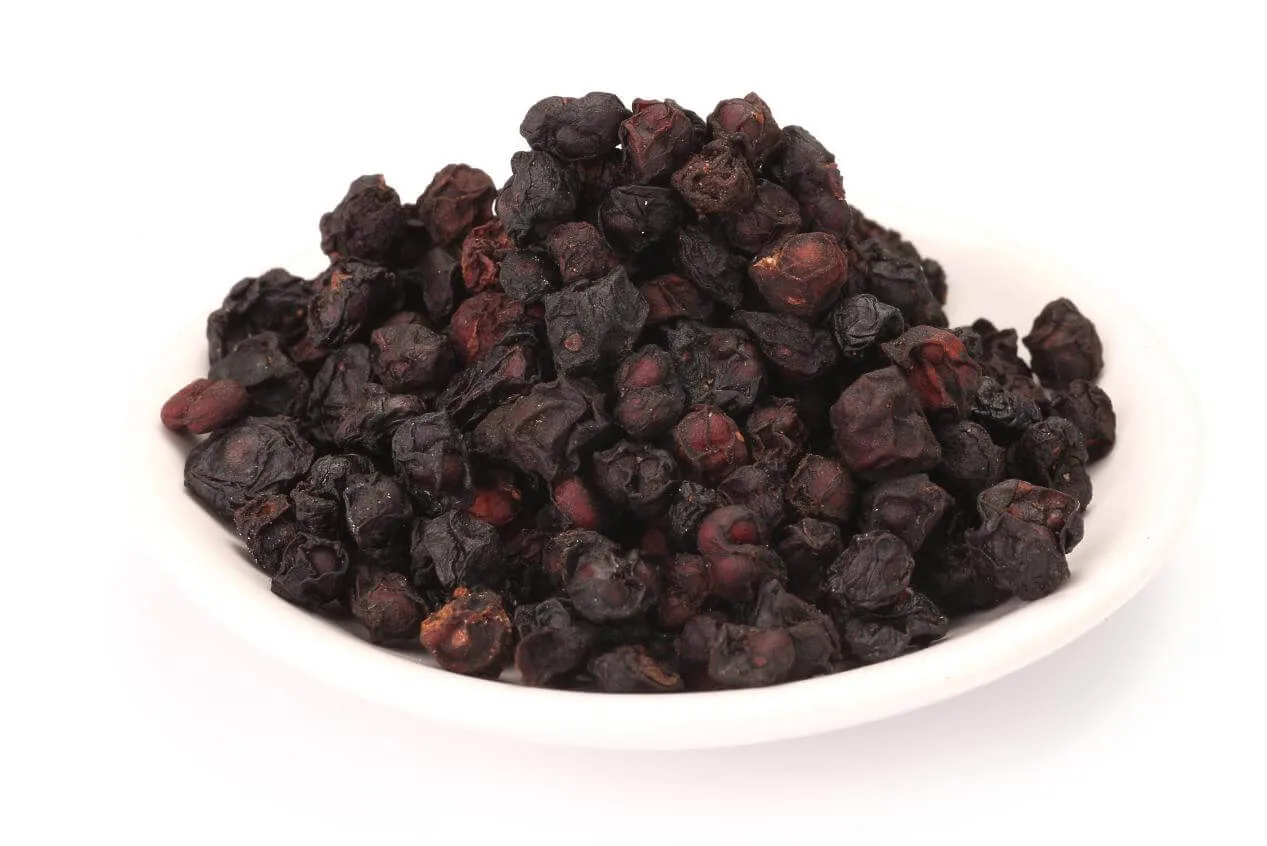
Schisandra sphenanthera are smaller and surface brownish red to dark brown, shriveled, shriveled, flesh often clingy on the seed. In direct comparison, southern Schisandra berries are noticeably smaller than the northern type and show a brownish-red to dark-brown exterior rather than the vivid purplish-red of true Schisandra chinensis. The surface tends to be heavily shriveled, and the dried flesh commonly adheres stubbornly to the seed, making separation difficult during processing. These structural differences are reliable visual cues that help procurement teams reject mislabeled lots at the warehouse gate before they ever reach production. Because southern Schisandra is cheaper to source, it occasionally appears blended into northern Schisandra shipments, so a disciplined incoming inspection protocol—combining visual sorting, microscopy, and marker-compound testing—is essential for brands that promise a pure northern Schisandra specification to their customers.
Schisandra Chinensis distribution area:
The main producing areas of Schisandra Chinensis are northeast China, Inner Mongolia, Hebei, and Shanxi. Within these regions, the provinces of Heilongjiang, Jilin, and Liaoning in China’s northeast corner are especially renowned for producing the most potent and best-colored berries, thanks to the cold winters and short growing season that concentrate the fruit’s lignans. Inner Mongolia contributes significant wild-collected and cultivated volume, while Hebei and Shanxi supply both wild and organically farmed material from mountainous terrain. Each origin carries subtle differences in berry size, sugar content, and oil profile, which is why professional buyers often lock in a single regional supply base to keep their finished products consistent from one production run to the next. Traceability back to a defined producing area is also a growing requirement for export documentation and organic certification audits.
Harvest time: pick the fruit when it is ripe in autumn. The optimal harvest window falls in early to mid-autumn, once the clusters have turned fully red on the vine and the sugars and schisandrin levels peak. Picking too early yields sour, low-potency berries, while late harvesting risks frost damage and mold during the drying phase. Because Schisandra ripens unevenly, experienced growers may pass through a plantation several times, hand-selecting only the fully colored fruit. This selective, labor-intensive approach protects quality but raises cost, which is why commodity-grade material harvested in a single sweep is usually inferior. For organic programs, the autumn harvest must also respect the certification body’s rules on permitted inputs and worker safety, reinforcing the value of a transparent, audited supply chain.
Processing: dry it or steam it and remove fruit stems and impurities. After harvest, the berries are typically either sun-dried or gently hot-air dried, or alternatively briefly steamed before drying to stabilize color and reduce microbial load. Proper processing then requires the removal of fruit stems, leaves, sand, and other field impurities through winnowing, sieving, and hand sorting. Overly aggressive heating during drying destroys the volatile aromatic compounds and bleaches the characteristic red hue, so the best processors use low-temperature, well-ventilated methods that preserve both appearance and active constituents. For the organic market, all cleaning aids and any surface treatments must comply with EU and NOP organic regulations, and every processing step should be documented so that the finished lot can be traced from the drying yard back to the original harvest field without gaps.
The growing environment: It grows in ravines, streams, and hillsides with an altitude of 1200 to 1700 meters. In its wild habitat, Schisandra Chinensis climbs as a forest-edge vine along ravines, stream banks, and sunny hillsides, most often between 1200 and 1700 meters above sea level where cool nights and humid air encourage dense, fragrant fruit. Cultivated plantations mirror these conditions by choosing well-drained slopes with partial shade and reliable water rather than hot, low-lying farmland. The plant is hardy and perennial, but it rewards careful site selection with higher yields and richer chemistry. Organic growers face the added challenge of managing pests and weeds without synthetic pesticides, relying instead on buffer zones, cover crops, and manual labor. Knowing the natural ecology of the species helps buyers judge whether a given farming claim is realistic for the altitude and climate stated on a supplier’s certificate.
Medicinal value: its fruit contains Schisandrin (Schisandrin C23H3206) and vitamin C, resin, tannins, and a little sugar. The pharmacological interest in Schisandra Chinensis centers on its lignan fraction, especially schisandrin and related compounds such as schisandrin B and schisandrin C, with the widely cited marker schisandrin recorded in the literature under the formula C23H32O6. Alongside these lignans, the berry supplies vitamin C, plant resins, tannins, and a small amount of natural sugar, a combination that underpins its long history in traditional tonic formulas. Modern research has investigated the antioxidant, hepatoprotective, and adaptogenic activities associated with the lignan profile, which is precisely why standardized extracts quantify schisandrin content. For formulators, the presence of multiple compatible constituents rather than a single isolated molecule is part of the appeal, since the whole-fruit matrix is believed to contribute to the herb’s traditional “adaptogen” reputation for supporting resilience under stress.
EU&NOP organic standard Schisandra Chinensis is available now, and it is 100% organic. It is harvesting time now. We are pleased to confirm that certified EU and NOP organic standard Schisandra Chinensis is available right now, and every lot we currently ship is 100 percent organic, cultivated and handled under full organic compliance from field to finished package. Because this is the active harvesting season, fresh autumn material is moving through our drying and sorting lines and can be reserved while supplies are at their peak of potency and color. Buyers planning seasonal production runs should secure allocations early, since certified organic northern Schisandra is a limited, weather-dependent crop and the best lots are typically committed before the season ends. Our organic certification covers the entire chain, so you can document organic status with confidence for both European and North American regulatory frameworks.
Organic Schisandra Chinensis can be processed into organic Schisandra Chinensis extract. It is mainly used for health care products. Beyond the whole dried berry, organic Schisandra Chinensis can be further processed into an organic Schisandra Chinensis extract, a concentrated form that captures the fruit’s lignan profile in a standardized, easy-to-formulate ingredient. This extract is mainly used for health care products such as capsules, tablets, tinctures, and functional beverages, where consistent schisandrin levels matter more than whole-fruit appearance. Working from certified organic raw berries ensures the finished extract also qualifies for organic labeling, an increasingly important selling point in clean-label supplement markets. By controlling both the botanical raw material and the extraction step, suppliers can guarantee traceability and reduce the risk of adulteration that sometimes affects openly traded commodity extracts.
Organic schisandra extract specification: 2%, 5% and 9% schizandrin. The available organic schisandra extract specification comes in three standardized strengths—2%, 5%, and 9% schizandrin—so formulators can match the ingredient precisely to their target dosage and product format. The 2 percent grade suits gentle daily wellness blends, the 5 percent grade fits mainstream supplement capsules, and the 9 percent grade serves high-potency or clinical-style formulations that need maximum lignan density per gram. Each specification is produced from the same certified organic berries and verified by laboratory assay, giving buyers a predictable, repeatable active content. When requesting a quote, it helps to state the required schizandrin percentage, intended application, and annual volume so the right grade and packaging can be reserved from the current harvest.
Organic Schisandra Chinensis berry benefit:
- promote immune function; Premium organic Schisandra Chinensis berries are traditionally valued for helping to promote immune function, supplying a natural mix of vitamin C, lignans, and antioxidants that support the body’s everyday defenses. Regular use in wellness routines is associated with stronger seasonal resilience, making the berry a popular base for tonics and immune-supporting supplements.
- Anti-oxidation; The lignan and polyphenol content of Schisandra Chinensis delivers strong anti-oxidation activity, helping to neutralize free radicals that contribute to cellular aging and oxidative stress. This antioxidant character is one of the main reasons the fruit is incorporated into beauty, longevity, and general-health formulations where protecting cells from daily environmental pressure is the goal.
- anti-aging; Closely linked to its antioxidant action, the anti-aging benefit of Schisandra Chinensis comes from supporting skin vitality and metabolic health as part of a balanced regimen. Traditional use positions the berry as a rejuvenating tonic, and modern consumers value it for helping maintain energy and a youthful appearance when combined with a healthy lifestyle.
- Protect the liver; Among its best-studied properties, Schisandra Chinensis is known to help protect the liver, with research focusing on its lignans’ hepatoprotective effects that support the organ’s natural detoxification and recovery processes. This makes the berry a common ingredient in liver-support and cleansing supplements intended for periodic use.
- Fall blood sugar; Schisandra Chinensis also shows activity that may help fall blood sugar within a normal range, an area of growing interest for metabolic-wellness products. While it is not a substitute for medical treatment, the berry’s traditional role in supporting balanced glucose metabolism adds to its appeal as part of a broader, plant-based approach to daily health management.