
Table of Contents
The global organic food ingredients market has experienced consistent growth over the past decade, driven by consumer demand for clean-label, sustainably sourced, and health-conscious products. Within this market, organic dextrose powder occupies a strategically important position as a versatile carbohydrate ingredient used across functional beverages, sports nutrition, baked goods, confectionery, infant nutrition, and plant-based formulations.
Yet sourcing organic dextrose powder for global operations is far more complex than purchasing conventional ingredients. The intersection of organic agricultural constraints, multi-market regulatory requirements, logistics volatility, and batch-to-batch variability creates a supply chain environment that demands proactive management and strategic supplier partnerships.
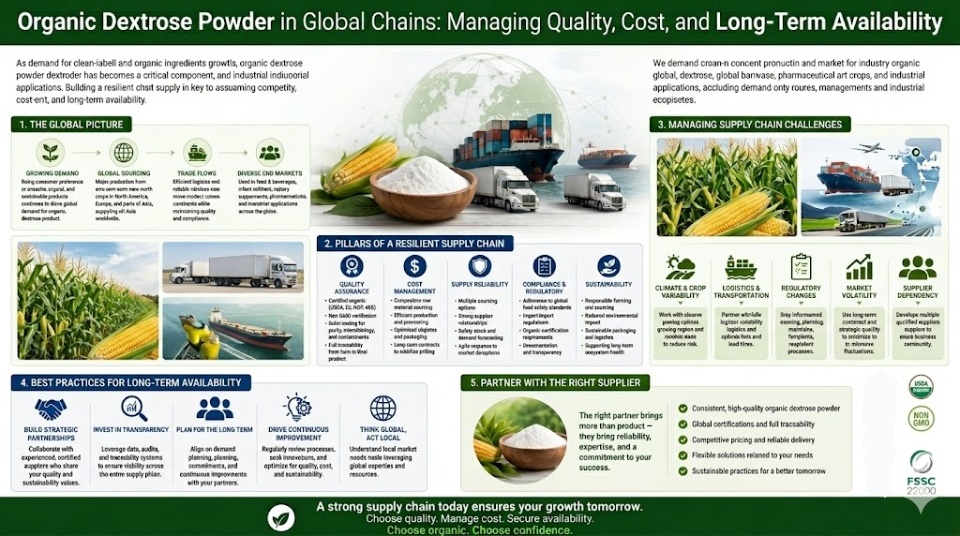
This article provides a comprehensive framework for procurement directors, supply chain managers, and operations leaders to navigate the complexities of global organic dextrose powder sourcing. We examine the core challenges, cost dynamics, supplier selection criteria, and long-term strategies that enable resilient and reliable supply chains.
The Strategic Role of Organic Dextrose Powder in Global Markets
Why Organic Dextrose Is Classified as a Strategic Ingredient
Organic dextrose powder is not a commodity ingredient — it is a strategic ingredient that shapes product positioning, regulatory compliance, and brand integrity. Several characteristics define this strategic importance:
Irreplaceability in Clean-Label Products: In applications requiring organic certification, dextrose powder often cannot be substituted with conventional alternatives without invalidating the organic claim. This creates a hard dependency on organic supply chains.
Cross-Category Applicability: Dextrose serves multiple product categories simultaneously. A single supplier relationship can support your beverages, sports nutrition line, and bakery ingredient needs — creating leverage but also concentration risk.
Regulatory Multi-Market Complexity: Brands operating in the US, EU, and Asia-Pacific markets must ensure their organic dextrose meets the specific organic standards of each jurisdiction. A single sourcing decision affects compliance across multiple regulatory environments.
Global Market Demand Drivers
The demand for organic dextrose powder is shaped by several concurrent market trends:
| Market Driver | Impact on Demand | Timeline |
|---|---|---|
| Clean-label consumer movement | Strong positive | Ongoing |
| Organic certification mandates for premium brands | Strong positive | Ongoing |
| Sports and performance nutrition growth | Moderate positive | 5–10 years |
| Infant nutrition organic standards | Moderate positive | Ongoing |
| Plant-based product expansion | Moderate positive | 5–10 years |
Key Supply Chain Challenges for Global Buyers
The Four Critical Challenges
Managing organic dextrose powder supply chains globally presents four interconnected challenges that buyers must navigate simultaneously:
Challenge 1 — Raw Material Volatility
Organic corn is the foundational input for organic dextrose powder. Unlike conventional corn, which benefits from synthetic fertilizers, pesticides, and genetically improved seeds that maximize yields, organic corn production is subject to:
- Lower average yields (organic farms produce 20–40% less than conventional farms)
- Higher susceptibility to weather extremes and pest pressure
- Geographic concentration in regions with established organic farming infrastructure (primarily US Midwest, parts of Europe, and China)
- Price volatility driven by organic acreage fluctuations, seasonal weather events, and organic certification transition periods
This volatility propagates through the supply chain, affecting both price and availability of organic dextrose powder.
Challenge 2 — Certification and Regulatory Alignment
Multi-market compliance creates documentation complexity:
| Market | Organic Standard | Key Requirements |
|---|---|---|
| United States | USDA NOP (National Organic Program) | 95%+ organic content, USDA-accredited certifying agent |
| European Union | EU Organic Regulation 2018/848 | Organic logo mandatory above 95%, equivalent standards for imported goods |
| Japan | JAS (Japanese Agricultural Standards) | Separate JAS certification required |
| China | CNCA Organic | Separate certification; different certifier ecosystem |
| United Kingdom | UK Organic Regulation | Post-Brexit standards; different from EU |
A single shipment must often carry multiple organic certifications to serve a manufacturer’s global distribution network.
Challenge 3 — Quality Consistency Across Batches
Organic production inherently introduces more variability than conventional manufacturing because the agricultural inputs are subject to natural conditions:
- Dextrose Equivalent (DE) variation may range from 95–100 between batches
- Color may vary slightly based on processing conditions
- Particle size distribution affects dissolution characteristics
- Moisture content fluctuations can impact powder flowability
For manufacturers producing at scale, this variability must be managed through tight supplier specifications and incoming quality control.
Challenge 4 — Logistics and Lead Time Complexity
Organic dextrose powder typically travels from manufacturing facilities (often in China, the US, or the EU) to global distribution points. The logistics chain introduces several risk factors:
| Risk Factor | Impact | Mitigation Strategy |
|---|---|---|
| International shipping delays | 2–6 weeks additional lead time | Forward purchasing and safety stock |
| Port congestion | Unpredictable arrival times | Alternative routing and port diversification |
| Cold chain (if humidity-controlled) | Additional cost; limited carriers | Bulk bag vs. bag-in-box selection |
| Customs clearance (organic goods) | Document verification; potential holds | Pre-cleared documentation packages |
| Geopolitical factors | Trade restrictions; tariff changes | Dual-sourcing from multiple regions |
The Hidden Cost of Supply Chain Disruption
When organic dextrose supply is disrupted, the consequences extend far beyond delayed shipments:
- Product reformulation costs: Reconfiguring a formula to substitute dextrose with an alternative can cost 5,000–50,000 in R&D and regulatory re-testing
- Certification risk: Switching to conventional dextrose in an organic product invalidates the organic certification — requiring re-certification and potentially removing the product from shelves
- Brand damage: Stockouts and formulation changes damage consumer trust, particularly in premium organic segments
- Contractual penalties: Retailers may impose penalties for failure to supply agreed volumes
These hidden costs make investment in supply chain resilience economically justified.
Managing Cost Without Compromising Quality
Understanding the True Cost of Organic Dextrose Powder
The landed cost of organic dextrose powder encompasses far more than the unit price per kilogram:
| Cost Component | Typical Range | Notes |
|---|---|---|
| Base unit price | 1.50–3.00/kg | Varies by supplier, volume, market conditions |
| Freight (international) | 0.10–0.50/kg | Depends on origin, volume, carrier |
| Import duties | 5–25% ad valorem | Varies by destination country |
| Insurance | 0.3–0.5% of cargo value | Recommended for full coverage |
| Customs clearance | 100–500 per shipment | Broker fees, duties deposit |
| Quality testing (incoming) | 200–800 per batch | COA verification, additional lab testing |
| Storage and handling | 0.05–0.15/kg/month | Warehouse costs, inventory carrying |
| Regulatory compliance documentation | Variable | Higher for multi-market manufacturers |
A supplier offering the lowest unit price may not deliver the lowest landed cost. Always calculate the full landed cost before making sourcing decisions.
Cost Optimization Strategies
Strategy 1 — Long-Term Contracts Over Spot Purchasing
Organic ingredient markets are inherently volatile. Securing annual contracts with price adjustment mechanisms (e.g., linked to agricultural commodity indices) provides budget predictability while maintaining flexibility. Long-term contracts also give suppliers the security to invest in dedicated organic production capacity.
Strategy 2 — Optimize Specifications to Reduce Waste
Over-specifying parameters that do not affect your application is a common source of unnecessary cost. Review your specifications with your supplier and R&D team annually to ensure each parameter is calibrated to your actual requirements.
Strategy 3 — Consolidated Shipping
For manufacturers with multiple production facilities globally, consolidating shipments to a central warehouse and redistributing internally can reduce per-unit freight costs significantly compared to direct-to-factory shipments.
Strategy 4 — Flexible Packaging for Unit Cost Reduction
Moving from 20 kg bags to 500 kg big bags (or bulk tankers for high-volume users) can reduce packaging costs by 15–25%. Evaluate whether your internal handling equipment supports larger packaging formats.
What Global Buyers Look for in a Strategic Supplier
Beyond Price: The Four Qualities of a Strategic Supplier
Global buyers with established organic ingredient programs consistently prioritize four supplier qualities:
Quality 1 — Reliable Production Capacity
A strategic supplier must demonstrate:
- Production capacity that comfortably exceeds your committed volumes
- Clear capacity expansion plans if your business grows
- Redundancy in production lines to handle equipment downtime
- Proven track record of supplying your specific market regions
Quality 2 — Transparent Documentation
Organic integrity depends on documentation. Suppliers must provide:
- Real-time access to organic certificates and transaction certificates
- Batch-level COAs that match your specifications
- Complete chain-of-custody from organic corn to finished powder
- Proactive communication about any deviations or issues
Quality 3 — Application Knowledge
The best organic dextrose suppliers do more than ship powder — they understand your applications:
- Technical support for formulation optimization
- Knowledge of how dextrose behaves in specific processes (heat treatment, pH extremes, carbonation)
- Understanding of multi-market regulatory requirements
- Awareness of competitors and industry trends
Quality 4 — Long-Term Partnership Mindset
Suppliers who view your relationship as a strategic partnership (rather than a transactional sale) provide:
- Priority allocation during tight supply periods
- Joint demand forecasting and planning
- Collaborative product development
- Fair treatment during price renegotiations
Red Flags in Supplier Evaluation
Be wary of suppliers who:
- Cannot provide references from existing B2B customers in your application sector
- Offer pricing that is significantly below market — this may indicate compromised organic integrity
- Are unwilling to share third-party audit reports or visit their facilities
- Have a history of certification changes, relocations, or ownership transitions
Supplier Perspective: Ensuring Long-Term Availability
What Suppliers Need from Buyers
Sustainable supply chains are a two-way commitment. Suppliers need buyers to provide:
- Forecast visibility: 6–12 month rolling forecasts allow suppliers to plan corn sourcing and production scheduling
- Volume commitments: Forward contracts with defined minimum quantities
- Payment reliability: Adherence to agreed payment terms, particularly for smaller suppliers
- Quality feedback loops: Regular communication about specification performance
Building Supplier Resilience
Leading organic dextrose suppliers invest in resilience through:
- Multiple organic corn sourcing regions: Reducing dependence on a single geographic region
- Contract farming arrangements: Pre-committed organic corn production from partner farms
- Production flexibility: Ability to produce both organic and conventional products on the same equipment with rigorous changeover protocols
- Geographic inventory positioning: Stock held in multiple distribution points globally
Practical Recommendations for Long-Term Supply Chain Success
Recommended Practices
| Practice | Benefit | Implementation Complexity |
|---|---|---|
| Qualify 2–3 approved suppliers | Avoids single-source risk | Medium |
| Maintain 60–90 days of safety stock | Buffer against disruption | Medium |
| Conduct annual supplier audits | Verifies ongoing compliance | Medium |
| Share 12-month rolling forecasts | Improves supplier planning | Low |
| Establish joint risk reviews | Proactive issue identification | Low |
| Negotiate multi-year contracts with price mechanisms | Budget certainty | Medium |
Geographic Sourcing Strategy
Consider sourcing organic dextrose powder from multiple geographic origins to reduce concentration risk:
| Origin | Strengths | Best For |
|---|---|---|
| China | Large organic corn production base; competitive pricing | Asia-Pacific and global manufacturers |
| United States | Strong USDA NOP certification; reliable logistics | US and North American brands |
| EU (France, Romania, Ukraine) | EU Organic compliance; proximity to European markets | EU brands; limited export to non-EU markets |
| Australia | Clean agricultural environment; JAS-compatible | Asia-Pacific premium brands |
FAQ
Q1: How does organic corn sourcing variability affect organic dextrose powder supply?
Organic corn production is inherently more variable than conventional corn due to the absence of synthetic fertilizers and pesticides. Organic farms typically yield 20–40% less per acre, and organic acreage fluctuates based on market prices and farmer decisions. This means organic dextrose supply can tighten significantly during years with poor organic harvests or when organic corn prices make alternative crops more attractive to farmers. Buyers should maintain 60–90 days of safety stock and engage suppliers early in the calendar year to secure allocation.
Q2: What certifications should I require from my organic dextrose powder supplier for multi-market distribution?
For global distribution, your supplier should hold at minimum: USDA NOP (for US market), EU Organic (for European market), and ideally JAS Organic (for Japan). If supplying to the UK post-Brexit, UK Organic certification is required separately. Always request the actual certificates and verify the certificate numbers against the issuing certifying bodies’ public registries, as fraudulent organic certificates do exist in the global market.
Q3: How can I manage batch-to-batch quality variation in organic dextrose powder?
Manage variability through a three-pronged approach: (1) Work with your supplier to establish tight specification ranges based on your actual application requirements, not generic industry standards. (2) Implement incoming quality testing that verifies key parameters (DE, moisture, microbial limits) against your specifications. (3) Establish a supplier scorecard that tracks batch compliance over time and triggers supplier conversations when trends show increasing variability.
Q4: What are the main differences between long-term contracts and spot purchasing for organic ingredients?
Long-term contracts provide price predictability, supply allocation priority, and the ability to negotiate custom specifications. They are appropriate for stable, high-volume requirements. Spot purchasing provides flexibility but exposes buyers to price volatility, allocation risk during tight supply periods, and potential quality inconsistencies between suppliers. Most established programs use a hybrid: the majority of volume under annual contracts with a smaller percentage available for spot purchases to accommodate demand fluctuations.
Q5: How do I verify that organic dextrose is truly organic throughout the supply chain?
Request: (1) the supplier’s current organic certificate from an accredited certifying body, (2) transaction certificates for each specific shipment documenting the organic status of the lot, (3) if possible, a third-party audit report. For higher-risk sourcing situations, consider engaging a specialized organic supply chain verification service. Be particularly vigilant with suppliers in regions where organic fraud has been documented.
Q6: What role does logistics play in organic dextrose powder quality?
Logistics significantly impacts quality in several ways: (1) Temperature and humidity during shipping can affect moisture content and powder flowability — use desiccants and humidity indicators for sea freight. (2) Cross-contamination with strong-smelling products (chemicals, spices, animal products) can affect flavor neutrality. (3) Extended lead times increase the risk of documentation expiration or certification validity issues at customs. Select freight partners experienced in food ingredients and provide detailed handling instructions.
Q7: How should I structure my supplier qualification process for organic dextrose powder?
Structure qualification in four stages: Stage 1 — Documentation Review (organic certificates, insurance, business licenses). Stage 2 — Sample Evaluation (quality testing against specifications, formulation trials). Stage 3 — Site Audit (production facilities, quality management systems, organic protocols). Stage 4 — Pilot Order (full-scale production order with full documentation package). Progress to the next stage only when the previous stage is successfully completed. Budget 3–6 months for complete qualification.
Q8: How does organic certification impact the cost structure of dextrose powder production?
Organic certification adds cost at multiple stages: organic agricultural production costs 30–50% more per bushel than conventional corn; organic processing requires dedicated equipment or thorough changeover protocols; organic certification fees and annual audits cost 2,000–10,000 per year per product; chain-of-custody documentation and third-party verification add administrative overhead. These costs are reflected in the 20–40% price premium for organic vs. conventional dextrose. However, organic products typically command 30–100% retail price premiums, making the ingredient premium economically viable for premium brands.
Conclusion
Managing organic dextrose powder supply chains for global operations requires a strategic mindset that extends far beyond procurement efficiency. The interplay between agricultural variability, organic certification complexity, multi-market regulatory requirements, and logistics volatility demands proactive management, robust supplier relationships, and comprehensive risk mitigation.
The most successful manufacturers in this space treat their organic dextrose supply chain as a strategic asset — investing in supplier partnerships, demand forecasting, and supply chain resilience to protect product integrity, brand reputation, and market availability.
The lowest unit price is rarely the true lowest cost when the full implications of supply disruption, reformulation, and certification risk are considered. Build relationships with suppliers who share your commitment to quality, transparency, and long-term partnership.
Recommended Products

Organic Dextrose Powder
Available in two crystalline forms — Organic Dextrose Monohydrate (CAS 5996-10-1, ≥99.5% purity) and…
Related Posts


