Clicky

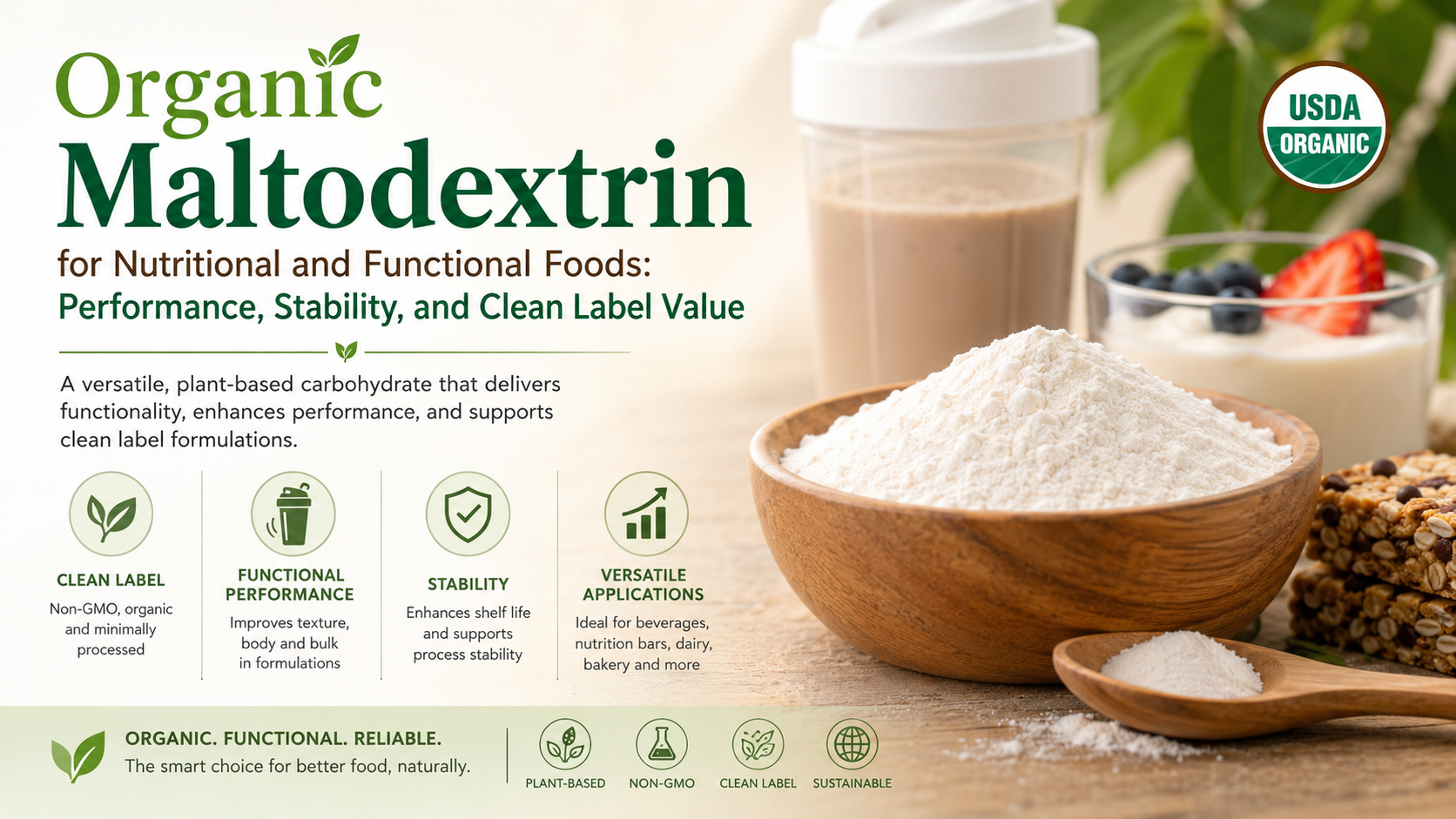
Organic Maltodextrin for Nutritional and Functional Foods: Performance, Stability, and Clean Label Value

Organic maltodextrin is one of the most versatile functional carbohydrates available to food manufacturers. It serves as a carrier, bulking agent, texture modifier, and processing aid across applications ranging from nutritional supplements and infant formulas to baked goods, confectionery, and functional beverages.

Despite its widespread use, the technical nuances of organic maltodextrin — particularly dextrose equivalent (DE) value selection, glycemic response characteristics, and application-specific performance — are often poorly understood, leading to suboptimal formulation choices.

This guide provides the technical depth B2B food manufacturers, purchasing managers, and R&D teams need to specify, source, and apply organic maltodextrin effectively.

Organic Maltodextrin For Nutritional And Functional Foods Performance, Stability, And Clean Label Value

What Is Organic Maltodextrin?

Organic maltodextrin is a white, neutral-flavor carbohydrate powder produced from certified organic starch sources — primarily corn, tapioca, or rice — through controlled enzymatic hydrolysis.

Key defining characteristics:

  • Carbohydrate classification: Polysaccharide of glucose units linked primarily by alpha-1,4 glycosidic bonds, with chain length typically between 3 and 19 glucose units
  • DE value (Dextrose Equivalent): A measure of the degree of hydrolysis — higher DE means shorter chains, more reducing ends, and sweeter taste
  • Sweetness: Ranges from barely perceptible (low DE) to mildly sweet (high DE), but always significantly less sweet than sucrose
  • Solubility: Fully water-soluble across all DE grades; dissolves without haze in cold or hot water
  • Organic certification: Must be derived from organic-certified raw materials and processed under certified organic conditions to qualify for USDA Organic, EU Organic, or JAS Organic claims at the finished product level

Molecular weight and DE relationship:

DE RangeAverage Glucose UnitsMolecular WeightSweetness (% of sucrose)Viscosity
DE 3–817–20HighBarely sweetHigh viscosity
DE 8–1210–12MediumVery mild sweetnessMedium viscosity
DE 12–186–9Medium-lowMild sweetnessLow viscosity
DE 18–254–6LowNoticeably sweetVery low viscosity

Lower DE maltodextrins (DE 3–12) are preferred for structural and bulking applications. Higher DE maltodextrins (DE 15–25) are selected when rapid solubility and slight sweetness are desired.


Glycemic Response: A Critical Distinction

Understanding maltodextrin’s glycemic profile is essential for responsible formulation and accurate consumer communication.

Glycemic Index Characteristics

Organic maltodextrin has a high glycemic index (GI) — approximately 85–95 on the glucose scale — regardless of its DE grade. This is because all maltodextrins, regardless of chain length, are rapidly hydrolyzed by salivary and pancreatic amylases into glucose in the upper digestive tract.

Important clarification: The DE value of maltodextrin does not meaningfully affect its glycemic index. Both low-DE and high-DE maltodextrins produce similar blood glucose responses.

What This Means for Product Positioning

Products where high GI is an advantage:

  • Sports and recovery nutrition (rapid energy replenishment)
  • Post-exercise glycogen replenishment
  • Clinical nutrition for malnourished or critically ill patients
  • Infant formulas (where rapid energy availability is desired)

Products where high GI is a limitation:

  • Diabetic-friendly or low-GI product positioning
  • Ketogenic or very low-carb formulations
  • Products making “low glycemic” or “blood sugar management” claims

For manufacturers targeting the diabetic-friendly or low-GI market segment, maltodextrin is not an appropriate ingredient. Consider allulose, erythritol, or resistant maltodextrin (RS4 type) as alternatives.

Energy vs. Nutritional Value

Maltodextrin provides readily available carbohydrate energy (approximately 4 kcal/g) but offers no significant vitamins, minerals, fiber, or bioactive compounds. It should be characterized honestly in nutritional labeling and marketing.

For B2B brands making nutritional claims, pairing maltodextrin with meaningful functional ingredients — protein, fiber, micronutrients, or bioactive compounds — ensures the finished product has genuine nutritional value beyond its carbohydrate content.


Functional Roles in Food Systems

Maltodextrin performs multiple technical functions that cannot be easily replicated by other ingredients:

The Six Core Functions

FunctionDescriptionApplication Examples
Bulking agentAdds mass and weight to formulations without significant sweetnessReduced-sugar products, protein powders, meal replacements
Texture modifierControls viscosity, mouthfeel, and creaminessBeverages, dairy alternatives, frozen desserts
Carrier for activesDisperses and stabilizes vitamins, minerals, probiotics, and botanical extractsNutritional supplements, infant formulas, functional beverages
Processing aidImproves flow, prevents caking, stabilizes during spray-drying or extrusionPowdered premixes, instant beverages
Crystallization controlPrevents sugar crystallization and fat bloom in confectioneryCaramels, fudge, chocolate coatings
Shelf life extensionReduces hygroscopicity, improves moisture retention, maintains textureBaked goods, dried powders, confectionery

Comparison with Alternative Carbohydrates

PropertyMaltodextrinCorn StarchTapioca StarchGlucose Syrup DE40Allulose
SweetnessLow-mildNoneNoneMild~70% sucrose
SolubilityFull (cold + hot)Swells onlySwells onlyFullFull
Glycemic IndexHigh (85–95)MediumMediumHighZero (0–5)
Bulking capacityYesYesYesPartialNo
Film-formingNoYesYesPartialNo
Organic availabilityYesYesYesLimitedYes
Clean label name“Maltodextrin”“Tapioca starch”“Corn starch”“Glucose syrup”“Allulose”

DE Value Selection by Application

Choosing the correct DE range is the single most important specification decision for maltodextrin procurement.

DE Selection Guide

ApplicationRecommended DE RangeRationale
Protein powders, meal replacementsDE 8–12Low sweetness preserves protein taste; provides smooth mouthfeel; good carrier for micronutrients
Spray-dried powdersDE 12–18High solubility; low viscosity at high solids; fast reconstitution
Baked goods (texture-focused)DE 8–10Low sweetness; structural contribution; moisture retention
Instant beverages, powdered mixesDE 15–20Rapid dissolution; mild sweetness supports flavor perception
Confectionery (caramels, toffees)DE 10–15Controls crystallization; provides body without excessive sweetness
Chocolate and coatingsDE 10–15Smooths mouthfeel; contributes to viscosity control without interfering with tempering
Infant formulasDE 10–15Balanced solubility and gentle sweetness appropriate for infant digestion
Sports nutrition (energy)DE 15–25Rapid dissolution; slight sweetness; fast glucose availability
Sauces and dressingsDE 10–15Viscosity control; neutral flavor; emulsion stability

Pilot Testing Protocol

Before committing to a DE grade, conduct a three-phase evaluation:

Phase 1 — Sensory screening: Test 2–3 DE grades at equivalent usage levels in your base formulation. Evaluate sweetness, texture, and mouthfeel.

Phase 2 — Process compatibility: Simulate your production process (mixing, drying, heat treatment, packaging) with each grade. Document flow behavior, solubility, and any processing issues.

Phase 3 — Shelf life testing: Package samples under commercial conditions and evaluate at T0, T3 months, and T6 months for texture, flavor, moisture, and physical stability.


Clean Label Positioning and Regulatory Compliance

Clean Label Advantages

Organic maltodextrin offers several clean label advantages:

  • Recognizable ingredient name: “Maltodextrin” is widely understood by consumers who read ingredient lists
  • Single-ingredient declaration: Unlike glucose syrup solids or modified starches, maltodextrin is a straightforward ingredient declaration
  • No E-numbers: In EU and most markets, maltodextrin does not require an E-number designation
  • Non-allergen status: Corn-, rice-, and tapioca-derived maltodextrin is free from the major allergens (wheat, dairy, soy, nuts)
  • Vegan and vegetarian compliant: Plant-derived, no animal-derived processing aids

Regulatory Considerations by Market

MarketOrganic CertificationLabel DeclarationGI/Health Claims
United States (FDA)USDA Organic (if certified)“Organic maltodextrin”No “low GI” or “complex carb” claims without substantiation; maltodextrin is classified as a digestible carbohydrate
European UnionEU Organic“Maltodextrin” (from organic sources)Health claims regulated under EFSA; no approved claims for maltodextrin as a functional ingredient
China (GB standards)Organic certification recognized“麦芽糊精” (maltodextrin)Novel Food regulations apply; consult local regulatory counsel for nutritional claims
Japan (JAS)JAS Organic recognized” Maltodextrin” or specific source (e.g., “tapioca maltodextrin”)FOSHU (Food for Specified Health Uses) claims require separate approval

Organic Certification Documentation Requirements

For B2B procurement, verify that your supplier provides:

  • Valid organic certificate (USDA Organic, EU Organic, or JAS Organic) — current and unexpired
  • Country of origin declaration for the raw material starch source
  • Processing method description confirming no prohibited processing aids
  • Non-GMO verification certificate (if non-GMO claims are to be made on the finished product)
  • Allergen statement and cross-contamination risk assessment
  • Technical specifications sheet (DE range, moisture, pH, microbial limits, heavy metal limits)

Sourcing Specifications and Quality Parameters

Standard Technical Specifications

ParameterSpecification Range
AppearanceWhite to off-white powder, free-flowing
DE value8–20 (customizable to order)
Moisture content≤6%
pH (10% solution)4.5–6.5
Ash content≤0.5% (acid-insoluble ash ≤0.3%)
Protein content≤1.0%
Lead≤0.5 mg/kg
Arsenic≤0.5 mg/kg
Cadmium≤0.1 mg/kg
Mercury≤0.1 mg/kg
Total plate count≤10,000 cfu/g
Yeast and mold≤100 cfu/g
E. coliNegative / 1g
SalmonellaNegative / 25g

Sourcing Considerations

Batch-to-batch consistency: For nutritional and infant formula applications, request a Certificate of Analysis (CoA) for each batch confirming DE value, moisture, and microbial limits are within your specification tolerance.

Supply chain security: Organic maltodextrin supply is dependent on organic-certified starch availability. Assess your supplier’s raw material sourcing agreements and inventory levels to avoid production disruptions.

Custom specifications: Most suppliers, including ORGANICWAY, can supply custom DE grades, particle size distributions, or packaging formats (25kg bags, jumbo bags, drums) to meet specific production requirements.


Athlete and Sports Nutrition Use: Benefits and Precautions

Maltodextrin has well-documented applications in sports and recovery nutrition that B2B buyers should understand.

Performance Benefits

During prolonged exercise (>60–90 minutes):

  • Provides rapid glucose delivery to working muscles
  • Maintains blood glucose levels during endurance exercise
  • Spares muscle glycogen, delaying fatigue onset
  • Recommended intake: 30–60g carbohydrates per hour for high-intensity endurance activity

Post-exercise recovery:

  • Accelerates muscle glycogen replenishment when consumed within 30–60 minutes post-exercise
  • Should be paired with protein (whey, pea, or soy protein) at a 3:1 or 4:1 carb-to-protein ratio for optimal muscle recovery
  • Recommended intake: 50–80g carbohydrates within 2 hours post-exercise

Precautions and Limitations

Blood sugar impact: Maltodextrin causes significant blood glucose elevation. Individuals with diabetes, insulin resistance, prediabetes, or metabolic syndrome should not use maltodextrin-containing products without medical supervision.

Digestive tolerance: Very high intake rates (>60–80g/hour) during exercise can cause gastrointestinal distress in some individuals. Combining maltodextrin with glucose or fructose (in a 2:1 ratio) may improve tolerance and oxidation rates.

Not suitable for low-carb diets: Products marketed to keto, low-carb, or intermittent fasting audiences should not include maltodextrin, as it is metabolized as pure glucose.

Not a “health food” in isolation: Maltodextrin is a pure carbohydrate energy source. Products containing maltodextrin should not be marketed as “low sugar” or “health food” unless supplemented with meaningful protein, fiber, or bioactive nutrients.


Working With ORGANICWAY

ORGANICWAY supplies organic maltodextrin in food-grade, pharmaceutical-grade, and infant-formula-grade options, with:

  • USDA Organic, EU Organic, and JAS Organic certified products
  • Customizable DE ranges from DE 3 to DE 25
  • Full technical documentation: specifications, organic certificates, CoA, MSDS, allergen statements
  • Supply chain traceability from organic-certified starch sources
  • Technical support for DE grade selection and application development

Looking for High-Quality Organic Ingredients? Contact Us Today

Work with a certified supplier offering bulk supply, customization, and global delivery.