


Table of Contents
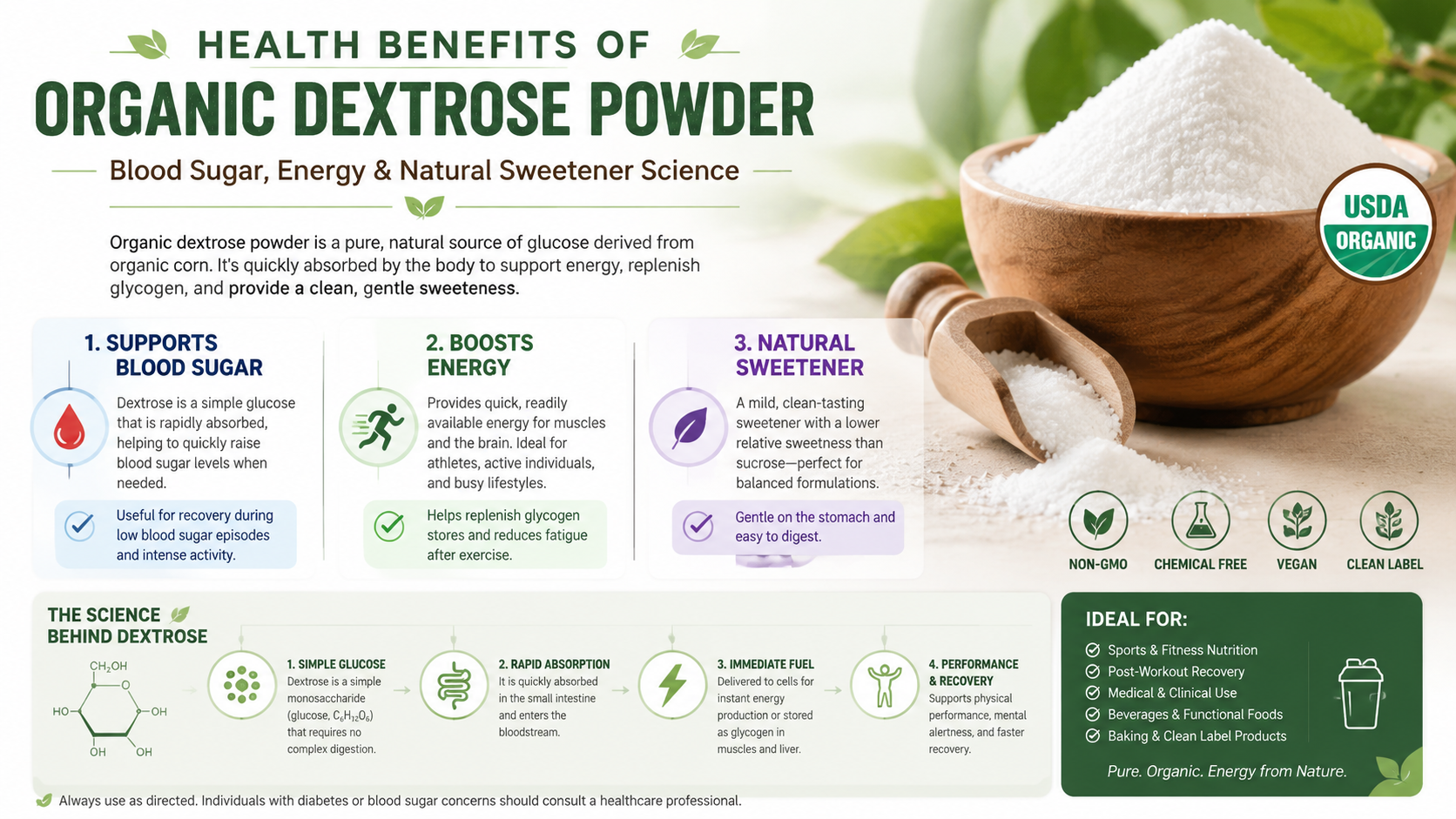
As food manufacturers and formulators increasingly seek clean-label sweeteners with predictable metabolic effects, organic dextrose powder has emerged as a scientifically grounded ingredient for blood sugar management, natural energy delivery, and clean-label product development.
This guide examines the health benefits of organic dextrose powder from multiple angles — blood sugar regulation, energy metabolism, natural versus synthetic origins, and sustainability — to help procurement teams, R&D professionals, and brand managers make evidence-based sourcing decisions.
What Is Organic Dextrose Powder?
Organic dextrose powder is a purified form of D-glucose monohydrate derived from organically grown, non-GMO corn through enzymatic hydrolysis of starch. As a monosaccharide (single sugar molecule), it is the simplest form of carbohydrate and the body’s most direct energy substrate.
Key Specifications
| Parameter | Typical Range |
|---|---|
| Purity (D-glucose) | ≥ 99.5% |
| Moisture content | 8.5%–10.5% (monohydrate form) |
| DE (Dextrose Equivalent) | ≥ 99 |
| Heavy metals | Compliant with USP/EP standards |
| Certifications | USDA Organic, EU Organic, Non-GMO, Kosher, Halal |
Unlike refined sucrose or high-fructose corn syrup, organic dextrose requires minimal processing. The organic certification ensures the source corn is cultivated without synthetic pesticides, herbicides, or genetically modified organisms, providing a cleaner supply chain traceability that B2B buyers increasingly demand.
Blood Sugar Management: How Dextrose Affects Glycemic Response
The Science of Glucose and Blood Sugar
Glucose is the body’s primary metabolic fuel. Every cell in the human body utilizes glucose for ATP (adenosine triphosphate) production through cellular respiration. When consumed, organic dextrose powder is absorbed directly through the small intestine via SGLT1 (sodium-glucose linked transporter 1) transporters, entering the bloodstream without requiring enzymatic breakdown.
This direct absorption profile gives organic dextrose a Glycemic Index (GI) of approximately 96–100, making it one of the fastest-acting carbohydrate sources available. While a high GI might seem counterintuitive for blood sugar management, controlled dextrose intake offers several physiological advantages:
- Predictable glycemic response: Unlike complex carbohydrate blends that produce variable absorption rates, pure dextrose provides a consistent, dose-dependent blood sugar response that formulators can precisely calculate in product development.
- Rapid glycogen replenishment: After intense physical activity, muscle glycogen stores are depleted. Dextrose’s rapid absorption facilitates efficient glycogen resynthesis, which is critical for recovery nutrition products.
- Hypoglycemia management: In clinical and sports nutrition settings, dextrose is the standard intervention for addressing mild hypoglycemia due to its reliable and fast-acting glucose delivery.
Dextrose vs. Other Sweeteners: Blood Sugar Impact
| Sweetener | GI Value | Primary Sugar | Fructose Content | Metabolic Pathway |
|---|---|---|---|---|
| Organic Dextrose | 96–100 | Glucose | 0% | Direct glucose absorption |
| Sucrose (table sugar) | 65 | Glucose + Fructose | 50% | Requires sucrase enzyme |
| High-Fructose Corn Syrup | 58–73 | Glucose + Fructose | 42–55% | Mixed pathway, fructose metabolized in liver |
| Erythritol | 0 | Sugar alcohol | 0% | Minimal absorption, excreted |
| Maltodextrin | 85–105 | Glucose polymer | 0% | Requires amylase breakdown |
Key insight for formulators: Organic dextrose’s zero-fructose profile means it bypasses hepatic (liver) metabolism entirely, delivering glucose directly to muscle and brain tissue. This makes it particularly suitable for sports nutrition, clinical nutrition, and energy product applications where predictable blood sugar impact is essential.
3. Natural Energy Enhancement: How Dextrose Fuels Performance
The Biochemistry of Dextrose as an Energy Source
When organic dextrose powder is consumed, the D-glucose molecules enter glycolysis — the metabolic pathway that converts glucose into pyruvate, generating ATP. This process occurs in both aerobic and anaerobic conditions:
- Aerobic pathway (with oxygen): Pyruvate enters the mitochondria, producing up to 36–38 ATP molecules per glucose molecule via the Krebs cycle and oxidative phosphorylation.
- Anaerobic pathway (without oxygen): Pyruvate converts to lactate, yielding 2 ATP molecules per glucose — the primary energy mechanism during high-intensity exercise.
This dual-pathway capability makes dextrose uniquely versatile as an energy ingredient:
- Pre-workout: Provides immediately available glucose for initial exercise demands.
- Intra-workout: Maintains blood glucose levels during sustained activity, delaying fatigue onset.
- Post-workout: Rapidly replenishes muscle glycogen when combined with protein, supporting the “anabolic window” for recovery.
Energy Applications by Sector
| Application Sector | Dextrose Role | Product Examples |
|---|---|---|
| Sports nutrition | Rapid glycogen replenishment, intra-workout fuel | Recovery drinks, energy gels, protein blends |
| Clinical nutrition | Enteral feeding, hypoglycemia management | Medical nutrition formulas, oral rehydration solutions |
| Functional beverages | Clean energy source, no crash | Ready-to-drink energy beverages, electrolyte drinks |
| Infant nutrition | Carbohydrate base for formula | Organic infant formula, weaning foods |
| Confectionery | Quick-energy delivery | Energy chews, performance candy |
Natural vs. Synthetic: Is Dextrose a Natural or Artificial Sweetener?
Understanding the “Natural” Question
A common misconception among consumers and even some industry professionals is that dextrose — due to its association with “corn sugar” and processed foods — is a synthetic or artificial ingredient. This confusion stems from the overlap between production processing and chemical origin.
The Reality: Dextrose Is Naturally Derived
Organic dextrose powder is produced through a natural enzymatic process:
- Organic corn starch is extracted from certified organic, non-GMO corn.
- Enzymatic hydrolysis using natural alpha-amylase and glucoamylase enzymes breaks starch chains into individual glucose molecules.
- Purification and crystallization removes proteins, lipids, and minerals.
- Drying produces the final monohydrate or anhydrous powder form.
At no point in this process are synthetic chemicals added to alter the molecular structure. The final product — D-glucose — is biochemically identical to the glucose naturally present in fruits, honey, and the human bloodstream.
Organic vs. Conventional Dextrose: What Sets Them Apart
| Attribute | Organic Dextrose | Conventional Dextrose |
|---|---|---|
| Source material | Certified organic, non-GMO corn | Conventionally grown corn (may be GMO) |
| Pesticides | No synthetic pesticides/herbicides | May contain pesticide residues |
| Processing aids | Natural enzymes only | May use synthetic processing aids |
| Certifications | USDA Organic, EU Organic, Non-GMO | Standard food-grade certifications |
| Supply chain | Full traceability from farm to finished product | Limited traceability |
| Consumer perception | Clean-label, natural, premium | Commodity ingredient |
For B2B buyers targeting health-conscious, clean-label, or premium market segments, organic dextrose offers a clear differentiation advantage. The “natural” positioning is supported by certification bodies and verifiable supply chain documentation, not merely marketing claims.
Sustainability and Health: The Organic Advantage
Environmental Impact of Organic Corn Cultivation
Choosing organic dextrose powder extends health benefits beyond the individual consumer to environmental and community health:
- Soil health: Organic farming practices — crop rotation, cover cropping, composting — improve soil organic matter, water retention, and microbial biodiversity.
- Reduced chemical runoff: Elimination of synthetic pesticides and herbicides protects local water systems and surrounding ecosystems.
- Biodiversity preservation: Organic corn fields support 30% more species on average compared to conventionally managed fields.
- Carbon footprint: Organic farming systems typically show 18–25% lower carbon emissions per hectare compared to intensive conventional agriculture.
Aligning with Consumer Health Trends
The global clean-label ingredient market is projected to reach $64.9 billion by 2028 (CAGR 6.8%). Within this market, organic-certified sweeteners represent one of the fastest-growing categories. Key consumer drivers include:
- Transparency demand: 73% of consumers say they want to know where their food ingredients come from.
- Avoidance of artificial additives: “No artificial sweeteners” is the #1 clean-label claim consumers look for.
- Organic preference: Organic-certified products command a 20–40% price premium across most food categories.
By incorporating organic dextrose powder into product formulations, food manufacturers can align with these trends while maintaining the functional performance that dextrose provides.
Safety Profile and Regulatory Status
Global Regulatory Compliance
Organic dextrose powder is classified as GRAS (Generally Recognized as Safe) by the U.S. FDA and is approved for use in food products worldwide:
| Region | Regulatory Status | Key Standard |
|---|---|---|
| United States | GRAS | 21 CFR Part 184 |
| European Union | Approved food additive | E 965 (dextrose monohydrate) |
| China | Approved food additive | GB 1886.233 |
| Japan | Approved food ingredient | Existing Food Additive List |
| Australia/NZ | Approved | Standard 2.9.3 (FSANZ) |
Safety Considerations
- Allergen-free: Organic dextrose is naturally gluten-free, dairy-free, soy-free, and nut-free.
- No artificial ingredients: No artificial colors, flavors, or preservatives.
- Shelf-stable: When stored in cool, dry conditions, organic dextrose powder maintains quality for 18–24 months.
- Dosage flexibility: As a naturally occurring molecule, dextrose has no upper intake limit from a toxicity perspective, though caloric intake should be managed per product formulation goals.
Practical Considerations for Food Manufacturers
Integration Guidelines
When formulating with organic dextrose powder, consider the following:
- Sweetness calibration: Dextrose is approximately 70–80% as sweet as sucrose. Adjust formulation ratios accordingly.
- Browning and texture: Dextrose promotes Maillard browning in baked goods, contributing to golden crusts and caramel notes.
- Hygroscopicity: Dextrose is moderately hygroscopic. Proper packaging with moisture barriers is recommended for finished products.
- Solubility: Excellent cold-water solubility makes it suitable for beverage applications without heating.
- Cost optimization: Organic dextrose typically costs 15–25% more than conventional, but the clean-label premium can offset this in consumer-facing products.
Quality Assurance Checklist
- Verify USDA Organic and EU Organic certification for each production batch.
- Request Certificate of Analysis (CoA) confirming purity, moisture, heavy metals, and microbial limits.
- Confirm non-GMO status through third-party testing (e.g., GMO testing at 0.9% threshold).
- Validate supply chain traceability documentation from farm to finished ingredient.

Conclusion
Organic dextrose powder offers a unique combination of metabolic efficiency, clean-label positioning, and supply chain transparency that makes it an ideal ingredient for health-conscious food and beverage products. Its role in blood sugar management, natural energy delivery, and sustainable sourcing addresses three of the most significant trends shaping the food industry today.
For procurement teams evaluating organic sweetener options, dextrose provides:
- Scientifically validated health benefits — direct glucose delivery with zero fructose.
- Clean-label compliance — certified organic, non-GMO, minimally processed.
- Functional versatility — suitable for beverages, baked goods, sports nutrition, and clinical nutrition.
- Sustainability alignment — supporting organic agriculture and reduced environmental impact.
As consumer demand for transparent, natural ingredients continues to grow, organic dextrose powder represents a forward-thinking ingredient choice that delivers both performance and consumer trust.
Contact ORGANICWAY for organic dextrose powder samples, technical specifications, and bulk pricing. Our team provides full supply chain documentation, certification verification, and formulation support for food manufacturers worldwide.