


Table of Contents
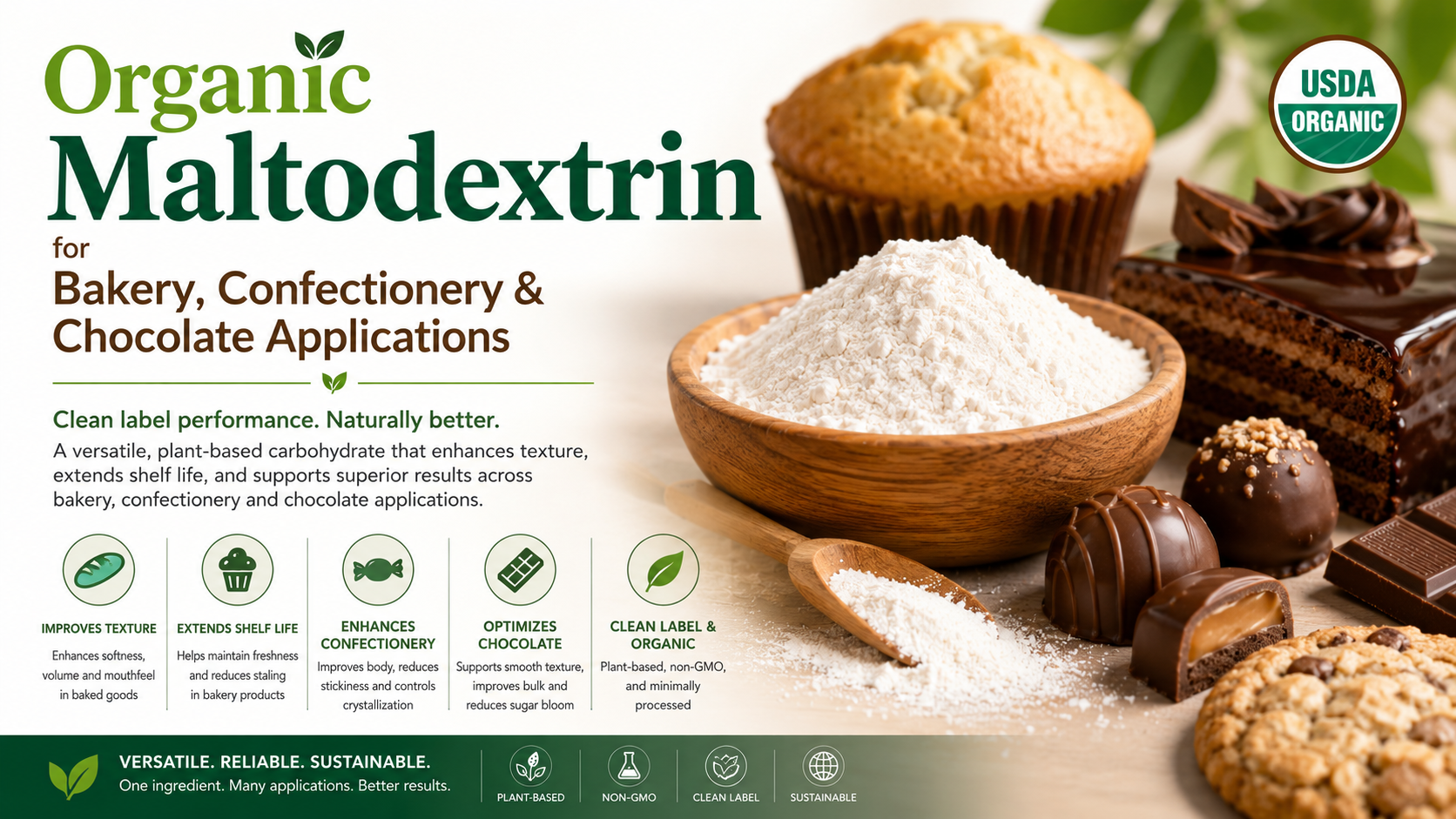
Bakery, confectionery, and chocolate products represent some of the most technically demanding applications for maltodextrin as a functional ingredient. These categories share a common challenge: replacing sugar or fat while maintaining the texture, structure, and sensory qualities that define consumer acceptance.
Organic maltodextrin addresses these challenges through its unique combination of neutral flavor, texture-modifying properties, crystallization control, and moisture management — all from a certified organic, clean-label-compliant source.
This guide covers bakery, confectionery, and chocolate applications in depth, with practical formulation data, process guidance, and application-specific recommendations.
Organic Maltodextrin in Gluten-Free Baking
The Gluten Replacement Challenge
Gluten performs several critical structural functions in baked goods:
- Elasticity: Allows dough to stretch and retain gas during proofing
- Cohesion: Binds ingredients together into a unified dough structure
- Gas retention: Traps CO₂ from leavening agents, enabling volume expansion
- Texture: Contributes to the characteristic chewiness and structure of wheat-based products
In gluten-free formulations, none of these functions occur naturally. The result is often crumbly, dense, or mealy products that fail consumer expectations.
How Maltodextrin Addresses Gluten-Free Challenges
Organic maltodextrin contributes to gluten-free baking through several mechanisms:
Viscosity and batter consistency:
- Increases viscosity in batter and dough systems, improving handling and machineability
- Allows batters to coat molds and pans more effectively
- Reduces cracking and breaking during depanning or unmolding
Moisture retention and shelf life:
- Maltodextrin’s hygroscopic properties bind water molecules, slowing moisture migration
- Reduces staling rate in bread and muffins by 15–25% compared to maltodextrin-free gluten-free formulations
- Particularly effective in applications where crumb softness is a key quality attribute
Texture enhancement:
- Improves crumb softness in gluten-free breads and cakes
- Adds mouthfeel in gluten-free cookies and crackers
- Contributes to a more cohesive eating experience in dense products (e.g., gluten-free pizza crusts)
Bulking and volume:
- Replaces the bulk contribution of flour when flour blends are used at reduced volumes
- Supports volume in leavened products when combined with appropriate gluten-free flour blends
Recommended DE Grade for Gluten-Free Baking
| Gluten-Free Product | Recommended DE | Typical Usage Level |
|---|---|---|
| Gluten-free breads | DE 8–12 | 5–15% of flour weight |
| Gluten-free muffins and cakes | DE 8–15 | 3–10% of flour weight |
| Gluten-free cookies and crackers | DE 10–15 | 3–8% of flour weight |
| Gluten-free pizza crusts | DE 8–12 | 5–10% of flour weight |
| Gluten-free pancake/waffle mixes | DE 12–18 | 5–12% of flour weight |
Formulation note: Maltodextrin should be combined with other gluten-free binders (xanthan gum, guar gum, hydroxypropyl methylcellulose) to fully replicate gluten’s elastic properties. A typical gluten-free flour blend might include: rice flour (40%), tapioca starch (20%), potato starch (15%), sorghum flour (15%), maltodextrin DE 10 (8%), and hydrocolloid binder (2%).
Avoiding Common Gluten-Free Formulation Mistakes
- Do not use maltodextrin as the sole structural ingredient — it is a functional modifier, not a primary flour replacement
- Monitor moisture addition — maltodextrin increases batter viscosity, so reduce liquid by 5–10% compared to maltodextrin-free recipes
- Adjust leavening — in dense gluten-free products, slightly increase chemical leavening (baking powder/soda) by 10–15% to compensate for reduced gas retention
- Storage conditions — maltodextrin-containing gluten-free products are slightly more hygroscopic; recommend moisture-barrier packaging for products with >8% maltodextrin content
Confectionery Applications: Caramels, Toffees, and Fondants
Crystallization Control
Sugar crystallization is one of the most significant challenges in confectionery production. Sucrose crystallization — if uncontrolled — produces grainy textures, unappealing appearance, and inconsistent quality.
Why maltodextrin controls crystallization:
- Maltodextrin, when present at 10–25% of total sugar solids, interrupts the regular crystal lattice formation of sucrose
- Shorter-chain maltodextrins (higher DE grades) are more effective crystallization inhibitors than longer-chain versions
- The result is a smooth, creamy texture in caramels, toffees, fudges, and fondants — without requiring invert sugar syrups or emulsifiers
Recommended usage for confectionery:
| Confectionery Product | Maltodextrin DE | Usage Level (% of total sugar solids) | Effect |
|---|---|---|---|
| Soft caramels | DE 10–15 | 15–25% | Prevents graininess; produces smooth, chewy texture |
| Toffees and hard caramels | DE 10–15 | 10–20% | Controls crystallization; improves boil tolerance during cooking |
| Fudge | DE 10–15 | 15–25% | Produces creamy, non-grainy texture; extends shelf life |
| Fondant and icing | DE 12–18 | 20–30% | Provides smooth, plastic texture; prevents crystallization on standing |
| Marshmallows | DE 8–12 | 5–15% | Contributes to foam stability and texture |
Viscosity Control in Confectionery
During confectionery cooking, viscosity is a critical process parameter. Maltodextrin affects viscosity predictably:
- Lower DE (DE 8–12): Increases final product viscosity more than higher DE grades; suitable for dense, chewy products
- Higher DE (DE 15–20): Has less impact on final viscosity; suitable where a softer, more fluid texture is desired
Process note: When adding maltodextrin to confectionery syrups, dissolve it completely before boiling. Adding maltodextrin powder directly to a boiling syrup risks clumping and incomplete dissolution.
Shelf Life Benefits
Maltodextrin contributes to confectionery shelf life through:
- Reduced hygroscopicity (at usage levels >15%): Reduces moisture absorption from ambient air, preventing sticky texture
- Moisture retention: Keeps soft candies (caramels, fudges) from drying out over time
- Fat bloom prevention (in chocolate coatings): Maltodextrin can be incorporated into chocolate coating formulations to improve fat distribution and reduce the risk of fat bloom during temperature cycling
Chocolate and Chocolate Coating Applications
Mouthfeel Enhancement
Maltodextrin improves chocolate mouthfeel through several mechanisms:
- Creaminess: Contributes to a smoother, more melt-in-the-mouth sensation
- Viscosity control: In chocolate coatings, maltodextrin allows fine-tuning of viscosity for optimal enrobing or molding behavior
- Aftertaste moderation: Can slightly extend the sweetness perception, reducing the perception of bitterness in high-cacao chocolates
Recommended usage in chocolate formulations:
| Chocolate Product | Maltodextrin DE | Usage Level | Purpose |
|---|---|---|---|
| Dark chocolate (>70% cacao) | DE 10–15 | 2–5% | Reduce bitterness; improve melt profile |
| Milk chocolate | DE 10–15 | 3–6% | Enhance creaminess; balance sweetness |
| Chocolate coatings (compound) | DE 12–18 | 5–10% | Viscosity control for enrobing; improve snap |
| Sugar-free chocolate | DE 10–15 | 5–15% | Primary bulk agent (combined with stevia or allulose) |
Sugar Reduction in Chocolate
Replacing sucrose with maltodextrin in chocolate is challenging because sucrose performs multiple critical functions in chocolate:
- Sweetness (primary)
- **Bulk and structure
- Melting behavior and mouthfeel
- **Shelf stability
Maltodextrin cannot replace sucrose’s sweetness — only its bulk and some mouthfeel properties. A practical sugar-reduced chocolate formulation might use:
- 30–50% reduction in sucrose replaced by maltodextrin DE 12 (bulk + mouthfeel)
- Monk fruit extract or stevia Reb A for sweetness compensation (50–100 ppm)
- Cocoa butter maintained at standard levels for proper tempering
Warning: Maltodextrin-based chocolate formulations do not temper like conventional chocolate. Compound chocolate coatings (which do not require tempering) are the most practical application for maltodextrin in confectionery coatings.
Processing Notes for Chocolate
| Parameter | Impact of Maltodextrin Addition | Recommendation |
|---|---|---|
| Tempering temperature | Maltodextrin increases viscosity during tempering | Reduce conching time by 10–15%; monitor viscosity continuously |
| Fat content adjustment | Maltodextrin partially replaces dry solids; may require fat reduction | Reduce cocoa butter by 0.5–1% for each 1% maltodextrin added |
| Particle size | Maltodextrin is fully water-soluble; does not require milling | Add at the post-refining stage or as a dry ingredient during mixing |
| Storage stability | Maltodextrin does not contribute to fat bloom but does not prevent it | Store maltodextrin-containing chocolate at stable temperatures (15–18°C, <50% RH) |
Bakery Applications Beyond Gluten-Free
Reduced-Sugar Bakery
Organic maltodextrin supports sugar reduction in conventional (gluten-containing) bakery products:
In cookies and biscuits:
- Replaces bulk at 50–75% of sugar weight
- Contributes slight sweetness (DE 10–15 preferred for neutral taste)
- Maintains texture moisture — cookies stay fresh 2–3 days longer in accelerated shelf-life tests
- Recommended addition: 8–15% of flour weight, replacing equivalent sugar
In cakes and muffins:
- Reduces sweetness intensity, allowing high-intensity sweeteners to perform better
- Contributes to tender crumb by interfering slightly with gluten formation (beneficial at low levels)
- Supports moisture retention — extends shelf life in packaged cake formats
- Recommended addition: 5–12% of flour weight
High-Fiber and Protein-Fortified Bakery
When adding protein isolates or high-fiber ingredients (which often produce dry, dense, or bitter products), maltodextrin:
- Improves mouthfeel by masking off-notes from protein concentrates
- Adds bulk and structure to compensate for fiber’s anti-nutritional effects (phytates, tannins)
- Enhances moisture retention in fiber-enriched products
Typical addition in high-protein bars:
- Maltodextrin DE 10: 10–20% of formulation
- Paired with: pea protein, brown rice protein, or whey protein concentrate
- Combined with: soluble fiber (resistant dextrin, polydextrose) for complete sugar reduction
Moisture Retention Mechanism
Maltodextrin’s hygroscopic properties make it a moisture retention agent in baked goods:
- During baking: Retains water, allowing more even heat distribution and reduced over-baking of surface layers
- During storage: Slowly releases moisture, preventing staling and maintaining freshness
Measured impact on shelf life (accelerated aging test at 35°C, 75% RH):
| Product | Without Maltodextrin | With Maltodextrin DE 10 (8%) |
|---|---|---|
| White sandwich bread | Firmness score 8/10 at day 5 | Firmness score 6/10 at day 5 |
| Sugar-free cookie | Stale after day 7 | Fresh through day 10 |
| Protein bar | Dry, crumbly texture at day 14 | Acceptable texture at day 21 |
Technical Specifications for Bakery and Confectionery
| Parameter | Specification for Bakery | Specification for Confectionery |
|---|---|---|
| DE range | DE 8–15 | DE 10–18 |
| Moisture | ≤6% | ≤6% |
| pH (10% solution) | 5.0–6.5 | 4.5–6.0 |
| Particle size | 100% through 80 mesh | 100% through 60 mesh |
| Solubility | Complete in cold water | Complete in hot water (80°C+) |
| Color | White, no off-odor | White to cream, neutral flavor |
| Storage | Cool, dry (<25°C, <50% RH) | Cool, dry (<20°C preferred) |
| Shelf life | 24 months from production date | 24 months from production date |
Working With ORGANICWAY
ORGANICWAY supplies organic maltodextrin in formats suitable for large-scale bakery, confectionery, and chocolate manufacturing:
- DE range availability: DE 3 to DE 25, with DE 8, DE 10, DE 12, DE 15, DE 18 as standard grades
- Organic certifications: USDA Organic, EU Organic, Non-GMO Project Verified, Kosher, Halal
- Packaging options: 25kg multi-ply paper bags with PE liner; jumbo bags; Drums
- Technical support: Application guidance, pilot batch formulation, DE grade selection
- Documentation: Full CoA, organic certificates, specifications, and stability data available