


Table of Contents
Not all hemp protein powders are equal — and the difference goes beyond a number on a label. When a food manufacturer selects a 70% grade for a high-fiber protein bar, and a supplement brand chooses an 80% grade for a clean-label shake, they are working with fundamentally different materials in terms of composition, processing depth, flavor contribution, and cost. Understanding these distinctions is the starting point for making a sound sourcing or formulation decision.
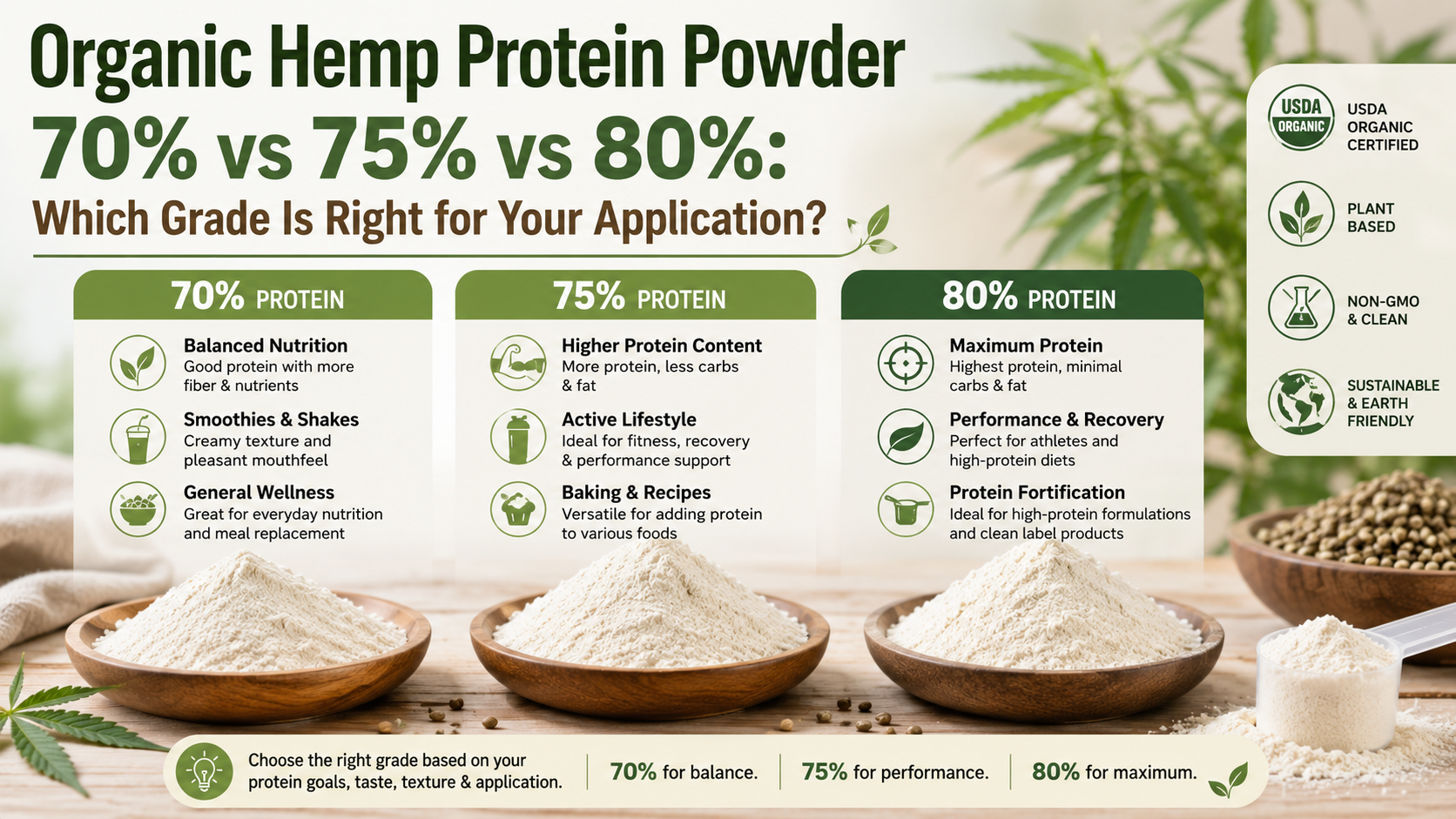
This guide breaks down the three commercially available grades of organic hemp protein powder — 70%, 75%, and 80% protein content — and maps each one to the scenarios where it performs best.
Why Hemp Protein Grade Matters
Organic hemp protein powder is made by cold-pressing hemp seeds to extract the oil, then milling the press cake into fine powder. The protein content of the resulting powder depends primarily on how thoroughly the oil is removed and how finely the fiber-rich hull fraction is separated during air classification. The more complete the oil extraction and fiber removal, the higher the protein concentration — and the more processing steps involved.
This means moving from a 70% to an 80% grade is not simply a matter of adding more protein. It changes the full nutritional matrix:
- Fat decreases as more oil is separated out
- Fiber decreases as more hull material is removed
- Protein density increases, but so does the degree of processing
For clean label brands, this trade-off matters. The 70% grade retains the most “whole food” character. The 80% grade is the most protein-concentrated but also the most refined. The 75% grade sits in the middle — a practical sweet spot for many applications.
Grade-by-Grade Specification Overview
| Parameter | Hemp Protein 70% | Hemp Protein 75% | Hemp Protein 80% |
|---|---|---|---|
| Protein (dry basis) | ≥70% | ≥75% | ≥80% |
| Moisture | ≤8.0% | ≤8.0% | ≤8.0% |
| Ash | ≤7.0% | ≤6.0% | ≤6.0% |
| Fat | ≤10.0% | ≤10.0% | ≤12.0% |
| Dietary fiber | ≤12.0% | ≤10.0% | ≤10.0% |
| Particle size | ≥95% through 80-mesh | ≥95% through 80-mesh | ≥95% through 80-mesh |
| Color | Light green to cream | Light green to cream | Light green to cream |
| Flavor | Earthy, mild nutty | Mild nutty | Mild nutty, lighter |
| Clean label suitability | Excellent | Excellent | Good |
| Typical application fit | Bars, whole-food blends | Shakes, RTD beverages | Supplements, high-protein formats |
All three grades share the same base certifications: USDA Organic, EU Organic, Non-GMO Project Verified, Kosher (Pareve), Halal, and FSSC 22000. Each batch ships with a Certificate of Analysis (COA) and Compliance Certificate. THC content is consistently ≤5 mg/kg across all grades — well within EU and international regulatory limits.
Hemp Protein 70%: The Whole-Food Grade
Who it’s for
The 70% grade is the best choice when protein is one benefit among several, not the only selling point. Brands positioning products around whole-food nutrition, dietary fiber, and plant-based fats will find this grade most aligned with their messaging.
Typical buyers include:
- Protein bar and energy ball manufacturers targeting the “real food” segment
- Granola and breakfast cereal brands adding a plant protein boost
- Pet food formulators where digestibility and palatability are priorities alongside protein content
Performance profile
With fiber content up to 12% and fat up to 10%, the 70% grade delivers the broadest nutritional contribution of the three. The higher fiber content creates a slightly denser texture in baked applications, which can be a functional asset in bars where binding and chewiness are desired. The retained omega-3 and omega-6 fats contribute to a mild, pleasant nutty flavor that many consumers associate with “natural” and “minimally processed” products.
The 70% grade is also typically the most cost-effective of the three, making it appropriate for applications where large inclusion rates (15–30% of the formulation) are needed to hit a meaningful protein claim.
Formulation guidance
- Protein bars & energy bites: 15–25% inclusion. The fiber and fat content improve binding and reduce the need for additional binders.
- Breakfast cereals & granola mixes: 5–10% inclusion. Works well in dry blending; minimal impact on color or flavor at this level.
- Pet food: 5–15% inclusion. High palatability; allergen-free profile is a significant advantage for premium pet food.
Hemp Protein 75%: The Versatile Mid-Range Grade
Who it’s for
The 75% grade is the most broadly applicable option across B2B applications. It delivers a meaningfully higher protein level than the 70% grade while preserving a relatively clean label and moderate fiber content. Brands that need to substantiate a protein content claim without pushing into highly processed territory will favor this grade.
This is the grade most commonly specified for:
- Ready-to-mix (RTM) protein shakes targeting the fitness and active nutrition segment
- Functional food and beverage products with moderate protein targets (15–25g per serving)
- Contract manufacturers that supply across multiple customer categories and want one versatile stock unit
Performance profile
The reduction in fiber (≤10%) compared to the 70% grade translates to noticeably better dispersibility in liquids. The 75% grade blends into water or plant milks with less settling and a smoother mouthfeel, making it better suited for shakes and drinks without requiring specialized emulsifiers or stabilizers. Flavor remains mild and nutty — acceptable to most consumers without masking.
At pH 4.0–7.0, solubility reaches ≥60%, which is adequate for most beverage formats. For RTD applications requiring higher clarity or full solubility, additional processing (ultrafiltration, enzymatic hydrolysis) may be needed regardless of the grade selected.
Formulation guidance
- Protein shakes (RTM/powder): 10–20% inclusion. Best balance of protein yield, mouthfeel, and label appeal.
- Functional beverages: 5–15% inclusion. Fine-particle specification (≥95% through 80-mesh) ensures a smooth drinking experience.
- Dietary supplements (capsules/sachets): 20–40% inclusion. Lower filling density than 80%, but delivers a broader nutritional profile per serving.
- Bakery blends: 5–15% inclusion. Partial flour substitution with improved protein content and minimal flavor disruption.
Hemp Protein 80%: The High-Concentration Grade
Who it’s for
The 80% grade is designed for applications where protein density is the primary formulation objective. Supplement brands, clinical nutrition developers, and manufacturers building products around a “high protein” front-of-pack claim will find this grade most efficient. Fewer grams of powder are required to reach a target protein level per serving, which can improve cost-per-gram-of-protein economics and reduce the required serving size.
Typical buyers include:
- Sports nutrition and bodybuilding supplement brands
- Clinical and medical nutrition formulators
- Brands building a high-protein plant-based portfolio (protein content ≥25g per serving)
- Manufacturers blending multiple protein sources where hemp fills a specific amino acid gap
Performance profile
With protein at ≥80% and fiber reduced to ≤10%, the 80% grade is the most refined of the three. The fat content specification (≤12%) is slightly higher than the 75% grade — a reflection of the processing dynamics at higher protein concentrations rather than less oil removal. In practice, this fat is largely bound within the protein matrix and has a minimal impact on oxidative stability at normal storage conditions.
Flavor in the 80% grade is lighter and less assertive than the 70%, which benefits applications where a neutral taste profile is important. However, some of the characteristic hemp “earthiness” remains — typically more than in pea or whey isolates — so sensory testing in the final formulation is advisable.
Formulation guidance
- Dietary supplements (powder, sachet, stick pack): 20–50% inclusion. Efficient protein delivery with a smaller serving mass.
- High-protein bars (>30g protein/bar): 20–35% inclusion. Higher protein yield per gram than the 70% or 75% grade.
- Meal replacement products: 20–40% inclusion. Strong protein claim support; pairs well with pea or rice protein for amino acid profile optimization.
- Plant-based meat alternatives: 10–20% inclusion. Improves protein content and binder performance in extruded or molded formats.
Amino Acid Profile: Consistent Across Grades
One factor that does not change significantly across the three grades is the amino acid distribution. Organic hemp protein powder contains all nine essential amino acids, making it a complete plant protein — a distinction it shares with only a handful of plant sources.
| Amino Acid | Approx. % of Total Protein |
|---|---|
| Arginine | 11–12% |
| Glutamic acid | 13–15% |
| Leucine | 6–7% |
| Valine | 5–6% |
| Isoleucine | 4–5% |
| Lysine | 4–5% |
| Threonine | 3–4% |
| Methionine + Cystine | 3–4% |
| Phenylalanine + Tyrosine | 7–8% |
Hemp protein is notably high in arginine — an amino acid associated with cardiovascular health and nitric oxide synthesis — and delivers a meaningful BCAA content (leucine + isoleucine + valine), though at a lower level than whey or pea protein isolates. The DIAAS score is moderate across all grades (~0.6–0.7), which means hemp protein is best positioned as a complementary protein rather than a standalone source in formulations where PDCAAS/DIAAS claims are critical.
Allergen & Regulatory Profile
Organic hemp protein powder is free from the major allergens regulated in the US (FDA Big 9), EU, and most international markets: no gluten, soy, dairy, peanuts, tree nuts, eggs, fish, shellfish, or sesame. This makes it an ingredient of choice in formulations targeting consumers with multiple dietary restrictions or in markets where allergen labeling complexity needs to be minimized.
THC content across all three grades is maintained at ≤5 mg/kg, consistent with EU Novel Food requirements and the regulatory thresholds of major import markets. Buyers should confirm applicable local regulations for their specific market, particularly for products making health claims or targeted at specific consumer groups.
Choosing the Right Grade: A Decision Framework
| If your priority is… | Recommended grade |
|---|---|
| Maximum fiber + protein balance | 70% |
| Broadest application versatility | 75% |
| Highest protein density per gram | 80% |
| Clean label / minimal processing story | 70% |
| Sports nutrition / supplement formats | 80% |
| Ready-to-drink beverages | 75% |
| Cost efficiency at high inclusion rates | 70% |
| Small serving size with high protein claim | 80% |
| General health food & functional foods | 75% |
All grades are available in packaging from 1 kg sample quantities through 25 kg commercial bags, with bulk and custom packaging available from 500 kg. Minimum order quantity is 20 kg. Standard lead time is 14–21 days from confirmed order. Free samples are available via FedEx, UPS, or EMS.
Working With OrganicWAY
OrganicWAY supplies organic hemp protein powder directly from certified-organic hemp cultivation through finished powder production. All three grades are manufactured without solvents or chemical extraction, supporting clean label positioning from ingredient origin to finished COA.
For procurement inquiries, sample requests, or formulation technical support, contact the team at info@organic-way.com. For a broader look at how organic hemp protein fits into plant-based formulation strategy, see our B2B procurement and formulation guide and hemp protein market outlook for 2026.