


Table of Contents
As food manufacturers navigate the growing demand for clean-label, organic-certified ingredients, organic glucose syrup has become one of the most strategically important sweeteners in commercial food production. It serves simultaneously as a sweetener, texturizer, preservative, and formulation tool — across virtually every food and beverage category.
This guide provides food manufacturers, procurement teams, and product developers with a comprehensive introduction to organic glucose syrup: what it is chemically, how it’s produced, how to specify the right grade for your application, and why organic certification matters for your brand and your bottom line.
What Is Organic Glucose Syrup?
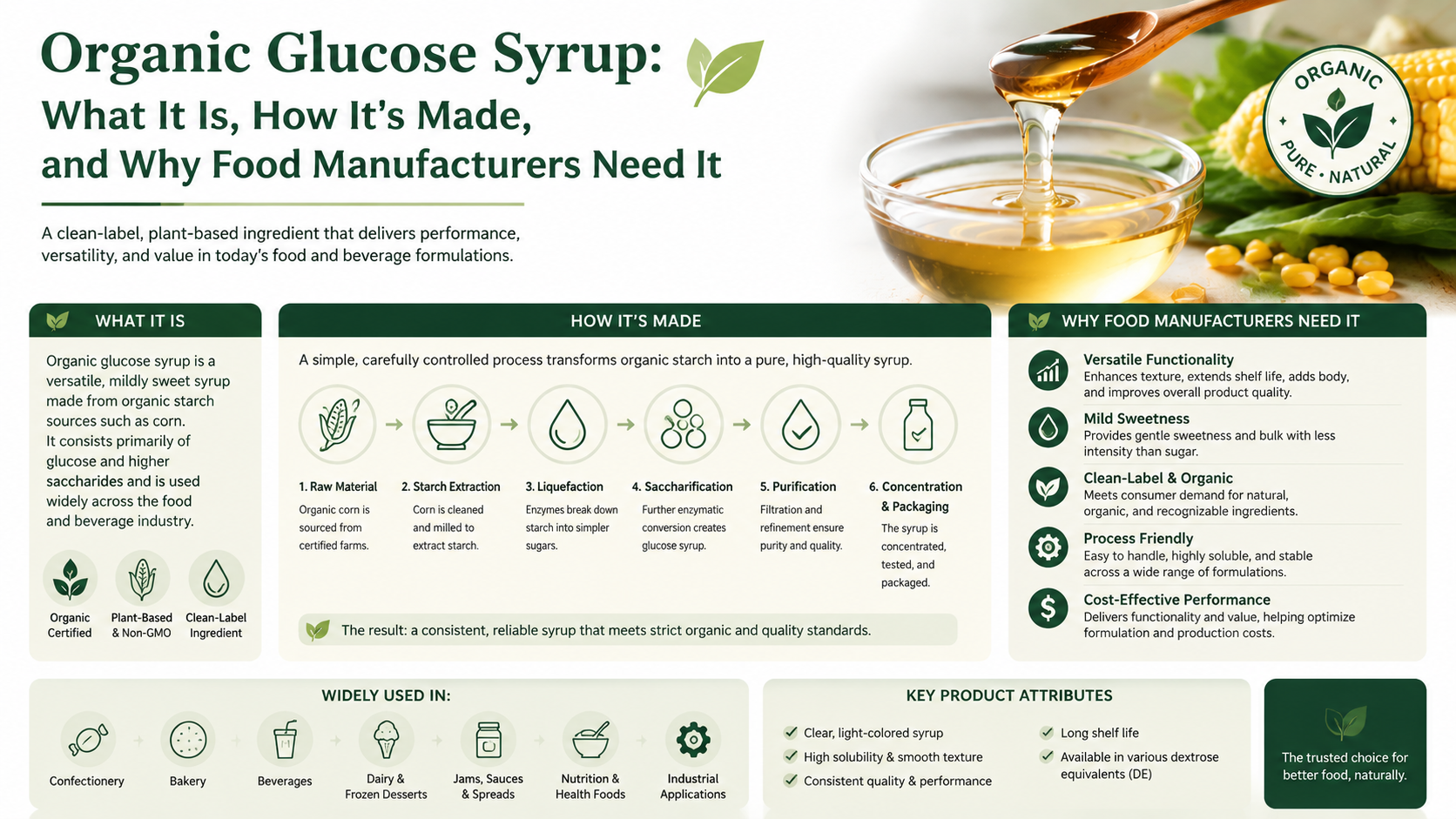
Organic glucose syrup is a concentrated aqueous solution of glucose, maltose, and higher saccharides produced by the enzymatic hydrolysis of organic starch. The starch source is typically certified organic corn, wheat, tapioca, or potato.
Chemical Composition
Unlike simple sugars (sucrose, fructose, dextrose), glucose syrup contains a spectrum of carbohydrate molecules:
| Component | Description | Function |
|---|---|---|
| Glucose (dextrose) | Monosaccharide, the simplest sugar | Primary energy source, moderate sweetness |
| Maltose | Disaccharide (two glucose units) | Contributes to body and viscosity |
| Maltotriose | Trisaccharide (three glucose units) | Texture modifier |
| Higher saccharides (DP4+) | Longer glucose chains | Viscosity, film-forming, anti-crystallization |
The ratio of these components is determined by the DE (Dextrose Equivalent) value — the single most important specification when sourcing organic glucose syrup.
Understanding DE Values
DE measures the percentage of reducing sugars (primarily glucose) in the syrup relative to pure glucose (DE 100). It indicates how far the starch hydrolysis process has progressed:
| DE Range | Syrup Character | Sweetness | Body/Viscosity | Typical Applications |
|---|---|---|---|---|
| 20–30 | Low conversion, high molecular weight | Low | High, thick | Confectionery (anti-crystallization), frostings |
| 30–42 | Medium conversion | Low to moderate | Medium | Candies, jams, baking, sauces |
| 42–55 | Standard conversion | Moderate | Moderate | General food manufacturing, beverages |
| 55–65 | High conversion | Moderate to high | Lower, thinner | Sweetened beverages, brewing |
Higher DE = sweeter and thinner syrup. Lower DE = less sweet and thicker syrup with stronger anti-crystallization properties.
For food manufacturers, selecting the right DE value is critical — it directly affects sweetness level, viscosity, freezing point depression, and crystallization behavior in the finished product.
How Is Organic Glucose Syrup Produced?
The production of organic glucose syrup follows a controlled enzymatic process that preserves the carbohydrate composition while meeting organic certification standards.
Production Steps
Step 1: Organic Starch Sourcing Certified organic, non-GMO starch is sourced from organic farms. The most common source is organic corn, though wheat, tapioca, and potato starches are also used. Organic certification ensures no synthetic pesticides, herbicides, or fertilizers were used in cultivation.
Step 2: Starch Slurry Preparation The starch is mixed with water to form a slurry, which is then heated to gelatinize the starch — breaking the granular structure and making it accessible to enzymes.
Step 3: Enzymatic Hydrolysis (Liquefaction) Natural alpha-amylase enzymes are added to break the long starch chains into shorter dextrins. This “liquefaction” step typically operates at 90–105°C and produces a cloudy, viscous solution.
Step 4: Saccharification Glucoamylase enzymes are added to further break dextrins into individual glucose molecules and shorter chains. The duration and enzyme concentration determine the final DE value.
Step 5: Purification and Filtration The syrup is filtered, deionized, and carbon-treated to remove proteins, lipids, minerals, and color compounds. This produces a clear, light-colored syrup.
Step 6: Concentration The purified syrup is evaporated under vacuum to the target solids content, typically 80–82% dry solids for standard glucose syrup.
Organic vs. Conventional Production
| Factor | Organic Glucose Syrup | Conventional Glucose Syrup |
|---|---|---|
| Source material | Certified organic, non-GMO starch | May be GMO or conventionally grown starch |
| Hydrolysis method | Enzymatic only | May use acid hydrolysis (faster, cheaper) |
| Processing aids | Natural enzymes only | May include synthetic processing aids |
| Pesticide residues | None (organic certification) | Possible residues |
| Environmental impact | Lower (organic farming practices) | Higher (conventional agriculture) |
| Traceability | Full farm-to-product documentation | Limited traceability |
| Certifications | USDA Organic, EU Organic, Non-GMO | Standard food-grade |
Why Food Manufacturers Need Organic Glucose Syrup
1. Clean-Label Compliance
Consumer demand for clean-label products is not a trend — it’s a permanent shift in food purchasing behavior. 73% of consumers want to understand ingredient sources, and 68% actively avoid GMOs. Organic glucose syrup provides:
- A simple, recognizable ingredient name
- Certified organic and non-GMO status
- Full supply chain traceability
- No artificial processing aids or synthetic additives
2. Functional Versatility
Organic glucose syrup is one of the most versatile functional ingredients available:
| Function | How It Works | Key Applications |
|---|---|---|
| Sweetness | Provides controlled, moderate sweetness | Beverages, baked goods, sauces |
| Anti-crystallization | Interferes with sugar crystal lattice formation | Candies, fondants, frostings, jams |
| Viscosity and body | Contributes to thickness and mouthfeel | Sauces, dressings, syrups |
| Moisture retention | Binds water, extending shelf life | Baked goods, snack bars |
| Browning | Supports Maillard reaction for color development | Baked goods, grilled products |
| Freezing point control | Lowers freezing point for smooth textures | Ice cream, frozen desserts |
| Fermentation substrate | Provides fermentable sugars for yeast and cultures | Breads, brewed beverages |
3. Low Fructose — A Growing Health Advantage
As research continues to highlight the metabolic concerns associated with excessive fructose consumption (liver stress, triglyceride elevation, insulin resistance), food manufacturers are actively seeking glucose-dominant sweetener options. Organic glucose syrup contains very low fructose (typically 0–5%), delivering energy primarily as glucose — the body’s preferred metabolic fuel.
This positions organic glucose syrup as a compelling alternative to high-fructose corn syrup and sucrose in:
- Children’s food products
- Sports and recovery nutrition
- Functional beverages
- Weight management products
4. Global Regulatory Acceptance
| Region | Regulatory Status | Key Standard |
|---|---|---|
| United States | GRAS | 21 CFR Part 184 |
| European Union | Approved food ingredient | No E number (natural origin) |
| China | Approved | GB 1886.XXX |
| Japan | Approved | Existing Food Additive List |
| Australia/NZ | Approved | FSANZ Standard |
Key Applications by Industry
Confectionery
The confectionery industry is the largest consumer of organic glucose syrup. Its anti-crystallization properties are essential for:
- Hard candies: Prevents graininess and ensures clear, glass-like appearance
- Gummies and jellies: Provides texture, body, and controlled sweetness
- Chocolate and coatings: Improves flow properties and shelf stability
- Caramel and toffee: Controls texture from soft to hard by varying DE value
Beverages
| Application | Glucose Syrup Function | DE Recommendation |
|---|---|---|
| Carbonated soft drinks | Sweetness, body | 55–65 |
| Fruit juices and nectars | Mouthfeel, sweetness | 42–55 |
| Energy and sports drinks | Rapid energy, clean label | 42–55 |
| Plant-based milks | Viscosity, creaminess | 30–42 |
| Tea and coffee beverages | Balanced sweetness | 42–55 |
Bakery
Organic glucose syrup in bakery products delivers:
- Moisture retention for extended freshness
- Crust browning through Maillard reaction support
- Soft crumb texture in cakes, muffins, and pastries
- Reduced staling for longer shelf life
Processed Foods
In sauces, dressings, marinades, and processed snacks, organic glucose syrup provides viscosity, body, and flavor balance while maintaining a clean-label ingredient profile.
Sourcing Guide: What to Look For
Essential Certifications
| Certification | Why It Matters |
|---|---|
| USDA Organic | Required for products sold in the US with organic claims |
| EU Organic | Required for EU/EEA market access |
| Non-GMO Project Verified | Third-party non-GMO verification |
| Kosher / Halal | Broad market coverage |
| ISO 22000 / FSSC 22000 | Food safety management |
Quality Specifications to Request
| Parameter | Typical Specification |
|---|---|
| DE value | Per application requirement (20–65) |
| Dry solids (Brix) | 80–82% |
| pH | 4.0–6.0 |
| Heavy metals (Pb, As, Cd, Hg) | Compliant with USP/EP limits |
| Microbiological | Per specification (TPC, coliforms, pathogens) |
| Sulfur dioxide (SO2) | < 40 ppm (or lower for clean-label) |
Storage and Handling
- Store at ambient temperature in sealed containers
- Protect from extreme heat and freezing
- Shelf life: typically 12–18 months from production date
- Viscosity increases at lower temperatures — allow to reach room temperature before use
Conclusion
Organic glucose syrup is a strategically essential ingredient for modern food manufacturers. It delivers the functional performance needed across confectionery, beverages, bakery, and processed food applications — while meeting the clean-label, organic, and non-GMO expectations that today’s consumers and retailers demand.
For food manufacturers evaluating their sweetener portfolio, organic glucose syrup offers:
- Certified organic and non-GMO sourcing for premium market positioning
- Low fructose content addressing consumer health concerns
- Broad functional versatility from anti-crystallization to moisture retention
- Global regulatory acceptance simplifying international product launches
- Multiple DE grades to match precise application requirements
Whether you are reformulating an existing product line for clean-label compliance or developing a new organic range, organic glucose syrup deserves a central place in your ingredient strategy.
Ready to source organic glucose syrup? Contact ORGANICWAY for samples, technical data sheets, certificates of analysis, and competitive bulk pricing. Our dedicated supply chain team provides end-to-end support from initial evaluation to ongoing quality assurance.