


Table of Contents
Baked goods, confectionery, chocolate, frozen desserts, and dairy products represent the most demanding applications for sugar replacement. Unlike beverages, where sweetness is the primary function of sugar, these categories rely on sugar for critical structural, textural, and functional roles: browning, moisture retention, structure formation, crystallization control, and freeze point depression.
Achieving these functions without conventional sugar is one of the most technically challenging problems in food formulation. High-intensity sweeteners (stevia, monk fruit) cannot replicate sugar’s structural contributions. Sugar alcohols (erythritol, maltitol, xylitol) address some functional needs but introduce cooling sensations, digestive discomfort, and processing challenges that limit their use.
Organic allulose syrup occupies a unique position in this landscape. It delivers genuine functional sugar-like behavior — browning, moisture, bulk, and texture — while reducing calories by approximately 90% and eliminating glycemic impact.
This guide covers the technical details formulators need to successfully replace sugar with organic allulose syrup across bakery, confectionery, chocolate, frozen dessert, and dairy applications.
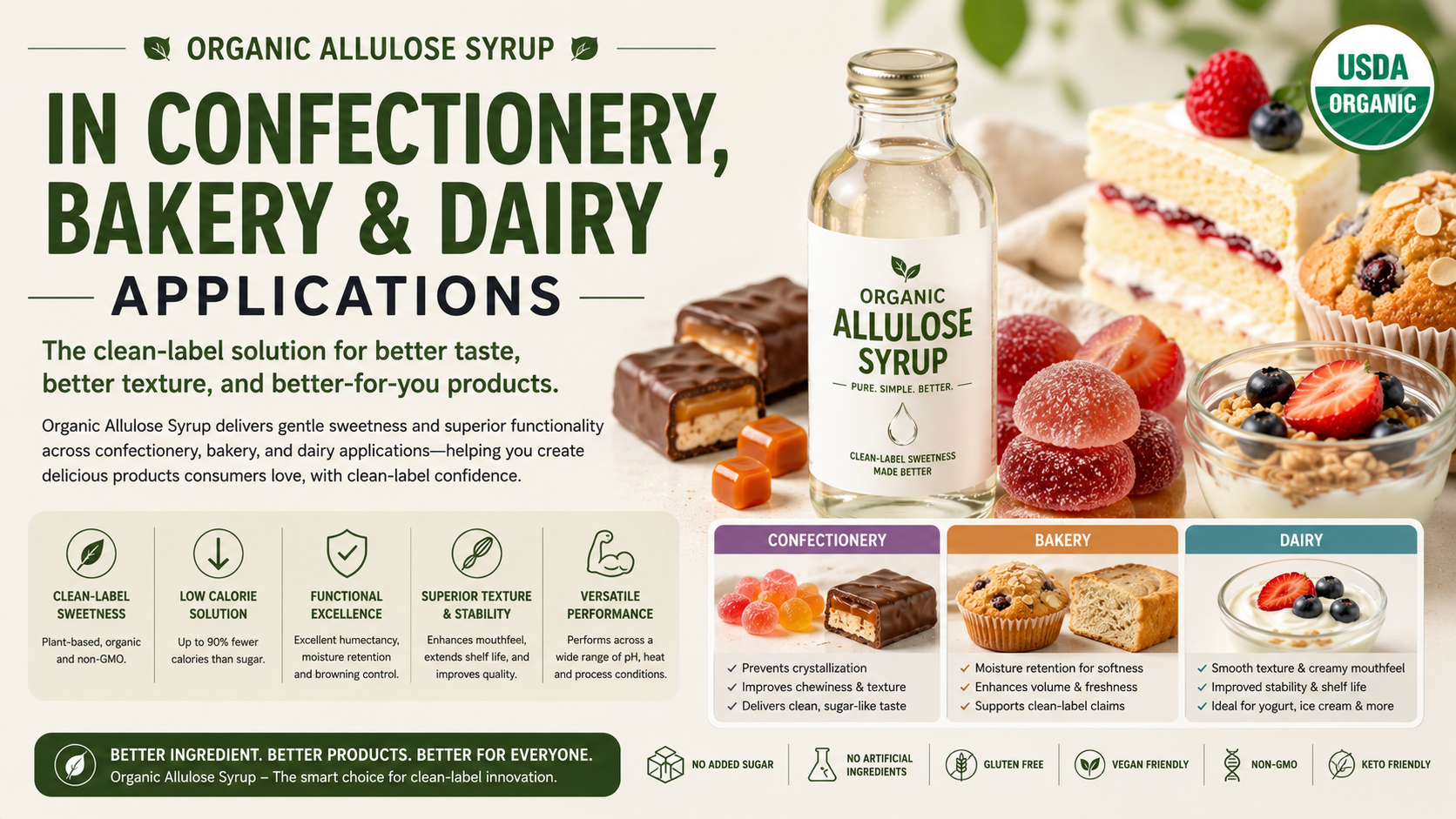
The Six Functional Roles of Sugar in Food Systems — And How Allulose Addresses Each
Understanding what sugar actually does in your formulation is the foundation of successful replacement.
| Function | Sugar’s Role | Allulose Performance | Implication for Formulators |
|---|---|---|---|
| Sweetness | 100% reference | ~70% sweetness (w/w) | Pair with high-intensity sweeteners for parity; or accept reduced sweetness at lower sugar reduction levels |
| Browning/Maillard reaction | Strong browning at >150°C | Moderate browning — starts earlier and plateaus lower | Reduce oven temp by 10–15°C; monitor closely in first batches |
| Crystallization control | Prevents sucrose/EU crystallization | Reduces crystallization risk overall | Beneficial for caramel and fudge formulations |
| Moisture retention | Binds water; extends shelf life | Comparable hygroscopicity | Minor formulation adjustment; no major change needed |
| Freeze point depression | Lowers freezing point predictably | Less depression than sucrose at equivalent sweetness | Adjust fat/solid content to compensate in frozen products |
| Structure/bulk | Provides volume and texture | Yes — comparable bulk | Primary advantage of allulose over high-intensity sweeteners |
| Fermentation substrate | Feeds yeast in leavened products | Not fermentable by baker’s yeast | Cannot be sole sugar in yeast-leavened products; use in combination or use chemical leavening |
Key takeaway: Allulose addresses 5 of sugar’s 6 primary functional roles. Only fermentation cannot be replicated. This makes it the most functionally complete sugar replacement available.
Bakery Applications
Cookies and Biscuits
The challenge: Cookies depend on sugar for spread, texture, browning, and moisture. Conventional sugar-free alternatives (erythritol-based) produce pale, crunchy, and often gritty cookies that consumers reject.
Why allulose works: Allulose syrup provides genuine browning (unlike erythritol), contributes bulk and texture, and extends shelf life through moisture retention.
Formulation guide:
| Parameter | Full Sugar | Allulose Replacement | Notes |
|---|---|---|---|
| Sugar replacement rate | Baseline | 60–100% by weight | 100% replacement possible with sweetness adjustment |
| Allulose syrup volume vs. dry sugar | N/A | Use 1.3–1.5× weight of dry sugar | Compensates for lower sweetness and slight volume difference |
| Monk fruit extract addition | None | 50–100 ppm | Achieves full sweetness parity without bitterness |
| Oven temperature | 175–180°C | 160–170°C | Allulose browns faster; reduce temp to prevent burning |
| Butter/fat content | Standard | May reduce 5–10% | Allulose contributes less tenderness than sugar; test specific product |
| Leavening agent | Standard | May increase 10–15% | Allulose produces slightly less gas retention |
Practical example — Chocolate chip cookie (per 1kg flour batch):
| Ingredient | Control | Allulose Formula |
|---|---|---|
| Flour | 500g | 500g |
| Sugar | 250g | 0g |
| Organic allulose syrup | 0g | 320g |
| Monk fruit extract 70% | 0g | 80 ppm |
| Butter | 250g | 240g |
| Eggs | 100g | 100g |
| Chocolate chips (85% cacao) | 200g | 200g |
| Vanilla | 5g | 8g |
| Baking powder | 8g | 10g |
| Salt | 5g | 5g |
| Net carbs per 40g cookie | ~22g | ~5g |
| Calories per 40g cookie | ~200 kcal | ~175 kcal |
Cakes and Muffins
The challenge: Cakes require sugar for tenderizing (interrupts gluten network), aeration (creaming with fat), moisture, and browning.
Key differences from cookies:
- Allulose does not cream with fat as effectively as sucrose — creaming time may need to be extended
- Foam cakes (angel food, chiffon) should not use allulose as primary sugar, as the fermentation and aeration properties are essential
- Dense cakes (brownies, pound cakes) are ideal allulose candidates
Replacement approach:
- Pound cakes, quick breads: 60–80% sugar replacement with allulose syrup; supplement with 50 ppm monk fruit extract
- Brownies: 70–100% replacement — allulose’s moderate browning is particularly suitable for chocolate products where excessive browning is not expected
- Muffins: 50–70% replacement; allulose may increase spread, so reduce leavening slightly and use tighter muffin cups
Crackers and Savory Bakery
The challenge: Savory crackers use sugar for browning, Maillard flavor development, and fermentation in sourdough systems.
Recommendation: Allulose is suitable for crackers with low fermentation requirements. For sourdough or heavily fermented products, use allulose in combination with a small amount of fermentable sugar (dextrose or sucrose at 5–10% of total sugar content) to support yeast activity.
Confectionery and Chocolate
Hard Candy and Caramels
Hard candy (boiled sweets):
Allulose syrup is an excellent sugar replacement for hard candy formulations. Its resistance to crystallization (unlike sucrose, which requires strict temperature control to prevent crystallization) simplifies the manufacturing process.
Formulation principles:
| Process Parameter | Sucrose Hard Candy | Allulose-Based Hard Candy |
|---|---|---|
| Boiling temperature | 150–160°C | 135–145°C (lower due to different caramelization profile) |
| Crystallization risk | High — requires invert sugar | Low — allulose resists crystallization |
| Humidity sensitivity | High | Lower — allulose is less hygroscopic |
| Color development | Strong amber at high temp | Moderate browning; monitor closely |
| Brittleness | Controlled by temperature | Slightly softer than sucrose candy at equivalent moisture |
Key warning: Allulose hard candies may become slightly sticky at high humidity (>60% RH) due to allulose’s hygroscopic nature. Adding 3–5% isomalt or resistant starch can mitigate this.
Caramels and toffees:
Allulose syrup produces excellent caramel flavors without the extreme heat required for sucrose caramelization. This is an energy efficiency advantage in production.
Formulation note: Caramels require fat and milk solids for texture. Maintain full fat content when replacing sugar with allulose to achieve the expected chewiness and mouthfeel.
Chocolate and Cocoa Products
The challenge: Conventional sugar-free chocolates rely on maltitol or erythritol, both of which produce a cooling sensation, reduced bloom resistance, and poor tempering behavior. Allulose addresses several of these limitations.
Formulation principles:
| Property | Sucrose Chocolate | Allulose-Based Chocolate | Impact |
|---|---|---|---|
| Sweetness | 100% | ~70% (w/w equivalent) | Requires supplementation with monk fruit or additional allulose |
| Tempering behavior | Predictable | Altered viscosity profile | Adjust tempering curves; allulose increases viscosity less than maltitol |
| Fat bloom resistance | Good | Moderate | Allulose chocolate may be slightly more prone to fat migration; use high-quality cocoa butter |
| Sugar bloom resistance | Susceptible | Better — allulose does not recrystallize | Advantage for products stored in variable temperatures |
| Cooling sensation | None | Minimal (very slight) | Far superior to erythritol-based chocolates |
| Label appeal | N/A | “No sugar alcohols” claim possible | Significant marketing advantage |
Usage example — Dark chocolate formulation (70% cacao):
- Cocoa mass: 45%
- Cocoa butter: 20%
- Organic allulose syrup: 32%
- Monk fruit extract: 60 ppm
- Vanilla extract: 0.5%
- Soy lecithin: 0.3%
- Salt: 0.2%
- Net carbs per 20g serving: ~4g (vs. 14g for sucrose-based equivalent)
Frozen Desserts: Ice Cream, Sorbets, and Gelato
The challenge: Ice cream sugar serves three critical roles: sweetening, freeze point depression (controlling texture and scoopability), and body/mouthfeel contribution.
Allulose syrup addresses all three, but the freeze point depression profile differs from sucrose and requires formulation adjustment.
Freeze point depression comparison:
| Sweetener | Freeze Point Depression Coefficient | Effect |
|---|---|---|
| Sucrose | 1.0 (reference) | Standard ice cream texture |
| Glucose syrup (DE 40) | 0.85 | Softer texture |
| Erythritol | 0.45 | Much harder, requires more fat for creaminess |
| Allulose | 0.75 | Softer than sucrose; creamy, scoopable at standard serving temps |
Formulation guidance — Vanilla ice cream (liter batch):
| Ingredient | Control | Allulose Formula |
|---|---|---|
| Cream (35% fat) | 250mL | 260mL |
| Whole milk | 300mL | 310mL |
| Sugar | 120g | 0g |
| Organic allulose syrup (75°Bx) | 0g | 140g |
| Monk fruit extract | 0g | 60 ppm |
| Skim milk powder | 40g | 45g |
| Vanilla extract | 10mL | 12mL |
| Stabilizer (locust bean gum + carrageenan) | 4g | 5g |
| Net carbs per 100mL serving | ~14g | ~4g |
| Calorie reduction | Baseline | ~40% |
Sorbets and water ices:
Allulose syrup produces excellent fruit-based sorbets with a clean, bright sweetness. The lack of fermentation risk makes allulose particularly valuable for sorbet formulations, where traditional sugar prevents bacterial growth but creates texture challenges at reduced levels.
Dairy and Plant-Based Dairy Alternatives
Conventional Dairy Products
Flavored yogurts and kefir:
Allulose syrup integrates easily into yogurt and kefir formulations. Key considerations:
- Fermentation compatibility: Allulose is not fermented by common yogurt and kefir cultures — it does not affect pH, texture, or fermentation timing during culturing
- Post-fermentation sweetness: Add allulose syrup after fermentation, during flavoring/mixing stage, to achieve target sweetness
- Syneresis control: Allulose contributes to moisture retention, reducing whey separation in Greek-style yogurts
- Recommended addition rate: 5–12% allulose syrup (w/w) depending on target sweetness and base yogurt sweetness
Milk-based desserts (puddings, flans, custard):
- Allulose syrup performs well in cooked dairy desserts
- NoMaillard browning at typical cooking temperatures is an advantage — prevents over-browning in custards
- Egg yolk proteins coagulate normally with allulose as the primary sweetener
Recommendation: For vanilla puddings and flans, allulose produces excellent results at 70–100% sugar replacement.
Plant-Based Dairy Alternatives
This is one of the most promising and technically challenging application areas for allulose syrup.
Oat milk-based products:
- Allulose syrup is fully compatible with oat milk systems
- Consider oat-based beverages’ natural sweetness when calibrating allulose addition rates
- No known interactions with oat beta-glucans or oat proteins
- Best for: oat milk yogurts, oat-based puddings, oat milk ice cream
Almond milk-based products:
- Allulose syrup complements almond milk’s mild, slightly bitter notes
- Does not interfere with almond protein stability
- Best for: flavored almond milk drinks, almond milk ice cream
Soy milk-based products:
- Allulose is fully compatible with soy protein systems
- Does not trigger the beany off-notes sometimes associated with soy
- Best for: soy milk-based RTD protein drinks, flavored soy yogurts
Coconut milk-based products:
- Allulose pairs naturally with coconut’s sweetness profile
- Excellent for coconut milk ice cream (which tolerates slightly lower freezing point depression)
- Best for: coconut milk yogurts, coconut frozen desserts, dairy-free caramel sauces
Key plant-based formulation notes:
- Emulsification: Allulose syrup does not interfere with common emulsifiers (lecithin, mono/diglycerides) used in plant-based beverages
- Stabilizer compatibility: Functions well with xanthan gum, gellan gum, and locust bean gum — all common in plant-based dairy alternatives
- pH range: Plant-based milks typically have pH 6.0–7.0, well within allulose’s stable range

Technical Specifications and Processing Notes
Processing Parameters by Application
| Process | Recommended Temperature | Allulose Adjustment Needed? |
|---|---|---|
| Baking (cookies, cakes) | Reduce 10–15°C vs. sucrose recipes | Yes |
| Hard candy boiling | 135–145°C (vs. 150–160°C for sucrose) | Yes |
| Caramelization | 130–145°C | Yes (lower temp needed) |
| UHT processing | 135–145°C, 3–5s | No — standard protocols apply |
| Hot-fill pasteurization | 85–95°C | No |
| Ice cream mix pasteurization | 72°C, 15s | No |
| Yogurt fermentation | 40–45°C (standard cultures) | No — allulose does not ferment |
| Chocolate tempering | Adjust viscosity curves (allulose increases viscosity less than maltitol) | Yes |
Shelf Life Considerations
| Product Category | Typical Shelf Life | Allulose Impact |
|---|---|---|
| Cookies/baked goods | 6–12 months | Shelf life unaffected; may extend due to moisture retention |
| Hard candy | 12–18 months | Crystallization risk lower than sucrose; shelf life extended |
| Chocolate | 12–24 months | Monitor fat bloom; use high-quality cocoa butter |
| Ice cream | 12 months frozen | No change vs. conventional |
| Yogurt/dairy | Per standard product shelf life | No change |
| Plant-based beverages | Per standard product shelf life | Check humidity compatibility for the specific plant base |
Sourcing Organic Allulose Syrup for Food Manufacturing
ORGANICWAY supplies organic allulose syrup in bulk formats suitable for industrial-scale bakery, confectionery, and dairy production:
- Certifications: USDA Organic, Non-GMO Project Verified, Kosher, Halal
- Technical documentation: Full specifications, organic certificates, stability data, and application guides
- Format options: Bulk liquid (drums, IBC totes), with custom Brix and viscosity specifications available for specialized applications
- Supply chain: Consistent quality across batches with full traceability from organic-certified plant sources