
Table of Contents
Maintaining a healthy gut has moved beyond a passing wellness trend into a recognized pillar of long-term health. Among the ingredients driving this shift, organic inulin powder stands out as one of the most researched and widely adopted prebiotic fibers in both the supplement and functional food industries. Whether you are a product formulator sourcing a clean-label fiber ingredient or a health-conscious consumer looking to support digestion, understanding what inulin is, how it works, and where it comes from is essential.
This guide covers the science behind inulin as a prebiotic, explains the gut health benefits that research supports, compares the major plant sources, and offers practical guidance for daily use.
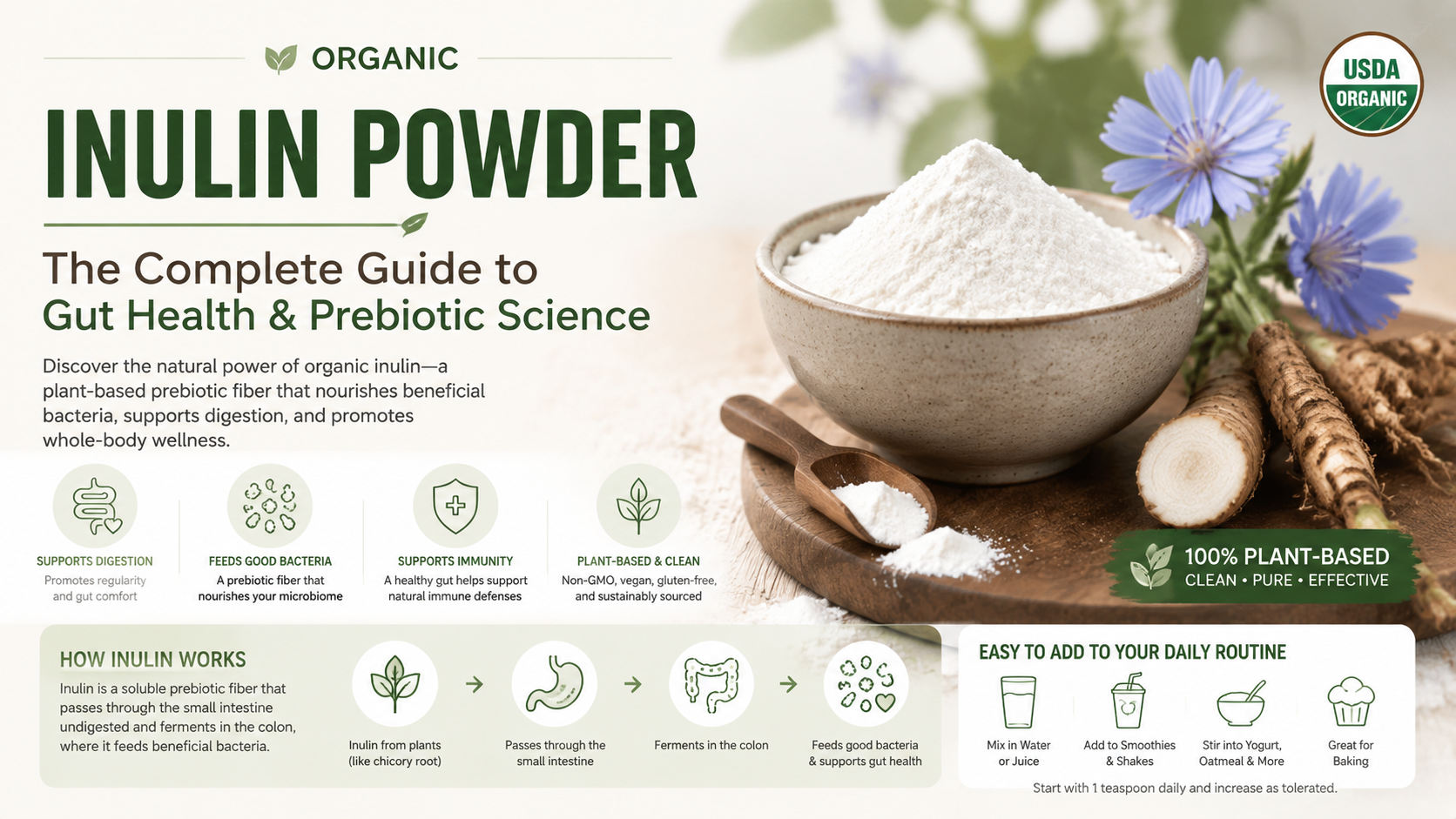
What Is Inulin? Structure, Sources, and Classification
Inulin is a naturally occurring soluble dietary fiber classified as a fructan — a polymer of fructose molecules linked by β(2→1) glycosidic bonds, typically terminated by a single glucose unit. This molecular structure is the key to its function: human digestive enzymes cannot break β(2→1) bonds, so inulin passes through the stomach and small intestine largely intact. Once it reaches the colon, it becomes a selective food source for beneficial microorganisms.
Inulin occurs naturally in thousands of plant species, but commercial extraction focuses on three primary sources:
- Chicory root (Cichorium intybus): The most widely used source globally. Chicory root contains high levels of long-chain inulin and has been the industry standard for decades.
- Jerusalem artichoke (Helianthus tuberosus): A hardy tuber native to North America that yields inulin with a distinct short-chain and medium-chain profile. More on this below.
- Agave (Agave spp.): Sourced primarily from the agave plant, agave inulin has a high proportion of short-chain fructooligosaccharides (FOS) and a mildly sweet flavor.
All three sources produce inulin with the same core chemical structure, but differences in chain-length distribution and minor nutrient co-factors lead to meaningful differences in fermentation behavior, tolerability, and functional performance in food applications.
Prebiotic Classification: Where Inulin Fits
The term “prebiotic” refers to a substrate that is selectively utilized by host microorganisms, conferring a health benefit. Inulin meets this definition precisely. Unlike probiotics — which are live microorganisms themselves — prebiotics feed the beneficial bacteria already present in the gut. Inulin was among the first fibers to be formally classified as a prebiotic, and it remains the reference standard in prebiotic research due to the depth of clinical evidence supporting its effects on Bifidobacterium and Lactobacillus populations.
How Inulin Works as a Prebiotic: The Fermentation Mechanism
The prebiotic action of inulin follows a well-documented biological pathway:
1. Arrival in the Colon
After ingestion, inulin resists digestion in the upper gastrointestinal tract and reaches the colon virtually unchanged. This is what separates prebiotic fibers from ordinary dietary fibers — the selective fermentation target.
2. Selective Bacterial Utilization
In the colon, specific strains of beneficial bacteria — most notably Bifidobacterium and Lactobacillus species — possess the enzymes (β-fructosidases) needed to hydrolyze the β(2→1) bonds in inulin. These bacteria metabolize inulin as their primary energy source, which gives them a competitive advantage over less desirable microorganisms. The result is a measurable shift in gut microbiota composition toward a healthier, more diverse profile.
3. Short-Chain Fatty Acid (SCFA) Production
As Bifidobacterium and Lactobacillus ferment inulin, they produce short-chain fatty acids — primarily acetate, propionate, and butyrate. These metabolites are not waste products; they are bioactive compounds that serve critical roles:
- Butyrate is the primary energy source for colonocytes (the cells lining the colon), directly supporting gut barrier integrity.
- Propionate enters the bloodstream and contributes to glucose regulation in the liver.
- Acetate plays a role in lipid metabolism and provides systemic anti-inflammatory signaling.
4. Gut Barrier and Systemic Health
The SCFAs produced during inulin fermentation help maintain the intestinal epithelial barrier by promoting tight junction protein expression and mucin production. A strong gut barrier reduces the translocation of harmful substances (often referred to as “leaky gut”). Beyond the digestive tract, the metabolites and immune signaling molecules influenced by prebiotic fermentation connect gut health to immune function, metabolic health, and even bone density through enhanced calcium absorption.
The Gut Health Benefit Chain: From Fiber to Full-Body Wellness
Connecting the mechanism above to practical health outcomes, the chain looks like this:
Inulin intake → colonic fermentation → SCFA production → improved gut barrier → balanced microbiome → better digestion, immune support, metabolic health
Each link in this chain is supported by published research. Studies have shown that regular inulin consumption can increase Bifidobacterium counts by 10 to 100 times within a few weeks. Inulin supplementation has also been associated with improved bowel regularity, reduced markers of intestinal inflammation, enhanced mineral absorption (particularly calcium and magnesium), and better postprandial blood glucose control.
Digestive Regularity and Comfort
One of the most immediately noticeable benefits of inulin supplementation is improved bowel regularity. As a soluble fiber, inulin absorbs water in the digestive tract and adds bulk to stool, which helps prevent constipation and promotes consistent elimination. Clinical trials have demonstrated that inulin intake at doses of 5–15 grams per day can significantly increase stool frequency and improve stool consistency without causing diarrhea or cramping when the dose is introduced gradually.
Immune Function Support
Roughly 70% of the human immune system resides in the gut-associated lymphoid tissue (GALT). The health of this immune organ depends directly on the composition and activity of the gut microbiome. When inulin feeds Bifidobacterium and Lactobacillus populations, these beneficial bacteria help train and modulate immune responses. Research has shown that prebiotic supplementation can increase the production of secretory IgA — an antibody that serves as a first line of defense against pathogens in the gut lining. A well-nourished microbiome also helps prevent the overgrowth of harmful organisms, reducing the frequency and severity of gastrointestinal infections.
Metabolic and Blood Sugar Benefits
Inulin has a glycemic index of zero, meaning it does not raise blood glucose levels. Beyond simply being a non-digestible carbohydrate, the SCFAs produced from inulin fermentation — particularly propionate — have been shown to improve insulin sensitivity and reduce fasting blood glucose levels in clinical studies. For individuals managing metabolic syndrome or type 2 diabetes risk, inulin offers a dual advantage: it displaces higher-glycemic ingredients in the diet while actively supporting glucose regulation through its fermentation metabolites.
Bone Health and Mineral Absorption
The SCFAs produced during colonic fermentation of inulin lower the pH of the gut lumen, which increases the solubility of dietary minerals — most notably calcium and magnesium. This enhanced mineral solubility translates to greater absorption. Multiple human trials have confirmed that regular inulin supplementation increases calcium absorption in adolescents and postmenopausal women, two populations where bone density is a particular concern. The practical significance is substantial: even a small improvement in calcium absorption over years can meaningfully reduce the risk of osteoporosis and fractures.
For consumers, this means that adding inulin to the daily diet supports more than just bowel movements — it nourishes the entire gut ecosystem, which in turn supports immune resilience, metabolic balance, and nutrient utilization.
Jerusalem Artichoke Inulin: What Makes It Different
Among the three main commercial sources, Jerusalem artichoke (JA) inulin has attracted growing interest from formulators and researchers for several reasons.
Chain-Length Profile and Fermentation Kinetics
JA inulin contains a mix of short-chain and medium-chain fructans, including a significant proportion of FOS (fructooligosaccharides). This mixed-chain profile produces a two-stage fermentation pattern: the short-chain FOS fraction ferments relatively quickly in the proximal colon, while the medium-chain fraction extends fermentation further along the colon. This gradual, progressive fermentation has a practical benefit — it distributes bacterial activity across more of the colon and tends to produce less gas and bloating compared to long-chain-dominant chicory inulin, which ferments more abruptly.
In contrast, chicory root inulin is dominated by longer-chain molecules with degrees of polymerization (DP) often exceeding 20. While this long-chain inulin is effective as a prebiotic and offers excellent fat-mimicking properties in food formulations, its fermentation tends to occur in a more concentrated burst, which can lead to increased gas production and mild digestive discomfort in sensitive individuals.
JA inulin typically falls in the DP range of 2–20, with a substantial portion below DP 10. This shorter average chain length means that a larger fraction of the inulin is available for early fermentation by bacteria located throughout the colon, rather than being concentrated in a single region. The result is smoother, more predictable digestive tolerance — a critical advantage for consumer products where user experience matters.
Mineral Content
Jerusalem artichokes are naturally rich in potassium, iron, and magnesium. While these minerals are present at modest levels in the finished inulin powder, they represent an additional nutritional attribute not found in chicory-derived inulin.
Growing Conditions and Purity
Jerusalem artichokes are hardy, drought-resistant plants that thrive in organic soils with minimal chemical input. This makes JA inulin well-suited to organic certification programs and reduces concerns about pesticide residues or heavy metal accumulation that can affect other root crops.
For product developers, the JA source is particularly appealing when the target application requires high digestive tolerability — such as products marketed to sensitive consumers, children, or the elderly.
Inulin Source Comparison
| Parameter | Chicory Root | Jerusalem Artichoke | Agave |
|---|---|---|---|
| Primary chain length | Long-chain dominant | Short + medium chain mix | Short-chain (high FOS) dominant |
| FOS content | Low (~5–10%) | Moderate (~15–30%) | High (~40–60%) |
| Fermentation speed | Slower, can produce more gas | Gradual, well-tolerated | Fast, sweet taste |
| Organic availability | Widely available | Available, growing supply | Available |
| Flavor | Neutral to mildly sweet | Mildly sweet | Noticeably sweet |
| Key formulator consideration | Industry standard, versatile | Best digestive tolerability | Strong sweetness reduces added sugar |
Inulin Powder vs. Inulin Syrup: Choosing the Right Form
Inulin is available in both powder and syrup forms, and the choice depends on the application:
Inulin Powder is the most common form for supplements, baked goods, dry mixes, and protein powders. It has a low moisture content, a long shelf life (up to two years when stored in a cool, dry environment), and disperses easily in liquids. Powder is the preferred choice for capsules, tablets, and dry food formulations. The neutral to mildly sweet flavor of inulin powder allows it to be incorporated into savory applications as well as sweet ones, making it one of the most versatile functional fibers available to formulators.
Inulin Syrup is produced by partially hydrolyzing inulin powder, which increases its solubility and sweetness. It works well in beverages, dairy products, sauces, and confectionery where liquid incorporation is needed. The trade-off is a shorter shelf life and a higher moisture content that limits its use in dry applications. Inulin syrup typically contains 70–80% inulin on a dry-weight basis, with the remainder being water and shorter fructan fragments created during the hydrolysis process. This gives it a viscosity and mouthfeel similar to honey or light corn syrup, which can be useful in formulation.
Formulation considerations for B2B buyers:
- Moisture sensitivity: Powder works in low-moisture systems; syrup suits high-moisture products.
- Sweetness: Syrup provides 30–50% the sweetness of sucrose, powder is less sweet but cleaner tasting.
- Processing temperature: Both forms are heat-stable up to approximately 140°C, making them suitable for most baking and extrusion processes.
- Labeling: Both forms can be labeled simply as “inulin” or “chicory root fiber” depending on regional regulations, which is a significant advantage for clean-label positioning.
For B2B buyers, the decision depends on the product matrix: dry applications favor powder, while wet-process formulations may benefit from syrup’s improved solubility and mild sweetening power.
How to Use Organic Inulin Powder
For consumers, organic inulin powder is straightforward to incorporate into a daily routine:
- Beverages and smoothies: Add 3–5 grams to water, juice, coffee, or smoothies. The powder dissolves readily and has a mild, pleasant taste.
- Baking and cooking: Substitute 15–20% of flour with inulin powder in muffins, breads, and pancakes to increase fiber content without significantly altering texture.
- Yogurt and dairy alternatives: Stir into yogurt or plant-based milks for a prebiotic boost.
- Snack formulation: Use as a binding agent in energy balls, granola bars, or protein bars.
A common recommendation is to start with 2–3 grams per day and increase gradually to 10 grams or more as the gut adapts. Increasing fiber intake too quickly can cause temporary bloating or gas, regardless of the inulin source, so a stepped approach is always advisable.
Choosing Organic: Purity and Sustainability
For both manufacturers and end consumers, choosing organic inulin powder offers clear advantages. Certified organic inulin is produced without synthetic pesticides, chemical fertilizers, or genetically modified inputs. This aligns with the growing demand for clean-label products and provides assurance of ingredient purity. In a market where consumers are increasingly scrutinizing ingredient lists, the organic seal serves as an immediate signal of quality and trustworthiness.
From a sourcing perspective, organic certification also supports sustainable agricultural practices, including crop rotation, soil health management, and reduced chemical runoff — all factors that matter to today’s environmentally conscious buyer. For food manufacturers, sourcing organic inulin can simplify regulatory compliance in regions with strict pesticide residue limits and provides a marketing advantage in premium product categories.
When evaluating organic inulin suppliers, key criteria include certification body (USDA Organic, EU Organic, or equivalent), heavy metal testing documentation, microbiological specifications, and chain-of-custody traceability from field to finished ingredient.
Key Takeaways
- Inulin is a well-researched prebiotic fiber that selectively feeds beneficial gut bacteria, producing SCFAs that support digestion, immune function, and metabolic health.
- The three main commercial sources — chicory root, Jerusalem artichoke, and agave — each offer distinct advantages in chain-length profile, tolerability, and formulation behavior.
- Jerusalem artichoke inulin stands out for its mixed short- and medium-chain structure, which supports gradual fermentation and better digestive tolerability.
- Both powder and syrup forms are available, with powder being the better choice for dry applications and supplements, and syrup suited for beverages and wet formulations.
- Organic certification ensures ingredient purity and supports sustainable sourcing, an increasingly important factor for both B2B and C2C markets.
For inquiries about organic inulin powder sourcing, custom formulations, or bulk orders, contact us.
Related reading: Is Inulin Safe? Complete Side Effects & Dosage Guide — for safety and dosing information. Organic Inulin Market 2025-2030: B2B Procurement & Supply Chain Strategy — for B2B market intelligence and procurement guidance.