


Table of Contents
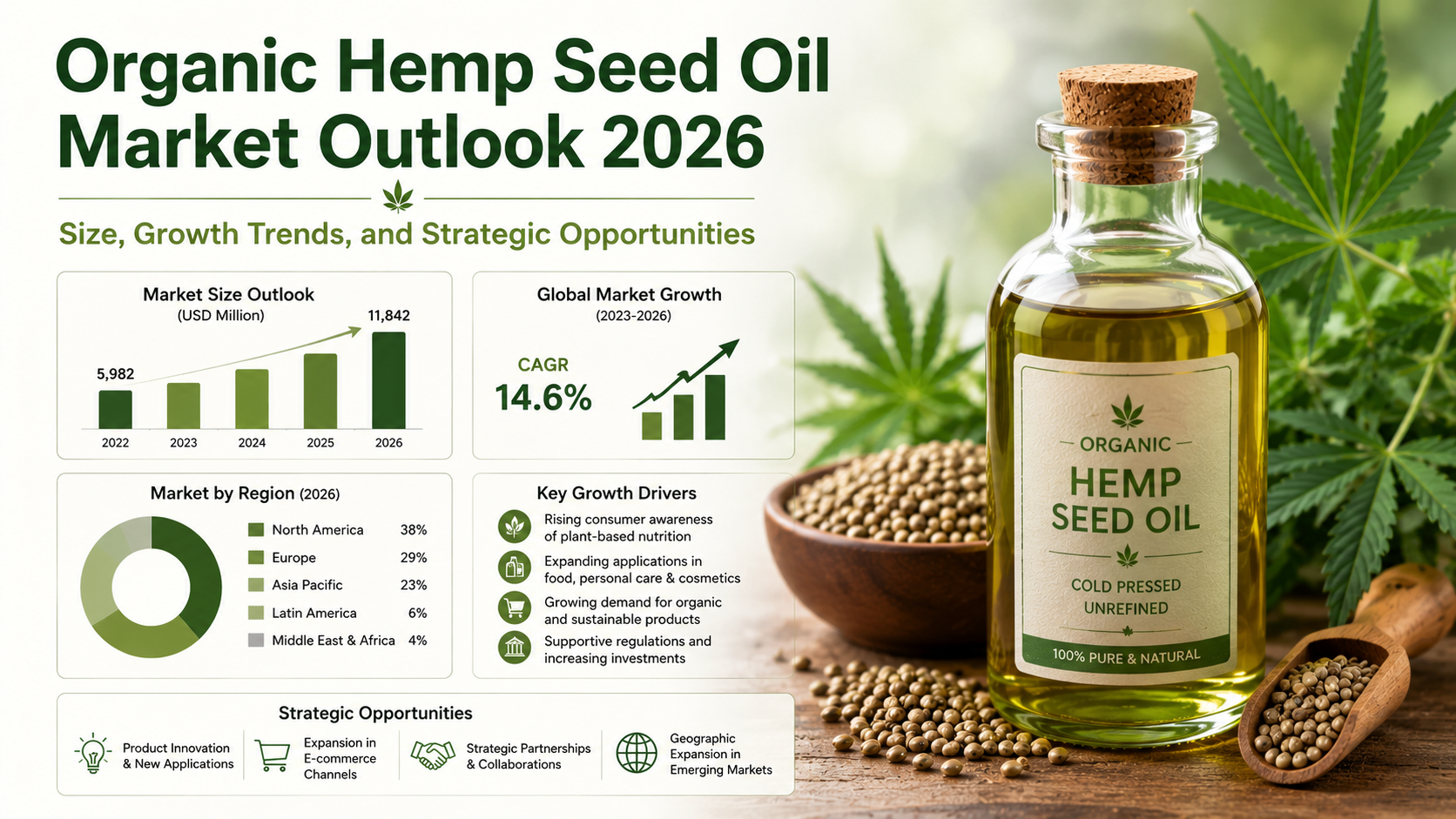
The organic hemp seed oil market has entered a phase of accelerated expansion, driven by rising health awareness, multi-industry application demand, and an increasingly favorable regulatory environment. With a compound annual growth rate of 14.7 percent projected through 2030, B2B buyers across food, nutraceutical, cosmetic, and pharmaceutical sectors are repositioning their procurement strategies to capture emerging opportunities in this high-value ingredient category.
Global Market Size and Growth Projections
The organic hemp seed oil market reached a valuation of $88.2 million in 2022 and is forecast to grow at a CAGR of 14.7 percent from 2023 to 2030. This trajectory positions hemp seed oil among the fastest-expanding segments within the broader specialty oils and plant-based ingredients market.
Several converging factors underpin this growth. Consumer demand for clean-label and plant-derived products continues to rise across developed and developing economies. At the same time, advances in extraction technology and supply chain infrastructure — particularly in China, the world’s largest hemp cultivator — have improved both product availability and cost efficiency for industrial buyers.
The 14.7 percent CAGR reflects not only volume expansion but also value uplift, as organic certification premiums and cold-pressed extraction methods command higher per-unit pricing compared to conventional alternatives. For procurement managers, this signals both opportunity and urgency: early supplier partnerships secured under current pricing structures may yield competitive advantages as demand intensifies toward the latter half of the decade.
Industry Application Breakdown
Food and Beverage — Largest Market Share
The food and beverage sector accounted for the largest share of organic hemp seed oil demand in 2022. Applications span cooking oils, food additives, sauces, salad dressings, baked goods, and smoothie formulations. The oil’s favorable fatty acid profile has made it a preferred ingredient for brands positioning products around cardiovascular health and balanced nutrition.
Functional food manufacturers have integrated hemp seed oil into ready-to-drink beverages and meal replacement formulations, where it serves as both a nutritional enhancer and a clean-label differentiator on ingredient panels.
Nutraceuticals and Dietary Supplements — Fastest-Growing Segment
The nutraceutical sector represents the fastest-growing application category for organic hemp seed oil. The increasing body of evidence linking omega-3 and omega-6 fatty acids to anti-inflammatory and cognitive health outcomes has driven demand. The convergence of hemp seed oil with cannabidiol (CBD) formulations has created a high-value sub-segment attracting both supplement manufacturers and pharmaceutical companies.
Cosmetics and Personal Care — Significant Growth
In personal care, organic hemp seed oil has gained substantial traction in skincare and haircare formulations. Skincare applications leverage the oil’s moisturizing and skin-regenerating properties, while haircare products use it for strengthening and anti-hair-loss claims. The clean beauty movement has amplified this trend.
Pharmaceuticals — Emerging Clinical Applications
The pharmaceutical application of hemp seed oil is expanding as regulatory frameworks for cannabinoid-based therapies evolve. Hemp seed oil functions as both a carrier oil and an active ingredient in formulations targeting anti-inflammatory, antibacterial, and analgesic outcomes. The regulatory approval of CBD-based treatments for Dravet syndrome and Lennox-Gastaut syndrome has further validated the clinical potential of hemp-derived ingredients.
Segment Comparison
| Application Segment | Market Position (2022) | Growth Trajectory | Key Value Drivers |
|---|---|---|---|
| Food and Beverage | Largest share | Steady growth | Clean-label demand, omega-3/6 profile, functional food innovation |
| Nutraceuticals & Supplements | Fastest-growing | Accelerating | CBD convergence, anti-inflammatory research, aging demographics |
| Cosmetics & Personal Care | Significant growth | Strong momentum | Clean beauty, plant-based formulations, moisturizing properties |
| Pharmaceuticals | Emerging | Expanding | CBD clinical approvals, carrier oil applications, anti-inflammatory R&D |
Regional Market Analysis
North America — Market Leader
North America commands more than one-third of global organic hemp seed oil demand. The United States accounts for the largest national share, supported by a comparatively favorable regulatory environment following the 2018 Farm Bill. Canada ranks as the second-largest market in the region, with a well-established hemp agricultural sector.
Europe — Second-Largest Market
Europe holds more than 20 percent of global market share, with Germany as the largest national market, followed by France and Italy. The European Union’s harmonized regulatory framework, which permits hemp cultivation with THC content below 0.2 percent, has provided a stable foundation for industry growth.
Asia-Pacific — Fastest-Growing Region
The Asia-Pacific region is the fastest-growing market for organic hemp seed oil. China leads regional demand, benefiting from a long history of hemp cultivation and a fully integrated supply chain. India and Japan represent emerging markets with significant growth potential.
China’s dual role as both a major producer and an expanding consumer market creates unique dynamics for international buyers. Sourcing from established Chinese suppliers offers cost advantages, while domestic demand growth within China is beginning to compete with export supply.
Regional Comparison
| Region | Market Share (2022) | Growth Rate | Leading Countries | Key Regulatory Feature |
|---|---|---|---|---|
| North America | >33% (dominant) | Strong | United States, Canada | 2018 Farm Bill; favorable hemp/CBD framework |
| Europe | >20% (second) | Steady | Germany, France, Italy | EU harmonized framework; THC <0.2% |
| Asia-Pacific | Fastest-growing | Accelerating | China, India, Japan | China: historic cultivation advantage; India/Japan: emerging |
Key Market Drivers
Plant-Based Diet Adoption
The global shift toward plant-based diets has elevated demand for plant-derived oils rich in essential fatty acids. Organic hemp seed oil, with its balanced omega-3 to omega-6 ratio, aligns directly with this trend and serves as a credible substitute for animal-derived omega supplements.
Clean Beauty Revolution
The cosmetics industry’s ongoing transition toward clean, transparent, and plant-based ingredient sourcing has created sustained demand for organic hemp seed oil in topical formulations.
CBD Regulatory Liberalization
The progressive relaxation of regulations governing CBD and hemp-derived products across multiple jurisdictions has expanded the addressable market for hemp seed oil. As CBD products move from specialty channels into mainstream retail, the demand for high-quality, organic hemp seed oil as a carrier and formulation base has grown proportionally.
Sustainability and Supply Chain Transparency
Corporate sustainability commitments and consumer demand for traceable sourcing are driving procurement teams toward suppliers who can demonstrate organic certification, environmentally responsible cultivation practices, and transparent supply chain documentation.
Market Challenges and Risk Factors
Regulatory Uncertainty
Regulatory frameworks for hemp-derived products remain inconsistent across jurisdictions. Variations in permissible THC thresholds, CBD classification, and labeling requirements create compliance complexity for brands operating across multiple markets.
Competition from Substitute Oils
Organic hemp seed oil competes with a range of established plant-based oils, including olive oil, coconut oil, sunflower oil, and flaxseed oil. Each benefits from deeper consumer familiarity, wider retail distribution, and in some cases lower per-unit costs.
Consumer Awareness and Stigma
A segment of consumers continues to associate hemp-derived products with marijuana, creating a perception barrier that limits adoption in more conservative markets. Industry education initiatives remain necessary to overcome this challenge.
Strategic Opportunities for B2B Buyers
Nutraceutical Product Development
The convergence of hemp seed oil with the growing demand for natural anti-inflammatory and cognitive health supplements represents a high-priority opportunity. Buyers should evaluate partnerships with certified organic suppliers capable of delivering consistent fatty acid profiles and full traceability documentation.
Functional Food Formulation
The food and beverage industry’s continued investment in functional and fortified products creates openings for organic hemp seed oil in ready-to-drink wellness beverages, plant-based meal replacements, and omega-enriched snack foods.
Cosmetics Ingredient Strategy
Personal care brands seeking to meet clean beauty standards should consider organic hemp seed oil as a multifunctional ingredient that delivers moisturizing, regenerating, and anti-inflammatory benefits without synthetic additives.
Emerging Market Penetration
Asia-Pacific markets, particularly India and Japan, offer significant untapped potential. Establishing distribution partnerships and regulatory compliance frameworks in these markets now positions buyers to capture growth as consumer awareness and demand mature.
Conclusion
The organic hemp seed oil market presents a compelling growth opportunity for B2B buyers across multiple industries. With a $88.2 million baseline in 2022 and a 14.7 percent CAGR extending through 2030, strategic procurement decisions made today will shape competitive positioning for years ahead. Partnering with a certified organic supplier offering full traceability and export-grade quality standards is the essential first step toward capturing value in this expanding market.