


Table of Contents
Nutritional beverages, infant formulas, and functional food products operate under formulation constraints that differ fundamentally from solid food applications. Ingredients must dissolve completely in aqueous systems, remain stable through spray-drying or pasteurization, deliver nutrients effectively, and meet stringent safety and regulatory standards.
Organic maltodextrin addresses these requirements through its exceptional solubility, neutral flavor, carrier functionality, and processing stability — making it one of the most widely used functional carbohydrates in liquid and powder nutrition formulations.
This guide covers beverage, infant nutrition, and functional food applications in detail, with practical formulation guidance, regulatory context, and application-specific recommendations.
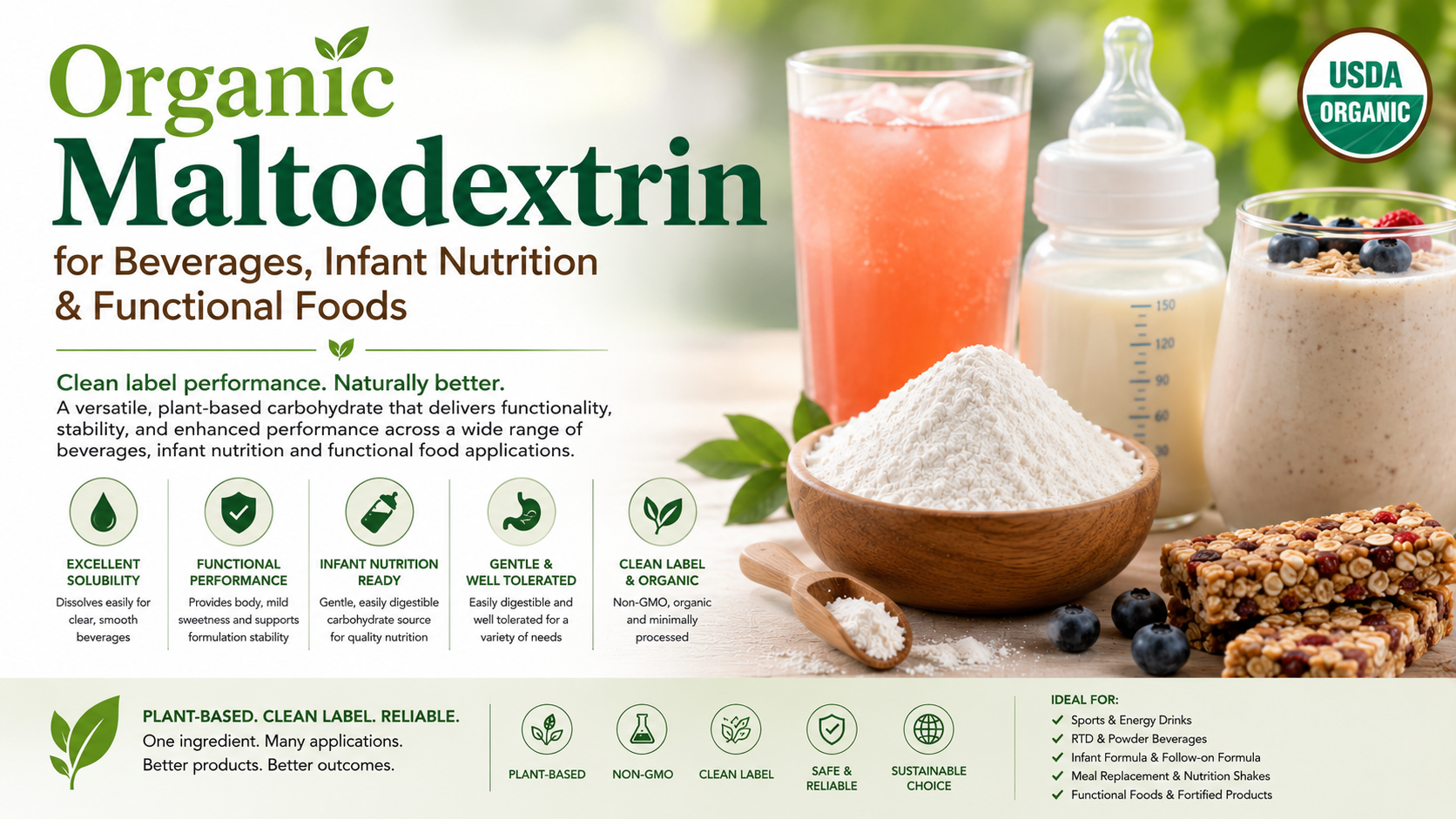
Organic Maltodextrin in Functional Beverages
Why Solubility Matters in Beverages
Functional beverages are one of the fastest-growing segments in the global food market. Consumers expect these products — whether powdered drink mixes, ready-to-drink (RTD) beverages, or concentrated shots — to dissolve completely, deliver active ingredients uniformly, and maintain stability throughout shelf life.
The nutrient solubility challenge:
Many functional ingredients — vitamins, minerals, botanical extracts, amino acids, and probiotics — are poorly soluble in aqueous systems. They tend to:
- Settle or sediment at the bottom of bottles or cups
- Form clumps or haze in transparent liquids
- Degrade under heat, light, or oxygen exposure
- Deliver inconsistent doses per serving
Maltodextrin solves these problems by acting as a carrier and dispersing matrix.
How Maltodextrin Improves Beverage Performance
Uniform nutrient dispersion:
- Maltodextrin’s water-soluble matrix physically separates fine nutrient particles, preventing aggregation and clumping
- In spray-dried powders, maltodextrin forms a protective glassy matrix around active ingredients, maintaining potency
- Result: Consistent nutrient distribution in every serving, from the first sip to the last
Improved solubility and reconstitution:
- Maltodextrin acts as a wetting agent for hydrophobic ingredients (fat-soluble vitamins, omega-3 oils)
- In powdered drink mixes, maltodextrin reduces the surface tension between water and powdered ingredients
- Result: Faster, lump-free reconstitution in both cold and hot water
Viscosity and mouthfeel control:
- At low usage levels (2–8%), maltodextrin adds subtle body to beverages without making them thick or syrupy
- Improves the mouthfeel of zero-sugar or reduced-calorie beverages, which can otherwise feel thin and watery
- Particularly valuable in protein drinks and meal replacement beverages where mouthfeel is a key consumer quality attribute
Beverage Application Guide by Category
| Beverage Category | Maltodextrin DE | Typical Usage Level | Primary Function |
|---|---|---|---|
| Powdered drink mixes (instant tea, coffee, lemonade) | DE 15–20 | 10–30% of powder blend | Solubility, bulk, carrier |
| Protein and recovery drinks | DE 10–15 | 5–15% of powder | Texture, dispersibility, mouthfeel |
| Sports and energy drinks (powder) | DE 15–20 | 15–25% of powder | Rapid dissolution, energy delivery |
| RTD functional beverages | DE 10–15 | 1–5% of formula | Mouthfeel, stability |
| Meal replacement shakes | DE 10–15 | 8–18% of formula | Bulk, texture, nutrient delivery |
| Fortified juice beverages | DE 10–12 | 3–8% of formula | Carrier for vitamins, viscosity |
| Plant-based beverages (oat, almond) | DE 10–15 | 2–8% of formula | Texture enhancement, stability |
Processing Stability in Beverages
Functional beverages are exposed to multiple stress factors during processing and storage:
| Process Condition | Maltodextrin Performance | Formulation Implication |
|---|---|---|
| UHT processing (135–145°C) | Stable — no degradation or browning | Standard UHT protocols apply |
| Hot-fill pasteurization (85–95°C) | Fully stable | No modification needed |
| Cold-fill + chemical preservation | Stable | Compatible with sorbate, benzoate systems |
| Spray drying | Excellent carrier matrix | Maltodextrin protects heat-sensitive actives during drying |
| High-pressure processing (HPP) | Fully stable | No impact on maltodextrin functionality |
| Refrigerated storage (4°C) | Stable; contributes to freeze-thaw stability in frozen concentrates | Slightly increases viscosity at low temperatures |
| Ambient storage (20–25°C) | Stable over 12–18 months in sealed packaging | Standard shelf life for maltodextrin-containing powders |
Organic Maltodextrin in Infant Nutrition
Regulatory and Safety Context
Infant formula is one of the most heavily regulated food categories globally. Maltodextrin use in infant formula is permitted and common, but with specific requirements:
United States (FDA):
- Maltodextrin is approved as a carbohydrate source in infant formula under 21 CFR Part 107
- Must meet FCC (Food Chemicals Codex) or equivalent purity standards
- Organic maltodextrin must be sourced from organic-certified raw materials
European Union:
- Permitted as a carbohydrate source in infant follow-on formulas (Commission Delegated Regulation (EU) 2016/127)
- Maximum usage levels specified for follow-on formulas; not permitted as the sole carbohydrate source in infant formulas (0–12 months) without specific approval
China:
- GB 10765–2021 (Infant Formula) and GB 10767 (Follow-up Formula) specify permitted carbohydrate sources
- Organic maltodextrin from approved sources is permitted in infant formula when sourced from certified organic raw materials
Key safety consideration for B2B buyers: Always confirm that your organic maltodextrin supplier’s product is specifically tested and documented for infant formula use — this requires stricter microbial and heavy metal specifications than standard food-grade maltodextrin.
Functional Benefits in Infant Formulas
Solubility and dispersibility:
- Infant formula must dissolve completely in warm water (approximately 40°C) to ensure uniform nutrient delivery and prevent lumps that could pose a choking risk
- Maltodextrin’s rapid dissolution and neutral flavor make it compatible with the delicate palate of infants
Digestibility:
- Maltodextrin is hydrolyzed by salivary and pancreatic amylases into glucose — the primary energy substrate for infant metabolism
- Its moderate chain length means it is absorbed more slowly than pure glucose but more rapidly than intact starch
- This makes it suitable as a complementary carbohydrate source alongside lactose (the primary carbohydrate in breast milk)
Nutrient carrier:
- In spray-dried infant formula, maltodextrin forms a protective matrix that shields vitamins (particularly B vitamins and vitamin C) from oxidative degradation during processing and storage
- Ensures micronutrient potency is maintained throughout the 18–24 month shelf life typical of infant formulas
Recommended Specifications for Infant Nutrition Use
| Parameter | Standard Food Grade | Infant Formula Grade |
|---|---|---|
| DE range | 8–20 | 10–15 (typical) |
| Lead | ≤0.5 mg/kg | ≤0.1 mg/kg |
| Arsenic | ≤0.5 mg/kg | ≤0.1 mg/kg |
| Cadmium | ≤0.1 mg/kg | ≤0.05 mg/kg |
| Mercury | ≤0.1 mg/kg | ≤0.05 mg/kg |
| Total plate count | ≤10,000 cfu/g | ≤1,000 cfu/g |
| Yeast and mold | ≤100 cfu/g | ≤50 cfu/g |
| Cronobacter sakazakii | Not routinely tested | Must be Negative / 10g |
| Salmonella | Negative / 25g | Must be Negative / 25g |
| Particle size | 100% through 60 mesh | 100% through 80 mesh (improved dispersibility) |
Functional Food and Nutritional Supplement Applications
Protein Powders and Meal Replacements
Organic maltodextrin is one of the most common ingredients in protein powders and meal replacement formulations:
Role in protein powders:
- Bulking agent: Provides volume and body to protein-fortified products, particularly important when protein content is high (30–40g per serving) and total powder weight is low
- Flavor moderation: Masks the off-notes of protein concentrates (particularly pea protein and rice protein), producing a smoother taste profile
- Solubility enhancement: Improves the reconstitution behavior of high-protein, high-fiber formulas that would otherwise clump
Typical inclusion in protein powder formulations:
| Protein Powder Type | Maltodextrin DE | Typical Inclusion | Function |
|---|---|---|---|
| Whey protein isolate | DE 10–15 | 5–15% | Bulking, flavor balance |
| Plant protein blend (pea/rice/hemp) | DE 8–12 | 10–20% | Texture improvement, off-note masking |
| Casein protein | DE 12–15 | 5–12% | Smooth mouthfeel |
| Meal replacement (high protein) | DE 10–15 | 15–25% | Bulk, satiety contribution |
Sweetness calibration in protein powders:
- Maltodextrin DE 10 has approximately 10–15% of sucrose’s sweetness
- At typical usage levels (10–20%), maltodextrin contributes mild sweetness that supports flavor systems without overwhelming them
- Combine with natural high-intensity sweeteners (stevia, monk fruit) for products targeting zero-added-sugar positioning
Prebiotic and Probiotic Formulations
Maltodextrin plays a unique role in prebiotic and probiotic-containing products:
As a prebiotic carrier:
- Certain maltodextrin grades (particularly resistant maltodextrins or those with specific molecular weight distributions) have prebiotic activity
- Standard maltodextrin is rapidly digested; for prebiotic fiber effects, consider combining with resistant dextrin, FOS, or GOS
For probiotic stability:
- Maltodextrin acts as a protective carrier for probiotic bacteria during spray-drying, storage, and reconstitution
- Maltodextrin creates a low-water-activity matrix that extends probiotic viability
- In shelf-stable probiotic powders, maltodextrin can contribute 20–40% of the carrier matrix
Recommended DE grade for probiotic applications: DE 8–12, which provides better film-forming and protection properties than higher DE grades.
Sports and Recovery Nutrition
During-exercise energy products:
- Maltodextrin is the preferred carbohydrate for sports drinks used during prolonged exercise
- Its high glycemic index (GI 85–95) ensures rapid glucose availability for working muscles
- Standard sports nutrition protocol: 30–60g maltodextrin carbohydrates per hour during exercise >60 minutes
- For maximum oxidation rates, combine maltodextrin with fructose in a 2:1 ratio (60g maltodextrin + 30g fructose per hour)
Post-exercise recovery:
- Maltodextrin + protein combinations (3:1 or 4:1 carb-to-protein ratio) maximize muscle glycogen replenishment
- For rapid glycogen synthesis, consume within 30 minutes post-exercise: 50–80g maltodextrin + 15–25g protein
Pre-workout formulas:
- Maltodextrin provides immediate energy substrate, reducing feelings of hunger and fatigue during fasted training
- Typically combined with caffeine, beta-alanine, and creatine monohydrate
Caution for sports nutrition marketing: Products containing maltodextrin should not carry “sugar-free,” “low-GI,” or “keto-friendly” claims. Appropriate claims include “fast-absorbing carbohydrates,” “energy support,” or “muscle recovery support.”
Regulatory and Labeling Guidance by Market
United States
| Claim Type | Maltodextrin Status | Notes |
|---|---|---|
| “Organic” (finished product) | Permitted with organic-certified maltodextrin | Must comply with USDA Organic regulations |
| “Non-GMO” | Permitted with non-GMO verified maltodextrin | Requires verification through Non-GMO Project or equivalent |
| “All-natural” | Generally permitted | Depends on specific manufacturing process; verify with regulatory counsel |
| “Gluten-free” | Permitted | Corn-, rice-, and tapioca-derived maltodextrin is gluten-free |
| “Sugar-free” | Not permitted | Maltodextrin is classified as a carbohydrate/sugar on FDA Nutrition Facts label |
| “Low GI” | Not permitted without substantiation | Maltodextrin has high GI (85–95) |
| “Keto-friendly” | Not recommended | Not compatible with ketogenic dietary positioning |
European Union
| Claim Type | Maltodextrin Status | Notes |
|---|---|---|
| “Organic” (finished product) | Permitted with EU organic-certified maltodextrin | Must comply with EU Organic Regulation 2018/848 |
| “Sugar-free” | Not permitted for products containing maltodextrin | EU regulations restrict “sugar-free” to products containing no mono/disaccharides |
| Nutrition claims | Governed by Regulation (EC) 1924/2006 | No approved health claims specifically for maltodextrin |
China
| Claim Type | Maltodextrin Status | Notes |
|---|---|---|
| “有机” (Organic) | Permitted with China organic-certified maltodextrin | Must comply with GB/T 19630 standard |
| Food category usage | Must comply with GB 2760 food additive categories or GB 14880 for nutritional fortification | Verify specific product category permissions |
| Novel Food | Maltodextrin is not classified as a Novel Food in China | General food ingredient regulations apply |
Formulation Troubleshooting Guide
| Problem | Likely Cause | Solution |
|---|---|---|
| Poor dissolution in cold water | High DE maltodextrin clumped during storage; excess moisture exposure | Switch to DE 15–18; store in dry conditions; use pre-dispersion in warm water step |
| Clumping in protein powder | Maltodextrin absorbed moisture; high humidity during packaging | Reduce particle size to 80 mesh; add 0.5–1% silica flow aid; reduce storage humidity |
| Off-flavor in finished beverage | Low-quality maltodextrin with residual processing notes; high DE provides slight sweetness | Source higher-purity maltodextrin; switch to lower DE grade (DE 8–10) |
| Shorter-than-expected shelf life | Maltodextrin absorbed ambient moisture | Reduce maltodextrin moisture content specification; improve packaging barrier properties |
| Haze in clear beverages | High DE maltodextrin incompatible with acidic system | Test maltodextrin at actual pH and temperature; consider switching to dextrose or allulose |
| Fat separation in emulsions | Maltodextrin at high usage (>20%) disrupts emulsifier balance | Reduce maltodextrin level; increase emulsifier concentration; add stabilizer (xanthan gum) |
Working With ORGANICWAY
ORGANICWAY supplies organic maltodextrin suitable for functional beverages, infant nutrition, and nutritional supplements:
- Infant formula grade: Stricter specifications for lead, arsenic, cadmium, and microbial limits
- Sports nutrition grade: Optimized DE range (DE 15–20) for rapid dissolution and energy delivery
- Probiotic carrier grade: DE 8–12 for maximum stability protection
- Certifications: USDA Organic, EU Organic, Non-GMO Project Verified, Kosher, Halal
- Documentation: Full technical specifications, organic certificates, CoA, MSDS, allergen statements
- Custom specifications: Available for DE, particle size, and packaging format